
If you’ve ever tried to scale a coaching program across a fast-moving organization, you’ve probably noticed how quickly consistency becomes a challenge. One manager raves about their coaching experience, while another wonders if their session even followed the same playbook. As AI-powered coaching platforms become more prevalent, a new question emerges: How do we know these digital coaches are truly upholding the rigorous, evidence-based methods we rely on—not just offering generic advice dressed up as expertise? By the end of this guide, you’ll understand exactly how the AI Coach System ensures every coaching interaction remains faithful to the Integral Institute™’s foundational principles, blending philosophical depth with measurable validation and ethical safeguards. The ICF/PwC Global Coaching Study confirms that executive coaching delivers an average ROI of 529%, with organizations reporting measurable improvements in leadership effectiveness and business outcomes.
Why Does Methodological Fidelity Matter in AI Coaching?
Let’s start with the heart of the issue: methodological fidelity is the assurance that every coaching session—whether delivered by a human or an AI—faithfully applies the underlying coaching model as intended. For organizations, this isn’t just a technical concern; it’s about trust, impact, and risk management. Deloitte research shows that organizations with strong coaching cultures report 21% higher profitability, demonstrating the direct business impact of investing in people development.
Most teams assume that if an AI is trained on a reputable coaching framework, it will naturally apply those principles correctly. But research consistently demonstrates that complex models can be subtly diluted or misapplied when scaled through technology. This means that without rigorous validation, even well-intentioned AI systems can drift from the standards that make coaching transformative in the first place.
For leaders and HR professionals, the stakes are high. When coaching lacks fidelity, outcomes become unpredictable, and the credibility of the entire development initiative is at risk. According to the International Coaching Federation, 73% of coaching clients expect their coach to be certified, underscoring how much value is placed on recognized standards and methodological rigor (ICF, 2024).
What Is Methodological Fidelity in the Context of AI Coaching?
At its core, methodological fidelity means that an AI coach doesn’t just mimic the language of coaching—it consistently applies the specific frameworks, processes, and ethical guidelines that define the practice. In the context of the Integral Institute™’s approach, this includes honoring the Integral Model’s focus on individual mindset, professional competencies, organizational culture, and systemic structures.
It’s tempting to think of fidelity as a simple checklist: Did the AI ask open-ended questions? Did it reference a growth mindset? But in practice, maintaining fidelity is far more nuanced. It’s about ensuring that every interaction reflects the philosophical depth and evidence-based rigor of the original methodology, even as the AI adapts to diverse user needs and contexts.
This is where many platforms fall short. They may claim alignment with established models but lack transparent processes for ongoing validation. The result? A gradual drift toward generic, surface-level advice that erodes the very value coaching is meant to deliver.
For professionals evaluating AI coaching solutions, understanding how methodological fidelity is operationalized—beyond marketing claims—becomes a critical differentiator. If you want to dig deeper into how platforms maintain accuracy and integrity in applying coaching principles, the methodological fidelity resource offers foundational context.
How Does AI Coach System Encode and Validate Integral Principles?
Ensuring that an AI coach upholds the full complexity of the Integral Institute™’s methodology is no small feat. The process begins with the careful encoding of the Integral Model itself. This involves training the AI on thousands of hours of real coaching sessions, annotated and reviewed by certified experts to capture not just the “what” but the “how” and “why” behind each coaching move.
But encoding is only the start. The real challenge is ongoing validation—making sure the AI continues to interpret and apply these principles accurately as it interacts with users in real time. AI Coach System employs a living audit model: a dynamic, continuous loop where AI outputs are regularly reviewed against both philosophical benchmarks (does the dialogue reflect whole-person development?) and empirical standards (are users achieving meaningful outcomes?).
Here’s how the stepwise coaching audit process typically unfolds:
- Dialogue Sampling: Randomly selected AI coaching conversations are flagged for review.
- Human-in-the-Loop Review: Certified coaches analyze these dialogues, assessing alignment with the Integral Model and identifying any deviations or reductionist patterns.
- Feedback Loop: Insights from these reviews are fed back into the AI’s training data, refining its responses and decision-making logic.
- User Feedback Integration: Direct feedback from users is analyzed for signals of both satisfaction and philosophical misalignment, further informing model adjustments.
- Periodic Re-Calibration: At set intervals, the AI’s outputs are benchmarked against new case studies, updated frameworks, and evolving ethical standards.
This approach moves beyond static compliance, creating a system that learns and adapts while remaining anchored in the original methodology. For those interested in how AI coaching integrates validation and audit mechanisms, the coaching audit process resource provides practical insights.

What Quality Control and Audit Mechanisms Are Used?
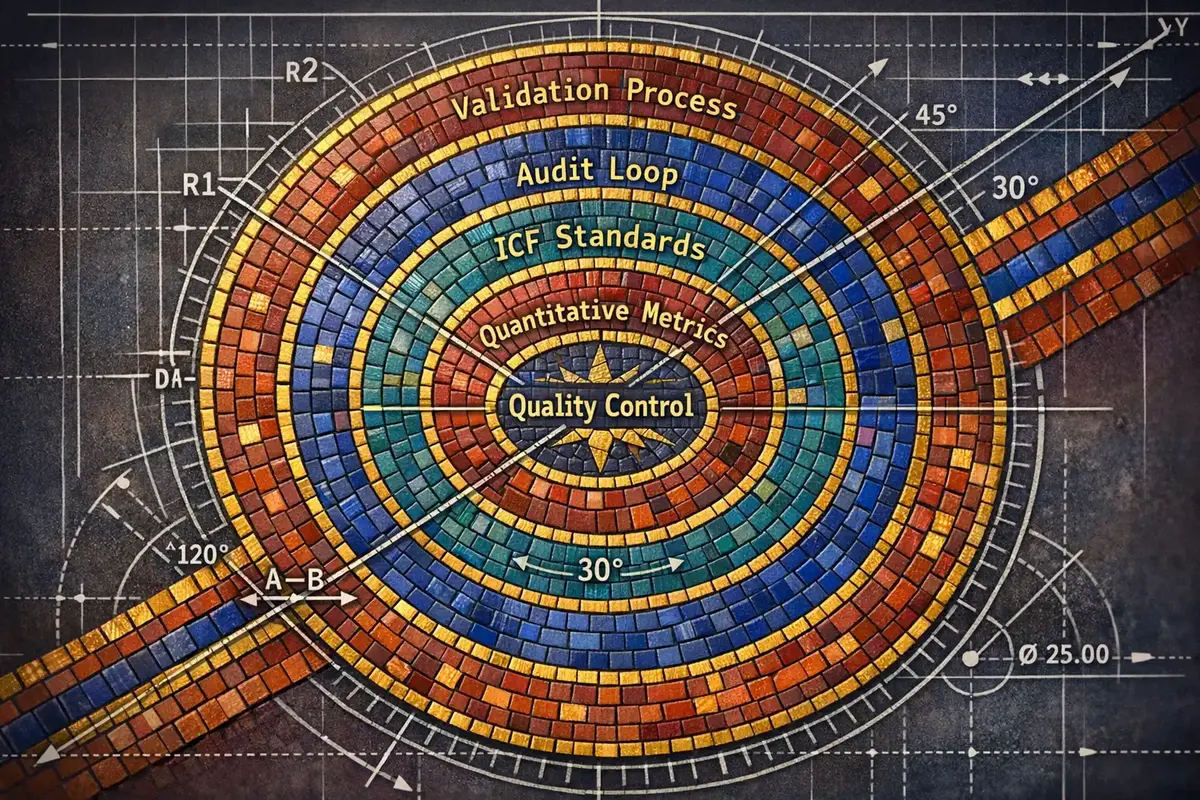
Most organizations assume that once an AI model is trained, its work is done. But in high-stakes domains like coaching, ongoing quality control is essential. The AI Coach System’s audit mechanisms are designed to catch both subtle and overt deviations from the Integral Institute™’s standards.
Let’s break down the main components:
- Human-in-the-Loop Coaching: Certified experts remain actively involved, reviewing AI-generated coaching sessions and providing corrective feedback. This isn’t just a one-time check; it’s a recurring process that keeps the AI’s outputs aligned with evolving best practices. For a deeper look at this partnership, see human-in-the-loop coaching.
- Dialogue Analysis Tools: Advanced analytics scan for key indicators of fidelity, such as adherence to the Integral Model’s four-quadrant approach, use of reflective questioning, and avoidance of prescriptive or reductionist advice.
- User Feedback Channels: Every coaching interaction invites user input, which is then analyzed for both satisfaction and deeper signals of alignment or misalignment with core principles.
- Ethical Safeguards: The system is regularly benchmarked against recognized coaching ethical standards, including those set by the International Coaching Federation, to ensure that issues like confidentiality, autonomy, and bias mitigation are rigorously maintained.
Here’s the thing: Quality control in AI coaching isn’t just about catching mistakes—it’s about creating a culture of continuous improvement. By treating every coaching interaction as an opportunity for learning and refinement, the platform ensures that methodological fidelity is never static, but always evolving in response to real-world complexity.
How Is Fidelity Measured? Bridging Qualitative and Quantitative Validation
It’s easy to assume that fidelity can only be measured with hard metrics: goal attainment rates, usage frequency, or satisfaction scores. But the reality is more nuanced. The AI Coach System bridges the qualitative and quantitative divide, recognizing that both narrative integrity and data-driven outcomes matter.
On the quantitative side, research from the National Institutes of Health found that both AI and human coaching produced similar positive outcomes for goal attainment, with effect sizes of η²ρ = .269 (AI) and η²ρ = .265 (human), both p < .001 (NIH, 2022). What’s more, participants who used the AI coach more frequently achieved an average goal attainment increase of 37.62, compared to 17.62 for lower usage groups (NIH, 2022). These numbers suggest that, when used consistently, AI coaching can deliver results on par with traditional human coaching.
But numbers alone don’t tell the whole story. The platform also tracks:
- Narrative Integrity: Are users experiencing “aha moments” that signal deep, whole-person insight?
- Dialogue Quality: Does the conversation reflect the subtlety and depth of the Integral Model, or does it slip into generic advice?
- User Autonomy: Are users empowered to set their own goals and direct their developmental journey, in line with integral principles?
By synthesizing these qualitative signals with hard data, the AI Coach System creates a holistic picture of fidelity. If you’re interested in how evidence-based approaches demonstrate coaching value, the evidence-based coaching resource offers further insights.
What Ethical Standards and Bias Mitigation Strategies Are in Place?
Ethics is often treated as a compliance box to check, but in AI coaching, it’s foundational. The AI Coach System is benchmarked against the ICF’s gold-standard coaching ethical standards, which cover everything from confidentiality and informed consent to fairness and transparency.
Most people assume that bias in AI is a purely technical problem—fix the algorithm, and you fix the bias. But real-world evidence shows that ethical risks can also emerge from how coaching frameworks are interpreted and applied, especially in diverse or complex contexts. That’s why the platform combines automated bias detection tools with regular human review, ensuring that both technical and philosophical sources of bias are addressed.
Ethical safeguards include:
- Transparent User Consent: Users are informed about how their data will be used and have control over their coaching experience.
- Bias Audits: Regular reviews of AI outputs for patterns of bias or exclusion, with corrective actions taken as needed.
- Cultural Sensitivity: The system supports multiple languages and adapts to diverse professional and cultural contexts, reflecting the Integral Model’s emphasis on whole-system awareness.
By integrating ethical standards directly into both the technical and human validation loops, the platform builds trust and ensures that coaching remains a force for positive, equitable development.
How Do Human Experts Stay Involved in the Validation Loop?
One of the most persistent myths about AI coaching is that it’s a “set and forget” solution. In reality, maintaining fidelity to complex methodologies like those of the Integral Institute™ requires ongoing human expertise.
Certified coaches play several key roles:
- Dialogue Auditors: They regularly review AI-generated sessions, identifying both strengths and areas for improvement.
- Model Stewards: They update the AI’s training data with new insights, case studies, and evolving best practices.
- Ethics Guardians: They ensure that the platform’s outputs remain aligned with both the letter and the spirit of ethical guidelines.
This human-in-the-loop coaching approach is not just a safeguard—it’s a source of continuous innovation and learning. By keeping experts in the validation loop, the AI Coach System ensures that its digital coaches remain grounded in the Integral Model’s multi-level framework, even as they scale to serve thousands of users.
What Metrics and Analytics Are Used to Track Fidelity and Impact?
Quantifying the impact of coaching—and the fidelity of its delivery—requires a blend of analytics. The AI Coach System leverages a suite of coaching metrics analytics to provide both real-time and longitudinal insights:
- Goal Attainment Scores: Tracking individual and cohort progress toward self-defined objectives.
- Usage Frequency: Analyzing how often users engage with the AI coach, and correlating this with outcome improvements.
- Dialogue Quality Metrics: Assessing the presence of key coaching moves (e.g., reflective questioning, values alignment) within each session.
- User Satisfaction and Narrative Analysis: Combining quantitative ratings with qualitative feedback to capture both surface-level and deep insights.
“Participants who used the AI coach more frequently achieved an average goal attainment increase of 37.62, compared to 17.62 for lower usage groups.” (NIH, 2022)
These analytics are not just for show—they inform ongoing model refinement and provide organizations with the evidence they need to assess both effectiveness and fidelity. For a deeper dive into quantifying coaching impact, the coaching metrics analytics resource is a valuable reference.
How Can Organizations Evaluate Methodological Fidelity in AI Coaching Solutions?
If you’re tasked with selecting or auditing an AI coaching platform, knowing what to look for can be daunting. Here’s a practical checklist to guide your evaluation:
- Transparency: Does the platform clearly explain how its AI is trained, validated, and updated?
- Auditability: Are there documented processes for regular human review and feedback integration?
- Metrics: Does the platform provide both quantitative and qualitative measures of fidelity and impact?
- Ethical Standards: Is the system benchmarked against recognized frameworks like ICF’s AI Coaching Standards?
- User Feedback: Are there robust channels for users to provide feedback and flag issues?
- Continuous Improvement: Is there evidence of ongoing learning and adaptation, rather than a static compliance model?
Most buyers focus on features and price, but overlooking fidelity can undermine the entire investment. By asking these questions, you’ll be better equipped to select a solution that delivers not just coaching—but coaching you can trust.
FAQ: Ensuring Methodological Fidelity in AI Coaching
What is methodological fidelity in AI coaching?
Methodological fidelity refers to the consistent and accurate application of a specific coaching methodology—such as the Integral Model—by an AI system. It ensures that every coaching interaction, regardless of scale, upholds the philosophical, ethical, and procedural standards set by the original framework.
How does AI Coach System validate its coaching outputs?
AI Coach System uses a combination of automated analytics, regular human expert reviews, and user feedback to validate coaching outputs. This dynamic process, known as a “living audit,” ensures that the AI’s guidance remains aligned with both the letter and spirit of the Integral Institute™’s methodology.
Can AI coaching be as effective as human coaching?
Empirical research demonstrates that AI coaching can achieve similar positive outcomes to human coaching, especially when users engage frequently. For example, one study found that both AI and human coaching produced comparable goal attainment results (NIH, 2022).
What role do human experts play in maintaining fidelity?
Human experts are actively involved in reviewing AI-generated sessions, updating training data, and ensuring ethical standards are met. Their ongoing participation is critical for adapting the AI to new contexts and maintaining the depth and integrity of the coaching model.
How does the platform address ethical risks and bias?
The platform combines automated bias detection tools with regular human audits, benchmarked against recognized ethical standards like those from the International Coaching Federation. This dual approach helps identify and correct both technical and philosophical sources of bias.
What metrics are used to track coaching fidelity and impact?
Metrics include goal attainment scores, usage frequency, dialogue quality indicators, and user satisfaction ratings. These quantitative and qualitative measures are analyzed together to provide a holistic view of both effectiveness and adherence to the coaching methodology.
How can organizations assess the methodological rigor of an AI coaching solution?
Organizations should look for transparency in training and validation processes, regular audit mechanisms, robust metrics, adherence to ethical standards, and evidence of continuous improvement. Asking targeted questions about these areas helps ensure the chosen platform delivers trustworthy, high-fidelity coaching.
By drawing on two decades of proven integral methodology and blending human expertise with advanced analytics, AI Coach System demonstrates that it’s possible to scale coaching without sacrificing depth, rigor, or ethical integrity. For professionals seeking to build better leaders, teams, and organizations, understanding and demanding methodological fidelity is not just a best practice—it’s an essential safeguard for the future of coaching.