

Why Coaching ROI Is Easier to Prove Than Most Leaders Think
86% of organizations that tracked coaching ROI say they earned back their investment or more. That should make coaching easier to defend in a budget review—yet many CFOs and business leaders still treat it as a soft expense rather than a measurable performance intervention (International Coaching Federation, 2024).
You have likely seen the scene. A VP in a mid-market technology company walks into a quarterly review with strong anecdotes from an executive coaching program, positive participant feedback, and maybe a few glowing comments from managers. Then finance asks the only question that matters: what changed in the business because of this, and how do we know coaching caused it?
That is where most programs lose credibility. Not because coaching fails, but because the evidence is thin in the wrong places. The same International Coaching Federation study found that 70% of coached individuals reported improved work performance and 80% reported improved self-confidence (International Coaching Federation, 2024). Useful signals, yes. But executive teams do not fund signals. They fund outcomes they can trust.

The Real Problem Is Not Measurement. It Is Attribution.
Most leaders are asking the wrong first question. They ask whether coaching can be measured at all. It can. The harder question is whether coaching changed results that would not have happened anyway.
That is an attribution problem, not a sentiment problem. If a leader becomes more confident during a market recovery, after a role redesign, and under a stronger manager, coaching may still have helped—but you need a method that separates contribution from coincidence. Without that discipline, even real gains look debatable.
This is why weak evaluation creates unnecessary friction. It slows renewal decisions, weakens sponsorship, and turns a potentially strategic intervention into a discretionary line item.
The Evidence Hierarchy Executives Actually Trust
Not all proof carries the same weight. Reaction data—whether participants liked the experience—is the weakest layer. It tells you about acceptance, not impact.
Behavior change is stronger. If managers run better one-to-ones, delegate more effectively, or handle conflict with less escalation, you are getting closer to value. Stronger still are business outcomes: retention, productivity, promotion readiness, cycle time, quality, sales conversion, or team stability.
ROI matters only when the layers beneath it are credible.
That is the hierarchy this article will use. Start with reaction if you must. Move quickly to behavior. Tie behavior to business outcomes. Then calculate ROI only when the evidence stack can survive scrutiny—from finance, from operations, and from your own standards. Because if most organizations can show a return, why do so many coaching programs still fail the attribution test?
Why Most Coaching Programs Fail the Attribution Test
What if the evidence most coaching sponsors collect is the very evidence that weakens their case? That matters because executive teams do not reject coaching when it feels useful; they reject it when the proof cannot survive comparison with every other investment competing for budget.
A positive testimonial is not proof. A strong satisfaction score is not proof either.
The Most Common Evidence Is Often the Least Convincing
Many organizations still measure leadership development through broad perception data. Harvard Business Impact reports that employee surveys are the dominant method organizations use to assess leadership effectiveness (Harvard Business Impact, 2025). That is understandable. Surveys are easy to run, easy to summarize, and politically safe.
But they are also weak at answering the question budget owners actually ask.
A survey can tell you that a leader is now rated as more effective. It cannot tell you whether that shift came from coaching, a new manager, a role change, a training program, a better quarter, or simple relief after a difficult period passed. Harvard Business Impact also notes that many organizations use both internal and external leadership development programs (Harvard Business Impact, 2025). Once multiple inputs are active at the same time, attribution gets messy fast.
That is why coaching evaluation fails in practice even when the coaching itself is strong. The measurement design asks, did something improve? The executive question is sharper: what improved because of coaching?
Correlation Is Cheap. Causation Is What Gets Funded.
Picture a regional healthcare provider during annual planning. A director completes a coaching engagement. In the same period, the organization changes reporting lines, adds operational support, and replaces an underperforming peer leader. Three months later, team morale is better and escalations are down. The coaching sponsor calls it a success.
Maybe it is. Maybe it is not.
Without a baseline, a comparison group, or at least a credible contribution logic, the story collapses under scrutiny. Improvement that happens after coaching is not the same as improvement caused by coaching. Leaders know this instinctively, even if they do not say it that way in the meeting.
This is the hidden executive concern. Finance is not trying to be difficult. Operations is not being cynical. They are trying to separate coaching impact from background noise.
The real test is not whether outcomes moved. It is whether coaching can credibly explain why they moved.
That standard changes everything. It forces you to define expected behavior shifts in advance, identify competing influences, and decide what evidence would count before the program begins. If your current approach cannot do that, the problem is not coaching. It is the measurement stack behind it.
And that raises the harder question: what kind of evidence does hold up when a CFO, an HR leader, and a business unit head all read the same scorecard?
Which Measurement Stack Actually Holds Up Under Executive Scrutiny?
Kirkpatrick-style evaluation still matters here because it forces a discipline most organizations skip: separating what people felt from what they learned, what they did differently, and what the business got back. Many coaching programs still treat participant satisfaction as the main proof point. The evidence executives trust is more structured than that.
A defensible stack answers different decision questions at each layer. Reaction asks whether the experience was credible enough to earn engagement. Learning asks whether the leader left with clearer judgment, language, or methods. Behavior asks whether those methods showed up in actual work. Business results ask whether those behavior shifts changed team or operational outcomes. ROI asks whether the value of those outcomes exceeded cost.
That sequence matters because each layer reduces a different kind of uncertainty. Reaction reduces adoption risk. Learning reduces capability risk. Behavior reduces execution risk. Business results reduce strategic doubt. ROI reduces capital-allocation doubt.
What Each Layer Is For—and What It Is Not
In a quarterly budget review at a regional manufacturing company, a plant VP may say the coaching “landed well” with frontline leaders. Useful, but thin. If those leaders cannot run tighter shift handovers, address performance issues faster, or reduce avoidable escalation, the program has not yet crossed the line from positive experience to operational relevance.
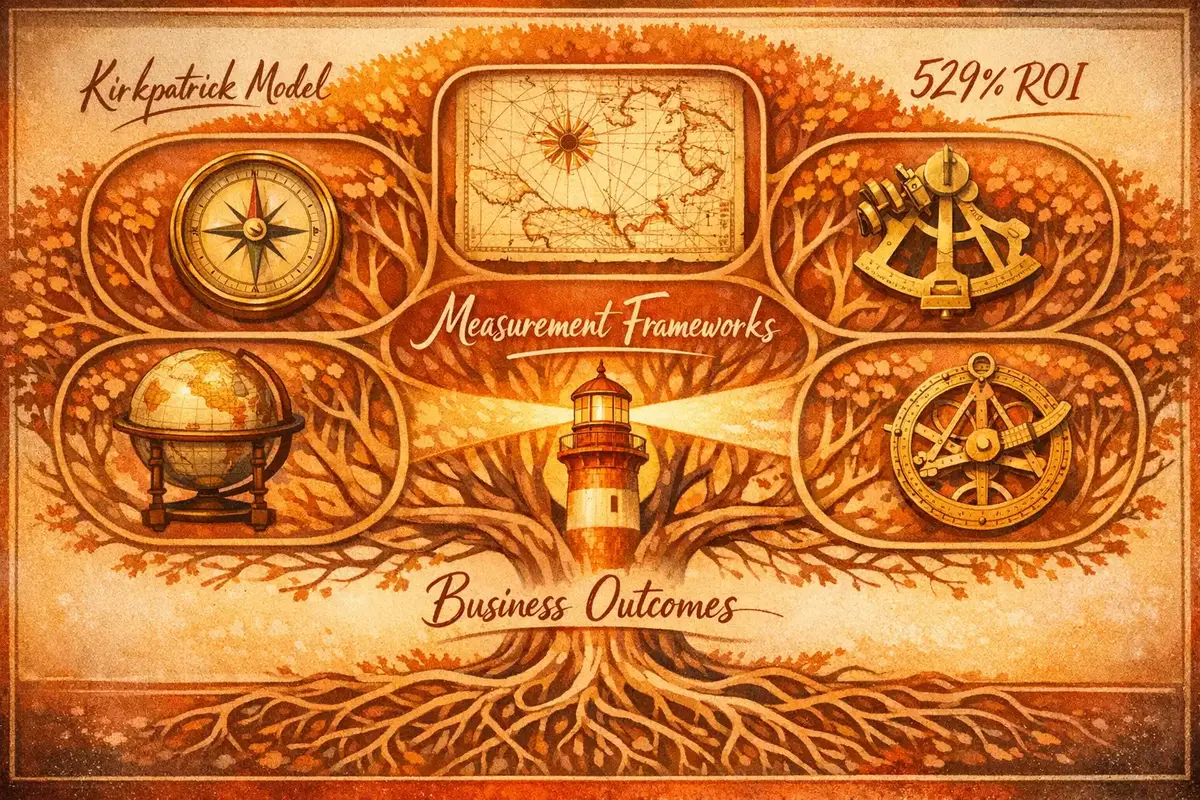
This is why a single headline metric rarely survives executive scrutiny. A high net promoter score can coexist with no observable behavior change. A strong self-rating can mask manager dependence. Even a business improvement can be challenged if no one documented the mechanism connecting coaching to the result.
The stronger approach is a multi-signal measurement stack. Pair participant reaction with manager observation. Pair self-reported learning with a before-and-after behavioral rubric. Pair those behavioral shifts with one or two business indicators already tracked by the function—retention, quality defects, cycle time, client renewal, span-of-control stability. If you want a practical model for coaching ROI, this is the bridge between soft evidence and finance-grade evidence.
ROI Is the Top Layer, Not the Whole Case
The MetrixGlobal case study is often cited for the number, but the real lesson is methodological. It reported 529% ROI from executive coaching based on direct financial benefits, rising to 788% when employee-retention benefits were included (MetrixGlobal, 2005).
529% ROI on direct financial benefits—and 788% when retention effects were added (MetrixGlobal, 2005)
Impressive, yes. But ROI only persuades when the layers beneath it are already credible. Otherwise the number looks engineered.
That is the executive standard: not one metric, but a chain of evidence. And once you accept that, a harder design question appears. Which outcomes belong at the leadership level, which at the team level, and which at the individual level—signal, or noise?
What Should You Measure for Leadership, Team, and Individual Outcomes?
70% of the variance in team engagement sits with the manager or team leader—which means a weak coaching scorecard can hide real business risk until trust drops, good people leave, and performance slips in ways finance sees only after the quarter closes (Gallup, 2024). If the manager drives most of the team experience, why do so many coaching scorecards stop at individual sentiment?
Three Lenses, Not One Score
A single “coaching impact” number is usually a category error. Leadership outcomes, team outcomes, and individual outcomes answer different questions, and they should be measured that way.
Take a regional healthcare provider in the middle of a team restructure. A director receives coaching after two senior clinicians resign and patient-flow meetings start breaking down. If you measure only the director’s confidence, you may miss the real issue. The business does not need a more optimistic leader in the abstract; it needs clearer decisions, steadier communication, and fewer avoidable escalations.
That is the leadership lens. Measure whether the leader sets priorities better, runs sharper one-to-ones, makes decisions faster, or handles conflict with less drift. These are not broad personality judgments. They are role-relevant behaviors tied to the work.
The team lens is different. Because managers shape so much of the team experience, an individual coaching intervention can reasonably show up in collective outcomes—engagement, retention risk, collaboration quality, or manager-specific pulse items—if the coached leader actually changes how they lead (Gallup, 2024). This is where many leadership development coaching programs either gain credibility or lose it.
When the intervention is individual but the manager role shapes the team system, team metrics are not “nice to have.” They are part of the evidence.
Individual Growth Still Needs External Proof
Individual metrics matter. They just need discipline.
The International Coaching Federation reports that 70% of coached individuals improved work performance and 80% improved self-confidence (International Coaching Federation, 2024). Both are useful. Neither is sufficient on its own.
Confidence is an internal shift. Work performance is closer to value. But self-report alone tends to overstate impact, especially when the participant liked the coach and wants the effort to feel worthwhile. The stronger design pairs self-assessment with observable workplace behavior: manager observations, peer feedback, decision quality, follow-through rates, meeting effectiveness, or reduced rework.
That is how you avoid claiming too much from too little. If someone says they are more confident, what changed in the work? If they say performance improved, who else saw it—and where?
A good measurement plan separates these lenses before the coaching starts. A better one does the same when the coach is not human at all. Because once AI enters the picture, the risk is no longer under-measuring impact—it is overstating it.
How Do You Measure AI Coaching Without Overstating Its Value?
A director in a mid-market services firm opens the dashboard before a budget review and sees what looks like a win: thousands of AI coaching interactions, high repeat usage, and fast completion rates. Then the CFO asks the harder question—did the tool change leadership behavior, or did it simply make support easier to access?
That distinction matters because AI coaching is usually strongest where human coaching is hardest to scale. The Conference Board argues that AI can handle up to 90% of day-to-day coaching functions—a powerful claim, but one that points to coverage and continuity more than full substitution for human judgment or relational depth (The Conference Board, 2025).
Measure AI First as a Scaling Layer
If you evaluate AI by asking whether it replicates the deepest outcomes of a strong human coach, you will either underrate it or overclaim. The better question is narrower: where does it create measurable value first?
Start with access, frequency, consistency, and between-session follow-through. Can more managers get support without waiting weeks? Do they use it in the flow of work—before a difficult feedback conversation, after a client escalation, during a team conflict? Does it reinforce commitments between formal development moments? Those are not secondary benefits. In many organizations, they are the mechanism of value.
AI coaching often proves itself first through reach and repetition—not through the same evidence stack used for high-trust human coaching.
Harvard Business Impact reports that 55% of organizations prioritize generative AI and machine learning in leadership development (Harvard Business Impact, 2025). That tells you where the market is moving. It does not tell you what to measure. Usage volume alone is weak proof unless it is tied to a work pattern that matters: faster manager response, more frequent preparation for one-to-ones, fewer missed follow-ups, better adherence to agreed actions.

Human, AI, and Hybrid Need Different Proof
Human coaching is more likely to justify itself through deeper behavioral shifts—better judgment under pressure, stronger self-awareness, cleaner conflict handling, more durable change in how a leader is experienced by others. AI coaching is more likely to show stronger adoption data—logins, prompt recurrence, action completion, habit reinforcement, and breadth of manager participation.
That is why a hybrid model is often easier to defend than either extreme. Deloitte’s position is directionally useful here: AI should help managers spend more time developing, coaching, motivating, and nurturing people, not less (Deloitte, 2025). In practice, that means using AI for cadence and reinforcement, while reserving human coaching for complexity, identity-level change, and moments where trust carries the intervention.
If you want a credible framework for AI coaching, do not force one model to prove the other’s value. Measure AI on scaled behavior support. Measure humans on depth of change. Measure hybrid on whether the combination improves both.
That leaves one executive problem. When all three models produce different kinds of evidence, what belongs on a single scorecard—and what will finance dismiss as noise?
What Does a CFO-Ready Coaching Scorecard Need to Show?
The chain-of-evidence scorecard matters here because it answers the only question finance really cares about: what evidence would a skeptical finance leader need before approving the next round of coaching spend? Most sponsors assume the hard part is proving coaching created value. It is not. The harder part is showing that the value was measured in a way a CFO would recognize as disciplined.
That is why a good coaching scorecard is not a dashboard of everything you can count. It is a decision tool.
Build the Scorecard in Four Rows
Use four rows: activity, behavior change, business results, and financial return.
Activity shows exposure and completion: who participated, how often, for how long, and in what format. This is necessary, especially in organizations where multiple development inputs run at once. Harvard Business Impact found that 43% of respondents say their organizations use both internal and external leadership development programs (Harvard Business Impact, 2025). In that environment, activity data helps define what coaching actually touched.
Behavior change is the first row that earns executive attention. Pick two or three observable shifts tied to the role: decision speed, quality of one-to-ones, escalation handling, delegation, follow-through. Keep it narrow.
Business results come next. In an enterprise retail budget review, a regional VP does not need twenty metrics. They need a short line of sight from coached manager behavior to store-manager retention, time-to-productivity, or customer issue resolution.
A CFO-ready scorecard shows movement from participation to behavior to business effect before it ever shows ROI.
Show Your Measurement Logic, Not Just Your Numbers
The scorecard should state four things plainly: baseline, comparison, time horizon, and monetization logic.
Baseline means where the leader or team started. Comparison can be a matched group, a pre-post trend, or a proxy benchmark when a true control group is unrealistic. Time horizon matters because some outcomes move in 90 days; others need two review cycles. Monetization logic means explaining how a business change became a financial estimate—reduced attrition cost, faster ramp, fewer performance failures.
This is where overclaiming usually starts. Yes, 86% of organizations that tracked coaching ROI reported making back their investment or more (International Coaching Federation, 2024). Useful signal. Not a license to force every coaching program into the same ROI formula.
Some programs are about succession depth. Some are about retention risk. Some are about performance repair. The scorecard should support those decisions without pretending every case deserves a headline ROI number. Because once the scorecard exists, a sharper question appears: which measures actually change funding decisions—and which ones just decorate the page?
The Best Coaching Measurement Is the One That Changes Decisions
Bad coaching measurement destroys value twice. First in the business — through missed performance gains, avoidable turnover, and slow leadership correction — then again in the budget meeting, where trust erodes because no one can tell what deserves more investment.
When the next budget review arrives, will your coaching data help leaders decide—or just help them feel reassured?
Measure for allocation, not applause
In a regional finance firm during annual planning, a business-unit head may know a coaching program was well received and still cut it. Not because coaching failed. Because the evidence did not show which population needed it most, which format changed behavior fastest, or where the next dollar would outperform other talent bets.
That is the real purpose of measurement. Not to produce a flattering number. To improve design, targeting, and scale.
If the evidence is sound, you can stop arguing in generalities. You can fund coaching for newly promoted managers and not for already stable senior leaders. You can shift from broad access to role-specific interventions. You can decide whether a struggling function needs deeper human work, lighter habit support, or a hybrid model.
Keep the hierarchy intact
The sequence is simple, and most organizations break it under pressure: attribution first, then behavior change, then business outcomes, then ROI.
Skip attribution and every improvement is debatable. Skip behavior and business results look accidental. Skip business outcomes and ROI becomes a finance exercise detached from operational reality.
Research from the International Coaching Federation shows coached individuals often report stronger work performance (International Coaching Federation, 2024). Useful. But self-reported improvement is still an input to judgment, not the judgment itself.
Different models, different proof
Human coaching, AI coaching, and hybrid coaching should not be forced through one evidence standard because they create value differently. The Conference Board notes that AI can handle much of day-to-day coaching support (The Conference Board, 2025). That points to consistency, access, and reinforcement. Human coaching should earn its case through deeper shifts in judgment, relationships, and behavior under pressure. Hybrid models should prove that the combination changes both reach and depth.
That is the closing discipline: measure coaching in the way you intend to manage it. So before the next review, ask a harder question — are you collecting evidence to defend coaching, or to make better decisions about it?
Key Takeaways
- Coaching ROI is easier to prove when attribution is handled carefully and evidence is layered from reaction to ROI.
- Surveys and testimonials are useful, but behavior change and business outcomes carry more executive weight.
- Leadership, team, and individual outcomes should be measured separately, not collapsed into one score.
- Human, AI, and hybrid coaching need different proof because they create value in different ways.
Frequently Asked Questions
How can coaching effectiveness be measured in a credible way?
Coaching effectiveness is best measured with a layered approach: participant reaction, observable behavior change, business outcomes, and finally ROI. The strongest evidence comes from showing that specific behaviors improved and that those changes contributed to measurable business results.
Why is attribution the biggest challenge in proving coaching ROI?
Attribution is difficult because performance can improve for many reasons at the same time, such as a new manager, a role change, a market recovery, or another development program. To make a credible case, you need a baseline, a comparison point, or a clear logic chain that explains why coaching—not just time passing—drove the result.
What evidence do executives trust most when evaluating coaching programs?
Executives usually trust behavior change and business outcomes more than satisfaction scores or testimonials. Measures such as delegation quality, conflict handling, retention, productivity, cycle time, or promotion readiness are more persuasive because they connect coaching to operational impact.
What should a CFO-ready coaching scorecard include?
A CFO-ready scorecard should show activity, behavior change, business results, and financial return. It should also define the baseline, the comparison method, the time horizon, and the monetization logic so the financial estimate is transparent and defensible.
How should AI coaching be measured differently from human coaching?
AI coaching should be measured first as a scaling tool, using metrics like access, frequency, consistency, and follow-through. Human coaching is better evaluated through deeper behavioral shifts, while hybrid models should prove both reach and depth of impact.