

Why AI coaching fails when it copies the conversation but not the method
94% of employees and 99% of C-suite leaders say they are familiar with gen AI tools. That means your buyers, coaches, and internal sponsors already know what AI can sound like; the harder question is why so much AI coaching still feels thin, generic, and forgettable (McKinsey, 2025).
You have likely seen the scene. A learning director in a mid-market healthcare company pilots an AI coach during budget season, the demos go well, the conversations look polished, and yet managers come back saying the experience was “helpful” without changing anything that matters. The system can mirror tone, ask decent questions, even summarize patterns. But it cannot reliably do what a real method does: shape attention, sequence development, and work with the person rather than just the transcript.
That gap is getting expensive. 71% of L&D professionals are already exploring, experimenting with, or integrating AI into their work, which means shallow design is no longer a niche product flaw; it is becoming an organizational scaling problem (LinkedIn, 2025). If your system copies the surface of coaching while missing the underlying discipline, you do not just get weaker outcomes. You train the market to confuse conversational fluency with developmental rigor. This article addresses that exact problem: how to translate Integral Coaching into an AI system without stripping out the method that makes it effective.
The failure is usually in translation, not interface
This is the first distinction that matters. Integral coaching is not a library of prompts, a tone of voice, or a branching dialogue tree. It is a developmental method with commitments about how change happens, what should be observed, when challenge is useful, and how practices are matched to the client’s way of making meaning.
When teams build software too literally, they often convert the visible artifacts of coaching into product features. A reflective question becomes a prompt. A developmental arc becomes a workflow. Presence becomes response latency and empathetic phrasing. The result may resemble coaching in conversation while abandoning coaching in structure.
That is why a serious integral coaching translation starts below the interface. The design problem is not “How do we make the bot sound like a coach?” It is “What must the system detect, remember, prioritize, and refuse if it is to behave like the method?”
Fidelity is the real technical requirement
For an AI coaching system to be credible, philosophy has to become machine-readable without becoming simplistic. That means turning distinctions, developmental assumptions, and intervention logic into design requirements the system can execute consistently.
This is where most products flatten. They preserve the conversation and lose the method — or preserve the terminology and lose the discipline. The real test comes next: what exactly makes Integral Coaching different enough that it can guide system design rather than decorate it?
What makes integral coaching different from a standard coaching script?
Integral Coaching is the framework that matters here. But what exactly is being translated when people say they want an AI coach to be “integral”? If the answer is just “better questions,” you are already too close to the surface.
A standard coaching script assumes the main unit of work is the conversation. Integral coaching does not. It treats the person as a whole system in motion: habits, interpretations, body, relationships, and context all shape what change is possible and what kind of support will actually land. That is why wholeness is not a poetic add-on; it is a design constraint.
The training language makes this explicit. The Integral Institute describes the method as one that works with the client’s current way of being while building capacity for new action and awareness (The Integral Institute). Integral Coaching Canada similarly frames the work as developmental rather than merely problem-solving, with practices tailored to the person rather than pulled from a generic library (Integral Coaching Canada). New Ventures West makes the same point from another angle: the coach is not just helping someone decide what to do, but helping them observe how they are organized to act in the first place (New Ventures West).
The method lives below the script
This is where many product teams get lost. They can name the distinctions — way of being, structure of interpretation, developmental movement — but naming is cheap. Encoding them is hard.
Take a regional manufacturing VP in a quarterly review. She says her team is “not stepping up,” and a scripted coach can ask useful follow-ups about delegation, expectations, and accountability. An integral coach hears something else as well: a recurring interpretation of others, a patterned stance toward control, and a developmental edge that may require practice, not advice. Same transcript. Different object of attention.
That difference matters if you are building an coaching methodology into software. A script maps utterance to response. A method maps observation to intervention logic.
The real challenge is not generating plausible coaching language. It is deciding what the system believes is changing in the client.
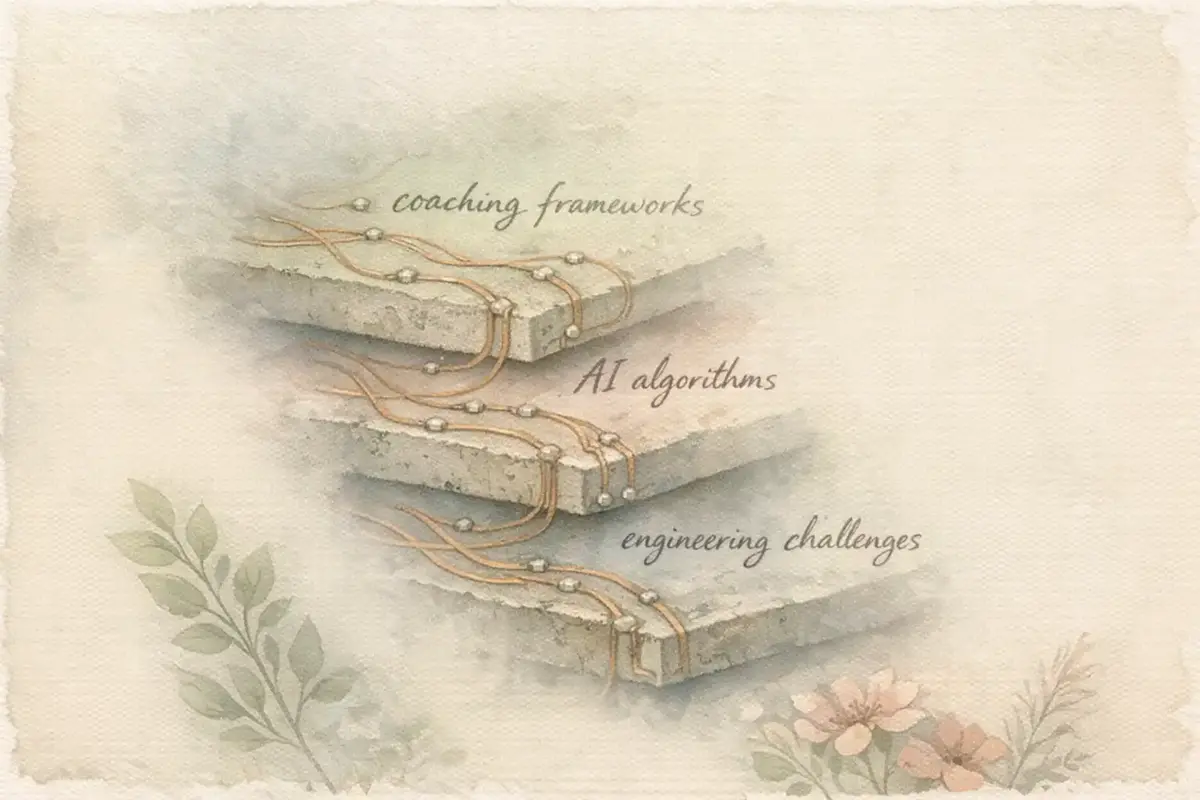
A three-layer translation framework
A useful translation starts by separating philosophy, behavior, and system design.
Philosophy defines the assumptions: people develop unevenly, context changes meaning, and growth is more than solving the presenting issue. Behavior defines what a coach actually does: listen for recurring interpretations, test distinctions, assign practices, and revisit them over time. System design then asks a harder question: what must the AI detect, store, infer, and sequence to support developmental coaching without flattening it?
Collapse those layers and the system becomes performative — fluent, warm, method-thin. Keep them separate, and you have the beginning of fidelity. But once principles are separated cleanly, how do they become requirements a product team can actually build against — feature by feature, memory by memory?
How do principles become design requirements in an AI coach?
55% of organizations are prioritizing generative AI and machine learning, which is exactly why a translation layer cannot be optional in an AI coaching system (Harvard Business Publishing, 2025). Without that layer, the method breaks at the point of implementation: principles stay inspirational, while the product defaults to generic chat behavior.
That contrast is now hard to ignore. Organizations are investing in AI, and they are also measuring leadership outcomes with familiar tools — 62% rely on employee surveys to assess leadership effectiveness (Harvard Business Publishing, 2025). Yet a survey can tell you whether users liked the interaction; it cannot tell you whether the system actually followed a developmental method. If organizations are already funding AI and measurement, why do so many systems still drift away from the coaching discipline they claim to support?
The answer is usually architectural. A principle such as “work with the client’s current way of being” has to move through a repeatable chain: principle → data representation → interaction pattern → safeguard → test. If you skip a link, fidelity becomes a branding claim rather than a system property.
From coaching principle to system behavior
Take a regional services firm during a team restructure. A director uses the AI coach after repeated conflict with peers. An integral method does not treat each session as a fresh prompt. It needs a structured view of recurring interpretations, practiced commitments, and developmental edges over time.
That means the system needs explicit design requirements, not vague aspirations. Memory policy defines what persists across sessions. State transitions define when the system moves from observation to hypothesis, from hypothesis to practice, and from practice to review. Response constraints define what the model may ask, what it must verify, and when it should slow down rather than sound confident.
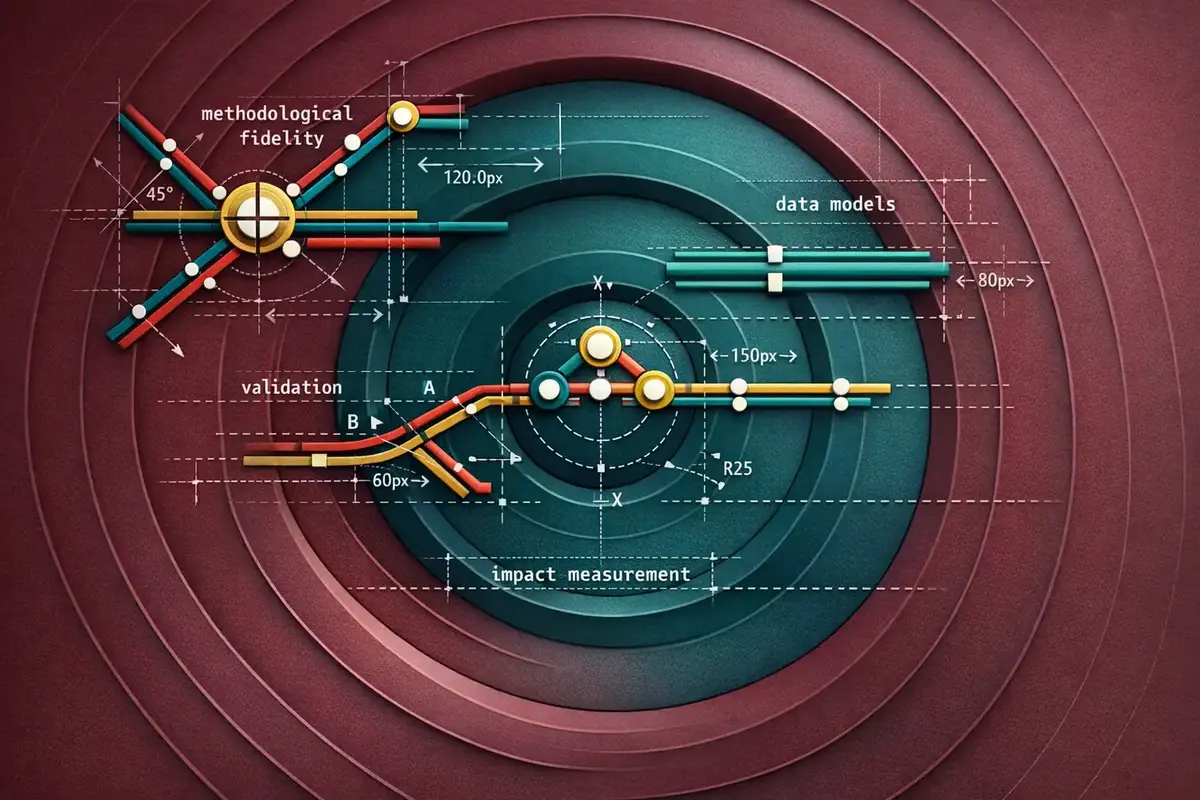
The minimum viable model is simpler than many teams think. It should distinguish three things cleanly: what the system remembers, what it infers, and what it must never assume. Remembered items might include stated goals, prior practices, and user-confirmed patterns. Inferences might include a tentative interpretation of avoidance or control. Assumptions are the danger zone — especially when the model starts treating a probabilistic guess as a fact about identity, motive, or readiness.
Rules for safety, probabilities for nuance
This is where hybrid design matters. Rules-based logic is best for guardrails: privacy boundaries, escalation conditions, prohibited claims, and the requirement to label hypotheses as tentative. Probabilistic logic is better for nuance: recognizing language variation, adapting questions to context, and maintaining a coherent coaching framework across messy real-world dialogue.
You need both. A purely rules-based system becomes brittle. A purely probabilistic one becomes persuasive in the wrong places.
The practical design question is not whether the AI can sustain a plausible coaching conversation model. It is whether the hidden architecture keeps the method intact when the conversation gets ambiguous — or emotionally charged. And that pushes the next issue into view: where, exactly, does that architecture live if not in the words on the screen?
Why conversation design is the hidden architecture of methodological fidelity
The Coaching Conversation Model matters here because it forces a harder question: when a user asks for help, what should the system do first? In a single chat box, that decision looks like UX. It is not. It is the method showing its bones.
Picture a team lead at a mid-market technology company during a client escalation. She tells the AI coach, “I’m tired of carrying people who should already know better.” Should the system reflect the frustration, challenge the judgment, or pause and gather more context? Compress that moment into one generic reply loop and you do not just simplify the interface. You erase the discipline that tells an integral coach what kind of move is appropriate now, and what would be premature.
Sequence is not presentation. It is intervention logic.
This is the hidden architecture. A serious coaching conversation model is not a prettier wrapper around prompts; it is the operational form of the method. Integral Global frames conversation as a structured movement rather than an undifferentiated exchange, which is exactly why sequence matters: exploration opens observation, distinction-making sharpens what is actually happening, reflection deepens ownership, and commitment turns insight into practice (Integral Global).
That order changes outcomes. Ask for commitment too early and the system produces performative action plans. Stay in reflection too long and the user feels understood without being developed. The conversation design has to decide when to widen the lens, when to name a pattern, and when to ask for a concrete promise. That is not interface polish. It is methodological fidelity in executable form.
One chat loop is too blunt
Leadership Circle teaches Integral Coaching as a developmental process, not a stream of interchangeable questions (Leadership Circle). An AI system should therefore move through explicit conversation states — exploration, distinction-making, reflection, commitment — instead of treating every turn as “user says X, coach asks Y.”
The practical implication is sharp. The same question does not do the same work for every user. “What are you avoiding?” may help one leader see a recurring pattern. For another, especially early in the dialogue, it can trigger defensiveness or false certainty. Good coaching methodology adapts the prompt to developmental context: readiness, emotional charge, prior commitments, and the user’s demonstrated capacity for self-observation.
That is why conversation design is where method survives — or quietly disappears. And once the system can sequence a dialogue well, a harder boundary appears: what should it carry forward from one conversation to the next, and what should it let go?
What should an AI coach remember, and what should it intentionally forget?
Memory is where an AI coach either keeps the method intact or quietly corrupts it. In a regional finance firm during annual planning, a division VP opens a session frustrated after a tense board prep, and the system has to decide whether that frustration is a passing state or a meaningful pattern.
That distinction matters because personalization is now the expected baseline. The Conference Board reports that workers broadly experience AI as providing customized coaching (The Conference Board, 2025). But customization without a disciplined memory policy is not coaching depth. It is just accumulation.
A practical rule: remember structure, not every signal
A sound memory policy for an AI coaching system should preserve what changes the meaning of future work: stated goals, active commitments, practices the user agreed to try, and recurring patterns the user has confirmed over time. Those elements create developmental continuity. They let the system ask better follow-up questions, notice drift, and reconnect today’s conversation to unfinished work.
What it should not retain with equal weight is just as important. A sharp comment made in a bad meeting, a moment of defensiveness after criticism, or a one-off self-description offered under pressure should not harden into profile truth. If the system stores every emotionally charged utterance as durable identity data, it starts coaching a caricature.

The better design move is selective persistence. Store user-validated patterns. Decay unverified interpretations. Re-open old conclusions when new evidence conflicts with them. In practice, that means the system might remember, “You have repeatedly linked conflict with loss of control, and you wanted to practice pausing before intervening,” while letting go of, “You were angry and dismissive last Thursday.”
Test memory for depth, not for capture
This is also where evaluation gets sharper. The question is not whether the system remembers more; it is whether memory improves the quality of developmental work without making the user feel watched. A good test asks whether retained context leads to more precise challenge, better continuity of practice, and fewer repetitive sessions. A bad test rewards recall volume.
Research consistently shows that trust collapses when personalization starts to feel like surveillance. So the standard should be clear: memory must serve the coaching task, not the construction of an ever-thickening user dossier. That is a methodological boundary, not just a privacy preference.
The hard part comes after this. How do you know the system is using memory well — preserving pattern, avoiding distortion, staying true to Integral Coaching — rather than merely sounding coherent?
How do you test whether the AI still behaves like an integral coach?
Organizations with mature leadership development practices are 1.8 times more likely to report better financial results (Deloitte, 2025). If your AI coach drifts from method while still sounding polished, the cost is not abstract: weaker managers stay weak, trust in the system erodes, and talent decisions get shaped by bad developmental signals.
That is why evaluation has to start with a hard question: How do you know the system is faithful if the output sounds helpful but the method has drifted? User satisfaction is not enough. The ICF reports that 85% of clients say coaching improves self-confidence (ICF, 2025), but confidence is an outcome of coaching, not proof that the underlying method was followed.
Test for developmental intent, not conversational charm
A retail enterprise offers a familiar example. During a market shift, a regional director uses the AI coach after two store leaders miss targets and blame staffing. The system responds warmly, summarizes the tension well, and suggests three actions. Everyone rates the interaction highly. Yet the method may already be gone if the system skipped observation, rushed to advice, and failed to work with the leader’s way of making sense of the problem.
So the scorecard has to look below the transcript. A serious test of developmental coaching asks whether the system preserved developmental intent: Did it stay context-sensitive? Did it make useful distinctions, or just paraphrase? Did it remain non-directive when the moment called for inquiry rather than prescription? Did its moves stay consistent with the declared coaching framework?
The key metric is not “Was this helpful?” It is “Did the system intervene the way an integral coach should here?”
Build failure modes into the evaluation plan
This is where most teams are too optimistic. They test for fluency and sentiment, then discover the real problems after launch.
You need explicit red-team cases for over-directiveness, shallow personalization, and false certainty. Give the system ambiguous situations, emotionally charged language, and incomplete context. Then inspect whether it starts prescribing too early, treating generic memory as insight, or stating interpretations as facts. Those are not edge cases. They are predictable failure modes in any AI system that sounds more certain than its evidence warrants.
The uncomfortable truth is that a method can disappear gradually — one “helpful” shortcut at a time. And if fidelity cannot be measured, what exactly are you scaling: coaching, or just a convincing imitation?
The real promise of AI coaching is not scale alone, but disciplined translation
23% of employees worldwide were engaged at work. That is the number most leaders should sit with before they approve another AI coaching rollout, because it suggests the problem is not access to more conversation but access to better developmental work (Gallup, 2024).
Most organizations still start in the same place. They assume the win is scale: more employees reached, lower delivery cost, faster support between manager check-ins. The evidence points somewhere less convenient. If engagement is this fragile, what kind of AI coaching is actually worth building?
Low employee engagement costs the global economy US$8.9 trillion, or 9% of global GDP (Gallup, 2024)
That figure changes the standard. A system that merely produces competent coaching language is not enough. At that point, fluency is cheap. What matters is whether the system can help a person see a pattern, test a new practice, and stay with the work long enough for behavior to shift.
The moat is method, not interface
Consider a startup technology founder in a board meeting after a weak quarter. She opens the AI coach at 11 p.m. and asks how to “get the team to move faster.” A thin system will offer prioritization tips, maybe a few reflective questions, and leave her feeling briefly organized. A disciplined system will do something harder: separate the immediate operating problem from the founder’s recurring way of interpreting urgency, then respond in a way that fits the method rather than the mood.
That is the real moat. Methodological fidelity determines whether the product supports growth or simulates it.
The durable systems will be the ones that translate principles carefully instead of automating them indiscriminately. They will know that not every coaching move should be scaled, not every user statement should become memory, and not every plausible inference should be delivered as insight. In practice, restraint is part of the product.
A useful next step for builders and buyers
If you are evaluating or designing an AI coach, think in layers. Principle. Data representation. Interaction pattern. Safeguard. Test.
Can you name the developmental principle? Can you show how it is represented in data? Can you explain the interaction pattern it should produce, the safeguard that limits misuse, and the test that proves the behavior holds under pressure? If not, you may have automation without translation.
That is the closing discipline. Not bigger deployment. Better conversion of method into system behavior.
With only 23% of employees overall engaged globally (Gallup, 2024), the human stakes are already clear. So the honest next step is simple: are you building something that scales coaching language — or something that can actually carry a coaching method?
Key Takeaways
- AI coaching fails when it copies conversational style but loses the underlying method.
- Integral Coaching requires translation into philosophy, behavior, and system design.
- Memory should preserve validated patterns and developmental continuity, not every signal.
- Evaluation should test developmental intent, not just fluency or user satisfaction.
Frequently Asked Questions
What is the main reason AI coaching fails when it sounds like coaching but does not follow a coaching method?
AI coaching fails when it imitates the tone and flow of coaching but does not preserve the underlying developmental logic. The result is fluent conversation without real change, because the system cannot reliably shape attention, sequence growth, or choose interventions based on the person’s developmental context.
How is Integral Coaching different from a standard coaching script?
Integral Coaching treats the person as a whole system, including habits, interpretations, body, relationships, and context, rather than treating the conversation as the main unit of work. It focuses on how a person is organized to act, not just on what they should do next.
How do coaching principles become design requirements in an AI system?
A coaching principle must be translated into a chain of system behavior: principle, data representation, interaction pattern, safeguard, and test. For example, the system may need memory for validated patterns, state transitions for moving from observation to practice, and rules that prevent it from treating guesses as facts.
What should an AI coach remember, and what should it forget?
An AI coach should remember stable, user-validated information such as goals, commitments, practices, and recurring patterns that shape future work. It should avoid storing one-off emotional reactions or unverified interpretations as if they were durable truths about the person.
How can you test whether an AI coach still behaves like an integral coach?
Testing should focus on developmental intent, not just whether the conversation feels helpful. Good evaluation checks whether the system stays context-sensitive, makes useful distinctions, avoids false certainty, and uses memory and questions in ways that match the coaching method.