
Why AI coaching feels generic until typologies change the conversation
45% of U.S. employees now use AI at work at least a few times a year, yet most AI coaching still sounds like the same competent stranger (Gallup, 2025).
You have seen the moment. A director in a mid-market services firm opens an AI coach before a quarterly review, asks for help handling a resistant team member, and gets a polished answer that is technically fine but socially tone-deaf. It offers encouragement when the situation needs structure, or structure when the person in front of them needs space to think.
That gap is no longer marginal. If AI is already entering daily work for a large share of employees, generic coaching is not just a product flaw; it is a trust problem. Gallup reports that 23% of U.S. employees use AI at work a few times a week or more (Gallup, 2025). At that frequency, a default voice compounds fast: more ignored suggestions, more shallow engagement, more users deciding the system is useful for drafting but not for judgment. This article addresses that exact problem—why AI coaching feels generic, and how typologies change the conversation without making the coach erratic.
The real issue is not intelligence but fit
Most AI coaches are built around a hidden assumption: one clear, balanced, supportive communication style should work for everyone. It does not.
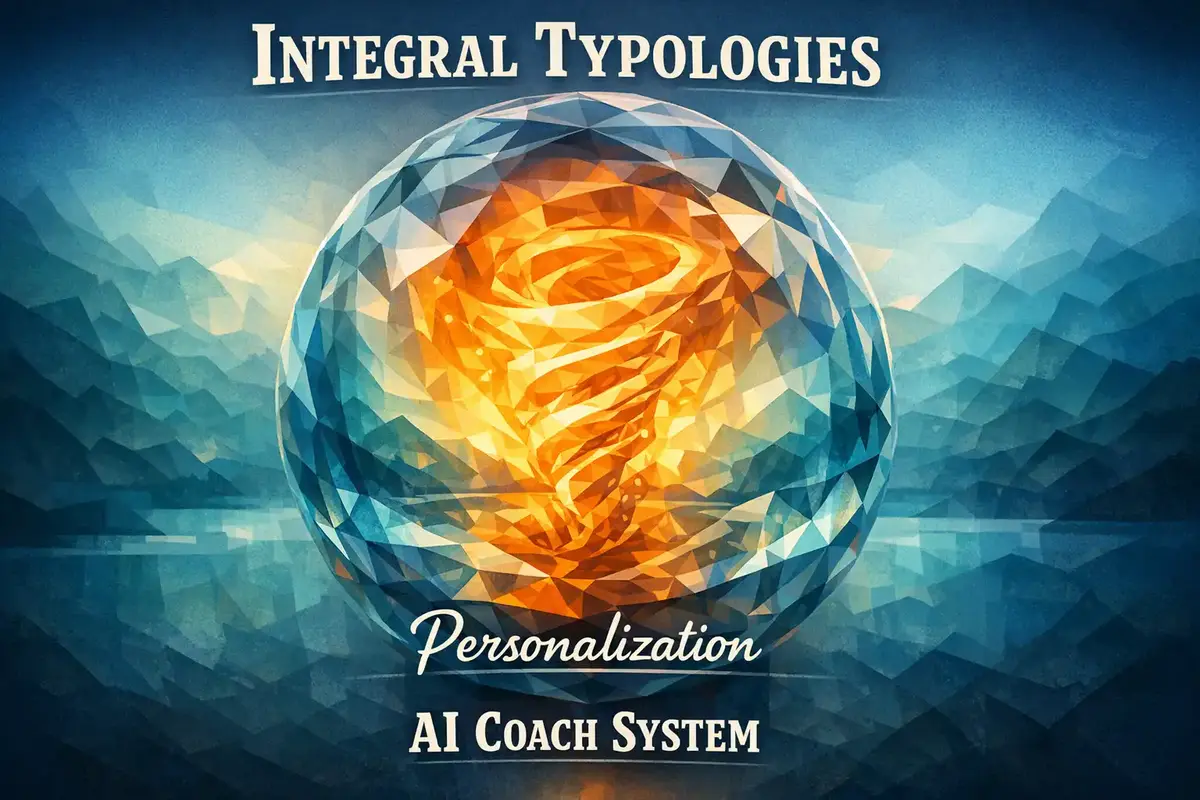
A useful coach has to do two things at once. It has to notice what kind of experience the user is having and decide how the message should land. Those are different design problems. Integral typologies help with the first one by identifying which dimension of the user’s experience matters in the moment—inner state, behavior, role demands, relational context, or system pressure. Personality typologies help with the second by shaping delivery—direct or reflective, concise or exploratory, challenging or reassuring.
That distinction matters because personalization often fails when teams collapse diagnosis and tone into one layer. The result is an assistant that changes wording cosmetically but does not actually meet the user where they are. If you want a broader view of how AI adoption is changing workplace expectations, this is where the design pressure starts to show.
Better personalization is narrower, not looser
The promise here is not personality theater. An AI coach does not become more human by pretending to be a certain kind of person.
It becomes more useful when it can adapt communication style to user preference while staying anchored to the same coaching intent, safety boundaries, and decision logic. That is a tighter form of personalization, not a softer one. The best systems do not mimic identity; they increase precision. They know when to ask a grounding question, when to offer a framework, and when not to push.
The design challenge is simple to state and hard to solve: how do you vary tone enough to feel relevant without varying so much that the coach feels inconsistent?
That is where typologies stop being decorative and start becoming operational. But what, exactly, do they add to AI coach design—and what should teams use them for first?
What do integral typologies actually add to AI coach design?
The AQAL-informed three-layer model matters here because it gives AI coach design a way to sort signal from noise. Without it, teams treat every user difference as “personality,” and the coach starts solving the wrong problem.
What changes when you stop asking whether a user is a type and start asking which lens best fits the moment? Quite a lot. In plain English, integral typologies are not boxes for people. They are lenses for noticing whether the live issue sits in mindset, behavior, relationships, role expectations, or the wider system—a distinction central to integral leadership and AQAL framing developed by The Integral Institute.
That sounds abstract until you watch what breaks in practice.
A VP at a regional healthcare provider is preparing for a team restructure. One manager asks for a script. Another wants space to think through the political fallout. A third is not confused at all; she is constrained by process. If the AI coach reads all three as the same “anxious user type,” it will over-personalize tone and under-diagnose the situation. AQAL framing was built to prevent exactly that flattening by distinguishing multiple dimensions of human experience rather than reducing everything to one axis (The Integral Institute).
Type, stage, and personalization are not the same thing
Beginner explanations often blur three separate ideas. That is where confusion starts.
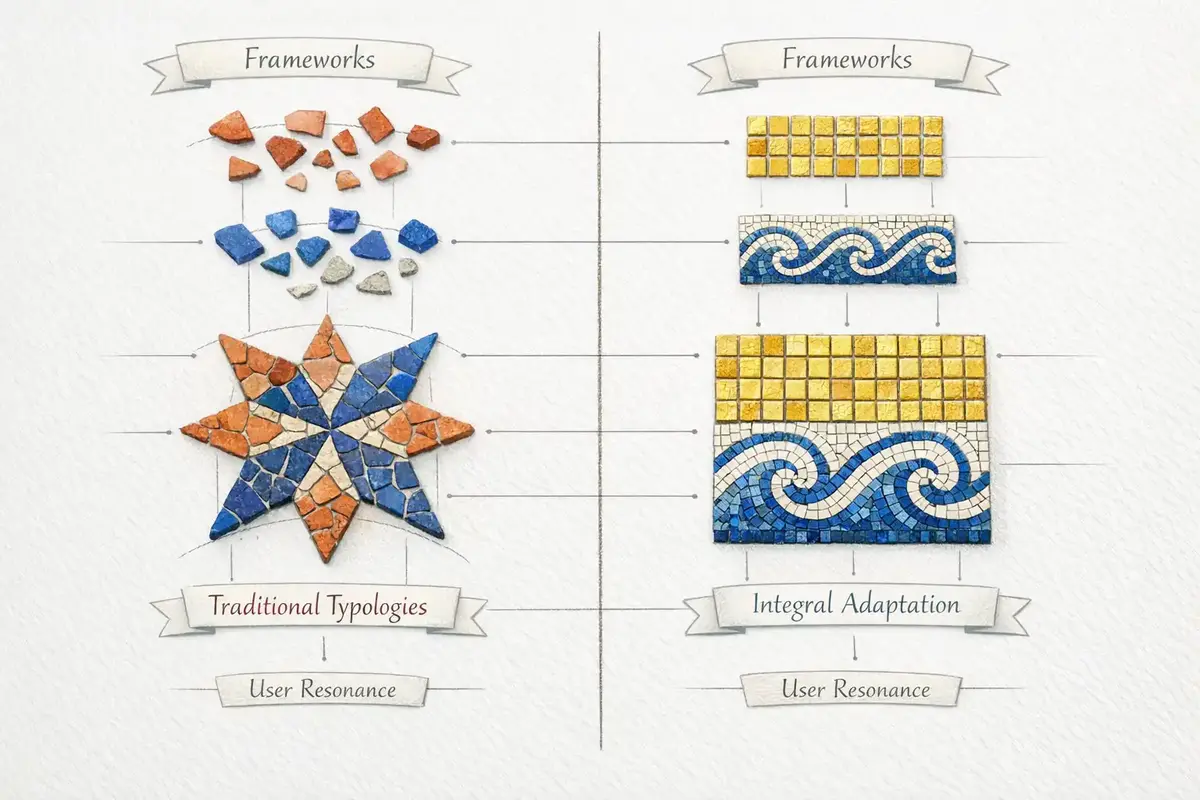
Type describes recurring preferences or patterns in how someone tends to interpret and communicate. Stage points to developmental complexity—how a person makes meaning, not just what style they like. Personalization is the delivery choice the system makes in response. Conflate those, and you get a coach that treats a temporary need for clarity as a permanent identity, or mistakes developmental readiness for a tone preference.
This is why the design logic works best in three layers. First, the integral layer asks: what dimension of the situation matters most right now? Second, the typology layer asks: what communication hypothesis is most useful here? Third, the AI response layer decides how to phrase, pace, and structure the intervention.
The real gain is disciplined flexibility
Used this way, typology stops acting like destiny. It becomes a bounded hypothesis inside a broader diagnostic frame.
That is the practical value. The coach can stay consistent in intent while varying how it responds—more direct here, more reflective there—without pretending the user is their type. And once you accept that distinction, a harder question appears: when does a useful communication hypothesis become a limiting label?
Why personality typologies work best as communication hypotheses, not labels
Personality typologies sound useful because they promise clarity. But what if the very thing that makes them easy to use also makes them easy to misuse?
That is the trap in the type-as-heuristic model. Teams see a clean category and start treating it as a stable truth about the person rather than a working guess about how to communicate. The result is subtle but costly: the coach stops listening. It begins to explain the user instead of helping them.
Useful types shape delivery, not identity
This is where disciplined design matters. A typology should guide phrasing, pacing, and structure—not identity claims.
If a user tends to prefer direct language, the coach can lead with a recommendation and keep the rationale brief. If another user responds better to reflection, the same coaching intent can begin with a question and leave more room for interpretation. If a third wants detail, the coach can show steps, tradeoffs, and sequence. None of that requires saying, “You are this kind of person.” It only requires a practical communication hypothesis.
That distinction is not semantic. It is operational.
A team lead at a manufacturing company, during a client escalation, may want a fast script: “Start with the missed commitment, name the recovery plan, then ask for one decision.” A founder at a technology startup facing the same pressure may reject that as too rigid and respond better to: “What outcome do you need from this call, and where are you over-explaining?” Same problem. Same coaching goal. Different delivery.
The beginner-friendly test: can you swap the wording without changing the intent?
This is why readable personality-type communication examples are so helpful for beginners. They make the adaptation visible. Truity’s communication examples are useful not because they prove a person is a type, but because they show how different people often prefer different levels of directness, reflection, or detail (Truity).
The practical question is not “What label fits this user?” but “What form of response is most likely to land well right now?”
That keeps the system flexible. A user can want blunt feedback in a budget meeting and a more exploratory tone in a career conversation. Preference shifts by context. Good coaching design expects that.
Practical, not reductive
The safest use of typology is modest use. Treat it as a starting point, then update from behavior.
When the coach notices that short answers work better than long ones, or that the user consistently asks for examples before acting, it should adapt. Quietly. Without turning a communication pattern into a fixed persona. That is how type-based adaptation stays useful instead of becoming stereotype with better UX.
And once you allow that kind of flexibility, a harder issue appears: how much adaptation actually improves perceived fit—and when does it start to feel artificial instead?
What does the research say about AI coach personality and perceived fit?
79.36% of the variance in how people evaluated AI coach attributes was explained by just four factors in a 2025 pilot study published in Frontiers. That matters because when coach personality misses the mark, the cost is not abstract: trust drops, adoption stalls, and the system gets demoted from “coach” to “drafting tool” (Frontiers, 2025).
If coach personality can be measured, what does that mean for the way AI should speak to different users? It means perceived fit is not a soft preference that teams can hand-wave away in UX copy. It is a structured design variable.
Suitability is more patterned than most teams assume
The useful contribution of the Frontiers study is not just that it looked at AI-driven coaching. It showed that users do not judge a coach in a random, purely subjective way. Through factor analysis, the researchers identified four key dimensions of AI coach attributes, which means coach design can be examined as a measurable pattern rather than treated as a vague matter of taste (Frontiers, 2025).
That is a practical finding, not an academic one. In product terms, it suggests users are reading for recognizable clusters: how the coach motivates, how it communicates, how it presents authority, and how appropriate that combination feels in context. Teams building a single “balanced” persona should pay attention here. A generic voice may sound safe internally while feeling misaligned externally.
A regional healthcare VP facing a budget-cycle staffing decision does not need the same coaching presence as a startup founder working through a market-shift narrative for investors. One may want calm structure and fast prioritization. The other may respond better to challenge, reframing, and a sharper push on assumptions. Same model. Different fit.
The case for varying tone is now stronger
Four factors explained 79.36% of the variance in perceived AI coach attributes and suitability (Frontiers, 2025).
That number is the hinge. When a small set of dimensions explains that much of the response pattern, perceived suitability is clearly being shaped by underlying structure. Not noise. Not whim.
This supports a more disciplined version of personalization. Systems should vary motivational style and communication profile because those features appear to influence whether a coach feels appropriate to the user and the moment. That does not justify theatrical persona switching. It does justify controlled adaptation in tone, pacing, and level of directness. If you are evaluating AI coach personality and perceived fit, this is the research base for moving beyond one universal voice.
The implication is straightforward: consistency should live in the coaching logic, not in one frozen speaking style. But once you allow tone to adapt, a harder operational question appears — how do you make those shifts feel coherent rather than erratic?
How do you adapt tone without making the coach feel inconsistent?
The stable-core adaptation model matters here because it asks a harder question than most teams do: what happens when an AI coach sounds personalized but loses its sense of continuity? If the coach is warm in one exchange, blunt in the next, and analytical after that, is that flexibility—or drift? The answer depends less on style than on whether users can still recognize the same judgment underneath.
That is the design line many teams miss.
One coach, multiple modes
Picture a finance director at a mid-market firm during budget season. She opens the coach and wants a fast answer: “Give me the three points I need for this headcount pushback.” Later that day, a team lead in the same company brings a different need: “Help me think through why I am avoiding this conversation with my manager.”
If the system is well designed, those two exchanges should sound different. The first should be concise, ordered, and action-first. The second should slow down, ask a better question, and leave room for reflection. But the ethical core should not move. The coach should still avoid overclaiming, still stay within the same boundaries, still aim for clarity over performance.
That is what consistency actually is. Not one frozen voice. One recognizable logic.
Research on working alliance in a single session points in the same direction: users can form a meaningful sense of alliance with AI in a brief interaction, but that depends on how reliably the system supports the task and relationship in front of them, not on theatrical personality shifts (PMC / Frontiers in Psychology, 2025). In practice, users forgive tonal variation far more easily than they forgive arbitrary judgment.
Start shallow, then earn the right to go deeper
Most teams personalize too deeply, too early. They try to infer identity when they should first be adjusting tone, structure, and level of detail.
Start with simple switches. Lead with bullets for users who ask for decisions. Lead with questions for users who ask for meaning. Shorten responses when the user is under time pressure. Expand them when the user is exploring tradeoffs. These are delivery changes—not value changes.
The safest personalization is often the most visible: how the coach frames, sequences, and sizes the response.
Fragmented personas emerge when the system changes its stance, not just its wording. A coach that is collaborative in one moment and oddly prescriptive in the next feels less human, not more. The fix is architectural: keep principles stable, vary expression.
And that raises a sharper issue. Which users actually want more challenge—and which ones disengage when the coach pushes too hard?
Why personality traits and AI use patterns matter for personalization strategy
1,800 university students were included in a 2025 higher-education study from Scientific Reports, available via PMC. That matters because most organizations still design AI coaching as if willingness to use AI is broadly uniform, when the evidence shows meaningful trait-linked differences in who uses generative AI and how often (PMC, 2025).
Trait patterns change the design brief
The strongest signal in the study was not that personality determines behavior. It was that personality appears to shape propensity. Among students using generative AI for educational purposes, conscientiousness and openness were the strongest positive predictors of use, with coefficients of β = 0.267 and β = 0.250 respectively (Scientific Reports, 2025).
Conscientiousness (β = 0.267) and Openness (β = 0.250) were the strongest positive predictors of educational Gen-AI use (PMC, 2025).
That should change how teams think about personalization. Not because a coach should label someone “high openness” and start performing a persona, but because communication preferences are unlikely to be evenly distributed across the user base. Some users will naturally engage with experimentation, reframing, and exploratory prompts. Others will come to AI for structure, efficiency, and task completion. Same system. Different entry points.
A retail enterprise director in a quarterly review sees this immediately. One store operations lead wants the coach to pressure-test options and surface patterns. Another wants a checklist, a sequence, and a cleaner decision path before acting. If both get the same reflective, middle-of-the-road response, one will feel slowed down and the other under-supported.
Large enough to matter, limited enough to interpret carefully
The sample was not trivial. Of the original 1,800 students, the final analytic sample included 1,016 participants with prior Gen-AI experience for educational purposes (PMC, 2025). That is large enough to treat trait-linked variation as a real design consideration, not anecdote.
It is not large enough — nor is the construct precise enough — to justify amateur psychology inside the product. This is the practical middle ground behind personality traits and generative AI use: traits can inform response strategy, but they should not harden into identity claims.
That is the operational lesson. Use typology to form a first hypothesis about tone, pacing, and structure. Then update from behavior.
Because once you accept that some users are more ready for challenge, ambiguity, or experimentation than others, the real build question gets sharper: what should a team instrument first — the model’s personality, or the signals that tell it when to change?
What should teams notice first when building typology-aware AI coaching?
86% of organizations that tracked coaching ROI reported positive returns, with a median return of 5 to 7x (ICF, 2024). If AI coaching gets adaptation wrong, that value does not disappear in theory; it leaks out through lower trust, weaker follow-through, and expensive talent decisions made with shallow support.
That is the stake. Not whether the coach sounds clever, but whether it helps people act better when the moment is costly.
Notice response preferences before you redesign the coach
The first thing to watch is simple: does the user respond better to structure, reflection, directness, or relational warmth?
Teams often start too deep. They debate persona, developmental logic, even long-term memory design before they have learned a more basic fact: what kind of response actually helps this user move. In a regional services firm during promotion calibration, for example, an HR director may ignore a beautifully empathetic answer and immediately act on a three-step recommendation. Another leader in the same workflow may do the opposite. The useful signal is not who they are. It is what kind of coaching input changes their next decision.
That is why the safest build path is shallow first. Adjust framing, sequencing, and tone before you alter the system’s deeper behavior.
Measure outcomes, not just perceived personalization
The coaching market is already large enough to make this a serious design discipline, not a novelty exercise. ICF estimated $4.56 billion in annual global coaching revenue in 2022, with 109,200 certified coaches worldwide (ICF, 2023). Read that alongside the broader coaching ROI and market context, and the implication is clear: coaching works when it changes performance, not when it merely feels tailored.
So evaluate adaptation against three tests.
Does it improve clarity, increase trust, and raise follow-through?
If the answer is no, the personalization is cosmetic. A more “human” tone that leaves the user less certain about what to do next is not progress. It is drift.
Keep the model disciplined: lens, hypothesis, response
The durable mental model is straightforward. Start with the integral lens: what dimension of the situation matters most right now? Then apply the typology lens: what communication hypothesis is worth testing? Then use the AI response layer: how should the system phrase this reply, at this moment, for this user?
In that sequence, typologies stay useful because they stay modest. They are heuristics. They earn their place only when real user response confirms them.
That is the closing distinction of this article. Use the integral lens to diagnose, the typology lens to guide communication, and the response layer to adapt without losing coherence. If you are building now, the honest next step is not “Which type system should we adopt?” It is simpler: what are you measuring to know whether adaptation is actually helping?
Key Takeaways
- AI coaching feels generic when one default voice is used for every situation.
- Integral typologies help diagnose what kind of issue is actually present.
- Personality typologies work best as communication hypotheses, not labels.
- Good personalization keeps coaching logic stable while varying tone, pacing, and structure.
Frequently Asked Questions
What are integral typologies in AI coach design?
Integral typologies are lenses for identifying what kind of issue is present in a coaching moment, such as mindset, behavior, relationships, role demands, or system pressure. They help an AI coach diagnose the situation before deciding how to respond, which makes personalization more accurate and less generic.
How are personality typologies different from integral typologies?
Personality typologies describe recurring communication preferences, such as whether someone tends to prefer direct, reflective, concise, or detailed responses. Integral typologies focus on the kind of problem or context the user is facing, while personality typologies guide how the coach should phrase and structure its reply.
Why should AI coach personality be treated as a communication hypothesis rather than a label?
A typology works best as a working guess about how to communicate, not as a fixed identity claim about the user. This keeps the coach flexible, prevents stereotyping, and allows the system to update its style based on actual user behavior.
What does research suggest about perceived fit in AI coaching?
Research indicates that users evaluate AI coach suitability in patterned ways rather than by random preference alone. Studies have found that a small number of factors can explain a large share of how people judge coach attributes, which supports adapting tone, pacing, and directness to the situation.
How can teams personalize AI coaching without making it feel inconsistent?
Teams should keep the coaching logic stable while varying the expression, such as tone, structure, and level of detail. The safest approach is to start with shallow adaptation, measure whether it improves clarity, trust, and follow-through, and only then expand personalization.