

Why one development plan fails when it only sees the person from one angle
The Four Quadrants model matters because it names the full field of human development in one move: inner and outer, individual and collective (Integral Life, 2020). When coaching ignores that structure, capable people get labeled as resistant when the plan is simply aimed at the wrong target.
You have seen the pattern. A mid-market technology director enters a quarterly review with clear goals, strong intent, and a real appetite to improve, yet six months later the same friction remains: difficult conversations are still delayed, team trust is still thin, execution still depends on personal heroics. The visible behavior invites a familiar response—more accountability, more habits, more feedback. But if the actual constraint sits in how the leader interprets conflict, in team norms that punish candor, or in a reporting structure that rewards caution, a one-angle plan wastes time and credibility. This article answers that problem by showing how one issue changes when you examine it through four distinct lenses.
Most development plans fail quietly. Not because the person lacks ability, but because the diagnosis is shallow.
A better diagnosis changes the coaching conversation
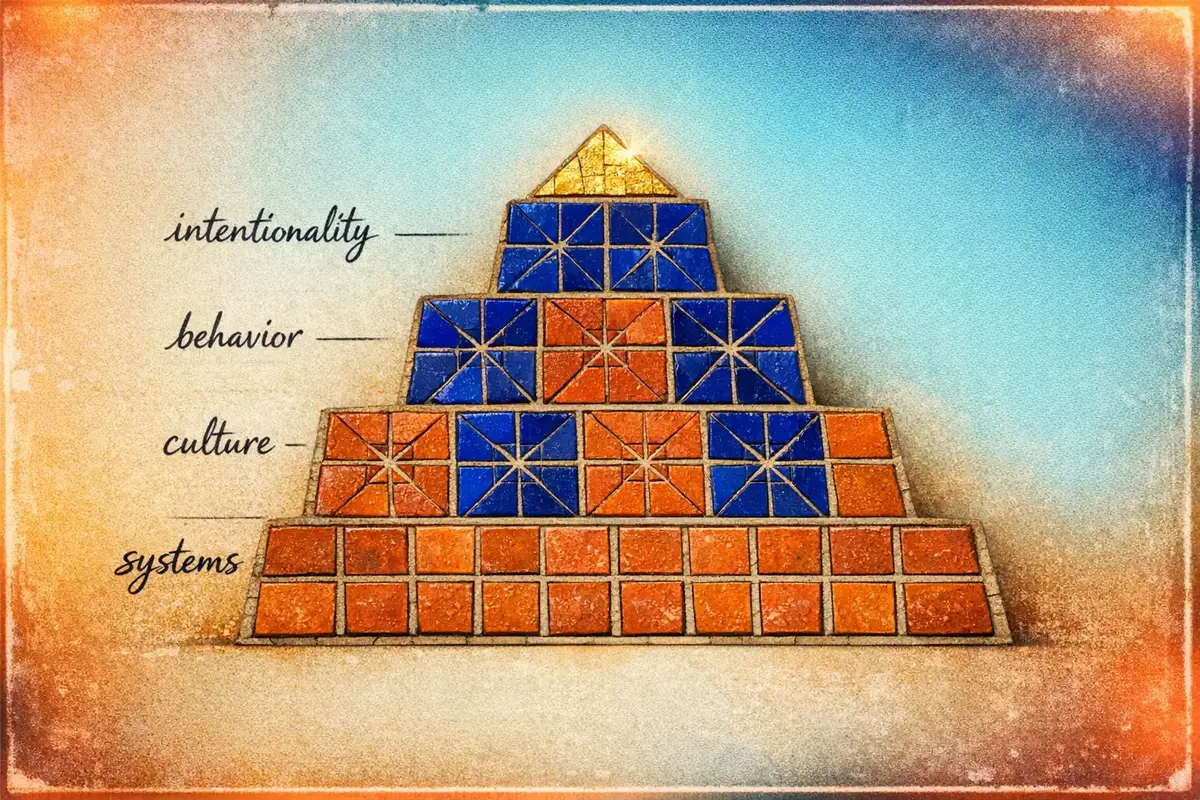
Integral Life describes the Four Quadrants as “four basic perspective-dimensions” covering the interior and exterior of the individual and collective (Integral Life, 2020). In practice, that means one development challenge can be viewed through four different questions: What is happening inside the person? What are they doing behaviorally? What shared assumptions shape the team around them? What structures, incentives, or workflows keep the pattern in place?
The framework covers the interior and exterior of both the individual and the collective (Integral Life, 2020).
That is not abstract theory. It is a practical guardrail against lazy coaching. If you only look at behavior, you prescribe tactics. If you only look at mindset, you miss operational reality. If you only look at culture, you can overlook personal agency. The value of integral coaching is that it prevents the coach from mistaking the most visible symptom for the real developmental bottleneck.
Why personalization starts with the right lens
This is where AI Coach System becomes useful. It does not treat personalization as a nicer tone or a customized action list. It uses the Four Quadrants to match the coaching lens to the source of the challenge—inner experience, outer behavior, culture, or system—so the intervention fits the problem instead of circling around it.
That distinction matters. A leader who looks inconsistent may actually be navigating a culture that punishes risk. A team member who appears disengaged may be following incentives exactly as designed. The wrong lens creates false conclusions; the right lens creates movement.
And once you accept that a stalled change effort may be personal, relational, cultural, or structural, one question becomes unavoidable: which quadrant is actually driving the problem—and how would you know?
What are the four quadrants, and why do they change the coaching question?
The Four Quadrants model matters here because it forces a harder question: when a coaching issue shows up, what exactly are you looking at? Why do so many coaching conversations stay vague until someone names the difference between inner life, behavior, culture, and systems?
Most leaders assume the problem is obvious because the symptom is visible. Someone avoids conflict. A team misses deadlines. A function feels political. But visible does not mean well-defined. Integral Life’s core point is simple: development can be viewed through the interior and exterior of the individual and collective (Integral Life, 2020).
Four clean lenses, not one blurred diagnosis
Start with the inner individual quadrant. This is the person’s private experience: beliefs, fears, motives, meaning-making. A coach working here asks, What is this person telling themselves? What feels risky? What do they think success or failure means? That matters because anxiety and avoidance can produce the same outward behavior as indifference.
Then the outer individual quadrant. This is what can be seen and described: actions, habits, communication patterns, follow-through. The question changes from interpretation to observation: What did they actually do in the meeting? What behavior repeats under pressure? That distinction is basic and often missed. Coaches regularly confuse what a person feels with what they do.
Culture is not the same as structure
The collective side is where many assessments get sloppy. The inner collective quadrant is shared culture — norms, trust, unwritten rules, what people sense but rarely say aloud. In a regional healthcare provider during a team restructure, a VP may look hesitant in executive meetings. The easy read is lack of confidence. The better read may be cultural: dissent is remembered, and caution has become the group’s survival code.
The outer collective quadrant is different. It covers systems, roles, incentives, reporting lines, workflows, and decision rights. Here the coaching question becomes operational: What in the structure rewards this pattern? Where does the process block the desired behavior? Culture says, “People like us do not challenge.” Structure says, “This approval chain makes challenge expensive.”
The Four Quadrants represent “four basic perspective-dimensions” of the interior and exterior of both the individual and the collective (Integral Life, 2020).
Better questions produce better coaching
That is why the model changes coaching. Not because it classifies reality neatly, but because it sharpens assessment. Is the issue fear, skill, team norm, or system design? Personal reluctance — or organizational logic?
Get that wrong, and coaching becomes elegant guesswork. Get it right, and an uncomfortable truth appears: sometimes the person is not the main obstacle at all.
Why capable people still stall when the environment is part of the problem
The Four Quadrants framework matters most when a committed client keeps trying and still does not move. Without it, coaching often collapses into a flattering but incomplete story: they need a better mindset.
Consider a team lead in a regional manufacturing company during a budget cycle. She is respected, technically strong, and fully bought into her development goals. Yet she keeps leaving cross-functional meetings with clear intentions and then fails to follow through on the hard conversations she said she would have. A narrow diagnosis turns this into a confidence issue. A wider one asks harder questions: does she avoid conflict, or does the workflow make ownership ambiguous, the team norm punish direct challenge, and the approval chain reward delay?
That is where quadrant thinking earns its keep. It stops the coach from over-reading the individual and under-reading the setting.
When motivation meets a system built for the old pattern
A capable person can be highly motivated and still be trapped in a loop. Not because motivation is weak, but because the surrounding environment keeps paying out for the old behavior.
If the culture quietly teaches that raising risk is career-limiting, candor will look like a personal trait rather than a collective problem. If the process requires three layers of sign-off before action, hesitation will look psychological when it is partly structural. If the person lacks a repeatable behavior under pressure, the issue may be skill, not belief. These are different problems. They should not get the same coaching response.

Integral Coaching Canada makes this point in a more disciplined way: using the quadrants as a Looking AT lens helps ensure balanced development across all four quadrants (Integral Coaching Canada, 2026).
Using the four quadrants in this way ensures balanced development is achieved in all four quadrants (Integral Coaching Canada, 2026).
Better diagnosis, less blame
This is not about excusing poor performance. It is about locating the real source of friction before prescribing effort.
Integral Coaching Canada also notes that the four-quadrants model can function as a type-structure lens, giving a deeper view into a client’s perceptual maps (Integral Coaching Canada, 2026). In practice, that means the coach can distinguish between what the client believes, what they actually do, what the team normalizes, and what the system reinforces. That distinction changes the intervention. Sometimes the answer is practice. Sometimes it is renegotiating norms. Sometimes it is redesigning the work.
And that creates the next problem. If several quadrants are involved at once—as they usually are—which one should the coaching process treat as the real bottleneck?
How does AI Coach System turn the quadrants into a personalized growth plan?
The Four Quadrants framework matters here because it answers a harder operational question: how does a coaching platform move from a broad assessment to a plan that actually fits the client’s lived reality? If the model already shows that development problems can sit in four different places, why do so many plans still end up as one generic list of goals? And if the diagnosis is broad, what turns it into action without flattening the person into a type?
The answer is not “more personalization” as a slogan. It is a tighter sequence: assess across four lenses, identify the weak or missing lens in the current plan, then build practices that match that bottleneck.
From quadrant scan to real diagnosis
This is where AI Coach System becomes more than a digital prompt engine. It can use a quadrant-based assessment to test whether the current coaching development plan is overbuilt in one area and underbuilt in another. Many plans are. They are rich in goals and thin in diagnosis.
Integral Coaching Canada notes that the four-quadrants model is advanced as a type structure lens that enables a deeper understanding of clients’ perceptual maps (Integral Coaching Canada, 2026). That matters because two clients can present the same issue and need very different plans. One may need inner work to reinterpret authority. Another may need observable practice in conflict. A third may be operating inside a team norm that makes directness costly.
Take a founder at a startup during a client escalation. The visible problem is inconsistent executive communication. A weak platform would prescribe “communicate more clearly.” AI Coach System can go further: is the founder’s main constraint stress interpretation, message discipline, team signaling, or a chaotic decision process that changes the message every 48 hours? The plan changes depending on the answer.
Using the four quadrants in this way ensures that balanced development is achieved in all four quadrants (Integral Coaching Canada, 2026).
Personalization is route, pace, and support
That is the practical difference. Personalization does not just change the goal; it changes the route to the goal.
If the bottleneck is inner-individual, the plan may emphasize reflection prompts, pattern recognition, and meaning-making work. If it is outer-individual, the system can shift toward rehearsal, behavioral commitments, and tighter feedback loops. If the issue sits in the collective quadrants, the plan may need stakeholder mapping, norm-setting conversations, or changes to meeting design and decision rights.
Pacing matters too. Some clients need short-cycle practice every week. Others need slower integration because the challenge is not skill acquisition but identity strain. Support matters in the same way — private reflection, manager visibility, team-level reinforcement, or structural changes around the role.
A plan that misses this will still look polished. It may even feel motivating for a week. But when change stalls, what are you really seeing — the wrong goal, or the wrong way of getting there?
What is the difference between Looking AT and Looking AS in coaching?
Looking AT and Looking AS matter because most organizations still coach as if one good assessment should produce one correct plan. The framework shows something more demanding: the coach has to ask not only what is happening across the quadrants, but also how this client naturally reads reality.
That gap is where many otherwise solid coaching efforts lose precision.
Looking AT: what is present, absent, or out of balance
Looking AT uses the quadrants as a diagnostic map. The coach examines the client’s situation across inner experience, observable behavior, shared norms, and system conditions, then asks a blunt question: what is underdeveloped, overused, or misaligned here?
Integral Coaching Canada is explicit on this point. Using the four quadrants in this way ensures balanced development across all four quadrants (Integral Coaching Canada, 2026).
Using the four quadrants in this way ensures that balanced development is achieved in all four quadrants (Integral Coaching Canada, 2026).
In practice, this keeps coaching honest. A retail VP in a regional chain, facing a market shift and margin pressure, may be described as “too cautious.” Looking AT slows that judgment down. Is the gap actually in decision behavior? In confidence under uncertainty? In a team culture that punishes failed bets? Or in reporting rules that make local experimentation hard? The same symptom can point to four different development needs.
Looking AS: how the client organizes experience
Looking AS changes the question. Instead of asking what is missing, it asks how the client tends to interpret events in the first place.
This is where the model becomes more than a checklist. Integral Coaching Canada notes that the four-quadrants model can be advanced as a type structure lens that enables a deeper understanding of clients’ perceptual maps (Integral Coaching Canada, 2026). That matters because two leaders can face the same tense board update and construct entirely different realities from it. One reads challenge as useful pressure. Another reads it as loss of standing. Their actions may look similar for a week. Their coaching needs are not.
Why both modes matter
Used together, Looking AT and Looking AS protect against a common coaching error: flattening a person into a single profile or a single intervention. One mode shows the field. The other shows the filter.
You need both. Otherwise the coach may diagnose the right quadrant and still miss the client’s native bias — or understand the client deeply and still ignore the real structural gap. And when change keeps stalling, which matters more in that moment: the person’s lens, or the quadrant where the blockage actually sits?
Which quadrant is the real bottleneck when change keeps stalling?
The Four Quadrants framework matters most when stalled change starts costing real money. Revenue slips because decisions drag, trust erodes because the same tensions keep resurfacing, and strong people leave because they are coached to “work on themselves” while the real blockage sits somewhere else.
How do you tell whether the obstacle is inside the person, visible in behavior, embedded in culture, or built into the system? Start with a simple rule: choose the quadrant that explains the most repeated friction with the fewest assumptions, then test the other three for context. Integral Life’s core contribution is exactly this discipline: development must be viewed through the interior and exterior of the individual and collective (Integral Life, 2020).
Start where the friction is most visible
In an enterprise finance function during annual planning, a VP keeps pushing for faster decisions, yet approvals still stall and rework keeps piling up. The lazy diagnosis is mindset: she must be conflict-averse, unclear, or too cautious. That may be true. It is also often wrong.
If the meetings end without explicit owners, that is outer behavior. If she privately interprets disagreement as loss of credibility, that is inner experience. If peers treat challenge as disloyalty, that is shared norms. If the approval chain requires four sign-offs before any commitment, that is a system constraint.
Those are not variations of one problem. They are different bottlenecks.
The model covers four basic perspective-dimensions: the interior and exterior of the individual and collective (Integral Life, 2020).
Stop turning every problem into psychology
This is the common coaching error. A repeated breakdown gets translated into a personal story because personal stories are easier to discuss than team habits or structural design.
A quadrant-based review interrupts that reflex. It asks, what evidence do we actually have? Not what feels plausible. Not what sounds developmental. What best explains the pattern with the least speculation?
That makes the first move practical for beginners. If missed deadlines track to vague commitments, start with behavior. If the same capable person freezes only with one stakeholder group, inspect meaning-making. If everyone goes silent in the same meetings, look at norms. If good intentions die in process, examine the system first.
The real bottleneck is the one that keeps reproducing the problem
The point is not to pick one quadrant forever. It is to find the current choke point fast enough to stop wasting effort.
Once you see that, another question gets sharper. If the bottleneck can move from person to team to structure over time, what kind of coaching model keeps the whole human picture visible—without collapsing back into a single lens?
Why the most useful coaching models make the whole person visible
The Four Quadrants matter here because most organizations still coach as if performance problems live inside the person. The evidence points somewhere more demanding: development sits at the intersection of the person, their behavior, the culture around them, and the system they work in (Integral Life, 2020).
That is the real shift.
What changes when coaching stops trying to fix the person and starts seeing the full system around the person? Usually, blame drops and accuracy rises.
One explanation is tidy. Real development is not.
In a regional services firm during a quarterly review, a department head is told she needs to be “more strategic.” It sounds plausible. It is also incomplete. If she is spending her week in reactive client work, if her team escalates every exception to her, if the culture rewards responsiveness over reflection, and if she privately equates delegation with loss of control, then “be more strategic” is not a coaching insight. It is a slogan.
This is why the quadrant model holds up. It resists the executive habit of reducing a repeated pattern to one cause.
Integral Life defines the model as four basic perspective-dimensions covering the interior and exterior of both the individual and the collective (Integral Life, 2020). That sounds conceptual until you use it in practice. Then it becomes a discipline: do not confuse a belief with a behavior, a team norm with a process, or a structural constraint with a motivation problem.
The Four Quadrants represent four basic perspective-dimensions of the interior and exterior of the individual and collective (Integral Life, 2020).
Whole-person coaching is more humane because it is more precise
The lasting value of a model like this is not complexity for its own sake. It is that people get coached in context.
Integral Coaching Canada makes the practical case clearly: using the quadrants as a Looking AT lens helps ensure balanced development across all four quadrants (Integral Coaching Canada, 2026). Balanced does not mean equal attention at all times. It means the coach does not overinvest in one explanation because it is familiar or easy to measure.
That is where integral coaching becomes useful to serious operators. It gives you a way to build a coaching development plan that matches reality instead of flattering assumptions.
Using the four quadrants in this way ensures that balanced development is achieved in all four quadrants (Integral Coaching Canada, 2026).
A useful coaching model should make the whole person visible — not just the part that is easiest to diagnose. If you are reviewing your own growth, or someone else’s, the honest next step is simple: are you trying to change the person, or are you finally seeing the full pattern they are living inside?
Key Takeaways
- The Four Quadrants model looks at inner and outer, individual and collective dimensions together.
- Better coaching starts with the right lens, not with a generic action list.
- Stalled change can come from behavior, mindset, culture, or system design.
- Looking AT and Looking AS help coaches diagnose both the field and the client’s interpretation of it.
Frequently Asked Questions
What are the Four Quadrants in coaching?
The Four Quadrants are a framework for viewing development through four lenses: the inner individual, outer individual, inner collective, and outer collective. They help coaches distinguish between a person’s internal experience, visible behavior, shared team culture, and the systems or structures shaping results.
Why do development plans fail when they focus on only one quadrant?
A one-angle plan can mistake symptoms for causes, such as treating a structural problem like a motivation problem or a culture problem like a skill gap. When the real bottleneck is missed, the person may work hard without making meaningful progress.
How does the Four Quadrants approach personalize coaching?
It personalizes coaching by matching the intervention to the actual source of the challenge. Depending on the bottleneck, the plan may emphasize reflection, behavior practice, team norm changes, or structural redesign.
What is the difference between Looking AT and Looking AS?
Looking AT is a diagnostic view that asks what is happening across the four quadrants and where the imbalance lies. Looking AS asks how the client naturally interprets reality, which helps the coach understand the person’s perceptual lens as well as the situation itself.
How do you identify the real bottleneck when change keeps stalling?
Start with the quadrant that best explains the most repeated friction with the fewest assumptions, then test the other quadrants for context. If the pattern is driven by behavior, mindset, culture, or system design, the coaching response should target that specific source rather than defaulting to generic advice.