
Why Structured Practice Beats Good Intentions in AI Coaching
Five minutes a day sounds too small to matter—so why do so many capable professionals still fail to sustain developmental practice? That is the wrong question, and it hides the real constraint. The issue is rarely awareness. It is whether an AI coaching experience can turn intention into a loop you can actually repeat under pressure.
A mid-market technology director knows this pattern well. She leaves a quarterly review convinced she needs better self-regulation, sharper thinking, and less reactive leadership. By Friday, client escalations, hiring decisions, and calendar spillover have pushed that insight to the margins. The cost is not abstract: development becomes episodic, behavior stays largely unchanged, and every new insight competes with operational noise. This article addresses that gap—how an AI coaching system makes Integral Life Practice usable by converting aspiration into structure.
That matters because Integral Life Practice is not inherently overwhelming. Integral Life frames it as something that can begin with as little as five minutes a day and organizes the work around four core modules: Body, Mind, Spirit, and Shadow (Integral Life). The barrier, then, is not entry.
It is continuity.
Motivation Starts the Process; Structure Carries It
Most coaching fails at the handoff between inspiration and execution. A user finishes a strong session with language for what matters, but not with a clear next action, a sequence for when to do it, or feedback on whether the practice is working. Good intentions decay fast when they depend on memory and willpower alone.
A useful AI coach does something more operational. It narrows the field, assigns one practice, defines the cadence, and creates a simple review loop. That is what makes developmental work feel manageable for beginners. Not because the ideas are simpler, but because the next move is obvious.
Integral Life Practice can start with as little as five minutes a day, across Body, Mind, Spirit, and Shadow—small enough to begin, but broad enough to become diffuse without guidance (Integral Life)
The Real Problem Is Sequencing, Not Ambition
Busy professionals usually do not need more developmental ambition. They need sequencing. Should they begin with a breathing practice to reduce reactivity, a reflection prompt to sharpen meaning-making, or a shadow exercise to catch recurring triggers? Without a system, they either do too much at once or default to what feels familiar.
That is where the AI coaching system becomes more than a convenience. Its value is not that it can suggest practices. Its value is that it can make practice repeatable—small enough to start, structured enough to continue, and responsive enough to evolve over time.
And that raises the harder question: if ILP begins with four domains, how should a beginner know where to start—and what to do next?
What Is Integral Life Practice, and Why Does It Need Structure?
Integral Life Practice matters here because it is not a single habit but a developmental framework. Without structure, that strength becomes the first thing that breaks: people see many valid options, choose none with confidence, and drift back to whatever already fits the calendar.
That is the beginner’s paradox. If ILP is so flexible, why do beginners still struggle to turn it into a routine they can actually follow?
A Framework, Not a Fixed Routine
Integral Life defines ILP through four core modules: Body, Mind, Spirit, and Shadow (Integral Life). That matters because it tells you what kind of architecture this is. Not a prescribed morning ritual. Not a branded sequence you must copy exactly. It is a modular system for developing different capacities that shape how you work, decide, relate, and recover (Integral Life).
In plain terms, Body covers energy, health, and physical regulation. Mind covers learning, perspective-taking, and cognitive range. Spirit points to attention, presence, and meaning. Shadow addresses the patterns you avoid, deny, or misread in yourself. Taken together, the model is broad enough to reflect real adult development, where performance problems are rarely just “mindset” or just “stress.”
That breadth is useful. It is also where friction starts.
ILP can begin with as little as five minutes a day, yet it still asks the user to choose among four developmental domains (Integral Life)
Why Flexibility Creates Decision Friction
Consider a VP at a regional healthcare provider during a team restructure. She knows she is more reactive in staffing conversations, sleeping worse, and carrying unresolved tension from a difficult board meeting. ILP gives her several legitimate entry points: a breathing practice for regulation, a journaling prompt for reflection, a reading practice for perspective, or shadow work around defensiveness.
All are reasonable. That is the problem.
For an experienced practitioner, flexibility feels liberating. For a beginner, it often feels like low-grade ambiguity. Which domain is primary? What should happen daily versus weekly? When do you stay with one module, and when do you rotate? A framework that can fit almost any life can also ask for more judgment than a new user actually has.
What Structure Adds
This is where a coaching interface earns its keep. It does not replace ILP’s philosophy; it operationalizes it. It turns a broad map into a sequence: start here, do this for five minutes, notice this signal, reflect on this question, then decide whether to continue or adjust.
That translation matters more than inspiration. The real issue is not whether ILP is comprehensive enough. It is whether someone under pressure can tell which practice to do today—and why that choice is better than the other three.
How Does an AI Coach Choose the Right Practice for a User?
Why do so many people abandon developmental routines even when they genuinely want to improve? The usual assumption is that they lack discipline. In practice, the failure often starts earlier: they are asked to choose from too many valid practices, in too many domains, with too little guidance about what fits their situation now.
That is where an AI coach has to do real work. Not by offering a larger library. By reducing choice.
Selection Is a Coaching Function, Not a Search Problem
A good system does not make the user browse endlessly through breathing exercises, reflection prompts, reading practices, and shadow inquiries. It interprets need. If a retail founder is heading into a tense budget cycle and reports short sleep, scattered attention, and sharp reactions in meetings, the right opening move is probably not a demanding insight exercise. It is a stabilizing practice that lowers noise first.
This is the practical logic behind practice matching. The coach looks at three things: the user’s stated goal, the time they can realistically protect, and the pattern of what they have actually followed through on. Those signals matter more than abstract preference. Someone asking for “better leadership presence” may need a body-based reset before they need a mindset prompt.
Sequencing Prevents Early Overload
This is why sequencing matters so much. If the first recommendation is too intense, too personal, or too cognitively heavy, users do what busy professionals always do: they postpone it, then quietly drop it.
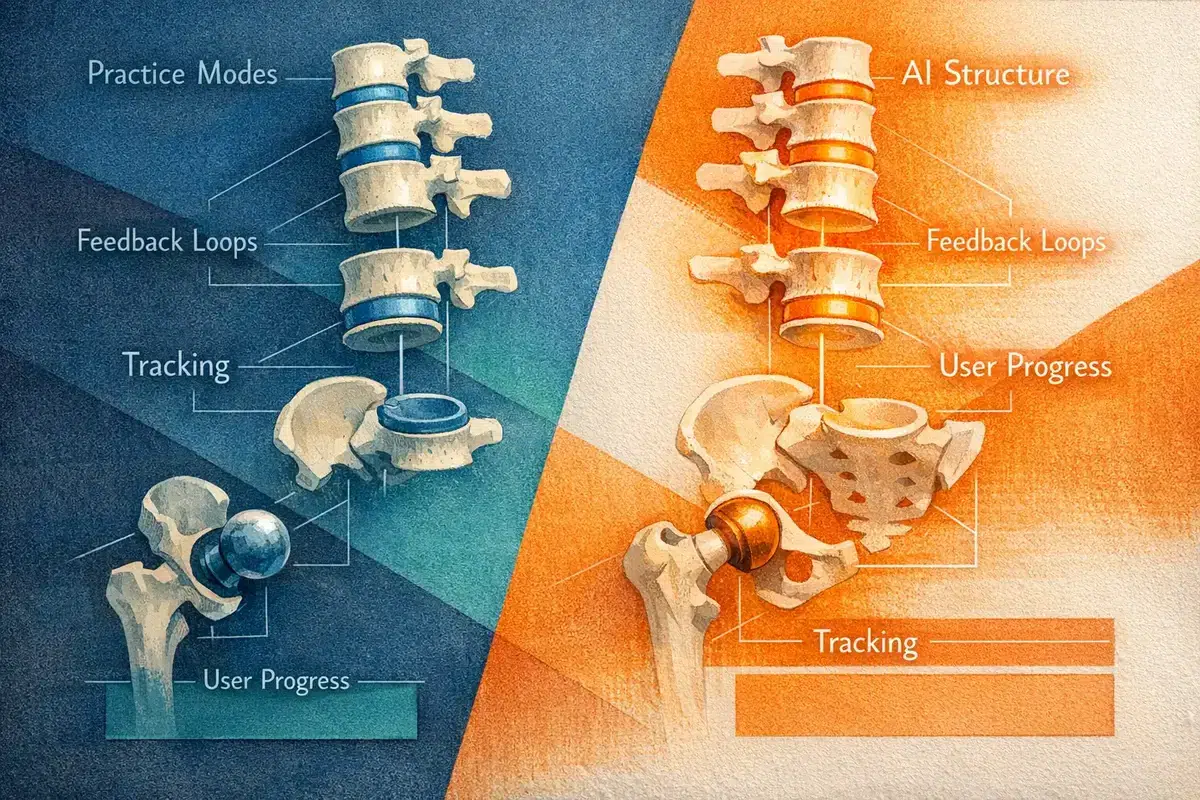
A capable AI coach avoids that trap by starting with one practice per module, not a full lifestyle redesign. One body practice. One mind practice. One spirit practice. One shadow practice. Then it adjusts the mix over time based on friction signals: skipped sessions, rushed check-ins, repeated resistance, or the opposite — easy completion with little stretch.
The point is not to keep things simple forever. It is to introduce complexity in the right order. That is the difference between developmental traction and self-imposed overload. Done well, practice sequencing becomes a form of risk management for growth.
The Best Recommendation Is the One a User Will Actually Repeat
This makes the recommendation engine less like a content feed and more like a skilled coach making a judgment call. If time shrinks, the practice gets lighter. If engagement is strong, the challenge can deepen. If a user keeps avoiding one module, the system does not just insist harder; it changes the entry point.
That sounds obvious. It is not common.
Most people do not need more developmental options. They need a better next step — clear enough to do, calibrated enough to sustain. And once that matching starts working, a harder question appears: how do you know whether the practice is producing real progress, or just the feeling of being busy?
What Do the Numbers Say About Skills, Engagement, and the Need for Practice?
$10 trillion in lost productivity is the price of low engagement globally — roughly 9% of GDP gone before most leaders even get to the agenda item called “development” (Gallup, 2026). That cost does not stay on a spreadsheet; it shows up as slower decisions, thinner trust, missed handoffs, and good people leaving when work starts to feel draining rather than developmental.
This is the backdrop for any serious conversation about practice. If skills are changing this fast and engagement is this low, what kind of development system can actually keep up?
The pace of change has already outrun occasional learning
The old model assumed people could update themselves in bursts: a workshop here, a coaching conversation there, a few insights captured after a difficult quarter. That model is now too slow. The World Economic Forum estimates that 39% of workers’ core skills will change by 2030 (World Economic Forum, 2025). Not peripheral skills. Core skills.
39% of workers’ core skills are expected to change by 2030 (World Economic Forum, 2025)
For a regional manufacturing VP heading into a market shift, that number is not abstract. It means the judgment patterns that made her effective five years ago may now be incomplete: how she reads ambiguity, how she regulates under pressure, how quickly she learns across functions. Skill disruption at that level cannot be handled by information alone. It requires repeatable practice — something that changes behavior under live conditions, not just understanding in hindsight.
That is why structured self-development matters more now, not less. When the environment moves faster, reflection has to become operational.
Engagement is a performance variable, not a culture slogan
Gallup reports that global employee engagement fell to 20% in 2025 (Gallup, 2026). One in five engaged. The rest are not necessarily hostile or checked out in obvious ways; many are simply doing work without energy, ownership, or developmental momentum.
Global employee engagement fell to 20% in 2025 (Gallup, 2026)
Leaders often treat this as a communications problem. It is usually a practice problem. If people are asked to adapt constantly but are given no reliable way to build attention, resilience, perspective-taking, or self-management, disengagement is a predictable outcome. You cannot demand agility from nervous systems and habits that have never been trained for it.
Skills-based organizations point to the right design logic
The strongest data here is not just about decline. It is about what works. Deloitte finds that organizations with a skills-based approach are 63% more likely to achieve results and 57% more likely to be agile (Deloitte, 2025).
That should change how we think about coaching. The case is not for more content. It is for a system that helps people build skills continuously, in small units, close to the work itself. A practice only matters if it survives contact with the calendar.
And that creates the next challenge. If development has to be ongoing rather than occasional, how do you track progress without turning the whole thing into another administrative burden — useful, or just one more task?
How Do You Track Progress Without Turning Practice Into Homework?
50% of the workforce has now completed training as part of long-term learning strategies, up from 41% in 2023 (World Economic Forum, 2025). That should be encouraging, but it creates a harder question for busy professionals: if more people are entering development systems, what keeps practice from becoming just another box to tick?
The answer is not more tracking. It is better tracking.
Measure contact, not compliance
Take a finance director at a regional bank during budget season. She starts well: a short morning reset, one end-of-day reflection, a weekly shadow prompt. For ten days, the rhythm holds. Then forecasts slip, meetings stack up, and she misses two sessions. By week three, the risk is not failure. It is the familiar executive move of quietly abandoning the routine because “I’m behind.”
That is where practice tracking needs a different logic. If the system only records completion, every missed session reads like a small breach. If it tracks engagement with the practice — how often she returned, where resistance showed up, which exercises felt restorative versus draining — it produces something more useful than a streak. It shows the shape of her development in real conditions.

Feedback loops should surface patterns early
This is the real job of feedback loops. Not judgment. Pattern recognition.
A good AI coach can show four signals quickly: consistency, avoidance, plateau, and overreach. Consistency means the practice fits. Avoidance means the entry point may be too exposed or poorly timed. Plateau suggests the exercise has become familiar enough to stop stretching the user. Overreach shows up when ambition outruns capacity — too many modules, too much depth, too little recovery.
That kind of feedback makes developmental consistency easier because it turns vague guilt into a visible adjustment. Research from the World Economic Forum shows that 50% of the workforce has completed training through learning and development initiatives (World Economic Forum, 2025). The implication is straightforward: access to development is expanding, but access alone does not tell you whether people are integrating the work.
Recovery matters more than perfect adherence
The best systems recover missed sessions gracefully. They prompt a shorter version, reduce cadence for a week, or ask one reflective question instead of demanding a full restart. That is how an AI coach supports practice tracking without making it punitive.
Because once tracking becomes homework, users protect themselves by doing less. The real design question is sharper than that: what is the smallest version of ILP a busy professional can sustain when the calendar turns hostile — and still grow?
What Is the Minimum Viable ILP for a Busy Professional?
Minimum Viable ILP matters because busy professionals do not fail on philosophy; they fail on design. At 7:40 a.m., a services-firm C-suite leader is clearing overnight messages before a board prep call and knows exactly what happens next: any practice that asks for 20 minutes, multiple steps, or emotional heavy lifting will be skipped.
That is the threshold to respect. Integral Life says an ILP can begin with as little as five minutes a day, which is precisely why the minimum viable version should be judged by survivability, not aspiration (Integral Life). And the broader leadership market is moving the same way: 55% of organizations prioritized scalability in leadership development programs, a sign that development now has to work under real operating conditions, not ideal ones (Harvard Business Publishing, 2025).
The smallest practice that still counts
So how small is too small?
A minimum viable ILP is one that is narrow enough to survive a hostile calendar but broad enough to shape more than one developmental dimension. In practice, that usually means one primary exercise with one secondary effect. A two-minute breathing reset before a difficult meeting is not just Body work; done consistently, it also changes attention and choice under pressure. A short evening reflection is not just Mind work; it can expose recurring defensiveness and begin to touch Shadow.
That is the key distinction. Minimal does not mean trivial. It means strategically compressed.
An ILP can start with as little as five minutes a day (Integral Life)
A practical starting formula
The best starting point is simpler than most people expect: one practice, one cadence, one checkpoint.
One practice means no menu. One cadence means a clear trigger — after coffee, before the first meeting, at shutdown. One checkpoint means a brief weekly question: Did this make me more steady, more aware, or more honest this week? That is enough to tell whether the practice is alive or merely performed.
This is where an AI coaching system earns its place. Not by adding sophistication early, but by removing friction: shortening the practice on overloaded days, prompting a restart after two missed sessions, and holding the scope steady until readiness is visible.
Practical implications and examples
For the busy professional, the minimum viable ILP is not a compromise; it is a design principle. Consider a senior manager who commits to a three-minute body scan each morning. Over a month, this micro-practice not only grounds the manager physically but also increases emotional awareness before high-stakes conversations. Or a product lead who uses a single daily prompt—“What did I avoid today?”—to surface blind spots. These micro-practices are not placeholders; they are leverage points. They create a feedback loop: small, consistent actions reveal patterns, and those patterns become the raw material for deeper work later.
The practical implication is that the ILP survives because it is frictionless and relevant. It fits into the margin between meetings or the pause before sleep. It is not another item on the to-do list; it is the smallest possible intervention that still moves the needle.
Scale only after evidence
Most people expand too early. They add journaling, meditation, reading, and inquiry in the same week, then confuse ambition with traction.
A better AI coaching system scales only when the basics are stable — when the user is returning without drama, reflecting without resistance, and showing signs that the current practice is no longer enough. That restraint matters. Because the real risk is not starting too small; it is building a routine that collapses on first contact with pressure.
And when practice does hold, a harder question appears: is the value in the exercise itself — or in the fact that development has finally become sustainable?
Why the Real Value of AI Coaching Is Sustained Development, Not Instant Transformation
Lost revenue is rarely blamed on abandoned developmental practice, but the connection is real. Trust erodes, good people leave, and avoidable mistakes multiply when leaders keep reacting from the same unexamined patterns.
If transformation is rarely instant, what kind of coaching actually helps people keep going long enough to change?
The loop is the value
Consider an enterprise technology VP in the middle of a client escalation. She does not need a dramatic breakthrough on Tuesday morning. She needs enough steadiness to choose a better response than the one that damaged the last conversation.
That is why structured practice works. Not because each exercise is profound on its own, but because it creates a repeatable loop: selection, repetition, feedback, and adjustment. One practice is chosen for the moment. It is repeated under real conditions. The user sees what happened. Then the practice is refined instead of abandoned.
This is the part many people miss. Development becomes credible when it survives interruption.
AI matters when it reduces friction
The useful role of AI coaching is not to simulate instant wisdom. It is to lower the effort required to stay connected to the work. A good system notices when the practice has become too ambitious, too vague, or too easy. It shortens the session, changes the prompt, or brings the user back to a simpler entry point.
That is not magical. It is operational.
Research consistently shows that sustained learning depends less on intensity than on continuity. In that sense, AI is most valuable when it behaves less like a guru and more like a disciplined guide — keeping the practice alive long enough for small gains to compound.
Return beats perfection
Busy professionals do not need another standard they can fail. They need a way to return without drama after a missed week, a rough quarter, or a hard conversation that exposed old habits again.
That is the real promise here. Not instant transformation, but durable adaptation.
So the honest next step is simple: what is the one practice you could return to this week — not perfectly, just consistently — and what would change if you stayed with it long enough to let it work?
Key Takeaways
- Structured practice beats good intentions because it turns aspiration into a repeatable loop.
- Integral Life Practice is broad and flexible, but that flexibility creates decision friction without structure.
- AI coaching adds value by matching, sequencing, and tracking practices in ways busy professionals can sustain.
- The goal is not instant transformation; it is durable, ongoing development that survives real work conditions.
Frequently Asked Questions
What is Integral Life Practice?
Integral Life Practice is a modular developmental framework built around four domains: Body, Mind, Spirit, and Shadow. It is designed to support growth in physical regulation, cognition, presence, meaning, and self-awareness rather than prescribing one fixed routine.
Why does Integral Life Practice need structure to work well?
Its flexibility is also its main challenge, because beginners can face too many valid choices and struggle to decide what to do first. Structure helps by narrowing the next step, setting a cadence, and making practice repeatable under real-world pressure.
How does an AI coach choose the right practice for a user?
An AI coach matches the practice to the user’s goal, available time, and follow-through patterns instead of offering a large menu of options. It often starts with the least overwhelming entry point and adjusts the recommendation as the user’s engagement and capacity change.
What is the minimum viable version of Integral Life Practice for a busy professional?
The minimum viable version is one small practice that can survive a busy calendar, such as a few minutes of breathing, reflection, or a short inquiry prompt. The key is to keep one practice, one cadence, and one simple checkpoint so the routine stays sustainable.
How should progress in developmental practice be tracked without making it feel like homework?
Progress should be tracked by engagement and patterns, not just completion counts. Useful feedback looks for consistency, avoidance, plateau, and overreach, then helps the user recover gracefully after missed sessions instead of treating them as failure.