
Why AI Coaching Needs More Than Good Intentions
94% of organizations already have generative AI in development, testing, or use. If AI coaching is entering live workflows at that speed, ethics is no longer a design aspiration; it is an operating requirement (Deloitte, 2024).
Picture a regional services firm in the middle of a quarterly review. A department director asks an AI coach to help prepare for a difficult performance conversation, and the system responds with language that sounds polished, calm, even supportive. That is exactly the risk. In coaching, a response can be fluent and still miss the human reality it is acting on.
The cost shows up fast when these systems move from experimentation to judgment-adjacent work. Deloitte reports that 87% said their organizations were increasing use of generative AI (Deloitte, 2024), while public sentiment is moving in the opposite direction: 52% of Americans said they feel more concerned than excited about AI, and the same share said they feel nervous about AI products and services (Stanford HAI, 2024).
87% said their organizations were increasing use of generative AI, while 52% of Americans said they feel more concerned than excited about AI (Deloitte, 2024; Stanford HAI, 2024)
That gap matters because coaching touches interpretation, power, identity, and timing. When an AI coach misreads whether someone needs challenge, reassurance, referral, or silence, the failure is not merely technical. It can damage trust, distort manager behavior, and normalize advice that sounds responsible without being context-aware. This article addresses that problem by arguing that AI coaching needs a wider ethical lens before it needs more conversational polish.
A Better Question Than “Can AI Coach?”
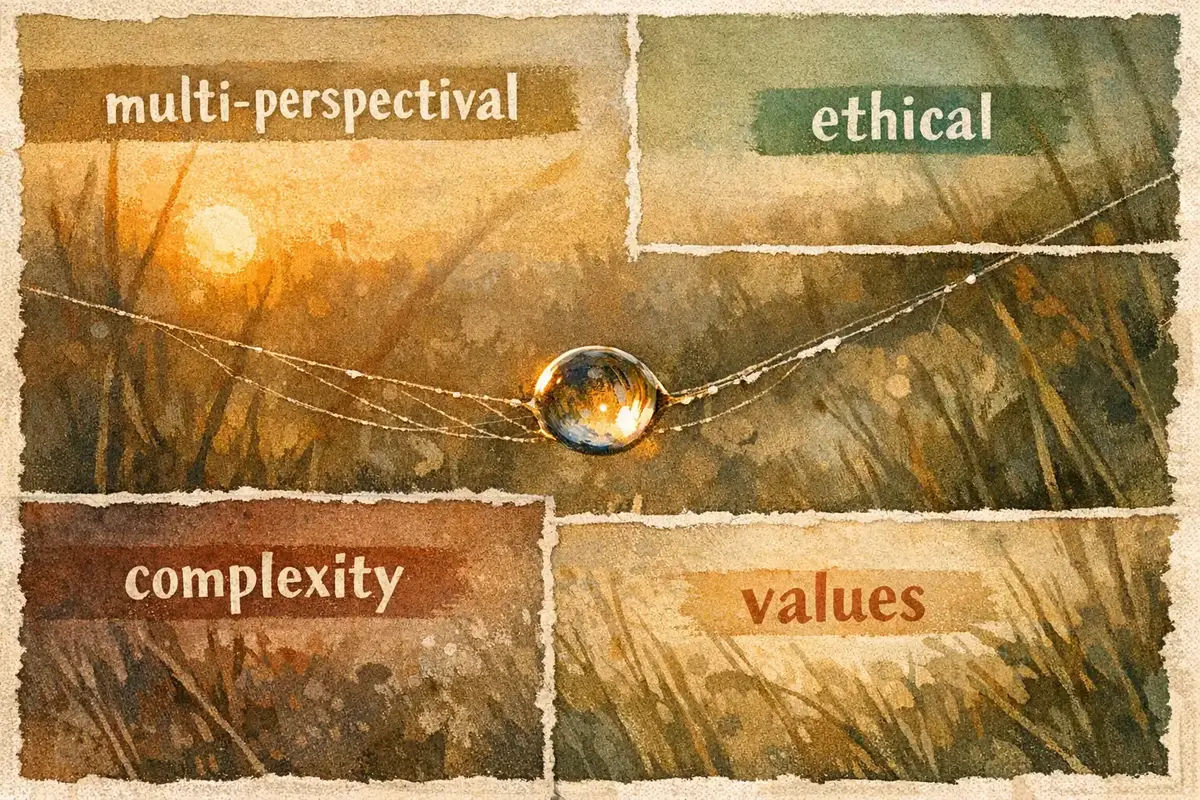
The useful question is not whether AI can coach at all. In narrow cases, it clearly can: reflection prompts, habit tracking, meeting preparation, and structured follow-up are already practical uses. The harder question is whether it can coach with enough perspective coverage to remain trustworthy when the situation becomes emotionally loaded, politically sensitive, or culturally ambiguous.
That is where integral metatheory becomes useful. Not as abstract philosophy, and not as branding for “holistic” thinking, but as a disciplined way to see more of the situation before the system responds. It asks whether the coach is reading only the individual’s words, or also the inner experience behind them, the observable behavior, the team norms, and the wider system shaping the exchange.
This is the missing layer in much of today’s conversation about ethical AI coaching. Good intentions matter. Guardrails matter. Transparency matters. But if the model cannot distinguish between a motivation problem, a meaning problem, a capability problem, and a system problem, it will adapt in the wrong direction.
Trust Depends on What the System Can See
Trust in coaching does not come from smooth language. It comes from fit. The response has to match the depth, context, and stakes of the moment.
So the real test is sharper than most teams admit: is the AI coach simply responsive, or is it responsively well-framed? That distinction will decide whether AI coaching becomes a credible layer of organizational support—or a faster way to scale partial understanding.
What Makes Integral Metatheory Different From ‘Holistic’ Thinking?
Integral metatheory matters here because it gives AI coaching a structured way to take in more than one kind of truth at once. Without that structure, “holistic” usually collapses into a softer tone, broader empathy, and the same narrow read of the situation.
That is the first distinction to get right. Generic holism says, in effect, consider the whole person. Useful instinct. Weak method. Integral metatheory asks a harder question: which part of the whole are you looking at, and which parts are you missing? As Integral Life argues, every view comes from somewhere; no single perspective captures the full event on its own (Integral Life, 2022). For an AI coach, that changes behavior. It is no longer enough to sound balanced. The system has to organize perspective-taking before it offers advice.
Take a mid-market healthcare provider during a team restructure. A VP asks an AI coach how to handle a manager who has become “resistant.” A vague holistic system may respond with emotional validation and a few communication tips. An integral lens forces a more disciplined scan: is this an inner stress reaction, an observable skill gap, a team-culture issue, or a structural response to workload and reporting changes? Same prompt. Different map. Better odds of a useful answer.
Translating the Model Into Coaching Language
The jargon can make the model seem more abstract than it is. In practice, the pieces are straightforward.
Quadrants mean four basic views of a situation: what the person feels, what the person does, what the group shares, and what the system rewards or punishes. Levels ask about current developmental complexity — not whether someone is “good” or “bad,” but whether they can handle ambiguity, conflict, and competing priorities with enough range. Lines refer to uneven growth: a leader can be strong in strategic thinking and weak in emotional regulation. States are temporary conditions such as fatigue, threat, confidence, or reflection. Types point to recurring style differences that shape how people interpret the same event.
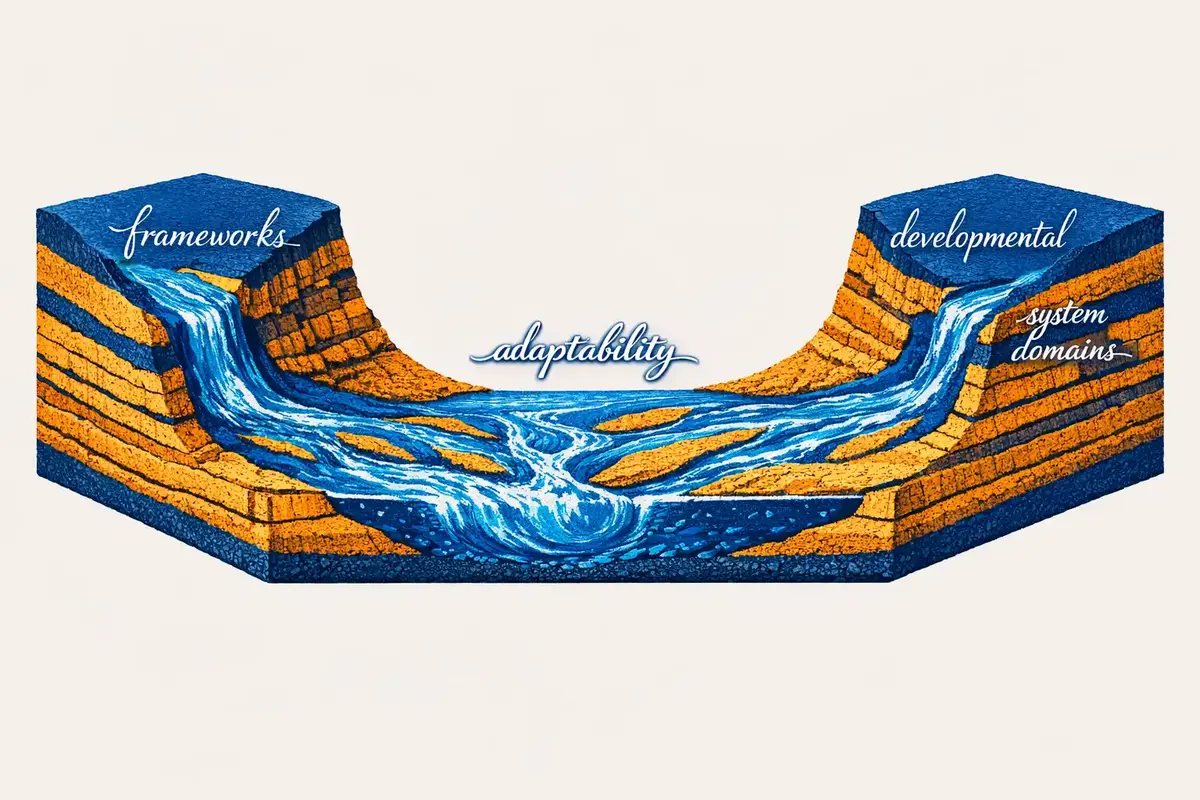
Research on coaching and human development consistently shows that change efforts work better when they account for both internal meaning-making and external conditions, rather than treating behavior as a standalone problem (PMC, 2022). That is why this framework is so relevant to AI coaching adaptability: it helps the system sort what kind of problem this is before it tries to solve it.
A Lens, Not a Rulebook
This is where many teams get confused. Integral ethics is not a list of fixed moral commands that tells an AI coach what to say in every case. It is a way of seeing more of the ethical terrain before acting — including whose interests are in play, what context is shaping the exchange, and what a partial intervention might distort (Integral Life, 2023).
That makes the framework more demanding than generic holism, not less. If an AI coach can see multiple dimensions, it also has to decide which dimension matters most in the moment — and when a coaching response becomes the wrong response altogether. When the system notices behavior, culture, capacity, and state at once, what should it adapt to first — and when should it stop and defer?
How Do Quadrants, Levels, and States Change an AI Coach’s Response?
Quadrants, levels, and states matter here because they expose a hard truth: many AI coaching systems sound adaptive while responding to only one slice of the person. If the language feels tailored, is that real adaptation—or just better phrasing? And when a system mirrors tone well, how often is it still missing the actual source of difficulty?
That gap is where weak coaching hides. Surface personalization adjusts wording. Developmental adaptation changes the intervention.
Quadrants Change What the System Thinks It Is Solving
Imagine a venture-backed technology startup during a product delay. A founder asks an AI coach how to handle a team lead who has become “unreliable” ahead of a board update. A shallow system may infer a motivation issue and suggest clearer expectations, tighter follow-up, and firmer accountability language.
A quadrant-aware system has to slow down. It asks, in effect, four different questions at once: what is happening in the leader’s inner experience, what is visible in behavior, what is happening in relationships and shared norms, and what in the system is driving the pattern. The answer may be very different. The team lead may be anxious and overloaded, visibly missing deadlines, working in a culture that rewards heroic overcommitment, inside a planning system that keeps changing priorities.
That is not semantic nuance. It is problem definition. Integral Life’s metatheory work makes this point clearly: every perspective is partial, and action improves when the frame widens before the recommendation lands (Integral Life, 2022). The Journal of Integral Theory and Practice has long treated these perspectives not as abstractions, but as distinct domains that shape how development and intervention should be read in practice (Journal of Integral Theory and Practice).
Levels and States Change Pace, Depth, and Timing
Levels matter because not every client can use the same degree of complexity at the same moment. One manager can work productively with paradox: “Your peer is both protecting her team and blocking cross-functional progress.” Another hears that and experiences only confusion or threat. The AI coach should not flatten the insight; it should right-size it.
Research on coaching and development shows that outcomes improve when interventions are matched to the person’s readiness, reflection capacity, and context rather than delivered as generic best practice (PMC, 2022). In practical terms, that means less interpretation-heavy prompting for someone who needs concrete sequencing, and more perspective-taking for someone able to work with competing truths.
States are different. They are temporary. Fatigue, defensiveness, grief, deadline pressure, and cognitive overload can all reduce what a person can productively hear today, even if they can handle more on a better day. So the ethical adjustment is not just softer wording. It may mean shorter questions, slower pacing, fewer options, or no challenge at all.
This is why adaptability in AI coaching is often misunderstood. It is not mainly about changing tone. It is about changing depth, pace, and intervention style based on what the system can responsibly infer—including signals that may later require cultural nuance in coaching, not just individual tailoring.
And once an AI coach starts adapting this way, a harder question appears: how do you know when adaptation is wise—versus when the system should stop, defer, or escalate?
What Do the Numbers Say About AI, Trust, and Coaching Ethics?
109,200 coach practitioners worldwide means AI coaching is not entering a niche; it is entering a live profession where weak design can erode trust, push clients away, and distort how thousands of practitioners work (International Coaching Federation, 2023).
That scale changes the ethics conversation. If a regional retail chain rolls out an AI coach to support store managers during budget season and the system repeatedly gives overconfident advice on conflict, feedback, or burnout, the cost is not abstract. Time gets wasted. Managers make poorer calls. Good people leave because a tool meant to support judgment starts substituting for it.
Scale Removes the Excuse for “We’ll Fix It Later”
The coaching field itself is expanding fast. The International Coaching Federation reports 54% growth since 2019, alongside those 109,200 practitioners worldwide (International Coaching Federation, 2023). That matters because even modest shifts in AI coaching behavior now have system-level effects: what gets normalized in prompts, what kinds of reflection are rewarded, and where human coaches are asked to step in only after trust has already been damaged.
54% growth since 2019 in the coaching profession means AI design choices will shape a larger practice ecosystem, not just isolated pilot programs (International Coaching Federation, 2023)
This is why AI coaching ethics cannot be treated as a compliance layer added after product-market fit. In coaching, the product is the interaction. If the interaction teaches bad habits — premature certainty, false reassurance, context-blind advice — the ethical failure is already embedded in use.

The Broader AI Market Is Already Past the Experiment Stage
The urgency is not limited to coaching. The World Economic Forum found that 54% of social innovators are already using AI to enhance core products or services, and nearly 30% are using AI to develop entirely new solutions (World Economic Forum, 2024). This is a useful signal for coaching leaders: AI is no longer being tested only at the edges. It is being built into the core offer.
Just as important, that roadmap was informed by 300 social innovation case studies and expert interviews (World Economic Forum, 2024). In other words, the governance question is not speculative. Research and practice are already converging on the same point: when AI starts shaping human outcomes, ethical framing has to sit upstream of deployment.
Trust follows from that sequence. Not branding first, safeguards later. Design first, trust earned after. That is the real implication behind today’s concern about ethical AI coaching: once a system is adaptive enough to influence judgment, who decides when it should adapt — and when it should stop?
How Should AI Decide When to Adapt, Defer, or Escalate?
The adapt-defer-escalate model matters because it turns ethics into an operating decision, not a vague aspiration. Without it, an AI coach keeps answering questions that are technically within scope but ethically beyond its depth.
That is where integral metatheory becomes useful as governance, not just interpretation. Its practical value is simple: it helps the system detect when it is seeing only part of the situation. If the prompt contains emotional strain, power asymmetry, identity risk, or unclear cultural meaning, the right move may not be a better answer. It may be a different route altogether.
When “Helpful” Becomes Unsafe
Consider a global manufacturing enterprise during a plant consolidation. A regional VP asks an AI coach how to handle a supervisor who has become “difficult” after role changes and team transfers. The system can easily generate a response on accountability, communication, and expectations.
But that is not the real test. The real test is whether the system can recognize that the case may involve grief, status loss, local labor norms, and fear about job security — all at once. In that moment, adaptation alone is too narrow. The AI should have explicit rules to defer when context is incomplete and escalate when vulnerability or cultural sensitivity raises the cost of getting it wrong.
The International Coaching Federation makes this operational point in its AI guidance: standards are not only about capability, but about boundaries, transparency, and the conditions under which human involvement is required (International Coaching Federation, 2024). A recent coaching study published by Taylor & Francis reaches a compatible conclusion from another angle: effective AI-supported coaching depends on role clarity, relational judgment, and careful handling of complexity rather than assuming automation can absorb the full coaching task (Taylor & Francis, 2024).
The strongest AI coaching system is not the one that answers most often. It is the one that knows when not to.
Oversight Is Part of the Design
This is why human review should be treated as a feature of the system. Not a fallback. Not an embarrassment.
The International Coaching Federation’s AI Coaching Framework and Standards push in this direction by emphasizing informed use, accountability, and fit-for-purpose deployment rather than blanket automation (International Coaching Federation, 2024). In practice, that means building a triage logic: AI for low-risk reflection and structure, human for nuanced developmental work, and escalation when signals suggest ambiguity, vulnerability, or possible harm.
That is the core of sound AI coaching governance. Not human versus machine, but human, AI, or escalate — based on context and risk.
And one variable keeps making that decision harder. The same phrase can signal resistance in one setting, respect in another, or distress in a third. When meaning shifts across cultures, what exactly should trigger escalation — and who gets to decide?
Why Cultural Nuance Is the Real Test of Ethical Adaptability
AI coaching fails expensively before it fails obviously. Revenue slips when managers act on bad advice, trust erodes when employees feel misread, and strong people leave when a system keeps translating difference into dysfunction.
That is why cultural nuance is not a refinement. It is the real test.
The Same Prompt Can Mean Different Things
Picture a regional finance firm in the middle of a client escalation. A director asks an AI coach how to respond to a team lead who “won’t speak up in meetings.” In one context, that may signal disengagement. In another, it may reflect respect for hierarchy, caution in a high-stakes setting, or a learned norm against public contradiction. If the system treats all silence as a confidence problem, it does not just miss the moment. It can push the director toward the wrong intervention — more pressure, more exposure, less trust.
This is where generic coaching logic breaks down. It assumes that the visible behavior carries a stable meaning across settings. It rarely does.
Research on AI-supported coaching points in the same direction: effectiveness depends on role clarity, context sensitivity, and careful interpretation of human signals rather than assuming the tool can read intent from language alone (Taylor & Francis, 2024). That is the practical challenge behind cultural nuance in coaching. The issue is not whether the AI can respond smoothly. It is whether it can avoid collapsing cultural difference into a coaching diagnosis.
Values Should Stay Stable. Expression Should Not.
Integral metatheory helps because it forces a wider read before action. Instead of asking only, “What should the coach say?”, it asks what is happening in the person, in the behavior, in the shared culture, and in the surrounding system. That does not guarantee wisdom. It does reduce the odds of false certainty.
The deeper ethical standard is easy to state and hard to build: consistent values, flexible expression. An AI coach should remain steady on dignity, transparency, and appropriate boundaries while changing its language, pacing, and intervention style to fit the context. Integral Life frames ethics in this broader way — not as a rigid script, but as a more complete way of seeing what responsible action requires in a given situation (Integral Life, 2023).
That standard also aligns with the International Coaching Federation, which emphasizes boundaries, informed use, and fit-for-purpose deployment in AI coaching rather than blanket automation (International Coaching Federation, 2024).
Better AI coaching is not the system that sounds most certain. It is the system that stays grounded in values while remaining alert to context.
For leaders, that is the durable mental model. Do not ask whether your AI coach is adaptive in general. Ask whether it can adapt without flattening meaning.
That is the bar now. Not more confidence — more context. In your own setting, is the system helping people feel understood, or merely processed?
Key Takeaways
- AI coaching needs ethics, context, and governance before conversational polish.
- Integral metatheory helps systems read inner experience, behavior, culture, and structure together.
- Quadrants, levels, and states change how an AI coach should adapt, defer, or escalate.
- Cultural nuance is the real test of whether AI coaching remains trustworthy.
Frequently Asked Questions
What is integral metatheory in AI coaching?
Integral metatheory is a structured way of understanding a coaching situation from multiple perspectives at once, such as inner experience, observable behavior, shared culture, and the surrounding system. In AI coaching, it helps the system avoid one-dimensional advice by identifying what kind of problem is actually present before responding.
How is integral metatheory different from generic holistic thinking?
Generic holistic thinking often means being broad, empathetic, or balanced, but it may still miss important parts of the situation. Integral metatheory is more disciplined because it asks which perspectives are being considered, which are missing, and how those perspectives should shape the response.
How do quadrants, levels, and states improve AI coaching?
Quadrants help an AI coach distinguish between inner experience, behavior, relationships, and system conditions. Levels guide how complex or direct the intervention should be, while states help the system adjust for temporary conditions like stress, fatigue, or defensiveness.
When should an AI coach adapt, defer, or escalate?
An AI coach should adapt when the situation is low-risk and the needed support is within its reliable scope, such as reflection or structure. It should defer or escalate when there is emotional vulnerability, power imbalance, cultural ambiguity, or any sign that a wrong response could cause harm.
Why is cultural nuance so important in ethical AI coaching?
The same behavior can mean different things in different cultural or organizational settings, so a response that seems helpful in one context may be harmful in another. Ethical AI coaching must keep core values like dignity and transparency stable while changing its language, pacing, and intervention style to fit the context.