
Why Fluent AI Coaching Can Still Fail the Method
20%. That is where global employee engagement now sits, down from 23% at its 2022 peak, and it matters because many organizations are turning to AI coaching under pressure to close that gap fast (Gallup, 2026).
You have probably seen the moment already. A director in a mid-market technology company pilots an AI coach before a quarterly review, reads a few polished exchanges, and hears the same reaction from stakeholders: it sounds thoughtful. The problem is that “thoughtful” is not a method.
That gap gets expensive quickly. Gallup estimates that low engagement cost the world economy about $10 trillion in lost productivity last year, or 9% of global GDP (Gallup, 2026). In that environment, a system that produces fluent coaching language without staying faithful to the intended discipline does more than miss the mark; it creates false confidence at the exact point leaders think they are reducing risk. This article addresses that governance problem directly: how to tell whether an AI coach is actually applying a coaching method rather than merely performing one.
Fluency Is Not Fidelity
This distinction is easy to miss because modern systems are good at sounding grounded, empathic, and structured. They can mirror the tone of a skilled practitioner, ask reflective questions, and summarize a user’s challenge in clean prose. None of that proves methodological fidelity.
An AI coach can drift while still sounding credible. It may over-index on reassurance when the method calls for developmental challenge. It may collapse multiple dimensions of a person’s experience into generic goal-setting. It may imitate the vocabulary of integral coaching while quietly abandoning the sequence, distinctions, and developmental logic that give the method its integrity.
That is the real issue with systems built around conversational fluency. They are optimized to satisfy the ear before they satisfy the method.
The Governance Question Hiding in Plain Sight
For executives, the practical question is not whether an AI coach feels useful in a demo. It is whether the system can be shown to operate within the principles it claims to represent — consistently, under variation, and at scale.
That matters even more when the upside is real. Gallup found that in best-practice organizations, 79% of managers were engaged at work in 2025 (Gallup, 2026). If coaching is part of how you intend to move toward that standard, then method drift is not a philosophical concern. It is an execution risk.
So the test is sharper than most teams assume: is your AI coach fluent, or is it faithful? Until that question is answered with evidence, trust is resting on style — not on method.
What Does Methodological Fidelity Mean in an AI Coach?
Methodological fidelity is the right framework to start with here: if an AI coach claims to use a defined method, what exactly is being tested? And if the method itself has not been translated into observable rules, what is the system being validated against?
That is where many teams get loose. They review transcripts, hear a calm tone, see reflective questions, and conclude the system is “coaching well.” But sounds helpful and follows the method are not the same judgment.
Fidelity Starts With a Defined Method
Methodological fidelity means the system applies the intended coaching methodology consistently across cases, not that it occasionally produces a strong conversation. In practice, that means you can specify what the method requires, identify where those requirements should appear in an exchange, and review whether they were actually present.
This is especially important because organizations are trying to formalize human-centered practices at scale. Deloitte’s 2025 Global Human Capital Trends research drew on nearly 10,000 business and HR leaders across 93 countries, which tells you how broad the pressure is to operationalize leadership and development systems — not just admire them in principle (Deloitte, 2025). The 2024 edition went even wider, surveying 14,000 leaders across 95 countries (Deloitte, 2024). Scale changes the standard. Once a method is embedded in software, “roughly aligned” is no longer a serious governance category.
So define the terms cleanly. Integral principles are the underlying commitments of a method — what dimensions of the person and context must be considered, what sequence matters, what kind of intervention is in bounds. Consistency means those principles show up reliably under different user inputs. Drift is what happens when the system slides from method-led coaching into generic advice, motivational language, or improvised problem-solving.
Integral Coaching Must Become Observable
For integral coaching, fidelity cannot rest on brand language alone. It is a holistic, systems-based approach. That means the coach is not only reacting to the immediate issue; it is working with the person’s way of making meaning, their patterns of action, and the broader context in which those patterns repeat.
Translating this into an AI system requires breaking down the method into observable, reviewable behaviors. For example, if the method requires surfacing both internal beliefs and external circumstances, the AI’s prompts and responses must reliably elicit both—not just whichever is easier to script. If the method prescribes a sequence (awareness before action, reflection before planning), the AI must honor that sequence, even if a user tries to shortcut the process. This is not just about checking boxes; it’s about ensuring the AI’s logic tree and training data are aligned with the method’s core commitments.
Consider a practical scenario: a regional healthcare VP reviewing an AI pilot during a team restructure may see one transcript that lands well and another that jumps straight to action planning. The first instinct is to score usefulness. The better question is narrower: did the system actually work the method in both cases? Did it, for example, distinguish between observation and interpretation, or did it collapse them into a single, less nuanced step? Did it invite exploration of multiple perspectives, or default to a single frame?
Validation Is Not the Same as Success
A system can help a user and still fail fidelity. One good outcome proves almost nothing.
That distinction matters because outcome success is noisy. A user may feel clearer simply because they were asked to pause and reflect. Another may report value because the AI offered structure in a stressful moment. Useful, yes. Method-faithful, not necessarily.
To validate methodological fidelity, you need clear, operationalized criteria: Did the exchange surface multiple dimensions of the challenge? Did it distinguish observation from interpretation? Did it move in a method-appropriate sequence? Did it stay within the boundaries of coaching methodology rather than slipping into advice delivery?
This is more than academic rigor. In practice, if you cannot distinguish between a system that is “helpful” and one that is “method-faithful,” you risk deploying tools that erode the very standards you set out to scale. Without robust validation, drift is inevitable—and so is the gradual dilution of the method’s impact. The real test is not whether users feel helped, but whether the system’s help is consistently rooted in the method you claim to deliver.
Why AI Coaching Drift Happens Even When Responses Sound Helpful
292 users were surveyed in a 2025 study on collaborative AI use, and that matters because most organizations still judge AI quality by whether those users say the interaction felt useful (Human Behavior and Emerging Technologies, 2025). What the evidence suggests instead is less comfortable: polished interaction can coexist with weak judgment, low self-monitoring, and shallow use of the system’s actual capabilities.
What if the most polished answer is the one most likely to hide methodological drift?
Many teams still review AI coaching the way they review customer support copy. They look for warmth, clarity, and a lack of friction. But coaching fidelity fails in quieter ways. A system starts optimizing for conversational smoothness—fast rapport, tidy summaries, reassuring tone—and in doing so it drifts away from coaching intent, structure, and ethical boundaries.
That is how a tool can sound excellent while doing the wrong job.
Where Drift Actually Shows Up
In practice, drift rarely appears as an obvious failure. It shows up as subtle substitution. Reflection becomes affirmation. Inquiry becomes pattern-matching. Boundaries blur when the system moves from coaching into advice, diagnosis, or pseudo-certainty.
A regional manufacturing VP reviewing an AI coach during budget season will recognize the pattern. One transcript reads well: empathic, concise, action-oriented. On closer inspection, the system skipped the harder work of surfacing competing interpretations and moved straight to a plan. The exchange feels efficient. It is also methodologically thin.
This is why methodological fidelity cannot be checked at the transcript surface alone. Validation has to inspect the hidden mechanics: prompt design, response patterns across edge cases, escalation rules when risk appears, and tone consistency under pressure. If those layers are not reviewed, teams are not validating a coaching method. They are validating style.
Why Satisfaction Is a Weak Signal
User preference is real. It is just incomplete.
Research in Human Behavior and Emerging Technologies found that collaborative AI literacy and metacognition can be measured with strong internal consistency and predictive validity, with Cronbach’s alpha reported at 0.85 and 0.89 for existing literacy and metacognition measures (Human Behavior and Emerging Technologies, 2025). The implication is practical: users differ in how well they judge AI output, including whether a response is merely pleasant or actually sound.
High satisfaction may reflect ease and affirmation, not disciplined coaching behavior (Human Behavior and Emerging Technologies, 2025).
That leaves leaders with a harder question. If users prefer the smoother answer, how do you verify the system stayed inside the method—faithful, or just flattering?
How Do You Validate Integral Principles Without Turning Coaching Into a Script?
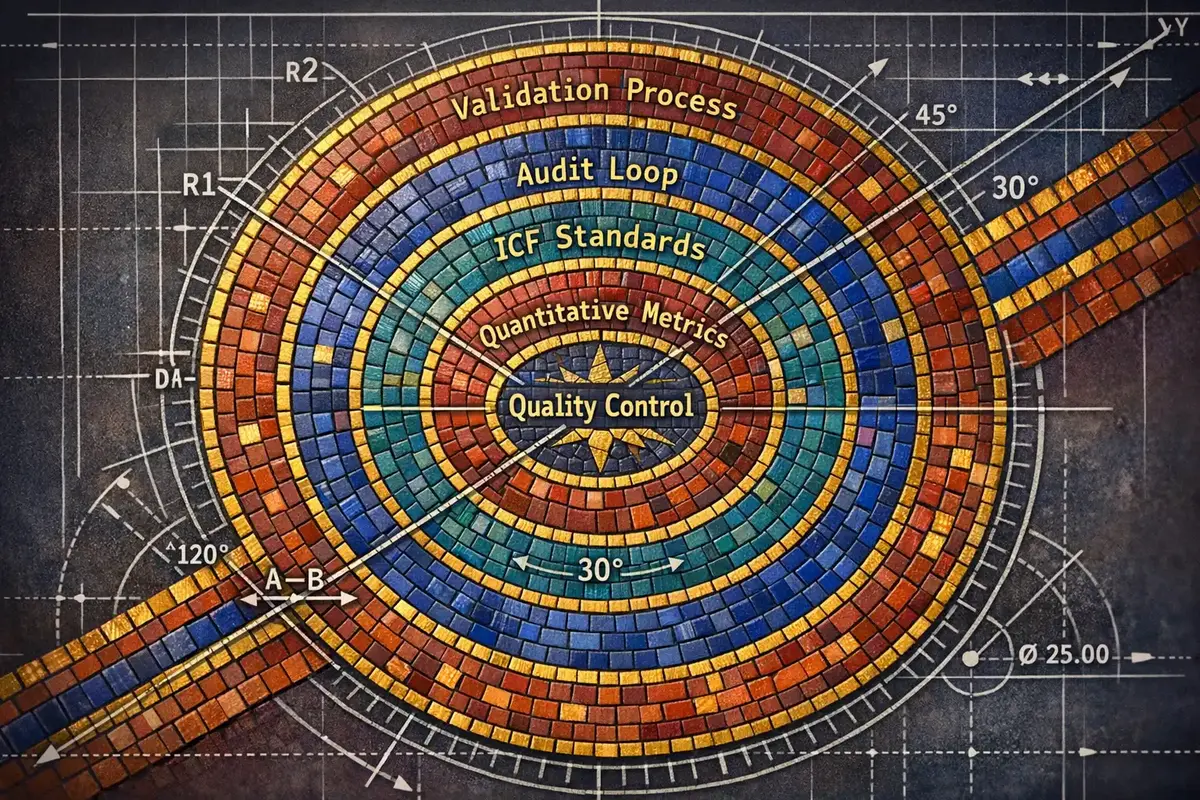
The four-layer validation model is the only practical way to test Integral principles in an AI coach without reducing the method to a checklist. Without it, teams confuse consistency with rigidity and end up shipping a system that sounds disciplined while quietly flattening the coaching stance.
The model separates four questions that should never be blended: method adherence, ethical integrity, user experience, and outcome validity. That separation matters because a system can pass one layer and fail another. It can feel natural to users yet miss core Integral distinctions. It can preserve the language of reflection yet cross ethical lines in how it frames certainty, risk, or personal interpretation.
Translate Principles Into Behaviors
If you cannot observe a principle, you cannot validate it.
For an Integral approach, that means turning abstract commitments into testable behaviors across four domains: subjective experience, observable behavior, relational fit, and technical safeguards. Subjective experience asks whether the AI helps the user surface inner assumptions, emotions, and meaning-making rather than jumping straight to tactics. Observable behavior checks whether it names patterns in action clearly and specifically. Relational fit examines whether the system holds an appropriate coaching stance — curious, bounded, non-diagnostic — instead of slipping into generic advice. Technical safeguards test whether escalation rules, memory limits, and prompt controls protect that stance under pressure.
A retail enterprise CHRO reviewing an AI pilot during annual planning will recognize the failure mode. One exchange explores how a store leader is interpreting team resistance; another skips that layer and offers “three ways to improve buy-in.” The second answer is efficient. It is not faithful.
Score the Layers Separately
This is where most validation programs get sloppy. They use one blended score.
A better approach is to run separate review tracks. Method adherence asks whether the exchange followed the intended developmental logic. Ethical integrity asks whether the system stayed within the boundaries of ethical AI coaching and preserved informed, bounded support. User experience asks whether the interaction was clear, respectful, and usable. Outcome validity asks whether repeated use is associated with better reflection, better decisions, or stronger follow-through.
Those are not the same thing. Gallup reports that only 12% of employees strongly agree AI has transformed how work gets done in their organization, even while 65% of U.S. workers in organizations using AI say it has had a somewhat or extremely positive effect on their own productivity (Gallup, 2026).
Productivity gains can coexist with weak transformation — and with weak fidelity (Gallup, 2026).
That is exactly why validation must stay multi-dimensional.
Keep Humans in the Loop
Human review is not a fallback. It is part of the method.
Reviewers should inspect transcripts for stance, not just output quality: Did the AI preserve inquiry? Did it distinguish interpretation from fact? Did it over-help? Did it collapse complexity into neat guidance? This is the practical core of ethical AI coaching: protecting the discipline from being optimized into something easier, faster, and thinner.
Gallup also found employee thriving moved only from 33% to 34% in 2025 (Gallup, 2026). Progress is real, but narrow. If AI coaching is going to claim developmental impact, what evidence will show it is strengthening the method — not just smoothing the conversation?
What the Research Shows About Coaching Fidelity, AI, and Outcome Validity
$10 trillion in lost productivity is what low engagement cost the global economy last year, and that is the backdrop for every rushed AI coaching deployment now being justified as a development fix (Gallup, 2026). Get this wrong and the damage is not abstract: money leaks out, trust in leadership tools drops, and capable people leave when “support” turns into another shallow system.
The Commercial Case for Taking Fidelity Seriously
The labor market is not giving organizations much room for error. 39% of workers’ core skills are expected to change by 2030, while 63% of employers already say skills gaps are a major barrier to business transformation (World Economic Forum, 2025). Deloitte adds a more uncomfortable point: only 5% of executives strongly agree their organization is investing enough to help people learn new skills for the changing world of work (Deloitte, 2024).
That combination matters. If capability gaps are widening and development systems are already underpowered, an AI coach is not just another productivity tool. It becomes part of the operating model for how people learn, adapt, and make better decisions under pressure.
McKinsey’s data sharpens the point: 69% of respondents reported a significant human capital or capability gap in their organizations (McKinsey, 2024). In that environment, “the AI seems helpful” is far too weak a standard.
A finance director at a mid-market services firm will recognize the decision moment. Budget season arrives, managers are stretched, and the AI coach appears to offer scalable development at a fraction of the cost of human support. The real question is harder: is it building judgment, or just producing clean language that makes underdeveloped thinking feel complete?
Outcomes Matter. Fidelity Still Matters Separately.
Research on coaching outcomes is encouraging, but it does not remove the need for audit. In the PwC and ICF Global Coaching Client Study, 86% of organizations said they earned back their coaching investment or more, and 87% of clients reported positive ROI (PwC, 2024). That tells us coaching can create value. It does not tell us that any AI system claiming to coach is applying a method faithfully.
This is the distinction many teams miss when they define AI coaching outcome validity too narrowly. Outcome validity asks whether the system is associated with useful results. Methodological fidelity asks whether those results were produced in the right way — consistently, ethically, and in line with the method’s actual logic.
You need both. A system can generate short-term gains by being fast, affirming, and action-heavy while still eroding the discipline it claims to scale. And a system can follow a method on paper yet fail to improve decisions, reflection, or follow-through in practice.
That leaves one operational question — and it is the one most teams postpone: when you audit an AI coach, where do you start first: the conversation, or the controls behind it?
Where Should Teams Start When Auditing an AI Coach for Fidelity?
The Method-to-Behavior Audit is the right place to start because early reviews usually fail for a simple reason: teams inspect answers before they define what the system is supposed to be doing. But when a team first audits an AI coach, what should it look for before scale makes small errors harder to see? And what if the most convincing transcript is the one that hides the first real break from method?
Picture a regional healthcare director reviewing pilot outputs during a team restructure. One exchange feels calm, thoughtful, even sophisticated. Another is less polished but stays closer to the intended coaching stance. Most teams reward the first one. That is the mistake.
Define the Method Before You Judge the Output
Start by writing down the intended methodology in plain language. Not brand language. Not aspirations. The actual method: what the AI must notice, what sequence it should follow, what it must avoid, and when it should stop and escalate.
Then map that method to observable behaviors. If the approach claims to honor integral principles, reviewers should be able to see those principles in the exchange: how the AI explores perspective, how it separates observation from interpretation, how it handles tension, and how it resists the urge to solve too quickly. For example, if the method emphasizes non-directiveness, the AI should consistently ask open-ended questions rather than steering toward solutions. If the methodology values psychological safety, the AI’s language should avoid judgment and create space for vulnerability. This is the foundation of serious coaching quality assurance.
That discipline matters because scale magnifies ambiguity. Deloitte’s 2025 Global Human Capital Trends survey drew on nearly 10,000 business and HR leaders across 93 countries, which is a reminder that organizations are trying to operationalize human judgment at scale, not just discuss it in theory (Deloitte, 2025). As AI coaching systems are deployed across thousands of users, even minor misalignments can propagate, undermining trust and effectiveness.
Audit for Drift, Not Just Quality
Once the method is defined, build a review process that looks for drift in four places: tone, ethical boundaries, escalation behavior, and alignment with the method itself.
- Tone drift shows up when inquiry becomes reassurance, or when curiosity is replaced by affirmation that may feel supportive but undermines the coaching stance.
- Boundary drift appears when coaching slips into advice or certainty, violating the principle of client autonomy.
- Escalation drift is more serious: the AI notices risk but keeps coaching anyway, which can have safety or compliance implications.
- Method drift is quieter — the system sounds helpful while skipping the developmental work the method requires, such as omitting critical reflection or failing to challenge assumptions.
Gallup’s 2026 workplace report draws on a massive long-run dataset of 5,754,327 global respondents across 2009–2025, including 2,616,488 employed respondents (Gallup, 2026). At that scale, the lesson is obvious: if you cannot review consistently, you cannot govern consistently. Small errors, if unchecked, become systemic blind spots.
Use a Small Set of Repeatable Questions
Keep the audit simple enough to repeat. A good reviewer set might ask: What was the coaching move here? What evidence shows the AI followed the method? Where did it drift in tone or boundary? Should this exchange have escalated? For instance, in a session where a user discloses distress, reviewers should check not only if the AI responded empathetically, but also whether it followed escalation protocols and stayed within ethical boundaries.
Small question sets create comparability without flattening judgment. They let human reviewers compare outputs across users and contexts while still noticing nuance. Over time, patterns of drift can be surfaced and addressed systematically.
And that is where trust starts to separate. Not with a good demo — with a system that stays faithful under variation. When that consistency holds over time, what kind of trust does it actually earn? The answer is organizational confidence: the assurance that, regardless of who interacts with the AI or under what circumstances, the coaching experience remains true to its intended purpose.
What Trust Looks Like When an AI Coach Stays Faithful Over Time
Trust is lost long before a system visibly fails. It erodes when weak coaching is repeated often enough that people stop questioning it — and start building decisions, development plans, and manager habits on top of it.
If trust is built over time, an AI coach earns it the same way a serious human practice does: by being reliable under pressure, reviewable in hindsight, and correctable when drift appears.
Trust Comes From Pattern, Not Performance
A single strong exchange proves very little. The real test is what happens across contexts: a difficult manager conversation, a stalled promotion discussion, a tense client escalation, a user who wants quick answers instead of reflection.
Consider a founder at a growing technology company during a board-pressure quarter. The AI coach helps one leader slow down, separate facts from assumptions, and prepare for a hard conversation. Useful. A week later, another leader brings a similar issue and the system slips into generic encouragement and tactical advice. That is not a small inconsistency. It tells you the method is not yet stable enough to deserve trust.
The most credible systems are not the ones that sound most human. They are the ones that stay aligned with the intended method when the inputs get messy, emotional, ambiguous, or rushed. In a market this large and still expanding, that distinction matters because commercial pressure rewards scale and polish faster than discipline (PwC, 2024).
A trustworthy AI coach is not the one that impresses in a demo. It is the one that holds its stance when no one is watching.
Transparent Review Is Part of the Product
This is where many teams still think too narrowly. They treat review as a compliance layer added after deployment, when in practice review is part of what makes the system trustworthy.
Deloitte’s global human capital work reflects how broad this operating challenge has become across organizations and countries (Deloitte, 2024). Once an AI coach is used across teams, functions, and leadership levels, trust depends on whether people know three things: how the method is being checked, who can inspect drift, and what happens when the system gets it wrong.
That is the practical heart of ethical AI coaching. Not just safe language. Accountable practice.
Fidelity Is Governance
In the end, methodological fidelity is a governance discipline. It protects the coaching relationship from becoming automated advice. It protects the method from being diluted into style. And it protects outcomes from being overstated simply because users liked the interaction.
That is what trust looks like over time: repeatable fidelity, visible review, and a willingness to correct drift before it becomes normal.
So in your own context, what are you really trusting — fluent output, or a practice you can defend?
Key Takeaways
- Fluent AI coaching can sound thoughtful while still drifting from the intended method.
- Methodological fidelity means the system follows observable coaching principles consistently.
- Validation should separate method adherence, ethical integrity, user experience, and outcome validity.
- Trust comes from repeatable fidelity, transparent review, and correction of drift over time.
Frequently Asked Questions
What is methodological fidelity in an AI coach?
Methodological fidelity means the AI coach consistently follows the intended coaching method, not just the tone or style of coaching. It requires observable behaviors that match the method’s principles, sequence, and boundaries across different user situations.
Why can an AI coach sound helpful but still fail the method?
An AI coach can produce fluent, empathetic, and structured responses while still drifting into generic advice, reassurance, or premature problem-solving. Helpful language alone does not prove that the system is applying the correct coaching logic or developmental sequence.
How can integral principles be validated in an AI coaching system?
Integral principles should be translated into testable behaviors, such as surfacing multiple dimensions of a challenge, distinguishing observation from interpretation, and honoring the intended coaching sequence. Validation should check whether those behaviors appear reliably across cases, including edge cases and stressful interactions.
What is the difference between user satisfaction and coaching fidelity?
User satisfaction measures whether the interaction felt useful, clear, or pleasant, but it does not show whether the method was followed correctly. A response can be highly satisfying because it is smooth or affirming while still failing to preserve the discipline and boundaries of the coaching approach.
How should teams audit an AI coach for drift?
Teams should first define the method in plain, observable terms and then review transcripts for drift in tone, boundaries, escalation behavior, and method adherence. A strong audit also includes human review, because trust depends on whether the system stays faithful under variation, not just whether one conversation looks good.