
Why AI coaching looks successful long before it proves anything
52% of employees are watching for or actively seeking a new job. That is the backdrop against which many leaders are calling an AI coaching pilot “successful” — after a quarter of strong logins, high completion rates, and positive comments in the dashboard.
You have probably seen the scene. A VP in a mid-market technology company walks into a quarterly review with clean adoption charts, a few enthusiastic manager quotes, and no credible answer to the question that matters: did this change retention risk or leadership readiness, or did people simply use the tool?
That gap gets expensive fast. Gallup reports that engagement and culture accounted for 37% of reasons employees left their employer in 2024, while wellbeing and work-life balance accounted for 31% — together, 68% of exits came from conditions coaching might plausibly influence, but only if it changes day-to-day experience, not just platform activity (Gallup, 2026).
52% of employees are open to leaving, yet many AI coaching programs are still judged first by usage volume rather than workforce outcomes (Gallup, 2026).
This article is about how to close that proof gap.
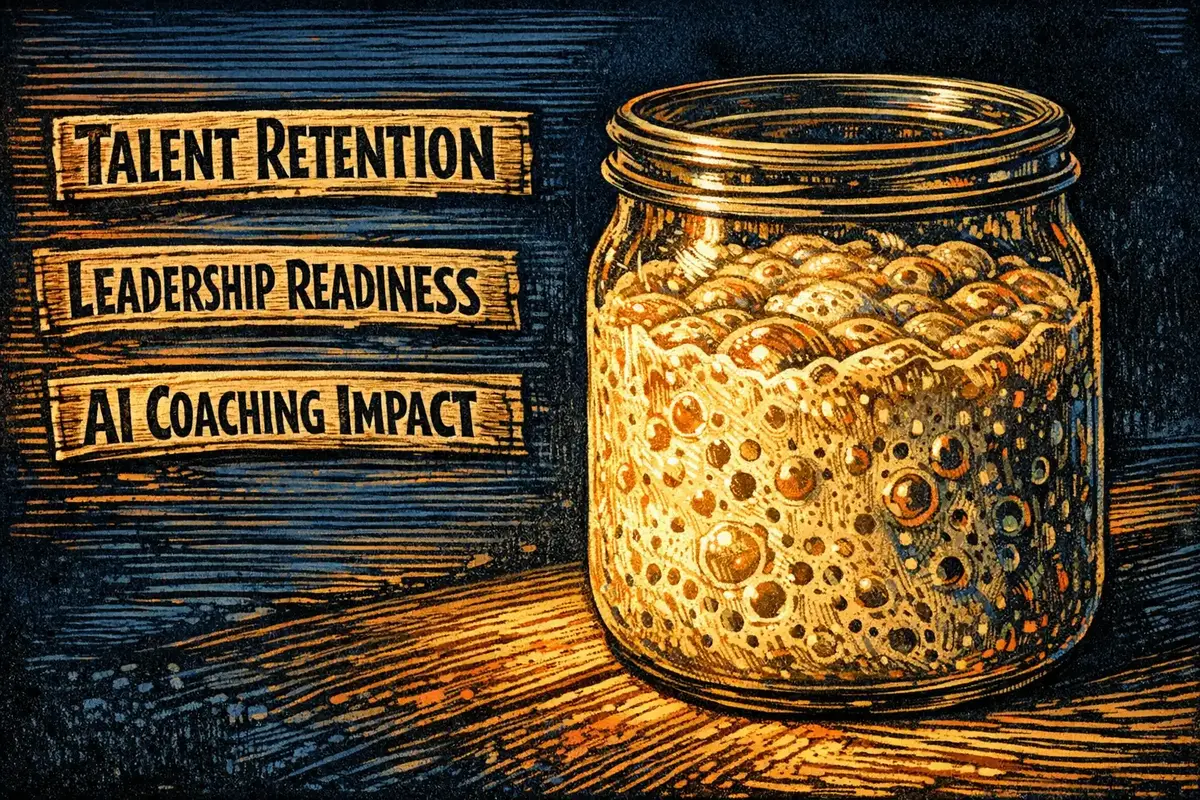
Activity is visible. Impact is not.
This is why AI coaching often looks successful long before it proves anything. Usage metrics are immediate, abundant, and easy to present: sessions started, prompts completed, return frequency, manager participation. They create the appearance of momentum.
But executives do not fund coaching to increase clicking. They fund it to change how managers handle conflict, how new leaders make decisions under pressure, how teams experience support, and whether strong people stay. Those are not activity measures. They are behavior and outcome measures.
The distinction matters because activity can rise while the underlying system stays the same. A manager can complete ten coaching sessions and still avoid hard feedback. A high-potential leader can report satisfaction with the tool and still not be ready to run a larger team. A company can celebrate adoption while regrettable attrition continues untouched.
That is where a serious AI coaching ROI conversation begins: not with “Are people using it?” but with “What changed because they used it?”
The measurement problem is a chain, not a snapshot
In practice, the hard part is not collecting more data. It is linking the right kinds of evidence in the right order. You need to move from activity to behavior change, then from behavior change to business outcomes such as retention, internal mobility, bench strength, and leadership readiness.
Most teams collapse those steps. They treat engagement with the coaching system as a proxy for value because it arrives first. It usually does. But early signals are not proof; they are only candidates for proof.
The rest of the article will separate those layers so you can tell the difference between a program that is popular, a program that is changing management behavior, and a program that is strong enough to matter when the manager layer gets thinner — and expectations get higher. If leadership readiness is no longer defined by title alone, what exactly should count?
What counts as leadership readiness when the manager layer is thinning?
41% of employees say their organization has slashed management layers. If fewer managers sit between strategy and execution, what exactly counts as someone being ready to lead? And if AI coaching is now filling part of the support gap, how do you tell whether it is building stronger leaders—or simply compensating for missing human management?
That question matters because flatter structures change the job before they change the title. A person can finish a leadership program, complete coaching sessions, and still not be ready for broader responsibility. Leadership readiness is not participation. It is observable capacity: making sound decisions with less supervision, giving direction others can act on, handling conflict without escalation, and creating enough trust that people will follow through when conditions are unclear.
Readiness shows up in the team before it shows up on the org chart
In a mid-market manufacturing company during a team restructure, a director is asked to absorb two additional functions after a layer of managers is removed. On paper, she looks ready: strong performance ratings, completed development milestones, active use of coaching support. But within six weeks, priorities start drifting across teams, decisions stall, and senior leaders spend extra time translating what “good” looks like.
That is the real test. Readiness is visible in whether a leader can reduce ambiguity for others.
Korn Ferry’s 2025 research makes the signal hard to ignore: 43% of employees say their leaders are not aligned, and 37% say the lack of managers has left them feeling directionless (Korn Ferry, 2025). Those are not just culture complaints. They are early operating indicators that the next layer of leaders is not yet carrying enough managerial weight.
Trust and clarity are not soft measures
Executives often treat trust as too subjective to belong in a readiness model. That is a mistake. If a leader cannot build trust, they cannot hold a wider span of responsibility for long.
80% of workers say they would stay in a job because they have a manager they trust (Korn Ferry, 2025).
That statistic changes the measurement logic. Trust in managers and clarity from leaders are not downstream morale themes; they are leading indicators of both retention stability and succession strength. A practical leadership readiness definition should therefore include measurable signals such as team confidence in decision quality, perceived clarity of priorities, follow-through on difficult conversations, and the ability to keep work moving without constant executive intervention.
The organizational link matters just as much as the individual one. A leader is not “ready” because they improved personally. They are ready when their growth closes a real succession risk: a thinner bench for frontline management, a fragile internal successor slate, a business unit too dependent on one experienced operator.
That is where many AI coaching programs get stuck. They can show who engaged and who improved. Harder question: did those gains map to the roles the business actually needs to fill—or are you still measuring development in isolation?
The three-layer measurement model that separates usage from impact
The three-layer measurement model matters because it stops you from calling motion “results.” Without it, teams stack logins beside retention numbers, imply a connection, and present confidence where they only have coincidence.
The model is simple: adoption, behavior change, and business outcomes. Each layer answers a different question. Adoption asks whether people are using the coaching. Behavior change asks whether that use is altering how they lead. Business outcomes ask whether those changed behaviors are improving something the organization actually values.
That distinction is the whole game.
Layer 1: Adoption tells you if the program has a chance
Start with adoption, but keep it in its place. This is the evidence that the system is being used often enough, by the right populations, in the right moments, to plausibly matter.
Useful adoption metrics include activation rates, repeat usage, session frequency, completion of coaching paths, and manager-level participation by role or business unit. In practice, this is where many quarterly reviews stop because the data is clean and immediate. MIT Sloan Management Review has argued that stronger measurement depends on matching KPIs to the decision they are meant to inform, not just choosing what is easiest to count (MIT Sloan Management Review, 2025). That applies here directly: adoption is a readiness-to-measure signal, not proof of value.
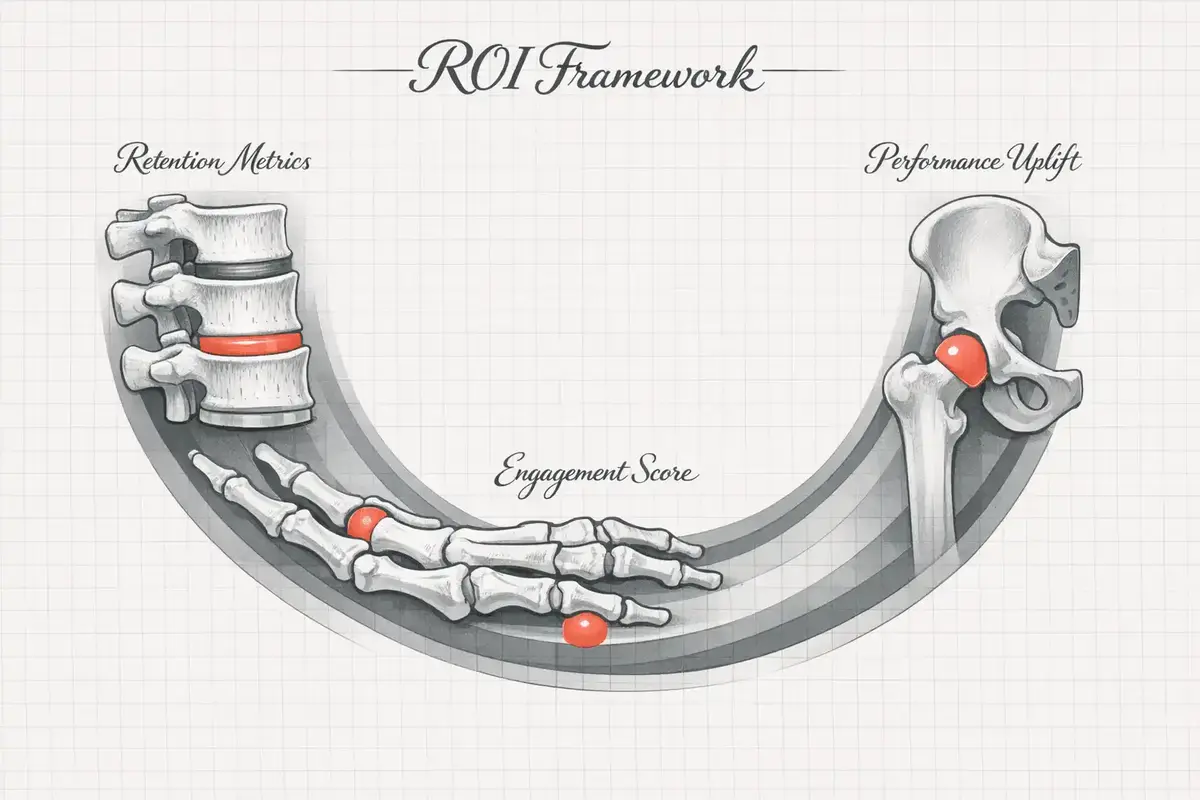
A regional healthcare provider offers a familiar example. During budget season, the CHRO shows that nurse managers are using AI coaching heavily before difficult staffing conversations. Good sign. But if the review ends there, leadership still does not know whether those conversations got better.
Layer 2: Behavior change is the hinge metric
This is the layer most companies underbuild. Yet it is usually the most important one, because it tells you whether the coaching is changing managerial practice before enterprise outcomes have time to move.
Behavior metrics should be observable and role-specific: quality of one-on-ones, speed of follow-up after conflict, clarity of delegation, consistency of feedback, or improvement in decision quality under pressure. ATD’s guidance on AI coaching data makes this point clearly: talent leaders need evidence that coaching is building capabilities tied to leadership readiness, not just generating engagement data (ATD, 2025).
The most useful KPI is often not the final outcome metric, but the intermediate one that shows leadership behavior is actually changing.
This is where a disciplined behavior change coaching approach earns its keep. If adoption rises but behavior does not shift, the program is being consumed, not absorbed.
Layer 3: Business outcomes show whether the organization benefits
Only now should you move to outcomes: internal promotion readiness, time-to-productivity in expanded roles, regrettable attrition in target groups, team stability, or reduced escalation load. These are the metrics executives care about, but they are lagging indicators. They become credible only when the first two layers support them.
A better KPI measurement discipline matches each claim to the right layer of evidence. Adoption supports a claim of reach. Behavior supports a claim of capability shift. Outcomes support a claim of organizational value.
Get the sequence wrong, and ROI stories collapse under scrutiny. Get it right, and a harder question appears: if retention improves, was coaching the cause — or merely nearby when the change happened?
Why retention improves when coaching changes the day-to-day experience
94% of employees say they would stay longer if a company invested in their career development. That should change how you read retention data: most organizations still treat turnover as a pay problem first, while the evidence says the daily experience of growth matters just as much (LinkedIn).
That gap is where many AI coaching cases are won or lost.
Retention moves when work feels more workable
In a regional financial services firm during year-end planning, a VP notices two patterns at once: compensation is competitive, yet strong analysts are still leaving; managers say they are “supportive,” yet skip hard feedback, recognition, and career conversations when workloads spike. The issue is not mystery attrition. It is a management system that feels thin in the moments employees actually remember.
People rarely stay because a dashboard says development exists. They stay because their manager gets better at the ordinary things that shape a week: noticing good work, clarifying priorities, preparing someone for a bigger role, and addressing friction before it hardens into resignation.
Gallup’s research is blunt here. 42% of departures are preventable (Gallup).
42% of departures are preventable — which means a large share of turnover is not fate, market noise, or compensation drift, but something in the employee experience that could have been changed (Gallup).
If AI coaching helps a manager run better one-on-ones, give specific recognition, or hold a more useful development conversation, that is not a soft cultural win. It is a retention mechanism.
Measure the behaviors that make exits less likely
This is why retention analysis has to get more precise. Do not ask only whether overall attrition moved. Ask whether preventable turnover fell in the populations where coaching was meant to change daily management practice. That is a much stronger test.
Recognition is a good example because it is both human and measurable. Gallup found that employees who were well recognized were 45% less likely to have turned over after two years (Gallup). So if AI coaching is prompting managers to recognize contribution more consistently — and employees report that recognition feels timely and specific — you now have a plausible bridge between coaching and retention.
The same logic applies to development signals. A high-potential employee who can suddenly see a path forward often stops taking recruiter calls quite so seriously. LinkedIn’s finding on career development should push leaders to track internal mobility intent, participation in stretch assignments, and manager-led career discussions alongside core talent retention metrics.
Tie retention KPIs to who changed, and how
The most useful retention metrics are attached to behavior, not just headcount. Look at regrettable attrition among teams whose managers improved recognition frequency. Look at stay rates among high-potentials whose coaching use coincided with clearer development plans. Estimate the avoided turnover cost only after you can show what changed in the day-to-day experience.
That is the real standard. Did people stay because coaching changed how work felt — or were they going to stay anyway? Without that answer, retention gains remain encouraging. Not convincing.
How do you prove AI coaching caused the change, not just happened nearby?
The counterfactual framework is what matters here: what would have happened without the coaching? If leadership scores improved, are you sure coaching did the work—or did a strong manager, a calmer quarter, or a broader culture shift carry the result? That is the uncomfortable question most ROI stories avoid until someone asks for budget renewal.
Completion rates will not save you. Neither will a stack of positive comments.
Start with comparison, not confidence
A defensible attribution case begins before the pilot launches. You need a baseline, a defined coached cohort, and a comparison group that is similar enough to make the contrast useful. Cloverleaf’s ROI framing is clear on this point: the value case for coaching gets stronger when outcomes are tied to measurable business changes rather than participation alone (Cloverleaf).
In a regional retail company during annual planning, the CHRO rolled out AI coaching to 120 store managers in high-turnover districts. Six months later, engagement scores rose and regrettable attrition fell. Good news—but not proof. Those districts had also received a new operations leader and a staffing reset. Without pre/post analysis and cohort comparisons, the company could not tell whether coaching changed manager behavior or simply arrived during a broader recovery.
That is the core attribution trap. Selection bias creeps in when the most motivated managers opt in first. Manager effects distort results when one exceptional leader lifts an entire cohort. Culture effects blur the picture when a business unit already has stronger norms around feedback and development. And timing lag matters because behavior can shift this quarter while retention moves two quarters later.
Use the strongest design you can actually run
A randomized control group is ideal. Most companies will not get one. Fine. Use matched cohorts instead: coached and uncoached managers with similar tenure, role scope, prior performance, and team conditions. Then compare change over time, not just end-state scores.
The Integral Institute makes the business-metric standard explicit: coaching should be assessed against outcomes that matter operationally, not treated as a standalone development experience (The Integral Institute). That means asking a harder question: did coached managers improve more than uncoached managers on the same measures, over the same period?
This is where a disciplined coaching impact measurement approach becomes practical, not academic. Track pre/post movement in targeted behaviors, then test whether the coached cohort moved differently from the comparison cohort. If both groups improved equally, coaching may have helped—but you cannot claim it caused the gain.
And until that comparison is clear, monetization is premature. Board-level ROI claims built on usage and anecdotes collapse fast under scrutiny. The harder problem comes next: once you do have credible evidence, which metrics belong in the board deck—and which should stay inside HR?
Which metrics belong on a board dashboard and which belong in HR?
51% less turnover is what high-engagement organizations saw on the low-turnover end of the spectrum (Gallup). That should make one thing clear: if executives only see usage counts, they are looking at the least important part of the story.
The board needs outcomes, not program telemetry
A board dashboard should answer three questions. Is risk going down? Is leadership capacity going up? Is the company getting a return large enough to matter?
That means the board does not need session counts, prompt completion, or weekly active users. Those are operating metrics. Useful, yes. Board-level, no.
What belongs instead is a short set of business outcome and risk indicators: regrettable attrition in priority talent pools, successor coverage for critical roles, internal fill rates for leadership openings, readiness of near-term successors, and the financial estimate of avoided turnover cost where attribution is already credible. If AI coaching is working, those are the numbers that should move.
A practical test is simple. In a quarterly review at an enterprise healthcare system, the CFO should be able to scan one page and understand whether leadership bench risk is narrowing in nursing, operations, or service-line management. She should not have to interpret coaching adoption curves to get there.
Companies that foster a culture of health have employee turnover rates 11 percentage points lower than those that do not (World Economic Forum, 2025).
That statistic belongs in the board conversation because it frames retention as enterprise risk, not HR sentiment.
HR needs the mechanism, not just the headline
HR and L&D dashboards sit closer to execution, so they need more detail. This is where adoption and behavior metrics belong.
HR should track the full stack: activation by target cohort, repeat use, manager participation, completion of key coaching journeys, and the intermediate behaviors the program is meant to change. Better one-on-ones. Faster conflict follow-up. More consistent recognition. Clearer delegation. This is where disciplined KPI measurement matters, because HR is managing the mechanism, not just reporting the result.
The mistake I see often is altitude confusion. Boards get flooded with operational detail, while HR gets only lagging outcomes it cannot steer in time.
Build one story at three altitudes
A strong dashboard separates leading indicators, intermediate indicators, and lagging indicators. Managers need the leading view: are people using the support in the moments that matter? HR needs the intermediate view: are leadership behaviors changing in the right populations? The board needs the lagging view: are retention risk and succession exposure improving?
Different audiences. Same logic.
If those layers blur, the company starts telling itself a flattering story instead of a true one. And when budget pressure hits, will your ROI case sound like evidence—or like optimism with charts?
The clearest ROI stories are the ones that stay honest about what changed
Bad ROI stories do real damage. They waste budget, erode trust in HR, and let good people leave while leaders congratulate themselves for activity that never became capability.
When the numbers finally improve, will you be able to explain why—or only that they did?
Keep the chain intact
The strongest ROI story is not a single headline number. It is a chain of evidence: people used the coaching, specific leadership behaviors changed, and business outcomes moved in the places those behaviors should matter.
Break that chain, and the story gets weak fast. A retention improvement without evidence of changed management practice is just a favorable outcome. Strong adoption without better delegation, feedback, or decision quality is just software engagement. Research from AIHR consistently points talent leaders toward practical measurement that follows development from participation to capability to organizational effect, rather than collapsing everything into one early claim (AIHR).
That discipline matters most when pressure rises. In a mid-market services company during budget review, a CFO may accept a vague development narrative once. She will not accept it twice if client delivery is still uneven and key managers are still leaving.
Retention and readiness are one operating signal
Treat retention and leadership readiness as separate workstreams, and you miss how organizations actually succeed or fail. The same manager behaviors that make strong people stay—clear expectations, useful feedback, credible development conversations—also make the next layer of leaders more capable.
That is why AI Coach System’s framing is useful: measure AI coaching as a leadership system intervention, not a software product metric (AI Coach System). The question is not whether the tool was popular. It is whether the management system got stronger.
A company with lower flight risk but no stronger bench has bought time, not capability. A company with “ready now” successors on paper but teams that do not trust local leadership has an assessment problem, not a pipeline.
Be transparent about what you can prove
The most credible approach is incremental. Start narrow. Show where coaching was used, what changed in manager behavior, and which outcomes moved afterward. Be explicit about what remains uncertain.
That kind of honesty reads as strength, not caution. Executives know complex systems rarely produce clean laboratory proof. What they want is a measurement approach that is careful about attribution, clear about limits, and consistent over time. AIHR’s practical guidance supports that posture: build evidence in layers, refine as the program matures, and resist claiming enterprise impact before the mechanism is visible (AIHR).
In the end, the clearest ROI stories are modest in tone and strong in structure. They do not ask the board to believe in coaching. They show what changed—and what did not.
That is the real next step. Not a bigger claim, but a cleaner one: in your context, can you trace the path from coaching use to better leadership to better outcomes—or are you still asking the outcome data to tell the whole story?
Key Takeaways
- AI coaching should be judged by behavior and business outcomes, not by usage alone.
- Leadership readiness is visible in decision quality, trust, clarity, and follow-through.
- A three-layer model helps separate adoption, behavior change, and business impact.
- Credible ROI requires comparison groups, baseline data, and honest attribution.
Frequently Asked Questions
How do you measure the ROI of AI coaching in talent retention?
Measure ROI by linking coaching use to changes in manager behavior and then to retention outcomes such as regrettable attrition, stay rates in key talent groups, and avoided turnover cost. Usage alone is not enough; the strongest case shows that coaching changed the day-to-day experience in ways that reduced flight risk.
What is the best way to assess leadership readiness with AI coaching?
Leadership readiness should be measured by observable capability, not by course completion or tool usage. Useful indicators include decision quality under pressure, clarity of priorities, follow-through on difficult conversations, and the ability to lead teams with less supervision.
What metrics should be used to separate AI coaching adoption from business impact?
Use a three-layer model: adoption, behavior change, and business outcomes. Adoption metrics show whether people are using the coaching, behavior metrics show whether leadership practices are changing, and outcome metrics show whether those changes improved retention, succession strength, or readiness.
How can you tell whether AI coaching caused better retention results?
To support causation, compare coached and uncoached groups with similar roles, tenure, and team conditions, and measure change over time against a baseline. Without a comparison group or pre/post analysis, improved retention may reflect other factors such as leadership changes, timing, or broader culture shifts.
Which AI coaching metrics belong on a board dashboard versus an HR dashboard?
Board dashboards should focus on business outcomes and risk, such as regrettable attrition, successor coverage, internal fill rates, and leadership bench strength. HR dashboards should include adoption and behavior metrics, such as repeat usage, manager participation, feedback quality, delegation, and follow-through on coaching actions.