
Why the people you rely on most are often the first to burn out
76% of employees experience burnout at least sometimes. If burnout is this common, treating it as an individual resilience problem is not just outdated; it is a direct performance risk (Gallup, 2020).
You have seen the scene before. In a quarterly review, the director who always steadies the room is the one taking on the unclear project, covering for a weak manager, and answering late-night messages because no one else can move as fast.
That pattern is expensive. Gallup found that 28% of employees say they are burned out “very often” or “always” at work (Gallup, 2020), which means this is not a marginal wellbeing issue sitting at the edge of operations. It sits inside execution, decision quality, retention, and leadership capacity. This article examines why the most trusted people are often the most exposed—and where AI coaching can reduce pressure before overload turns into disengagement or exit.
The mistake many organizations make is subtle. They read high output as proof of high capacity, then keep routing ambiguity toward the same people: the reliable team lead, the fast-rising VP, the high-potential employees who can absorb complexity without visible drama.
The pressure mix top performers carry
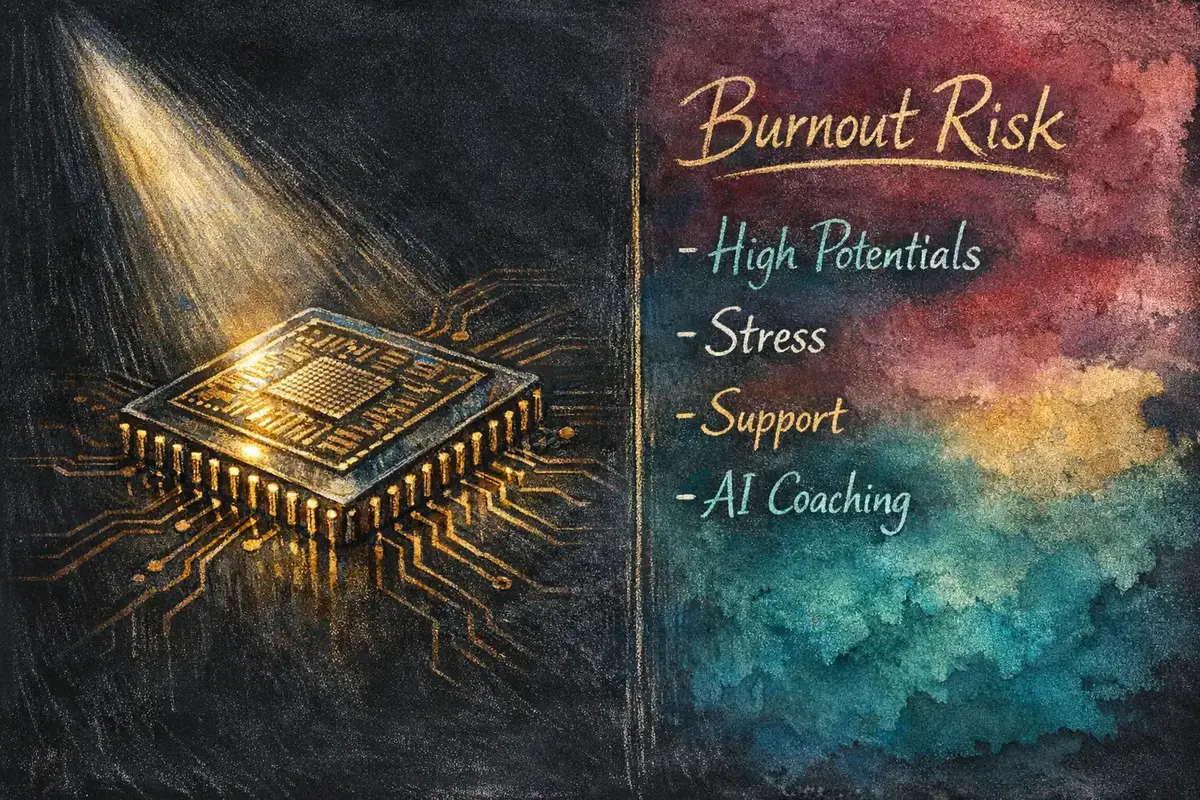
High-potential talent rarely burns out because they lack drive. More often, they burn out because they operate under a punishing mix of visibility, ambiguity, and constant expectation. Their work is watched more closely, their remit is less defined, and their reward for succeeding is usually more responsibility—often before support systems catch up.
In practice, this means they are not only doing their jobs. They are translating strategy, absorbing uncertainty from above, protecting team morale below, and improvising through gaps that the formal organization has not solved. That is why burnout among strong performers is so often misread. From the outside, it looks like commitment. From the inside, it feels like sustained cognitive and emotional drag.
Why support has to arrive earlier
This is where AI coaching becomes relevant—not as a replacement for managers, mentors, or clinical support, but as a practical layer of early help. Used well, it can create space for reflection, pattern recognition, prioritization, and better day-to-day decisions before strain hardens into chronic depletion.
That matters because burnout rarely announces itself at the point where intervention is easiest. It usually shows up later—after judgment slips, motivation narrows, and your most dependable people start asking a quieter question: is this pressure temporary, or is this just the job now?
What exactly is burnout, and why does it look different from ordinary stress?
The Stress-Burnout-Overload framework matters here because most organizations still treat three different problems as one. If stress is temporary strain, what changes when it becomes burnout—and why does that distinction matter for AI coaching? Many leaders assume the answer is obvious. It is not.
That confusion is costly because the symptoms can look similar at first: fatigue, irritability, slower thinking, less patience. But the underlying pattern is different, which means the support has to be different too.
A precise definition changes the conversation
Start with the cleanest definition available. The World Health Organization defines burnout as “a syndrome conceptualized as resulting from chronic workplace stress that has not been successfully managed” (World Health Organization, 2019).
Two words matter most: chronic and not successfully managed.
Burnout is not a hard week. It is not the strain of a product launch, a board meeting, or a difficult client cycle. It is what happens when pressure keeps repeating, recovery keeps shrinking, and the person starts experiencing work as a source of depletion rather than challenge. That is why burnout is better understood as a pattern over time, not a mood on a bad day.
The scale of ordinary work stress is already high. The American Psychological Association found that 77% of workers reported experiencing work-related stress in the last month (American Psychological Association, 2023). Stress, in other words, is common. Burnout is narrower—and more serious.
57% reported negative impacts sometimes associated with burnout (American Psychological Association, 2023)
Stress, burnout, and AI overload are not the same thing
A simple comparison helps.
| Pattern | What it says | What it means |
|---|---|---|
| Stress | I have too much to do right now. | Temporary strain. |
| Burnout | This is not letting up, and I am not recovering. | Sustained depletion over time. |
| AI-related overload | The pace, inputs, and decisions have multiplied faster than I can process them. | Workflow pressure from information and decision volume. |
Stress usually says: I have too much to do right now.
Burnout says: This is not letting up, and I am not recovering.
AI-related overload says: The pace, inputs, and decisions have multiplied faster than I can process them.
In a mid-market healthcare company during a team restructure, a director may handle two intense weeks of staffing gaps and still be fundamentally engaged. That is stress. If six months later she is emotionally flat, increasingly cynical, and doing only what is necessary to get through the day, that is closer to burnout. If the same period also brings new dashboards, constant prompts, and pressure to respond faster because AI tools should make work easier, that adds a different layer: overload driven by workflow design, not just workload.
This distinction matters for stress management. If you mislabel burnout as stress, you offer recovery advice when the real issue is sustained work design failure. If you mislabel AI overload as burnout, you may miss a fixable problem in information flow, role clarity, or decision rights.
And once you see that, a harder question appears: why do some people absorb this pattern longer than others—until the damage is already expensive?
Why high-potential employees are uniquely vulnerable to burnout
Burned-out employees are 63% more likely to take a sick day. That should change how leaders think about high-potential talent, because the people seen as most ready for more are often the ones absorbing the most unmanaged strain (Gallup, 2020).
Most organizations treat high-potential employees as a capacity signal. If someone learns fast, stays calm under pressure, and keeps delivering, they get the stretch assignment, the messy cross-functional work, and the high-visibility role. The assumption is simple: more opportunity means more engagement.
The evidence points to a harder truth. More opportunity often means more ambiguity, more scrutiny, and a shorter runway to prove readiness.
Acceleration raises the load before support catches up
In a regional financial services firm during budget season, a newly promoted director is asked to lead a cost review, steady a nervous team, and present to executives two levels above her role. None of that is unreasonable on its own. The problem is the combination: every task is visible, politically sensitive, and time-bound.
That is the paradox. Organizations call it development. The person living it often experiences it as sustained overextension.
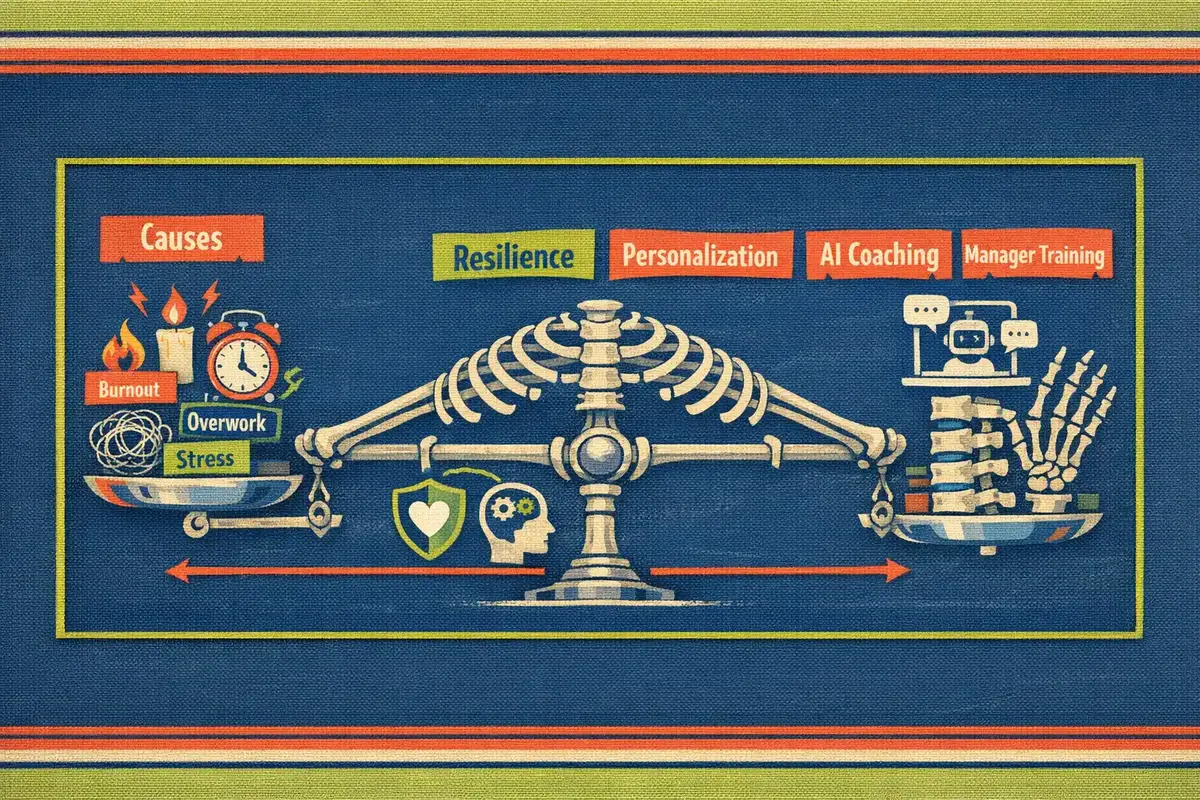
High-potential status changes the nature of work. You are no longer judged only on output. You are judged on judgment, pace, executive presence, and whether you can carry uncertainty without creating noise. That constant visibility narrows recovery time because even off-hours start to feel like preparation time. For many high-potential employees, the strain is not just volume. It is the feeling that every decision is also an audition.
The retention risk is often hiding in your talent strategy
This is where the cost becomes strategic. Gallup found that burned-out employees are also 23% more likely to visit the emergency room (Gallup, 2020). Burnout is not merely a morale issue. It shows up in health, absence, and eventually in whether ambitious people decide the price of staying is too high.
The hidden failure in talent acceleration is that companies can mistake endurance for sustainability. A high performer may keep producing long after commitment has started to erode. By the time disengagement is visible, you are no longer protecting future leaders; you are managing preventable loss.
That is why burnout prevention has to be built into development, not added after warning signs appear. The real question is no longer whether these employees need support. It is whether support can arrive early enough — and in a form they will actually use.
How can AI coaching reduce strain without replacing human judgment?
34% reductions in stress levels and 25% reductions in feelings of burnout are possible when support is structured well, not left to chance (CoachHub). Get this wrong and the cost is immediate: slower decisions, frayed trust, and high-potential people quietly deciding that staying is no longer worth the load.
The practical question is not whether support matters. It is what happens in the moment a strong performer is overloaded and no manager is available.
What AI coaching actually does at the point of strain
Used well, AI coaching is a support layer, not a verdict engine. It reduces friction through small interventions that arrive when people can still use them: a prompt to separate urgent from important, a reflection question before a difficult conversation, a rehearsal space for a high-stakes meeting, or a nudge to escalate when patterns look risky.
That sounds modest. It is.
But modest is the point. Burnout prevention often fails because the help arrives too late or asks too much effort from someone who already has no bandwidth. AI coaching lowers the activation energy. Instead of scheduling a session next week, the employee can think more clearly now.
In a technology startup during a client escalation, a product VP is juggling an angry enterprise account, an anxious engineering lead, and a board update due by morning. What helps first is not a grand intervention. It is fast triage: What decision must be made tonight? What can wait? What conversation needs a human manager, HR partner, or executive sponsor rather than another hour of solitary problem-solving?
The hidden gain: less cognitive drag for everyone
The value is not only better coaching content. It is less cognitive burden.
Managers are overloaded too. They miss early signals not because they do not care, but because they are carrying too many people, too many decisions, and too little time for thoughtful check-ins. A scalable layer of personalized support can absorb some of that day-to-day pressure by helping employees prepare, reflect, and sort issues before they become crises.
Research on AI transitions reinforces the human side of this. A Frontiers study of 375 respondents found that coaching leadership buffered job stress and protected physical health (Frontiers, 2024). The reported effect was statistically meaningful — 95% CI = [-0.136, -0.048] — which matters because it suggests support quality changes outcomes, not just sentiment (Frontiers, 2024).
Where the line must stay firm
This is where many organizations overreach. AI coaching should never be positioned as a substitute for human coaching, managerial care, or escalation when risk is high. It can help someone name a pattern, prepare a conversation, or pause before reacting. It should not be asked to carry trauma, adjudicate serious conflict, or replace a leader’s judgment.
The real test is simple: does the system make better human intervention more likely — or does it become an excuse to provide less of it? That question gets sharper when AI itself is changing how leaders lead.
What does coaching leadership change during AI transitions?
The Clarity–Safety–Follow-through framework explains why leadership style still decides whether AI lowers strain or simply redistributes it. In a retail enterprise during a system rollout, a regional VP watches store managers nod through the new AI workflow briefing, then send late-night messages asking what now counts as good judgment and what must still be escalated.
That moment is the real transition. Not the software launch.
Research in Frontiers studied 375 respondents and found that coaching leadership buffered job stress and protected physical health during AI transitions (Frontiers, 2024). The effect size matters less than the mechanism, though the reported interval was statistically meaningful — 95% CI = [-0.136, -0.048] (Frontiers, 2024). The lesson for executives is practical: people do not experience change through technology alone. They experience it through the behavior of the leader standing closest to the work.
1. Clarity changes how pressure is interpreted
When AI enters a workflow, uncertainty expands before efficiency shows up. Roles blur. Decision rights shift. People start asking quiet questions: Am I still expected to check this manually? If the tool is wrong, who owns the miss?
A coaching leader does not answer that anxiety with slogans about innovation. They reduce ambiguity. They define where AI should speed work up, where human judgment still governs, and what “good use” looks like in daily practice. That is a direct input into leadership effectiveness, because unclear change creates avoidable stress even when the tool itself is useful.
2. Safety determines whether problems surface early
Most AI transitions fail socially before they fail technically.
If employees think questions will be read as resistance, they hide confusion. If managers treat hesitation as underperformance, teams start performing certainty instead of exercising judgment. A coaching leadership approach changes that dynamic by making it acceptable to test, challenge, and escalate. That is how stress drops: not because leaders are more encouraging, but because people spend less energy managing fear.
3. Follow-through turns support into trust
This is where many organizations break the chain. They introduce AI support for individuals, but managers keep running old habits — vague priorities, inconsistent check-ins, unresolved friction.
The strongest response combines both layers: AI coaching for in-the-moment support, and manager behavior that creates clarity, psychological safety, and visible action. Without that culture, AI coaching helps people cope. With it, it helps people perform sustainably.
And that raises the harder operational question: where do you start — broad rollout, or a narrower design that people will actually use?
Where should organizations start if they want AI coaching to prevent burnout?
77% of workers reported experiencing work-related stress in the last month. If that is the baseline, why do so many organizations still assume the right starting point is a broad AI rollout rather than a precise intervention where strain is already visible (American Psychological Association, 2023)?
That assumption sounds ambitious. It is usually wasteful.
The better question is narrower: where does pressure show up first, before performance drops or people disengage? The American Psychological Association also found that 57% reported negative impacts sometimes associated with burnout (American Psychological Association, 2023). You do not need a company-wide transformation to act on that. You need to know where the early signals live.
Start where the load is already concentrated
In practice, three groups usually surface first: overloaded managers, high-potential employees in transition, and teams moving through rapid change.
In a mid-market manufacturing company during annual planning, a plant director is absorbing cost pressure from above while coaching two newly promoted supervisors below. He is not failing. He is becoming the shock absorber for the system. That is often the right place to begin — not because he is the only one under strain, but because pressure concentrated in one role tends to spread outward.
This is the implementation logic many firms miss. Start with the points of highest decision density and emotional load. That is where AI coaching can help people notice patterns earlier, reflect before reacting, and build small habits that reduce cumulative drag.
Use a simple rule: AI for support, humans for complexity and care
AI coaching works best when the task is early detection, reflection, prioritization, or habit support. Think journaling prompts, meeting preparation, boundary-setting check-ins, or pattern spotting across repeated stressful weeks.
The line should stay firm. If the issue involves risk, conflict, or sustained distress, it moves to a human — manager, coach, HR, or clinical support depending on severity. That decision rule matters because it keeps stress management practical without pretending every problem is coachable by software.
Build it into a broader support system
The mistake is treating AI coaching as a standalone fix. It is one layer.
It works when it sits inside a wider employee wellbeing system: clear manager expectations, escalation paths, access to human coaching, and norms that make asking for help professionally acceptable. Without that structure, AI may help people cope a little longer. With it, support arrives early enough to protect performance.
That is the real fork in the road — do you want a tool people can access, or a system that actually changes outcomes?
Sustainable performance starts when support arrives before exhaustion does
The design choice leaders eventually have to make
The Early Support Loop matters because the cost of getting this wrong is not abstract: revenue slips when key people start making narrower decisions, trust erodes when managers miss what is happening in plain sight, and strong talent leaves after concluding that high performance here simply means sustained self-neglect.
If burnout is a systems problem, what would it look like to support performance before people reach the edge?
The World Health Organization defines burnout as “a syndrome conceptualized as resulting from chronic workplace stress that has not been successfully managed” (World Health Organization, 2019). Read that carefully and the implication is hard to avoid. Burnout prevention is not mainly a toughness question. It is a design question — how work is paced, how pressure is noticed, and how quickly support shows up when strain starts repeating.
In a regional services firm during year-end planning, a senior manager keeps delivering, keeps smoothing conflict, keeps saying she is fine. Then two of her best people resign within a quarter. The visible loss is headcount. The deeper loss is confidence: the team has learned that reliability gets rewarded with more load, not better support.
That is the point at which many organizations finally act. Too late.
Credibility comes from what AI coaching does — and does not do
AI coaching becomes credible when it helps people notice strain earlier, act sooner, and stay connected to human judgment. Not when it pretends to replace it.
Gallup found that 76% of employees experience burnout at least sometimes (Gallup, 2020). At that level, waiting for visible exhaustion is poor operating discipline. A useful AI layer can prompt reflection, surface patterns, and help someone prepare the conversation they should have with a manager, coach, or HR partner before the problem hardens.
The long-term goal is simpler than many transformation plans make it sound. It is not to make people tougher. It is to make high performance sustainable.
That is the real choice in front of most leaders now: build a system that only responds after damage appears, or one that supports people while they still have room to recover. Which one does your organization reward today?
Key Takeaways
- Burnout is a systems problem, not just an individual resilience issue.
- High-potential employees are often exposed to more ambiguity, visibility, and pressure.
- AI coaching can reduce strain when it supports reflection, prioritization, and early action.
- Human judgment, manager behavior, and clear escalation paths still matter most.
Frequently Asked Questions
What is burnout, and how is it different from ordinary work stress?
Burnout is a syndrome caused by chronic workplace stress that has not been successfully managed. Unlike ordinary stress, which is usually temporary, burnout reflects sustained depletion, reduced recovery, and a growing sense that work is draining rather than motivating.
Why are high-potential employees and leaders especially vulnerable to burnout?
High-potential people are often given more ambiguity, visibility, and responsibility before support systems catch up. They may keep performing well while absorbing extra emotional and cognitive load, which makes burnout easy to miss until it becomes costly.
How can AI coaching help prevent burnout?
AI coaching can provide timely prompts for reflection, prioritization, meeting preparation, and pattern recognition before strain becomes chronic. It lowers the effort needed to get support in the moment, while still leaving complex issues, risk, and emotional distress to human judgment.
What role does leadership play in burnout prevention during AI transitions?
Leadership shapes whether AI reduces strain or simply adds confusion. Coaching leadership helps by creating clarity about roles and decision rights, psychological safety for questions and escalation, and follow-through that turns support into trust.
Where should organizations start if they want to use AI coaching to reduce burnout?
The best starting points are roles with concentrated pressure, such as overloaded managers, high-potential employees in transition, and teams facing rapid change. AI coaching works best as part of a broader wellbeing system with clear escalation paths, human support, and manager expectations.