
Why first-time leaders need support before the pressure hits
36% of managers say they were not sufficiently prepared for the people-manager parts of the job. If you run high-potential programs, that number should read less like a survey result and more like an operating risk (Deloitte, 2025).
You have seen the moment. A strong individual contributor in a mid-market technology company gets promoted to team lead just before a quarterly review, and within weeks the work changes shape: one underperformer needs feedback, one top performer wants more scope, and a cross-functional conflict lands in their lap. They were promoted for judgment, drive, and execution. Now they are being tested on coaching, prioritization, and emotional steadiness under pressure.
That gap is expensive because the manager role is not a side variable. Managers account for at least 70% of the variance in team-level employee engagement, which means a first-time leader’s readiness quickly becomes a team performance issue, not just a development issue (Gallup, 2026). When support arrives late, organizations pay in slower decisions, avoidable escalations, and teams that start to hedge instead of commit. This article addresses that exact problem: how AI coaching can help first-time leaders build management readiness before the pressure compounds.
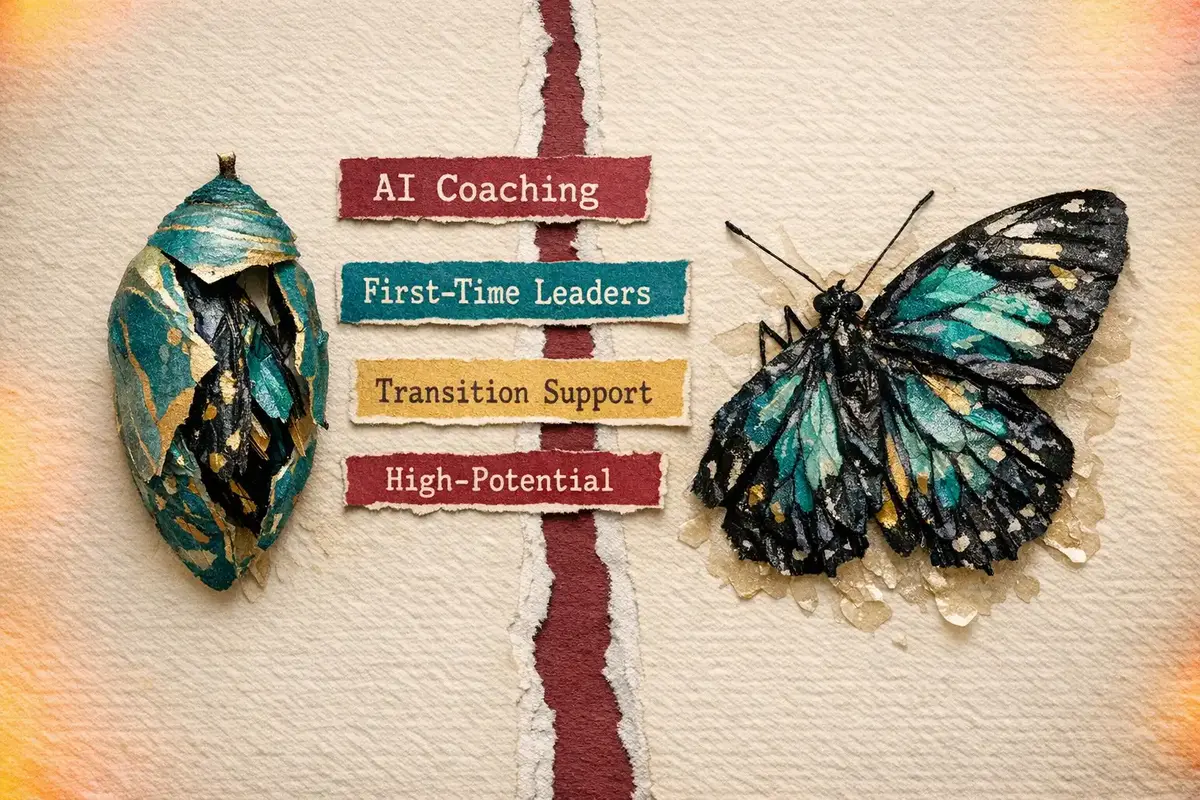
The readiness gap starts before the title change feels real
Most high-potential programs still assume that exposure is enough. A workshop on feedback, a cohort session on influence, maybe a manager handbook. Useful, but incomplete.
The real challenge is timing. First-time leaders rarely fail because they never heard the concepts. They struggle because the hardest moments are live, messy, and specific: what to say in a tense one-on-one, how to reset expectations without demoralizing someone, when to push and when to pause. Formal leadership development gives them language. It does not always give them support at the exact moment that language must become behavior.
Why AI coaching fits this moment
This is where AI coaching earns attention — not as a replacement for human judgment, and not as a substitute for formal development. Its best use is narrower and more practical: in-the-flow reinforcement.
A new manager does not need abstract inspiration five days after a difficult conversation went badly. They need help before the meeting, between meetings, and after the first draft of a response they are not fully confident in. Used well, AI coaching can create repetition, reflection, and small-course correction at a pace most programs cannot sustain on their own.
That distinction matters. If the question is whether organizations should choose human coaching or AI, the framing is already off. The real question is sharper: where does immediate reinforcement change the odds for a first-time leader — and where does human judgment still need to lead?
What is AI coaching, and how is it different from training or an assistant?
The Contextual Coaching Loop is the right way to understand AI coaching for first-time leaders. Without that model, organizations tend to buy either content libraries that do not change behavior or assistant tools that speed up tasks while leaving judgment untouched.
In plain English, AI coaching is conversational, context-aware support that helps a leader think through a situation, rehearse a response, and decide what to do next while the work is actually happening. It is not a course. It is not a chatbot that simply answers questions. At its best, it acts more like a structured thinking partner inside the flow of work — prompting reflection before a one-on-one, helping draft language for a difficult message, then asking what happened and what to adjust after the meeting. That pattern aligns with how organizations are starting to use AI to personalize growth at scale rather than just distribute information (Cornerstone OnDemand, 2024).
Training teaches concepts. Coaching shapes use.
A regional healthcare provider promoting a strong charge nurse into a unit supervisor role during staffing shortages does not mainly have a knowledge problem. The new leader usually knows the basics of feedback, delegation, and prioritization. The failure point is application under pressure: what to say when a senior colleague resists a schedule change, how to hold standards without escalating tension, when to coach and when to decide.
That is why AI coaching should be separated from training. Training is event-based. It explains models, introduces language, and builds baseline awareness. AI coaching picks up after that — where behavior either sticks or fades. The Center for Creative Leadership has pointed to AI’s value in leadership development programs when it supports practice, reflection, and personalization rather than trying to replace development itself (Center for Creative Leadership, 2024).
Managers who strongly agree they received meaningful feedback in the past week are far more likely to be engaged at work (Gallup, 2024)
That statistic matters here for a different reason: leaders need the same rhythm of reinforcement if you expect new habits to hold.
An assistant completes tasks. A coach improves judgment.
The cleanest distinction is this: an assistant helps you finish work; a coach helps you get better at leading. An assistant can summarize notes, schedule meetings, or draft a status update. Useful, yes. But those functions do not necessarily improve how a first-time manager reads a tense conversation or chooses between empathy and clarity.
The strongest mental model is hybrid coaching. AI handles repetition, prompts, and in-the-moment rehearsal. Humans handle nuance, accountability, and interpretation — the parts that depend on experience, ethics, and organizational context. That is the real dividing line, and it is why the debate is not AI or human, but AI coaching vs human coaching used with intent.
Because once support becomes continuous, a harder question appears: how do you keep reinforcement going long enough for behavior to survive real operating pressure — workshop by workshop, or week by week?
Why high-potential development programs need continuous reinforcement, not episodic workshops
39% of workers’ core skills are expected to change by 2030. If capability requirements are moving that fast, why do so many organizations still treat leadership readiness as something a workshop can install in a day (World Economic Forum, 2025)?
That question matters because most high-potential development programs are not failing at identification. They are usually quite good at spotting judgment, ambition, and learning agility early. The breakdown comes later, in the handoff from promise to consistent managerial performance.
A workshop can create clarity. It cannot create repetition.
That is the continuity gap. High-potential leaders leave a strong session with language for delegation, feedback, and meeting cadence, then return to calendars full of live decisions, half-formed habits, and very little structured reinforcement. In practice, the learning decays not because the content was weak, but because the operating environment is stronger.
Potential is identified in cohorts. Performance is tested alone.
Consider a mid-market manufacturing company promoting a plant team lead during a quarterly output review. The person was selected for reliability and technical credibility. Two weeks later, they are expected to run tighter shift handovers, address a quality miss without alienating a veteran operator, and prepare for a tense staffing discussion with their manager. None of that feels like the classroom.
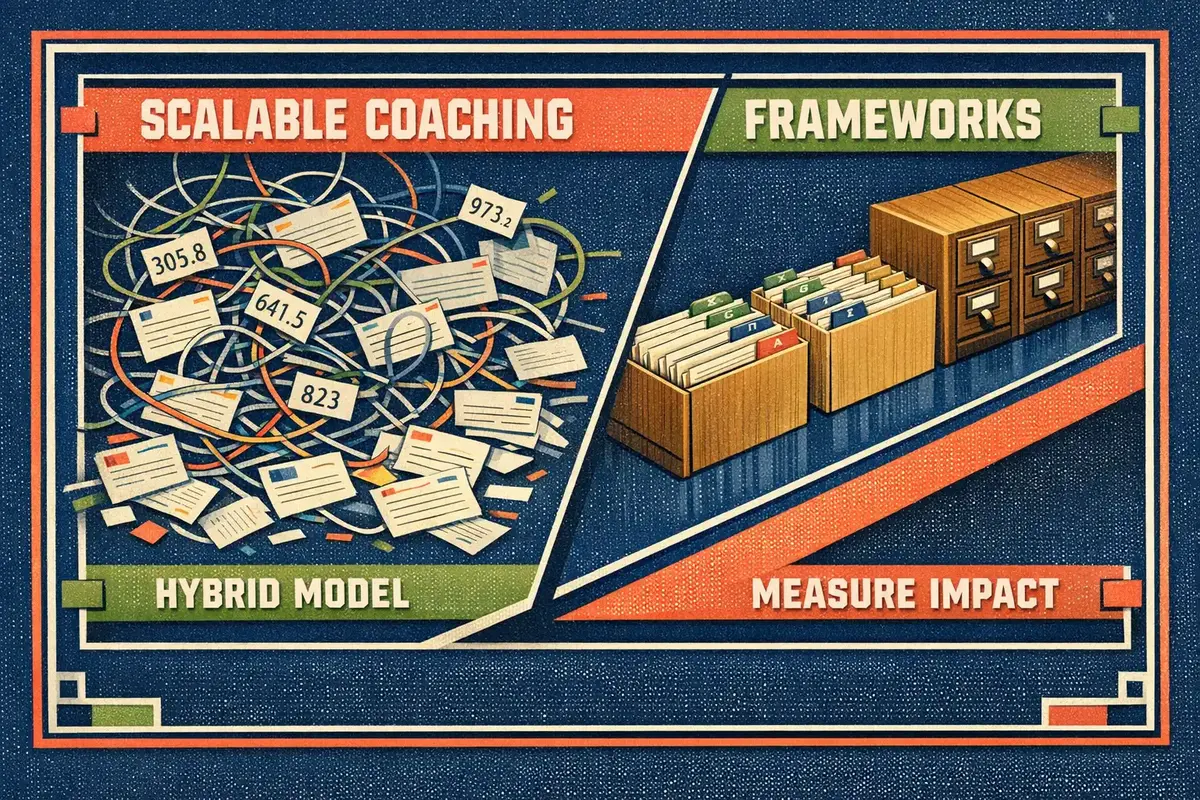
This is why the first 90 days carry outsized value. New leaders are not just absorbing information; they are forming default responses under pressure. If they practice avoidance in week three, over-explaining in week five, and weak delegation in week eight, those patterns harden quickly. If they get repeated support in those same moments, capability compounds just as fast.
Reinforcement is what makes training economically real
The World Economic Forum reports that the most common outcomes employers expect from training investment are enhanced productivity (77%) and improved competitiveness (70%) (World Economic Forum, 2025). Those are reasonable expectations. But they depend on transfer, not attendance.
Training creates potential value. Reinforcement determines whether any of it reaches the job.
That is where AI coaching fits best: not as the main event, but as the layer between formal sessions. Before a one-on-one, it can help a new manager clarify the point of the conversation. Before a team meeting, it can pressure-test the agenda. After a difficult exchange, it can prompt reflection while the details are still fresh. That between-session rhythm is what many high-potential development programs have been missing.
The practical question is no longer whether leaders need support after the workshop. They do. The harder question is narrower: which management behaviors are stable enough for AI to reinforce well in those first 90 days — and which ones still require a human coach in the room?
Which leadership behaviors can AI coach well in the first 90 days?
The Behavior Rehearsal Loop matters here because most organizations still treat early manager support as a knowledge problem, when the evidence points to a practice problem. They assume a new leader needs better advice; what often changes outcomes is the chance to rehearse a difficult conversation before it happens.
Take a first-time team lead at a regional financial services firm, two weeks before quarter-end. One analyst has missed deadlines twice, another is asking for more autonomy, and the new manager has a tense one-on-one in an hour. This is where AI coaching is strongest: not in solving leadership in the abstract, but in helping the leader prepare, test language, and think through tradeoffs while the stakes are still manageable.
The early wins are in repeatable management moves
The best first-90-day use cases are feedback conversations, delegation, one-on-ones, and goal-setting. These are not trivial behaviors. They are the operating core of the role, and they have clearer standards than more ambiguous people issues.
Culture Amp’s work on AI leadership coaching points in this direction: AI is most useful when it helps managers practice specific behaviors, reflect on likely reactions, and build consistency in how they show up day to day (Culture Amp, 2024). Cornerstone OnDemand makes a similar case for AI as a way to personalize development in the flow of work rather than relying on generic content alone (Cornerstone OnDemand, 2024).
A practical example: before that one-on-one, the manager can use AI to pressure-test the opening sentence, anticipate defensiveness, and separate observation from judgment. Before delegating a client report, they can clarify what outcome to assign, what authority to hand over, and what check-in cadence avoids either micromanaging or disappearing. Afterward, the same system can ask the useful question many managers skip: What did you say, how did they respond, and what will you do differently next time?
Where AI performs well — and where it does not
This is why prompting, rehearsal, and reflection matter more than raw advice. AIHR’s work on manager development consistently emphasizes coaching support that helps managers build habits through ongoing application, not just exposure to concepts (AIHR, 2024).
The strongest AI coaching use cases are behaviors you can describe, observe, and improve over repeated cycles.
Once the issue becomes politically sensitive, emotionally layered, or ethically unclear, the limits show fast. A new manager can rehearse feedback with AI. But if the real issue is identity, power, or trust after a team restructure, is that a repeatable coaching pattern — or a human judgment call?
Where should human coaching stay in the loop?
Some leadership calls should never be delegated to AI. The reason is simple: support can sharpen thinking, but judgment still carries human consequences.
You have seen the moment. A first-time director at a regional retail chain walks into a post-restructure meeting knowing one store manager feels sidelined, another is openly resistant, and the district VP wants a recommendation by end of day. In that room, the issue is not wording alone. It is power, history, credibility, and what happens after the conversation ends.
That boundary matters because many managers still lack the systems around them to make good calls under pressure. Deloitte found that 36% do not believe their organization has implemented technology solutions to help them perform these roles (Deloitte, 2025). But the answer is not to let technology become the final authority. It is to use it with clearer limits.
Support is useful. Final calls are not its job.
AI coaching can help a new leader sort facts from emotion, rehearse a difficult opening, or test whether feedback is specific enough. That is legitimate value. It becomes risky when the tool starts to feel like an arbiter on sensitive performance decisions, interpersonal conflict, promotion readiness, or whether someone should be exited.
Those are not pattern-matching problems alone. They involve incomplete information, organizational politics, legal risk, and moral weight. Ethisphere’s guidance on responsible AI is useful here: governance matters most where decisions affect people materially and where accountability cannot be blurred by automation (Ethisphere, 2024).
The line is clear: AI can prepare a leader for a hard conversation; it should not decide the outcome of that conversation.
This is the practical core of the AI coaching vs human coaching debate. Human coaches stay in the loop where the work is ambiguous, emotionally charged, or reputationally consequential.
Strong programs make escalation explicit
The best hybrid coaching models do not rely on instinct. They define escalation rules. If the issue involves possible bias, formal performance action, mental health concerns, team conflict with legal implications, or a career-defining decision, the leader is expected to involve a manager, HR partner, mentor, or human coach.
That clarity does two things. It prevents overreach, and it builds trust in the system itself.
Without those rules, AI becomes too easy to consult and too hard to challenge. With them, it becomes what it should be: a fast layer of reinforcement inside a governed development process. The next question is the one executives eventually ask anyway — if this hybrid model is the right design, how do you prove it is actually building readiness rather than just increasing activity?
How do organizations measure whether AI coaching is actually building readiness?
Up to 18% higher team engagement and 21% to 28% lower turnover is the kind of result management development can produce when it changes how managers actually lead (Gallup, 2022). So if AI coaching is worth adopting, what proof should leaders expect to see? And are most organizations even looking in the right place?
Too often, they are not. They track logins, prompt volume, completion rates, and satisfaction scores — useful operational data, but weak evidence of readiness.
Measure the moments that define the role
The better question is narrower: did first-time leaders become more capable in the moments that matter? That means measuring readiness behaviors, not just platform activity. Are one-on-ones happening consistently? Is feedback becoming more specific? Are delegation conversations clearer? Are escalations decreasing because managers are handling issues earlier and better?
In a regional services company during annual planning, a newly promoted director may use AI coaching heavily for six weeks. That tells you almost nothing on its own. What matters is whether their team meetings become more decisive, whether performance conversations happen on time, and whether cross-functional friction gets resolved without senior intervention. Usage is an input. Readiness is the outcome.
The test is not whether leaders used AI. It is whether they led better when the pressure was real.
Connect coaching to team and business signals
This is where many measurement models get too timid. Strong management is not a soft variable. Deloitte reports that companies with strong management show up to 15% higher financial performance than those with weaker management (Deloitte, 2025). If that is true, then AI coaching should be evaluated against downstream indicators that management quality influences: engagement, retention, execution, and performance.
Gallup’s meta-analysis is especially useful because it ties manager development to both manager and team effects. Managers who participated improved their own engagement by up to 22% more than nonparticipants, while their teams improved engagement by up to 18% more and saw 21% to 28% less turnover (Gallup, 2022). That gives organizations a practical scorecard: behavior change first, then manager confidence, then team outcomes.
Build a readiness dashboard, not a usage report
A credible dashboard should combine three layers: observed leadership behaviors, self-reported confidence in core manager tasks, and team-level indicators over time. That is how you tell whether AI coaching is building capacity rather than simply increasing activity.
Because once the numbers start moving, another question appears. Is the real value faster readiness — or something bigger, the kind of confidence that keeps compounding long after the first promotion?
The real promise of AI coaching is confidence that compounds over time
Organizations do not usually feel weak first-line leadership as a learning problem. They feel it in missed revenue, frayed trust, and good people deciding the role is not worth the strain.
That is why the real promise of AI coaching is not speed, novelty, or automation. It is a more reliable way to help new managers build confidence before a hard moment exposes what they cannot yet do alone.
A stronger pipeline is built in the margins
Consider a startup technology company heading into a client renewal. A newly promoted founder-turned-team-lead is not failing because they lack ambition. They are failing in smaller, quieter places: the feedback conversation they postpone, the delegation they over-control, the tense meeting they replay too late to improve.
This is where continuous support changes the trajectory. Used well, AI coaching gives first-time leaders a place to practice before the stakes peak and to reflect once the moment has passed. That rhythm matters more than most programs admit. The Center for Creative Leadership has argued that AI adds value in leadership development when it supports personalized practice and reflection inside a broader program, not when it tries to replace development itself (Center for Creative Leadership, 2024).
The compounding effect comes from repeated rehearsal, faster recovery after mistakes, and more deliberate choices the next time the pressure returns.
That is a different ambition from “deploying AI.” It is a design choice about how people grow.
From potential to performance, without the usual gap
Most high-potential development programs are still organized around events. Real readiness is built between events — in the week before a difficult one-on-one, in the hour after a client escalation, in the pattern a new manager forms under stress.
Research from the World Economic Forum points to a labor market where skills keep shifting and adaptation becomes part of the job itself (World Economic Forum, 2025). In that environment, development systems that depend on occasional intervention will keep arriving late. The better model is continuous reinforcement: formal learning for concepts, human coaching for ambiguity, and AI coaching for repetition in the flow of work.
Gallup’s work on manager development supports the larger point. Manager quality improves when development is treated as an ongoing practice rather than a one-time event, because behavior changes through reinforcement, not exposure alone (Gallup, 2022).
Design one system, not three disconnected supports
The strongest organizations will not ask whether AI should replace coaching. They will ask whether their support model actually fits how managers learn.
That means designing manager development as one system. AI for rehearsal and reflection. Human coaches for judgment-heavy situations. Direct managers who know how to reinforce expectations in real work. When those pieces connect, confidence stops being a personality trait and starts becoming an operating asset.
That is the central idea. AI coaching is a confidence engine and a reinforcement layer for first-time leaders, especially when it is embedded in a broader development system.
So the honest next step is simple: are you giving new leaders occasional advice, or a structure that helps confidence compound over time?
Key Takeaways
- First-time leaders often need support before pressure hits, not after performance problems appear.
- AI coaching works best as in-the-flow reinforcement for repeatable leadership behaviors.
- Human coaching should stay involved in ambiguous, sensitive, or high-stakes decisions.
- Readiness should be measured by behavior change and team outcomes, not just tool usage.
Frequently Asked Questions
What is AI coaching for first-time leaders?
AI coaching is conversational, context-aware support that helps new leaders think through a situation, rehearse what to say, and decide what to do next while work is happening. It is best used as a reinforcement layer, not as a replacement for training or human judgment.
Why do high-potential development programs need continuous reinforcement?
High-potential leaders often understand leadership concepts but struggle to apply them in live, messy situations. Continuous reinforcement helps new habits form during the first 90 days, when default behaviors are still being set under pressure.
Which leadership behaviors can AI coach effectively in the first 90 days?
AI coaching works well for repeatable behaviors such as feedback conversations, delegation, one-on-ones, and goal-setting. It is especially useful for rehearsal, prompting, and reflection before and after these interactions.
Where should human coaching stay involved instead of AI?
Human coaching should stay involved in ambiguous, emotionally charged, politically sensitive, or high-stakes decisions. AI can help prepare a leader, but it should not make final judgments about performance, conflict, promotion readiness, or exit decisions.
How can organizations measure whether AI coaching is building readiness?
The best measures focus on behavior change and team outcomes, not just tool usage. Useful indicators include more consistent one-on-ones, clearer feedback, better delegation, fewer escalations, stronger engagement, and lower turnover.