
Why High-Potentials Resist AI Coaching Until It Feels Safe
45% of U.S. employees now use AI at work at least a few times a year. Yet in a quarterly talent review, a high-performing director can still go quiet the moment an AI coaching pilot is mentioned.
That hesitation is not irrational. It is often the most intelligent response in the room.
AI use is rising, but organizational readiness is not keeping pace. Gallup found that usage moved from 40% to 45% between the second and third quarters of 2025, while 6 in 10 leaders say their companies are not ready to adopt AI effectively (Gallup, 2025). For high-potentials, that gap has a cost: if the system is unclear, the personal downside lands on them first — damaged credibility, awkward manager conversations, and one more tool that consumes attention without improving judgment. This article is built to answer that exact problem: why capable people resist, what makes that resistance reasonable, and how to earn adoption without forcing it.
The pattern shows up most clearly among high-potential employees because they have more to lose. Their reputation is already under scrutiny. Their communication style, decision quality, and readiness for bigger roles are being read closely by managers and peers.
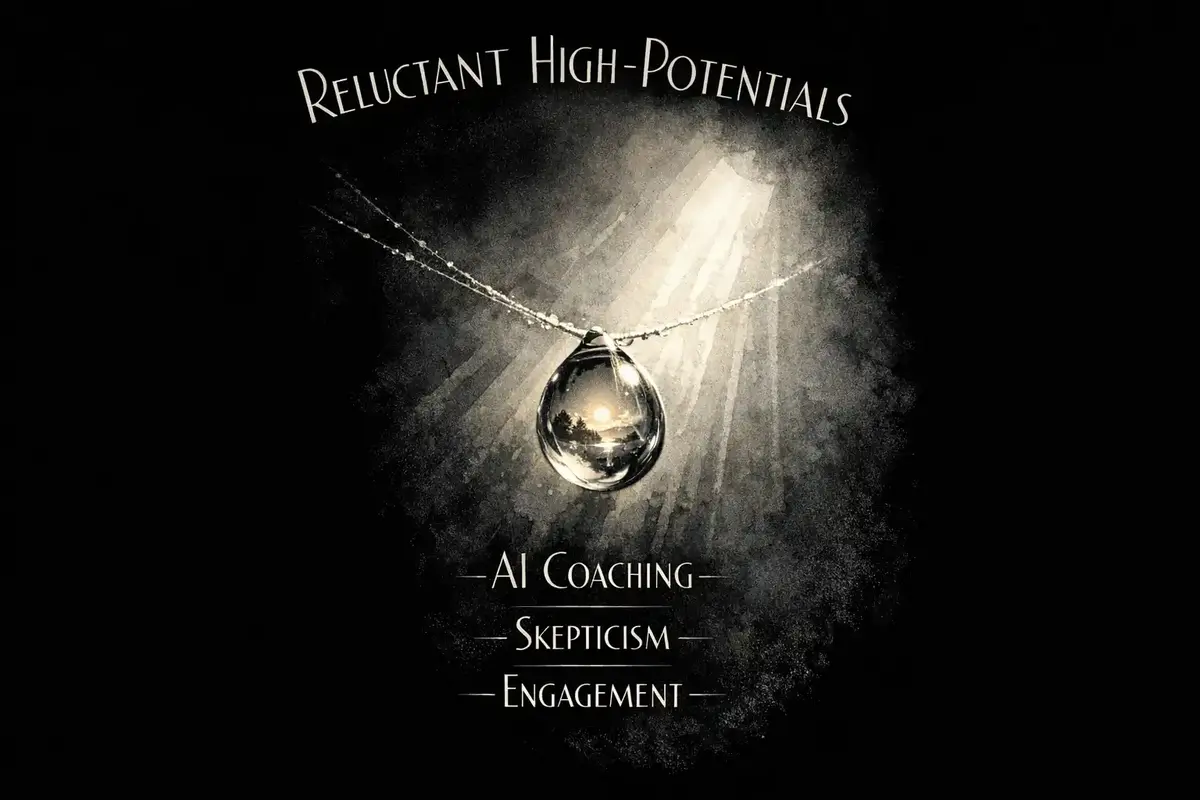
So when they question an AI coach, they are usually asking three practical questions. Will this give me generic advice dressed up as personalization? Will anyone else see what I ask, admit, or struggle with? And is this really support — or a softer form of monitoring?
Those concerns should shape the rollout, not be dismissed as resistance. In practice, adoption improves when AI coaching is framed as a private, low-friction support layer: a place to rehearse a difficult conversation, reflect after a tense meeting, or pressure-test a decision before the stakes rise. Not a substitute for managers. Not a replacement for executive coaching. A faster way to turn insight into action between human conversations.
6 in 10 leaders say their companies are not ready to adopt AI effectively (Gallup, 2025)
That is why trust comes first. If people suspect surveillance, they withhold. If they expect bland advice, they disengage. If they understand the tool as confidential practice space, they experiment.
The logic of this article follows that reality. We will clarify what AI coaching actually is, examine why skepticism is often rational, then move into rollout choices, manager behavior, and measurement. Because the real question is not whether AI coaching works in theory — it is whether your best people believe it is safe enough to use well.
What Is AI Coaching, and Why Does It Matter for High-Potential Employees?
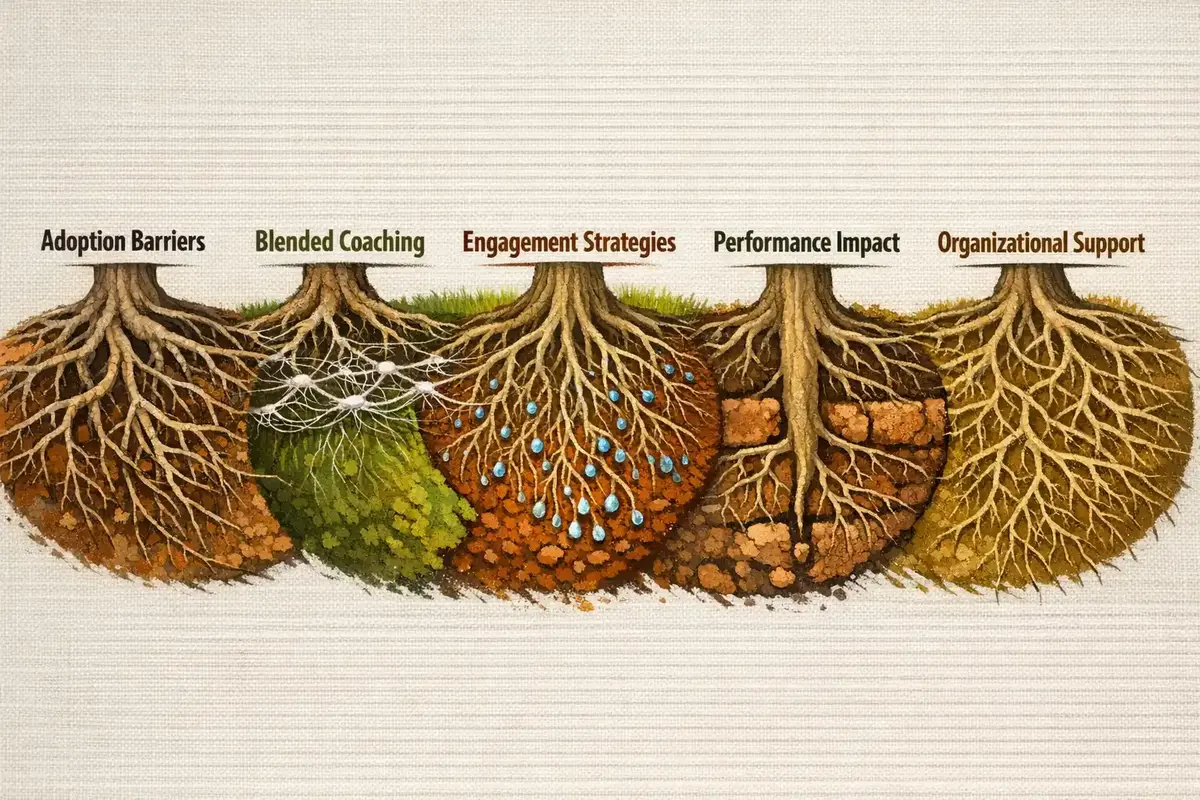
The blended-development model matters here because adoption rises or falls on one basic question: what exactly are people being asked to use? If employees hear “AI coaching” and picture an automated replacement for judgment, trust drops before the pilot even starts. If they picture a private practice layer that sits between real meetings, feedback, and human coaching, the decision looks very different.
That definition is not semantics. It is the product.
In plain language, AI coachingis an always-available developmental support layer that helps someone think through a situation, rehearse a response, and decide what to do next. Not therapy. Not performance management. Not a substitute for a skilled manager or executive coach. Its practical role is narrower and more useful: it gives employees a place to prepare between human moments, when the real work of behavior change usually gets lost.
The Real Value Is Repetition Without Exposure
Consider a director at a mid-market healthcare company heading into a quarterly review. She needs to challenge an operations VP without sounding defensive, and she does not want to test rough language in front of peers or wait two weeks for a coaching session. AI coaching matters in that moment because it compresses the cycle: reflect, rehearse, revise, act.
For high-potential employees, that is the value proposition. Not novelty. Speed, discretion, and repeated practice without social exposure.
This fits a broader workplace shift. McKinsey reports that 71% of organizations now regularly use generative AI in at least one business function, up from 65% in early 2024 (McKinsey, 2025). The implication is easy to miss: as AI becomes normal in workflow, employees will judge coaching tools less by technical sophistication and more by whether they help them perform under pressure.
71% of organizations regularly use generative AI in at least one business function, up from 65% in early 2024 (McKinsey, 2025)
Why the Human Distinction Changes Adoption
The most effective framing is simple: AI handles frequency; humans handle depth. An AI coach can help someone prepare for a difficult one-on-one at 10:30 p.m. A human coach can spot the identity pattern underneath that conflict and work it over time.
That distinction reduces unnecessary fear. It also matches user experience data: 96% said AI coaching provided customized coaching (The Conference Board). People do not need the tool to be human. They need it to be relevant, immediate, and safe enough to use honestly.
Misdefine it, and employees hear replacement. Define it well, and they see augmentation — a support layer, not a threat. But if skepticism persists even after the definition is clear, is that resistance to change — or evidence that the employees are reading the risks correctly?
Why Skepticism Is Often a Rational Response, Not a Change-Management Failure
1 in 10 leaders say they are fully prepared to adopt AI effectively. That should change how you read employee hesitation: what many firms call resistance may be a rational response to weak organizational readiness (Gallup, 2025).
Most organizations still treat low usage as a messaging problem. Explain the tool better. Ask managers to endorse it. Push one more reminder into the workflow. The evidence points somewhere less comfortable. If leadership itself is not confident about readiness, reluctance from high-potential employees is not a change-management failure. It is often a quality check.
High-Potentials Read the Political Risk Fast
For a high-potential employee, adoption is never just about utility. It is also about reputation, autonomy, and perceived competence.
A VP in a regional financial services firm, heading into a team restructure, will ask a different question than the average user: What does using this signal about me? If the answer is “I need help,” “my judgment is being watched,” or “my development is now being standardized,” skepticism rises for good reason. People being considered for bigger roles are unusually sensitive to anything that could flatten their distinctiveness or expose unfinished thinking too early.
That is why trust in coaching is not a soft issue. It is the operating condition for honest use.
Misread Reluctance Produces the Wrong Fix
Resistance gets sharper when AI coaching is introduced with the logic of compliance, surveillance, or a generic productivity rollout. The language gives it away: mandated activation, dashboard visibility, usage targets, enterprise efficiency. In that framing, the employee is not being supported. They are being processed.
6 in 10 leaders say their companies are not ready to adopt AI effectively (Gallup, 2025)
That Gallup finding matters because employees can usually feel the gap before leaders admit it. They notice when privacy boundaries are vague, when use cases are generic, and when the tool seems designed for reporting up rather than reflection inward. What looks like resistance to coaching is often a precise diagnosis: this does not fit my role, my risks, or my context.
Diagnose Before You Drive Adoption
The practical move is simple. Do not start by asking how to increase usage. Start by asking what kind of reluctance you are seeing.
Is it a trust problem — who sees what? A clarity problem — what is this for? A relevance problem — why would this help in my actual decisions? Or a role-fit problem — does this work differently for a director, a VP, and a first-line manager?
Get that wrong, and every rollout tactic feels like pressure. Get it right, and the same skeptical employee may engage quickly. But how do you introduce AI coaching in a way that lowers threat rather than confirming it?
How Do You Introduce AI Coaching Without Triggering Defensiveness?
A bad rollout burns value fast. It erodes trust, slows decision-making, and can push a strong future leader to disengage just when the business needs more judgment from them, not less.
Picture a newly promoted director at a regional retail company, walking into a post-holiday review after a bruising stretch assignment. Her manager says, “We want you to start using this AI coach so we can scale development and track progress.” The meeting is over in that moment. She may nod, but what she heard was evaluation, not support.
Start With the User’s Risk, Not the Tool
The first introduction should lead with autonomy, privacy, and usefulness. Not features. Not platform language. Not a tour of prompts.
A better opening sounds like this: You’ll decide whether and when to use it. Your private reflection stays private. The point is to help you think through hard moments before they become expensive ones. That framing lowers threat because it answers the employee’s real question: What happens to me if I use this honestly?
This matters more now because organizations are moving quickly to build AI capability. The World Economic Forum reports that employers broadly plan to upskill workers for AI use, which means employees will hear many AI messages in the months ahead (World Economic Forum, 2025). If your message sounds like every other enterprise push, skeptical high-potentials will file it under compliance and move on.
The first framing decides whether AI coaching feels like protected practice or quiet scrutiny.
Manager Language Sets the Meaning
The manager’s words do not just introduce the tool. They define its social meaning.
Say “this will help us see where you need development,” and the tool becomes a diagnostic device. Say “this gives you a place to prepare for tough conversations before stakes rise,” and it becomes a practice space. That distinction is the hinge.
Research from PwC shows how quickly AI agents are entering companies (PwC, 2025). In that environment, employees are already alert to where automation may expand from assistance into assessment. That is why manager coaching matters so much here: managers need scripts, yes, but more importantly they need judgment about what not to imply.
The strongest rollout language is modest. It does not promise better performance overnight. It does not present AI coaching as a shortcut to readiness. It positions the tool as a place to reflect, rehearse, and act with more intention — especially between meetings, after conflict, or before a difficult call. That is how you improve coaching adoption without pressure.
But even the right message can be undone by the wrong manager behavior. When skepticism turns into experimentation, what does the manager do next — and what quietly kills it?
Which Manager Behaviors Turn Skeptics Into Early Adopters?
The Manager-as-Translator model matters because 78% of organizations now use AI in at least one business function (McKinsey, 2025). Without that translation layer, AI coaching gets filed as one more corporate system — and skeptics stay skeptical.
If AI is already common, why do manager behaviors still decide adoption? Because employees do not adopt abstractions. They adopt what their manager makes socially safe to try.
Permission Before Enthusiasm
The first behavior is simple and often missed: normalize experimentation without prescribing it. Strong managers say, in effect, this is available, not required; useful for practice, not a test of commitment. That lowers the reputational risk that high-potentials feel first.
This is where many rollouts fail. A manager who pushes too hard turns a developmental tool into a signal of deficiency. A manager who uses it lightly — “I tried it to prepare for a difficult stakeholder conversation; it helped me tighten my opening” — does something more credible. They model use without performing evangelism. In manager coaching, that is the difference between endorsement and pressure.
A regional manufacturing VP heading into a budget-cycle conflict with operations does not need a lecture on AI. She needs a manager who can say, use it if you want to rehearse the trade-off conversation before Friday. Specific moment. Clear boundary. Low friction.
78% of organizations use AI in at least one business function, up from 72% in early 2024 (McKinsey, 2025)
Tie the Tool to Real Growth Moments
High-potentials engage when managers connect AI coaching to recognizable pressure points: preparing feedback for a struggling direct report, reflecting after a stretch assignment, or resetting after a client escalation. Not general development. Immediate developmental work.
That specificity matters more as AI becomes routine. 71% of organizations now regularly use generative AI in at least one business function (McKinsey, 2025). The implication is practical: employees no longer need proof that AI exists; they need proof that this use of AI helps them handle better judgment calls.
The best managers also clarify the split inside a blended coaching model. AI handles repetition, rehearsal, and reflection. Humans handle context, politics, and consequences. That line protects the tool from overclaiming and protects the employee from using it where human judgment is still essential.
That is what turns curiosity into early adoption. But usage alone proves very little. Is the employee actually changing behavior — or just spending more time in a new interface?
How Do You Measure Whether AI Coaching Actually Changed Behavior?
A regional services director finishes a tense quarterly review and tells you the AI coaching pilot is “getting traction.” When you ask what changed in the room — better feedback, cleaner decisions, fewer avoidable escalations — the answer is a dashboard of logins.
That is the measurement trap.
Gallup found that AI use at work rose from 40% to 45%, with frequent use moving from 19% to 23% and daily use from 8% to 10% between the second and third quarters of 2025 (Gallup, 2025). Useful context, but not proof of developmental impact. Rising use tells you the tool is becoming normal. It does not tell you whether people are thinking better, acting differently, or trusting the experience enough to use it honestly.
Measure Four Things, Not One
A practical framework is trust, return, reflection, and response.
Trust asks whether people feel safe enough to bring real situations into the tool. If candor is low, the coaching will stay generic no matter how advanced the system is. This is where trust in coaching becomes measurable: short pulse questions on privacy confidence, perceived usefulness, and willingness to use the tool for a politically sensitive moment.
Return is repeat engagement with purpose. Not raw volume. A director who comes back before a client escalation, after a difficult one-on-one, and ahead of a promotion-panel conversation is showing a stronger signal than someone who logs in ten times in one week and never again.
Reflection looks at quality. Are users naming a real trade-off, testing language, and clarifying next steps — or just asking for generic advice? You do not need invasive transcript review to see this. Simple self-checks after a session can ask whether the conversation sharpened the issue, changed the planned approach, or surfaced a risk the user had missed.
Look for Observable Movement
The most credible evidence sits outside the platform. Did self-reported confidence rise before a hard conversation? Did the manager observe a behavior shift — clearer delegation, less defensiveness, better follow-through? Did the employee participate more effectively in key development moments that matter to the business?
That is how you prove value without turning coaching adoption into surveillance. Measure patterns, not private content. Track behavior, not confession.
Because the fastest way to kill a promising program is to measure it like a monitoring system. And once leaders start proving impact, a harder question appears: how do you protect reputation while scaling something that clearly works?
Why the Best AI Coaching Programs Protect Reputation and Expand Human Potential
Bad AI coaching programs do real damage. They erode trust, slow decisions, and push strong people to protect themselves instead of growing.
What changes when leaders stop treating reluctance as a barrier and start treating it as a design requirement? The entire program gets better. Not just adoption.
Safety Is the Design Standard
The most durable programs are built around psychological safety, not operational efficiency. That sounds obvious until you see how many rollouts are still designed for scale first — broad access, fast activation, visible usage — and only later ask whether ambitious employees feel safe enough to use the tool honestly.
That sequence is backwards.
In a technology startup during a product reset, a founder asks a senior team lead to use AI coaching before difficult cross-functional meetings. The tool is framed as support, but the team lead cannot tell whether rough thinking stays private or becomes part of a broader talent picture. So he uses it carefully, asks bland questions, and gets bland value back. The failure is not the employee’s reluctance. It is the design.
The better programs assume that reputation protection is part of development. They make boundaries explicit. They separate reflection from evaluation. They reinforce that the tool exists to help someone think, rehearse, and decide — not to create one more stream of managerial visibility. That is where trust in coaching stops being a principle and becomes an operating choice.
Reluctance Is Diagnostic
Leaders often treat hesitation as friction to remove. In practice, it is often the cleanest feedback they will get.
If high-potentials hesitate, they are usually pointing to something real: unclear privacy rules, weak role fit, vague use cases, or a rollout that sounds more like standardization than support. Research consistently shows that AI adoption will keep expanding across the workforce, and the World Economic Forum notes that employers broadly plan to build AI capability through workforce upskilling (World Economic Forum, 2025). That makes the signal more valuable, not less. As AI becomes more common, employees get faster at spotting where a tool is well designed and where it is merely well marketed.
Listen closely and reluctance tells you what to fix.
From Skeptics to Credible Champions
When AI coaching works, high-potentials do not become champions because they were persuaded. They become champions because the tool helped them grow privately, act faster, and stay in control of their own development.
That is a very different kind of advocacy. Quiet. Credible. Hard to fake.
A strong program expands human potential by protecting the conditions under which people will actually use it well: candor, discretion, and choice. If your best people still seem hesitant, the question is not whether they need a stronger push. It is whether your design has earned their trust yet.
Key Takeaways
- High-potentials resist AI coaching when it feels unclear, exposed, or tied to evaluation.
- AI coaching works best as a private, low-friction practice layer between human conversations.
- Skepticism is often rational when organizational readiness and privacy boundaries are weak.
- The strongest programs protect reputation, normalize experimentation, and measure real behavior change.
Frequently Asked Questions
What is AI coaching in the context of employee development?
AI coaching is an always-available support layer that helps employees reflect, rehearse, and decide how to handle work situations. It is best understood as a private practice space between human conversations, not a replacement for managers, executive coaches, or performance management.
Why do high-potential employees often resist AI coaching?
High-potential employees often resist AI coaching because they have more to lose if the tool feels unsafe, generic, or tied to evaluation. Their hesitation is often rational when privacy is unclear, the use case is vague, or the rollout seems more like monitoring than support.
How should organizations introduce AI coaching without creating defensiveness?
The rollout should lead with autonomy, privacy, and usefulness rather than features or mandates. Employees are more likely to engage when they understand that the tool is optional, confidential, and meant to help them prepare for difficult moments before the stakes rise.
What manager behaviors increase adoption of AI coaching?
Managers increase adoption when they normalize experimentation, avoid making the tool feel mandatory, and connect it to real pressure points such as feedback conversations, stretch assignments, or stakeholder conflict. They should also clarify that AI handles repetition and rehearsal, while humans handle context, politics, and consequences.
How can you tell whether AI coaching is actually changing behavior?
Behavior change is measured by trust, repeat use for meaningful situations, quality of reflection, and observable movement in real work. Strong evidence includes better preparation, clearer decisions, improved follow-through, and more effective participation in difficult conversations, not just higher login counts.