

Why the coaching waitlist is now a leadership risk
71% of global CEOs and 78% of senior executives believe AI will increase their value in the next three years. Yet the leadership moment that needs support most often arrives before a coach does (Korn Ferry, 2025).
You know the scene. A VP in a mid-market technology company walks out of a bruising quarterly review, needs to reset a failing performance conversation with a key director, and hears that the next coaching slot is in twelve days. By then, the conversation has already happened — badly — and the cost is no longer developmental. It is operational.
That is the real issue with coaching waitlists. They do not simply delay reflection. They delay decisions, feedback, repair, and recovery after the moments that shape trust and execution.
The bottleneck is timing, not belief in coaching
The market signal is clear: leaders are open to AI support, but many organizations are still struggling to turn AI interest into practical value. PwC found that 56% of CEOs say they have realized neither revenue nor cost benefits from AI (PwC, 2026). One reason is simple: too many AI discussions stay abstract, while the access problem in leadership development is immediate and concrete.
56% of CEOs say they’ve realised neither revenue nor cost benefits from AI (PwC, 2026)
When coaching is unavailable at the point of need, managers improvise. They postpone a difficult conversation. They overcorrect in public. They carry a board-level setback into the next team meeting. A week later, the original issue has spread into morale, retention risk, or slower execution. This article addresses that gap directly: why AI coaching matters first as an access solution, not as a shiny new category.
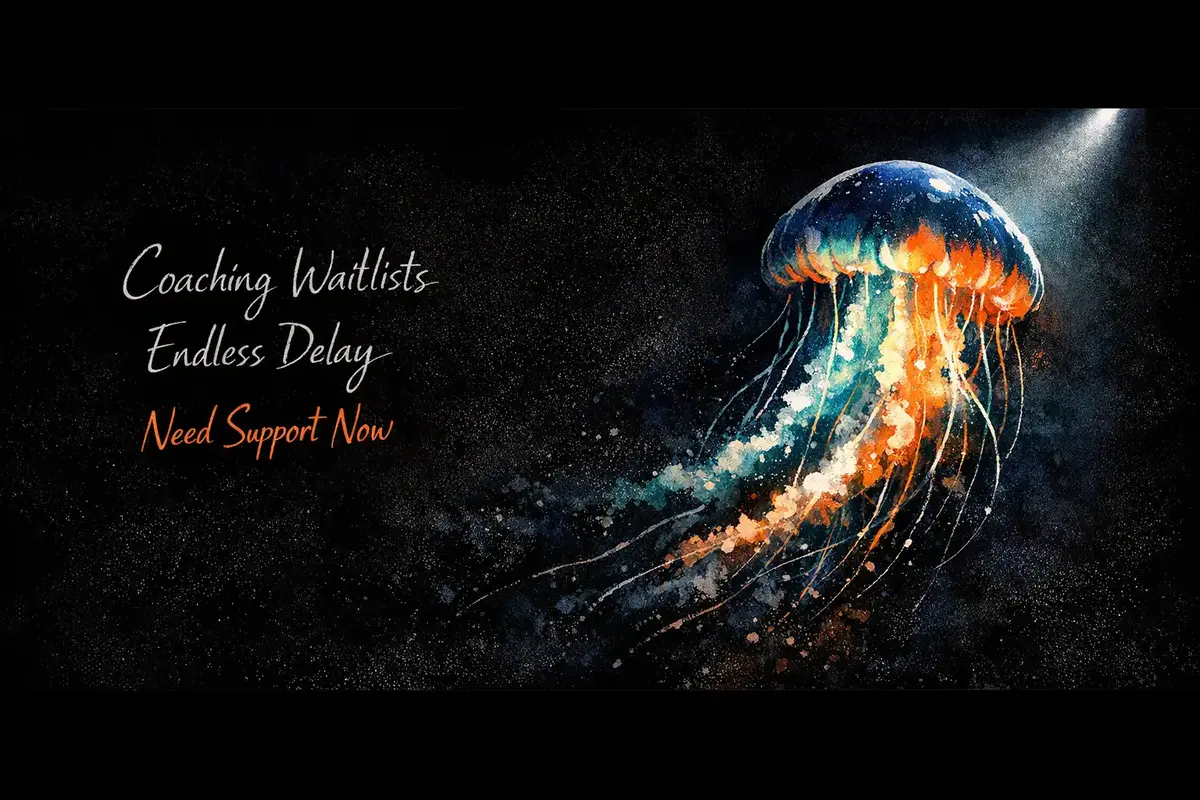
A supply-and-demand problem has become a leadership problem
This is not an argument against coaching. Quite the opposite. High-quality human coaching remains scarce because it is valuable, intensive, and hard to scale well. The problem is structural: demand for support now exceeds the supply of timely support.
That distinction matters. If leaders treat the waitlist as a minor scheduling annoyance, they miss the business risk hiding inside it. Leadership development is no longer only about who gets the best coach. It is also about who gets help in time to change the outcome.
AI coaching enters here with a practical promise: immediate support in the gap between event and response. Not replacement. Not magic. Access.
And that raises the next question executives should ask before they buy into the category or dismiss it: if this is not just another chatbot, what exactly makes AI coaching feel useful when the pressure is real?
What is AI coaching, and why does it feel different from a chatbot?
The just-in-time coaching framework matters here because it forces a harder question: if support arrives instantly, is it still coaching — or just faster software?
That is where many executives get stuck. They hear “AI” and picture a generic prompt box producing polished but shallow answers. Reasonable assumption. Wrong category.
AI coaching is best understood as guided, interactive support for reflection, preparation, and decision-making in live leadership moments. It is not simply a tool that gives information. It is a system designed to help a leader think better: clarify what happened, test interpretations, rehearse a difficult conversation, and choose a next move under pressure.
A simple way to separate the categories
The cleanest way to understand the space is to use three buckets.
A generic chatbot answers questions. Ask it for feedback tips, a meeting agenda, or a draft email, and it will usually comply. Useful, sometimes. But it does not reliably hold a developmental thread across leadership situations.
A coaching assistant helps a human coach do the work. It may summarize notes, track goals, suggest prompts, or organize session prep. The center of gravity is still the human coach.
AI coaching sits in a different place. It interacts directly with the leader and is built around a coaching process rather than a content request. That difference matters in practice. A director in a regional healthcare system preparing for a team restructure does not just need “talking points.” She needs to sort signal from emotion, pressure-test her assumptions, and rehearse how to deliver clarity without triggering avoidable resistance.
That is coaching behavior, not chatbot behavior.
| Category | What it does | Who it serves | Core role |
|---|---|---|---|
| Generic chatbot | Answers questions | Anyone asking for information | Content request |
| Coaching assistant | Supports a human coach | Coach and leader | Session support |
| AI coaching | Interacts directly with the leader | Leader | Coaching process |
Why it feels useful in the flow of work
The real advantage is not novelty. It is timing.
Just-in-time coaching means support appears inside the work itself — before the budget review, after the client escalation, between two tense meetings — not only in a scheduled session next Thursday. That changes the felt experience from “development activity” to “decision support.”
Deloitte’s 2025 Global Human Capital Trends research drew input from respondents across 93 countries, which is a useful reminder that this is not a narrow market experiment but a broad leadership context shift (Deloitte, 2025). Leaders are operating in more varied, faster-moving environments. Continuity matters more than ceremony.
Used well, AI coaching becomes the bridge between human sessions. It helps a leader capture the moment while it is still warm, get immediate feedback, and return to the human coach with sharper patterns and better questions.
But if access is now possible at scale, a harder issue appears. Why have waitlists persisted for so long — even in organizations that can afford almost anything?
Why do executive coaching waitlists persist even in well-funded organizations?
35% of workers report feeling overwhelmed at least once a week. That matters because most organizations still design coaching access as if leadership support can wait for a calendar opening (PwC, 2026).
The common assumption is simple: if the budget is there, the bottleneck should disappear. Buy more executive coaching, add a few external providers, and the queue should shrink. In practice, it rarely works that cleanly.
Scarcity is built into the model
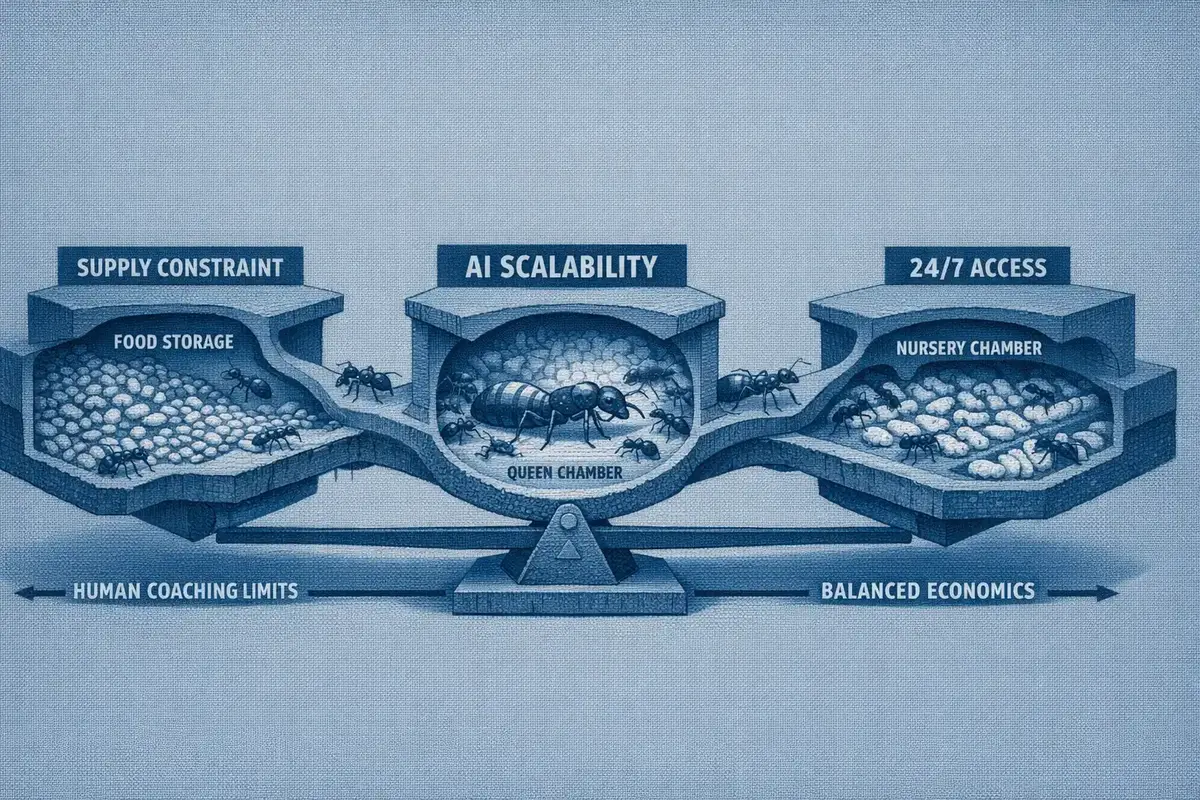
The constraint is structural. 1:1 coaching depends on finite human hours, fixed session lengths, and the friction of coordinating two busy schedules around moments that are rarely predictable. A leader does not need support only on Tuesdays at 3 p.m. They need it after the board prep goes sideways, before a reorg announcement, or in the 20 minutes between a client escalation and the follow-up call.
That mismatch compounds fast. Demand rises not in a smooth line but in spikes — during restructures, strategy shifts, promotion waves, and periods of uncertainty. PwC reports that only 30% of CEOs are confident about revenue growth in the next 12 months (PwC, 2026). When confidence tightens, pressure moves downward through the organization, and more leaders seek support at the same time.
A regional manufacturing VP feels this in a very concrete way during budget season. Three plant leaders need help handling performance tension, one newly promoted director is struggling to project authority, and the VP herself has to reset a strained relationship with finance before the next operating review. The company can afford coaching. It still cannot create three extra weeks of coach capacity on demand.
The waitlist is an architecture problem
This is why waitlists should not be read as evidence that coaching is failing. They are evidence that the delivery architecture is narrow. High-value support is being routed through a format that does not expand easily.
Korn Ferry adds another layer: 43% of senior executives struggle with impostor syndrome (Korn Ferry, 2025). That matters because many leaders delay asking for help until the issue is already acute. By the time they reach out, they do not need a thoughtful appointment in ten days. They need a thinking partner now.
43% of senior executives struggle with impostor syndrome (Korn Ferry, 2025)
Why AI changes the economics
AI coaching changes the equation by removing the scarcest input: synchronized human time. It can be available instantly, used repeatedly, and revisited in short bursts without creating another scheduling chain.
That does not make human coaching less valuable. It makes access less fragile. The real question is not whether every leadership moment deserves a human coach — it is which moments need one first, and which are better served immediately by AI.
Which leadership moments are best handled by AI coaching first?
14% of workers already use GenAI daily at work, which means the real risk is no longer unfamiliarity. It is letting revenue slip, trust fray, and good people walk because a leader needed help before the meeting started, not after the next coaching slot opened (PwC, 2026).
The best first use cases for AI coaching are not the most profound ones. They are the most time-sensitive.
Start where timing matters more than depth
Picture a director at a regional services firm, 30 minutes before a client recovery call. A delivery miss has triggered an executive complaint, her account lead is defensive, and she needs to decide whether to push accountability hard or stabilize the relationship first. This is exactly where AI coaching earns its place: performance conversation prep, decision support, and fast rehearsal under pressure.
In these moments, the leader usually does not need a breakthrough about identity. They need sharper judgment. They need to test language, anticipate reactions, and avoid making a tense situation worse. A strong performance conversation coaching flow can help a manager separate facts from assumptions, choose a tone, and walk into the room less reactive.
That is a different job from deep developmental work. And often, it is the right one.
Four moments where AI should go first
First, pre-conversation rehearsal. Before a promotion discussion, reset meeting, or corrective feedback exchange, AI can help a leader script the opening, pressure-test phrasing, and prepare for likely pushback.
Second, post-meeting debriefs. Right after a board update or team conflict, memory is fresh. AI can help capture what happened, identify where the leader got hooked emotionally, and define a cleaner second move while the situation is still recoverable.
71% of global CEOs and 78% of senior executives believe AI will bolster their value over the next three years (Korn Ferry, 2025)
Third, decision support in ambiguous moments. Not strategy formation at the highest level, but the practical call between two imperfect options — escalate now, wait 24 hours, address the issue privately, or bring in HR.
Fourth, crisis-adjacent reflection. Not the crisis itself, but the hour after a public setback, client loss, or internal flare-up, when a leader needs to slow down enough to avoid compounding the damage.
Use AI around human coaching, not instead of it
In many cases, the best place for AI is between human sessions. Before the session, it helps the leader arrive prepared. After the session, it reinforces commitments, rehearses behavior, and keeps momentum from fading into good intentions.
That is the practical map: use AI first when urgency is high and psychological complexity is moderate. But what about the moments that cut deeper — shame, identity, grief, power, rupture? That is where the boundary matters most.
When should human coaching still lead the conversation?
The Depth-and-Decision Boundary is the framework that matters here. Without it, organizations either over-assign AI to conversations it should not carry, or underuse it where speed would clearly help.
The boundary is simple: when the issue is mainly about preparation, repetition, or immediate reflection, AI can lead; when it is about identity, emotion, conflict, or consequential judgment, human coaching should lead the conversation.
Where human coaches still have the advantage
Consider a C-suite leader in an enterprise retail business during a market shift. Revenue pressure is rising, two direct reports are openly misaligned, and the CEO is no longer asking for better execution but quietly questioning whether this leader is still the right fit. That is not a scripting problem. It is a meaning-making problem.
A human coach is better equipped to work inside ambiguity without rushing to closure. They can hear contradiction, track what is said and what is avoided, and notice when a leader is defending competence at the expense of learning. In moments like this, the work is not just behavioral. It is relational and interpretive.
That matters more now because trust is already under strain.
66% of CEOs faced stakeholder trust concerns in the last year (PwC, 2026)
When trust, reputation, or role legitimacy is in play, coaching is not only about choosing the next sentence. It is about understanding what the moment is asking of the leader.

The right model is hybrid, not ideological
This is why human vs AI coaching is the wrong fight. The stronger design is hybrid: AI for frequency and follow-through, human coaching for depth and interpretation.
Used well, AI can help a leader prepare for a hard conversation, capture reactions after it, and test options before the next move. Human coaching then steps in where nuance matters most — power dynamics, grief after a failed promotion, recurring conflict, or the identity shift that comes with a bigger role.
That distinction is also practical for HR and L&D. PwC found that 56% of CEOs say they’ve realised neither revenue nor cost benefits from AI (PwC, 2026). One reason is predictable: firms automate the visible layer and ignore the judgment layer.
A clear boundary prevents that mistake. But drawing the line on paper is easier than introducing it in a way managers actually trust—so how do you roll out AI coaching without creating a second kind of confusion?
How can HR and L&D introduce AI coaching without creating confusion?
92% of respondents in Brazil said learning opportunities are a reason they stay with their organization. For HR and L&D, that changes the brief: introducing coaching support is not only a development decision, but a retention decision (Korn Ferry, 2025).
A finance director has just asked HR a practical question: when should my managers use this, and when should they call a person? If the answer is vague, adoption stalls before it starts.
Start with boundaries, not enthusiasm
The cleanest rollout begins with use-case clarity. Define the moments where AI coaching is the first line of support — meeting prep, post-conversation reflection, rehearsal before feedback, short decision check-ins — and define the moments that escalate to a human coach, HR partner, or manager.
This is where many launches go wrong. They introduce a capability before they introduce an operating model. Managers then fill the gap with assumptions: Is this for performance issues? Sensitive team conflict? Career questions? Confusion does not come from the tool. It comes from unclear boundaries.
A regional healthcare provider rolling this out to frontline leaders would be wise to start small: shift handoff tensions, difficult peer conversations, and preparation for 1:1s. Low-risk, high-frequency moments. Not grievance-adjacent situations. Not breakdowns involving trust or role risk.
Governance is what makes adoption credible
Trust is not a communications problem. It is a governance problem.
Leaders need plain answers on privacy, data handling, escalation paths, and whether coaching interactions feed performance management. If those lines blur, usage will become performative or disappear entirely. Deloitte’s 2025 Global Human Capital Trends research spans 93 countries, which is a useful reminder that implementation has to work across different legal, cultural, and managerial contexts — not just in a pilot-friendly headquarters environment (Deloitte, 2025).
93 countries are represented in Deloitte’s 2025 Global Human Capital Trends research (Deloitte, 2025)
The practical test is simple: can a manager explain, in one minute, what this is for, what it is not for, and what happens if a situation crosses the line?
Put it inside the work, then phase it
Do not launch AI coaching as another destination platform. Put it where leadership work already happens: before quarterly reviews, after team restructures, inside manager development journeys, and between human coaching sessions.
Then phase the rollout. Start with one population, one set of scenarios, and one success measure — faster preparation, better follow-through, fewer stalled conversations. Expand only after managers trust the boundary and see the value.
That is the real implementation question: will AI coaching become part of leadership rhythm — or just another HR tab people forget exists? The answer determines whether continuity becomes real, or remains a slideware promise.
The real promise of AI coaching is continuity, not replacement
Revenue is lost when leaders hesitate in the moment, trust erodes when they improvise badly, and strong people leave when hard conversations keep getting deferred. If coaching is meant to help leaders act better in real time, support cannot exist only as a future appointment.
That is why the real value of AI coaching is not substitution. It is continuity.
Keep development alive between the moments that matter
Picture a founder at a mid-market services firm in the middle of a tense budget cycle. A key operator has just challenged her priorities in front of the leadership team, she has to reset the relationship before the next review, and her usual coach is not available until later in the week. The risk is not just a bruised ego. It is a slower decision, a weaker message, and a team that starts reading uncertainty at the top.
In that gap, AI can keep development moving. It can help the founder sort reaction from judgment, rehearse the next conversation, and return to a human coach with a cleaner account of what actually happened. That is a better use of both forms of support.
Research from Korn Ferry shows how common internal doubt remains among senior leaders, with many still wrestling with impostor syndrome even at high levels of responsibility (Korn Ferry, 2025). PwC’s latest CEO research points to a similarly unforgiving context, with confidence on near-term growth still under pressure (PwC, 2026). In that environment, stalled development is not neutral. It compounds.
The better question is match, not choice
The future is likely hybrid coaching. AI handles immediacy — the preparation, the reflection, the follow-through. Humans handle depth — identity, conflict, grief, power, and the harder meaning-making work.
That model reduces friction without stripping out the relational value that makes executive coaching matter in the first place. It also asks more of the organization: not AI or human — that is the lazy question — but what kind of support does this leader need right now?
A useful mental model is simple: AI for immediacy, humans for depth, and both for continuity. If that is true in your context, what would you change first — the technology, or the way support is timed?
Key Takeaways
- Coaching waitlists are a timing problem that can become an operational and leadership risk.
- AI coaching is best used for immediate support, preparation, reflection, and decision support in live work moments.
- Human coaching should lead when the issue involves identity, emotion, conflict, or consequential judgment.
- The strongest model is hybrid: AI for access and continuity, humans for depth and interpretation.
Frequently Asked Questions
What is AI coaching in executive development?
AI coaching is guided, interactive support that helps leaders reflect, prepare, and make better decisions in real work moments. It is designed to help with thinking, rehearsal, and immediate feedback rather than simply answering questions or providing static advice.
Why are coaching waitlists a leadership risk?
Coaching waitlists become a risk when support arrives after the critical moment has passed, because delays can affect feedback, trust, performance, and recovery from mistakes. When leaders cannot get help in time, small issues can quickly turn into operational problems.
How is AI coaching different from a chatbot or a coaching assistant?
A generic chatbot answers questions, and a coaching assistant supports a human coach with tasks like notes or prompts. AI coaching directly engages the leader in a coaching process, helping them think through a situation, test assumptions, and prepare actions under pressure.
Which leadership situations are best for AI coaching first?
AI coaching is especially useful for time-sensitive situations such as preparing for difficult conversations, debriefing right after a tense meeting, checking decisions in ambiguous moments, and reflecting after a setback. These are cases where speed and clarity matter more than deep identity work.
When should human coaching still lead instead of AI coaching?
Human coaching should lead when the issue involves identity, emotion, conflict, trust, or high-stakes judgment. In those situations, the work requires deeper interpretation, relational awareness, and nuanced support that goes beyond immediate preparation or reflection.