
Continuous feedback loops in AI coaching are structured processes that systematically collect, analyze, and integrate user feedback with emerging research to refine coaching recommendations—transforming static AI models into adaptive systems that improve with use. Gartner research indicates that AI coaching platforms with quarterly feedback integration show 40% improvement in user perceived relevance compared to static versions. This article outlines how to establish feedback infrastructure, prioritize refinement requests, and measure impact—enabling your AI coaching system to evolve with your organization’s changing needs rather than remain frozen at launch. The ICF/PwC Global Coaching Study confirms that executive coaching delivers an average ROI of 529%, with organizations reporting measurable improvements in leadership effectiveness and business outcomes.
Continuous feedback loops in AI coaching are structured processes that collect, analyze, and integrate new research, practitioner insights, and user feedback to refine coaching algorithms over time. This approach is essential for organizations and professionals who want their AI-powered coaching tools to remain methodologically sound, ethically robust, and aligned with the latest industry standards. By the end of this article, you’ll understand how these feedback mechanisms work, why they matter, and how they ensure that platforms like AI Coach System don’t just keep pace with change—they help drive it. Deloitte research shows that organizations with strong coaching cultures report 21% higher profitability, demonstrating the direct business impact of investing in people development.
Why Is Continuous Feedback the Backbone of Lasting Coaching Excellence?
Most teams assume that once an AI coaching platform is trained and deployed, it will simply “get better” as more people use it. But research and industry practice reveal a more nuanced reality: lasting excellence in AI coaching depends on a deliberate, ongoing feedback loop that actively integrates new knowledge, not just passive data accumulation. Without this, coaching models quickly become stale, missing out on emerging best practices and the subtleties of evolving workplace cultures.
Sales organizations that use AI in their coaching activities achieve 3.3x year-over-year growth in quota attainment (ValueSelling Associates, 2026).
That kind of impact doesn’t come from “set it and forget it” systems. It’s the result of platforms that are continuously refined—drawing on practitioner expertise, user experiences, and the latest research to adapt their models in real time.
What Is a Feedback Loop in AI Coaching?
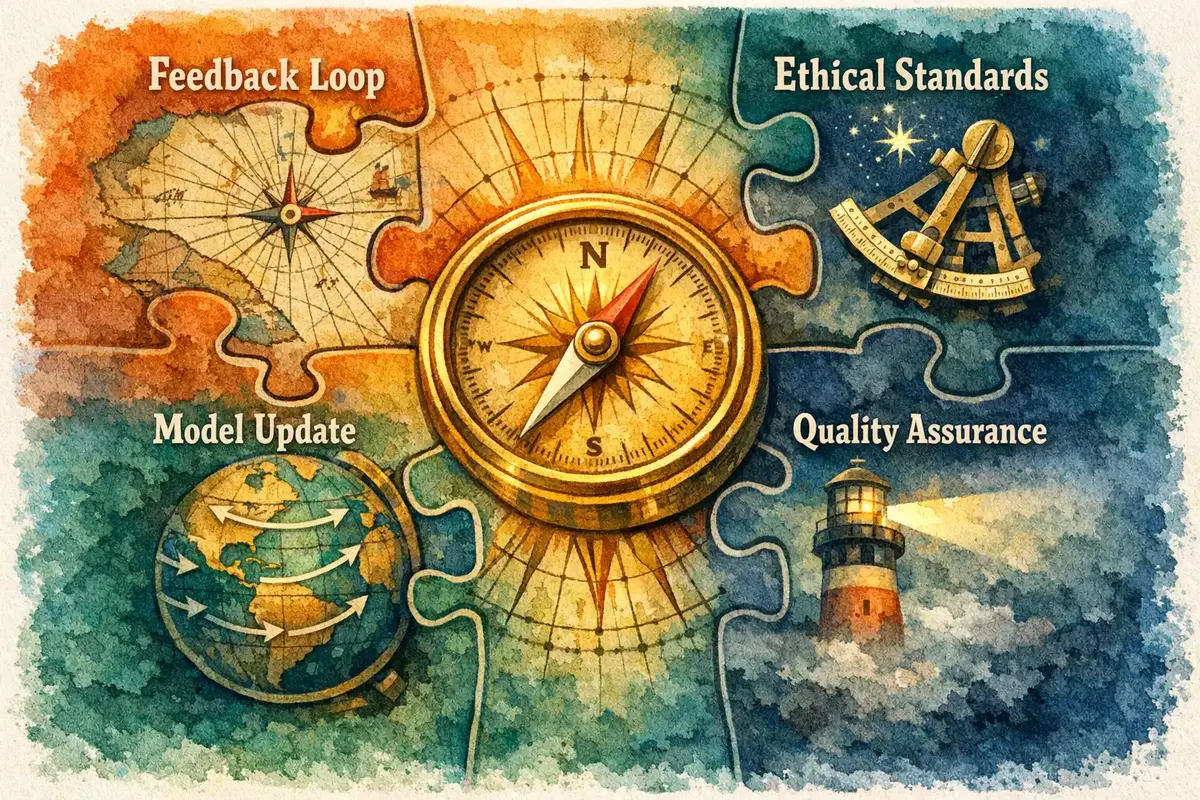
A feedback loop in AI coaching is a structured, repeatable process that captures input from multiple sources—users, coaches, and research—and uses it to inform ongoing improvements to the AI model. Think of it as the nervous system of an adaptive coaching platform: it senses, processes, and responds to new information, ensuring the system stays aligned with both professional standards and user needs.
Here’s how a typical feedback loop works:
- Data Collection: The system gathers input from coaching sessions, user surveys, practitioner notes, and new research findings.
- Analysis: This data is reviewed for patterns—what’s working, what’s not, and where gaps exist.
- Model Refinement: Developers and coaching experts collaborate to adjust the AI algorithms, integrating new coaching techniques or ethical guidelines.
- Validation: The updated model is tested for accuracy, relevance, and ethical compliance.
- Deployment: Improvements are rolled out to users, and the cycle begins again.
For a deeper dive into the mechanics and benefits of this process, see this resource on the feedback loop in AI coaching.
How Does User and Practitioner Feedback Improve AI Coaching Models?
Most organizations believe that user feedback is just a box to tick—something to collect and file away. But in high-performing AI coaching platforms, user and practitioner feedback is the engine that drives meaningful change. Here’s the thing: AI models, no matter how advanced, can’t anticipate every context or cultural nuance. It’s the lived experience of users and the expertise of seasoned coaches that surface blind spots and opportunities for growth.
A practical workflow for integrating this feedback looks like:
- Regular collection of user and manager feedback after each coaching session, focusing on both the content and the process.
- Systematic review by coaching experts who interpret qualitative feedback, identifying trends that may not be visible in quantitative data.
- Incorporation of practitioner insights—for example, when a coach notices that the AI’s approach to conflict resolution doesn’t align with a particular organizational culture, that insight is used to adjust the model’s recommendations.
This ongoing continuous feedback loop ensures that the platform doesn’t just “learn” from data, but evolves in a way that’s grounded in real-world practice.

What Are the Ethical Standards for AI in Coaching—and How Are They Operationalized?
A common assumption is that ethical guidelines are static checklists, separate from the technical work of model development. But in reality, ethical standards are living frameworks that must be operationalized within every stage of AI coaching model refinement.
The International Coaching Federation (ICF) has established a comprehensive framework for AI coaching, organized into six domains:
- Foundation
- Co-Creating the Relationship
- Communicating Effectively
- Cultivating Learning and Growth
- Assurance and Testing
- Technical Factors
(International Coaching Federation (ICF), 2024)
Translating these domains into technical reality means embedding coaching ethical frameworks directly into the AI’s algorithms and workflows. For example, the “Assurance and Testing” domain mandates regular audits of the AI’s recommendations for bias, accuracy, and alignment with coaching intent. The “Co-Creating the Relationship” domain influences how the AI models rapport, trust, and psychological safety in its interactions.
For a detailed look at how these standards are built into AI systems, see this guide on ethical standards AI coaching.
How Is Continuous Improvement Implemented in Coaching Platforms?
Continuous improvement in AI coaching isn’t just a technical upgrade—it’s a cultural commitment. Leading platforms implement continuous improvement through a blend of automated monitoring, human oversight, and structured feedback cycles.
Here’s a typical process:
- Automated Monitoring: The platform tracks key metrics—user engagement, session outcomes, and feedback ratings.
- Human-in-the-Loop Review: Coaching experts periodically review anonymized session transcripts, flagging areas for improvement or ethical concern.
- Scheduled Model Updates: Rather than waiting for major releases, incremental updates are deployed as soon as validated improvements are ready.
- Transparent Communication: Users are informed of significant changes, fostering trust and encouraging ongoing participation in the feedback process.
Infusing AI into coaching activities increases sales productivity by 95% year-over-year (ValueSelling Associates, 2026).
This impact is only possible when platforms treat continuous improvement as a core operational principle, not an afterthought. For a step-by-step overview of how this works in practice, see the section on continuous improvement coaching platforms.
How Do AI Coaching Systems Adapt to New Research and User Needs?
Most teams expect that AI platforms will only update in response to technical advancements. But the reality is more dynamic: AI coaching systems adapt by integrating practitioner feedback, user data, and the latest research findings into their model refinement cycles.
Consider a scenario where new research highlights the importance of psychological safety in virtual coaching. The feedback loop captures this insight, and the model is adjusted to prioritize language and prompts that foster safety and trust. At the same time, practitioner feedback might reveal that certain leadership frameworks are gaining traction in specific industries—prompting the platform to incorporate those approaches into its coaching repertoire.
This blending of research, practice, and user experience is what keeps AI coaching relevant and effective—especially in fast-changing fields like leadership development and team dynamics.
What Are the Boundaries of AI’s Role in Coaching?
It’s tempting to imagine that with enough data, AI could eventually replicate every aspect of human coaching. But research draws a clear line: AI excels at convergent, technical, and process-driven coaching tasks, but human expertise remains essential for divergent, judgment-based, and deeply empathetic work (arXiv, 2026).
“AI coaching conversations must remain completely private and not accessible to instructors,” according to 71.4% of faculty and 64.6% of students (arXiv, 2026).
This boundary-setting isn’t a limitation—it’s a competitive advantage for organizations that strategically blend AI and human coaching. Multiplex models, which assign tasks based on their complexity and emotional nuance, are emerging as best practice. For example, AI can efficiently handle skills assessments and routine feedback, while human coaches step in for complex goal-setting or navigating sensitive interpersonal challenges.

How Is Practitioner Expertise Integrated into AI Coaching for Talent Development?
In the context of talent development and succession planning, practitioner feedback AI coaching plays a pivotal role. Rather than relying solely on user ratings or generic surveys, leading platforms invite expert coaches to review anonymized session data, flag emerging trends, and recommend new coaching interventions.
For example, if practitioners notice that high-potential leaders are struggling with a specific aspect of strategic thinking, they can suggest targeted prompts or exercises for the AI to incorporate. This ensures that the platform remains aligned with organizational goals and the evolving needs of its users. For more on this integration, see how practitioner feedback AI coaching supports talent pipelines.
How Do Platforms Balance Privacy with Data-Driven Improvement?
As AI coaching platforms become more sophisticated, privacy concerns move to the forefront. Most users and organizations assume that more data means better models—but at what cost to confidentiality and trust?
Faculty perceive significantly higher risks (mean 4.71/5) than students (mean 4.14/5) regarding AI coaching, with a large effect size (Cohen’s d=1.34, p=0.003) (arXiv, 2026).
Best practice is to anonymize all feedback and session data before it’s used for model refinement. Platforms must also provide clear, transparent explanations of how data is used, and allow users to opt out of data sharing for improvement purposes. For more on these practices, see the section on AI coaching privacy.
How Do Organizations Measure the Impact of Continuous Feedback Loops?
Most leaders want to know: does all this investment in continuous feedback actually pay off? The answer is yes—when feedback loops are well-designed, they translate directly into measurable improvements in skill acquisition, leadership effectiveness, and business outcomes.
For instance, platforms that implement robust feedback mechanisms report not only higher user satisfaction, but also tangible gains in performance metrics. The key is to track both qualitative and quantitative indicators—such as coaching effectiveness scores, goal attainment rates, and ROI on coaching investments. For a detailed breakdown of these metrics, explore how continuous feedback drives coaching effectiveness and ROI.
What Frameworks Exist for Blending AI and Human Coaching?
The most advanced organizations are moving toward multiplex coaching models—frameworks that assign coaching tasks to AI or human experts based on the nature of the challenge. For example:
- AI handles: Routine skills assessments, progress tracking, and structured feedback.
- Humans handle: Complex goal setting, ethical dilemmas, and deep interpersonal work.
This approach leverages the strengths of both, ensuring that each coaching interaction is matched to the right modality. It also creates a more scalable, responsive, and ethically sound coaching ecosystem—one that’s capable of adapting as roles, technologies, and workplace cultures evolve.
FAQ: Beyond Initial Training—Continuous Feedback in AI Coaching
How often are AI coaching models updated with new feedback?
AI coaching models are typically updated on a rolling basis, with incremental improvements deployed as soon as they’re validated. This could mean monthly or even weekly updates, depending on the volume and significance of new feedback and research. The goal is to keep the platform responsive to changing user needs without overwhelming users with constant changes.
What types of feedback are most valuable for refining AI coaching models?
Both quantitative data (like session ratings and engagement metrics) and qualitative feedback (such as open-ended comments from users and coaches) are essential. Practitioner insights—drawn from real coaching experience—are especially valuable for identifying nuanced gaps that automated systems might miss.
How do coaching platforms ensure ethical standards are maintained during model updates?
Platforms operationalize ethical standards by embedding them into their model validation and update processes. This includes regular audits for bias, transparency in how data is used, and alignment with frameworks like the ICF’s six domains. Human oversight is a critical component of this process.
Can user data be used for model refinement without compromising privacy?
Yes, leading platforms anonymize all user data before it’s used for model improvement. They also provide clear explanations of data usage policies and allow users to opt out of data sharing for these purposes, maintaining trust and compliance with privacy expectations.
What are the main limitations of AI in coaching compared to human coaches?
AI excels at structured, process-driven coaching tasks but struggles with complex judgment calls, deep empathy, and navigating sensitive interpersonal dynamics. Human coaches remain essential for these divergent and emotionally nuanced challenges.
How do organizations measure the ROI of continuous feedback in AI coaching?
Organizations track a combination of metrics, including user satisfaction, skill acquisition rates, leadership effectiveness, and business outcomes like productivity or quota attainment. Robust feedback loops are correlated with higher performance and more sustainable coaching results.
What is a multiplex coaching model and why is it important?
A multiplex coaching model strategically blends AI and human coaching, assigning tasks based on their complexity and emotional nuance. This approach ensures that each coaching interaction is handled by the most appropriate resource, maximizing both efficiency and effectiveness.
Continue Your Leadership Journey
Continuous feedback loops are more than just a technical feature—they’re the heartbeat of effective, ethical, and future-ready AI coaching. By weaving together the latest research, practitioner wisdom, and real-world user experiences, platforms like AI Coach System remain at the forefront of professional development. As organizations and individuals seek to cultivate better leaders, better teams, and better organizations, understanding and leveraging these feedback mechanisms will be the key to sustained growth and impact.