

Why Most Boards Evaluate Themselves but Still Miss the Real Governance Gaps
99% of S&P 500 boards report some type of annual performance evaluation—so if your board still leaves core governance issues untouched, the problem is probably not whether you assess. It is how little those assessments often surface about how the board actually works (Harvard Law School Forum on Corporate Governance, 2024).
You know the scene. The annual review goes out before the last meeting of the year, directors tick through a familiar questionnaire, the governance committee summarizes themes, and everyone agrees the board is “functioning effectively.” Then the same issues reappear in the next budget cycle: weak challenge in the room, committee overlap, unclear accountability, and decisions that look sound in the moment but age badly under pressure.
That gap is not small. Harvard Business School found that 70% of the sample said their boards used regular self-assessments (Harvard Business School, 2017). Yet widespread use has not made board evaluation a reliable engine of improvement. In practice, many boards still treat assessment as an annual ritual—useful for process hygiene, weak on diagnosis. The cost shows up in slower course correction, unresolved tensions between committees and the full board, and avoidable deterioration in board decision quality. This article addresses that failure point: how to turn evaluation from a compliance exercise into a governance advantage.
The Real Miss: Boards Usually Review Performance from the Inside Out
A simple self-review asks directors what they think of the board. A 360-degree board assessment asks something harder and more useful: how directors, committees, the chair, and the full board experience one another in practice.
That difference matters because governance failures rarely begin as obvious failures. They begin as patterns. One committee believes it is escalating risk clearly; the full board experiences fragmented reporting. Independent directors think they are offering robust challenge; management experiences uneven guidance and late-stage intervention. The chair believes meetings are efficient; newer directors experience a room where candor is selectively rewarded.
A standard questionnaire can miss all of that. A 360 process is designed to catch it.
Better Governance, Not Better Scores
The promise here is not a cleaner form or a higher satisfaction rating. It is better governance: clearer feedback, stronger candor, and disciplined follow-through on the few behaviors that most affect board performance.
That is the standard worth using. Not whether the board completed an evaluation, but whether the process changed how it listens, challenges, prioritizes, and decides. If nearly every board already evaluates itself, the real question is sharper: what exactly makes a 360-degree assessment different enough to expose what self-assessment leaves hidden?
What Is a 360-Degree Board Assessment, and How Is It Different from Self-Assessment?
84% of public-company boards in common-law countries used regular self-assessments. So the real question is not whether boards evaluate themselves, but whether those evaluations can see what matters most in the room (Harvard Business School, 2017).
If boards already self-assess, what exactly does 360-degree feedback add that a questionnaire cannot? Many directors assume the difference is just more input. It is not. The difference is where the evidence comes from and what that evidence can expose.
A self-assessment usually asks directors to judge the board from the inside: agenda quality, materials, committee structure, time allocation, strategic coverage. Useful, yes. But it mostly captures declared views about process.
A 360-degree board assessment widens the lens. It gathers feedback across levels of board work: peer views on individual directors, input on committee effectiveness, observations on the chair, and, in some designs, perspective from senior management on how the board’s guidance lands in practice. That is why the taxonomy matters. Full-board assessment, committee review, individual director review, and multi-rater feedback are not interchangeable tools; they answer different governance questions.
| Tool | Primary focus | What it tends to reveal |
|---|---|---|
| Self-assessment | Board process from the inside | Declared views about agenda, materials, and structure |
| 360-degree board assessment | Board work across roles and relationships | Behavioral patterns, chair dynamics, committee effectiveness, and how guidance lands in practice |
55% of S&P 500 firms disclosed full board, committee, and individual director evaluations in 2024—a sign that more boards are separating where performance is being assessed, rather than treating “the board” as one undifferentiated unit (Harvard Law School Forum on Corporate Governance, 2024)
In a regional healthcare system during budget season, the board believed oversight was disciplined because committees were submitting reports on time. A broader review showed a different pattern: committee chairs thought escalation was clear, newer directors did not know where to challenge assumptions, and management experienced late requests that reopened decisions already near approval. Process looked sound. Behavior did not.
What 360 Feedback Reveals That Self-Assessment Often Misses
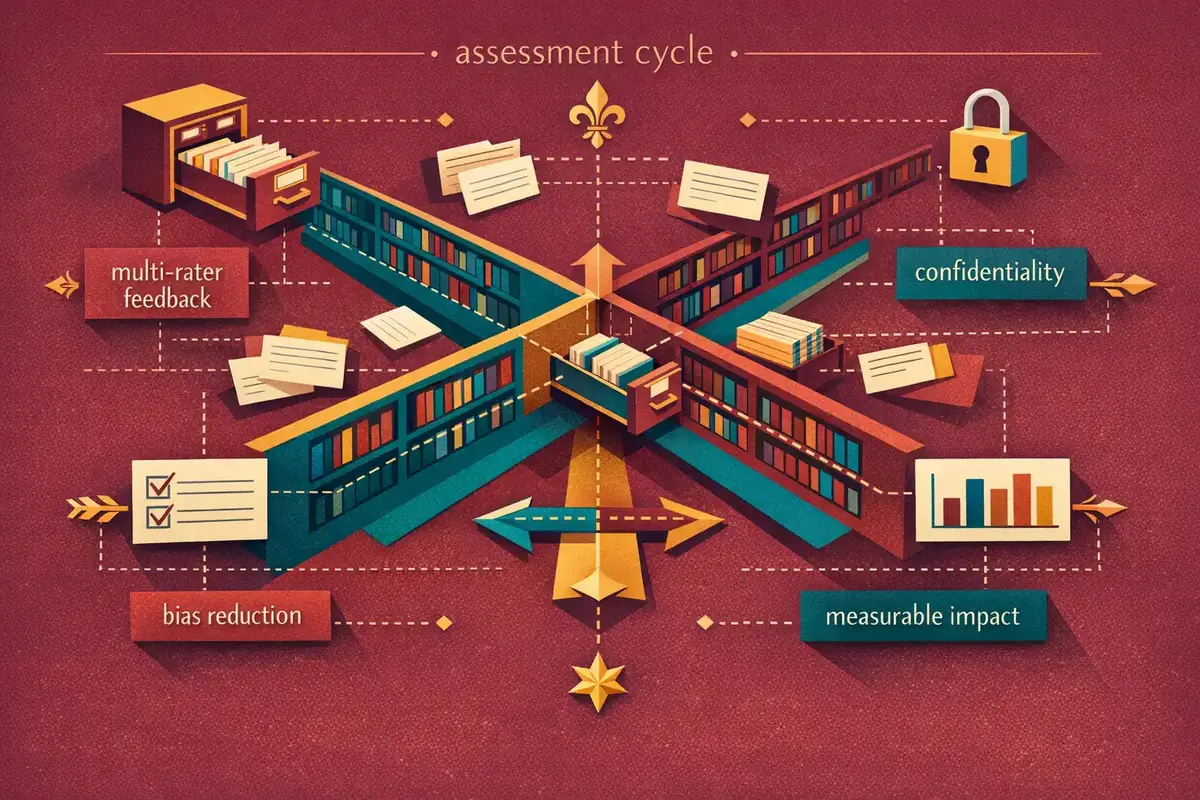
This is where 360 earns its keep. It is better at surfacing behavioral patterns: who invites challenge, where trust is thin, whether dissent is welcomed early or punished late, and how the chair shapes candor without realizing it.
That distinction also sharpens board development. If the issue sits with one committee, you do not “fix the board.” If the issue is role clarity for a few directors, you do not redesign the annual agenda. You diagnose at the right level, often against a clear board competency framework, and act with more precision.
47% of S&P 500 boards report individual director evaluations in 2024—still far from universal, which helps explain why many boards can describe collective performance but not individual contribution (Harvard Law School Forum on Corporate Governance, 2024)
The hard part is not collecting more views. It is creating enough trust that people tell the truth — and enough discipline that the board can hear it. Without that, is 360 feedback a governance advantage, or just a more elaborate mirror?
Why Board Culture and Candor Matter More Than a Perfect Questionnaire
Most boards think weak evaluation starts with weak design. In practice, it usually starts with a room that is too polite to tell itself the truth.
That matters because a board can have the right committees, a clean charter, and a sensible calendar — and still fail at governance if directors do not challenge one another when it counts.
When Structure Is Sound but Candor Is Thin
Picture a mid-market manufacturing company in the quarterly review. The audit committee has done its work, the strategy committee has circulated a sharp memo, and the board packet is on time. Around the table, heads nod. A director raises a concern about margin assumptions, then softens it before it lands. Another decides not to press the CEO on execution risk because the meeting is already running long. By the end, the minutes show alignment. The board has mistaken smoothness for effectiveness.
This is the hidden variable in board performance: candor. Not performative bluntness. Real willingness to name what feels off, test assumptions early, and stay with disagreement long enough to learn from it. Research from BoardSource consistently points to board culture as a major driver of board effectiveness, which is why assessment cannot stop at process mechanics or meeting hygiene (BoardSource).
A 360-degree review is useful here only if it asks about the lived culture of the board: who speaks first, who gets interrupted, whether dissent changes the discussion, and whether the chair creates safety for challenge or quietly closes it down. Leading Governance notes that board-level 360 review is especially valuable when the real issue is behavioral pattern, not formal structure — the kind of pattern a standard self-rating rarely captures (Leading Governance).
Good Feedback Still Needs Good Judgment
Boards also make a second mistake. They hear one sharp comment and treat it as proof of a systemic problem.
That is lazy diagnosis. Qualitative feedback is powerful because it reveals texture, motive, and context. It is also easy to overread. If one director says the board “avoids conflict,” the right response is not immediate redesign. It is to test the pattern: Does the same theme appear across peers, committees, and management interactions? Does it show up in decision moments, or only in one strained relationship?
Boardspan is right to frame assessment as a way to identify governance gaps, not merely collect opinions (Boardspan). The distinction is critical. Comments are raw material. Insight comes from triangulation.
A board that cannot separate recurring signals from isolated anecdotes will either dismiss hard truths or overcorrect around noise. So what does strong evidence actually look like in board assessment — and how often do boards act on it rather than admire it?
What the Research Shows About Board Assessment Quality and Follow-Through
90% of respondents said the board assessment process could be improved — which means the cost of getting this wrong is not abstract but operational: delayed decisions, eroded management trust, and senior talent walking away from a board they experience as inconsistent rather than useful (PwC, 2025). If most leaders believe the process needs work, the real issue is not whether boards evaluate; it is whether they use evaluation in a way that changes behavior.
Prevalence Is Not the Same as Quality
PwC’s data is blunt. Board assessment is common, but confidence in its value is far weaker than many governance committees assume.
Only 41% rated their boards as excellent or good (PwC, 2025)
That gap matters. A board can run an annual review, discuss the summary in one meeting, and still leave the hardest governance problems untouched: unclear expectations for committee chairs, weak challenge on strategic assumptions, or a chair who keeps meetings efficient at the expense of real debate.
In a regional financial services firm during a market-shift review, the CFO spent three weeks reworking capital scenarios after directors raised concerns that should have surfaced earlier. The board had completed its evaluation cycle on schedule. It still created avoidable drag — not because the questionnaire was poor, but because prior findings had never been turned into clearer norms for escalation, challenge, and decision rights.
The Strongest Signal Is What Happens After the Findings
This is where many boards lose the value. They treat assessment as diagnosis, then stop before treatment.
A useful analogy comes from the World Health Organization. In its own governance work, 96.4% of recommendations were accepted (World Health Organization). Acceptance alone does not prove impact, but it does show something boards often miss: formal review only matters when it produces visible commitments, ownership, and follow-through.
For boards, that means converting feedback into a short list of actions with named accountability. Not twelve aspirations. Three or four changes. Tight enough to track. Specific enough to observe. That is what turns assessment into board performance improvement rather than annual commentary.
The practical test is simple. After the assessment, can the board point to what will change in the next two quarters — agenda design, committee handoffs, chair behavior, director contribution, management interaction? If not, the process may have produced insight, but not governance value.
Research Favors Discipline Over Elegance
Boards often overinvest in instrument design and underinvest in implementation discipline. That is backwards.
A credible 360 process does not need a perfect survey nearly as much as it needs a mechanism for action: who synthesizes the findings, how priorities are chosen, where progress is reviewed, and when the board checks whether the change actually improved performance. Without that structure, feedback becomes theater — candid in the moment, forgettable by the next cycle.
So the real design question is sharper than most boards admit: is your process built to collect reactions, or to change conduct?
How Do You Design a Credible 360-Degree Board Assessment Process?
The competency-framework model is where a credible 360-degree board assessment starts. Without it, boards rate whatever feels salient that month—meeting length, one tense exchange, a recent strategy miss—and call the result insight.
What makes one board assessment credible enough to change behavior while another gets filed away and forgotten? Usually, design discipline. Research from the Corporate Governance Institute is useful here because it draws a clean line between standard self-assessment and 360-style multi-rater feedback: they are not the same instrument, and they should not be built as if they are (Corporate Governance Institute, 2024).
Start with the Standard Before You Ask for the Score
A board first needs an explicit view of what good performance looks like. Not in abstract terms like “effective oversight,” but in observable capabilities: strategic judgment, risk escalation, committee-chair coordination, quality of challenge, and decision discipline. A practical board competency framework does that job. It gives directors a shared rubric before anyone comments on peers, the chair, or the board as a whole.
That sequence matters. If the framework comes after the feedback, the board will retrofit standards to match personalities.
In a regional technology company during the annual planning cycle, the lead independent director thought the board’s problem was weak preparation. The 360 process showed something else: directors were prepared, but they were not testing management assumptions early enough, so two capital-allocation decisions had to be reopened within six weeks. The issue was not diligence. It was how challenge showed up in the room.
Define Participation and Confidentiality Up Front
Credibility rises when the rules are clear before the first question goes out. Who participates? Typically the full board, committee chairs, the chair or lead director, and selected senior executives who regularly experience the board’s oversight. Who sees raw comments? Usually one facilitator or governance lead. What gets reported? Aggregated themes at board level, tighter summaries at committee level, and carefully structured feedback for individual roles.
This is where many boards get sloppy. They promise anonymity broadly, then circulate comments so specific that authors are obvious. Or they protect confidentiality so completely that no one owns the findings.
A better design balances both. Board Intelligence has argued that structured implementation guidance improves the usefulness of board assessments because process choices—sampling, synthesis, reporting cadence, action ownership—shape whether feedback can actually be used (Board Intelligence, 2024). The questionnaire is only one component. Even a strong board evaluation questionnaire will fail if anonymity rules are vague and reporting levels are poorly defined.
Measure Performance and Dynamics, Not Just Process
A credible 360 should test two things at once: board effectiveness and board dynamics. Effectiveness covers strategic oversight, committee performance, succession attention, risk discussion, and decision quality. Dynamics cover candor, listening, meeting quality, whether dissent is invited, and whether assumptions are challenged before positions harden.
That link between process and outcome is the point. The Harvard Law School Forum on Corporate Governance has emphasized that strong board assessment connects governance process to governance results, not just procedural compliance (Harvard Law School Forum on Corporate Governance, 2024).
If your design cannot show which behaviors improve the board’s actual decisions, it is only measuring sentiment. And once the findings are in, a harder question arrives—where should a board begin if it wants improvement, not just a better diagnosis?
Where Should Boards Start If They Want Real Improvement, Not Just Feedback?
The Effective Governance board maturity model forces an uncomfortable question: are you trying to improve governance, or just prove that evaluation happened? That distinction matters more than most boards admit. If regular assessment is already common, why do so many boards still struggle to turn findings into changed behavior rather than another summary memo?
The answer usually appears before the first question is asked. Harvard Business School showed years ago that regular self-assessment is already widespread, which means prevalence is no longer the differentiator; implementation quality is (Harvard Business School, 2017). Boards that improve start by making one choice explicit: what exactly is being assessed in this cycle—the full board, committees, individual directors, or all three.
Start by Narrowing the Unit of Change
This sounds procedural. It is not. It determines whether feedback can lead to action.
A regional retail company in the middle of budget season learned this the hard way. The governance committee launched one broad review covering everything at once. The result was familiar: useful comments, no clear owner, and six weeks lost debating whether the issue was weak committee handoff, uneven director contribution, or the chair’s meeting control. The board had data. It did not have a starting point.
Boards get more traction when they define the unit of diagnosis first. If the real issue is committee escalation, assess committees. If the problem is contribution quality around the table, include individual director review. If the concern is strategic coherence, start with the full board. Trying to solve all three at once often produces blur, not insight.
Define Actions Before You Launch
This is the step many boards skip. They wait for the findings, then ask what to do with them.
A better approach is to set a short list of governance actions in advance: possible changes to meeting design, committee scope, board composition, or management oversight. Not because the board already knows the answer, but because predefining the action categories makes the feedback usable. It creates a bridge between comment and consequence.
Research from Diligent is useful here because it treats board evaluation as an ongoing process, not a one-time event. That is the right operating assumption. If the board cannot imagine how this cycle’s findings will alter the next two quarters of work, the process is still too detached from governance practice (Diligent, 2024). A simple board evaluation failure checklist can help expose where that detachment usually begins.
Think in Maturity, Not Events
The strongest boards do not jump from basic compliance to sophisticated multi-rater review in one move. They build repeatable habits.
That is where the Effective Governance model helps. It suggests boards can progress through stages of assessment sophistication over time—moving from annual formality toward a more disciplined cycle of diagnosis, action, and review (Effective Governance). The practical value of a board assessment maturity model is not the labels. It is the mindset: each cycle should make the next one sharper.
That raises the real test. Once a board has chosen the right scope and committed to action, what proves the assessment worked—better feedback, or better decisions?
Why the Best Board Assessments End with Better Decisions, Not Better Scores
A board can lose revenue, drain management trust, and push strong executives toward the exit while still giving itself a respectable evaluation. If the board leaves the room with a report but no changed behavior, nothing important was accomplished.
That is the real standard. Not whether the assessment was thorough. Whether it changed how the board decides.
The Score Is Not the Asset
In an enterprise technology company during a product-priority debate, the board’s review came back broadly positive. Then the same pattern repeated in the next quarter: directors challenged assumptions late, management reworked materials twice, and a key launch decision slipped while competitors moved. The assessment had produced comfort, not correction.
A strong 360-degree board assessment is valuable precisely because it can interrupt that cycle. But only if the board is willing to act on what it learns — especially when the findings are inconvenient. Research from the Harvard Law School Forum on Corporate Governance points in the same direction: board assessment matters most when it supports better governance outcomes, not when it merely documents process (Harvard Law School Forum on Corporate Governance, 2024).
That is why the end point is not a cleaner dashboard. It is stronger board decision quality.
Treat Assessment as a Learning Loop
The boards that improve do something simpler, and harder. They treat assessment as a learning loop: feedback, interpretation, action, review.
PwC has shown that many boards still believe their assessment approach leaves room for improvement (PwC, 2025). That should not be read as failure. It should be read as a governance fact: board effectiveness is not fixed. It is built through repeated cycles of reflection and adjustment.
Over time, that discipline compounds. Candor improves because directors see that honest feedback leads to fair action. Oversight sharpens because recurring weak spots are addressed before they become decision failures. The board becomes easier for management to trust — and harder for risk to hide from.
That is the advantage. Not a better score, but a better board.
So in your own context, what would prove the assessment worked — a favorable summary, or a visibly better decision six months from now?
Key Takeaways
- Most boards already evaluate themselves, but many assessments still miss how the board actually works.
- A 360-degree board assessment adds broader feedback, behavioral insight, and clearer diagnosis than self-assessment alone.
- Credible board assessment depends on candor, confidentiality, a clear competency framework, and follow-through on a short list of actions.
- The best assessments end with better decisions, not better scores.
Frequently Asked Questions
What is a 360-degree board performance assessment?
A 360-degree board performance assessment gathers feedback from multiple perspectives, such as directors, committee chairs, the board chair or lead director, and sometimes senior management. It is designed to reveal how the board actually functions in practice, including relationships, candor, challenge, and decision-making behavior.
How is a 360-degree board assessment different from a self-assessment?
A self-assessment mainly asks directors to judge the board from the inside, focusing on items like agenda quality, materials, and meeting structure. A 360-degree assessment adds multi-rater feedback, which can expose behavioral patterns, committee effectiveness, and how guidance is experienced by others.
Why do boards need 360-degree feedback if they already evaluate themselves?
Self-evaluations often capture declared opinions about process, but they can miss deeper governance problems such as weak challenge, unclear accountability, or poor escalation of risk. A 360-degree approach is more likely to surface the real dynamics that affect board effectiveness and decision quality.
What makes a credible 360-degree board assessment process?
A credible process starts with a clear competency framework, defined participation rules, and confidentiality standards that are set before feedback is collected. It should measure both board effectiveness and board dynamics, then translate findings into a small number of specific actions with clear ownership.
What should boards do after a 360-degree assessment to improve governance?
Boards should turn the findings into a short, prioritized action plan that changes how they meet, challenge assumptions, assign responsibilities, or interact with management. The assessment is successful only if it leads to better behavior and better decisions in the next few quarters, not just a favorable score.