

Why ethical board decisions are now a governance test, not a side issue
More than half of directors think someone on their board should be replaced. That is not a culture anecdote; it is a governance warning about judgment quality under pressure (PwC, 2025).
Picture the moment. A regional healthcare company is in a quarterly review, margins are tightening, and management asks the board to approve a restructuring that is legally clean but operationally brutal. No one in the room is proposing fraud. The real question is harder: which duty carries more weight right now—short-term stability, employee fairness, patient continuity, or the credibility of the board’s own oversight?
That is where most boardroom ethics actually live. Not in obvious misconduct, but in judgment calls made with incomplete facts, time pressure, and competing obligations. Directors are rarely choosing between right and wrong in a clean sense. They are choosing between two defensible options, each carrying a different risk, each shaping trust in ways that only become visible later.

The gap is not activity. It is discernment.
Boards are not ignoring the issue. In New Zealand, 87.7% of directors said their boards actively manage conflicts of interest (Institute of Directors New Zealand, 2025). That is encouraging, but it also sharpens the real question: if boards are already managing visible conflicts, why do ethical failures still emerge in plain sight?
Because process alone does not settle the hardest cases. A director can disclose a relationship, recuse from a vote, and still leave the board with a deeper unresolved problem: whether the decision itself is fair, proportionate, and aligned with the organization’s long-term purpose. This is why board ethics is not a side conversation about values language or compliance posture. It is a test of whether the board can convert formal governance into sound stewardship. If you are rethinking board ethics, this is the standard that matters.
Ethics is now part of board legitimacy
The cost of weak ethical judgment is rarely confined to one bad meeting. It shows up in slower decisions, defensive management behavior, talent loss at the edges, and investor doubt about whether the board sees risk early enough. Over time, the market reads those signals as governance quality.
That is the practical frame for this article. Ethics in the boardroom is not a standalone moral topic; it is part of governance quality, long-term value creation, and the board’s legitimacy to lead through ambiguity. The boards that handle pressure well do not simply avoid scandal. They make decisions people can trust even when outcomes are contested.
And that raises the next hard question: if ethical failure is usually hidden inside ordinary board decisions, what exactly should directors treat as an ethical issue in the first place?
What counts as an ethical issue in the boardroom?
98% of jurisdictions require or recommend that institutional investors address conflicts of interest. If almost every market treats conflicts as a governance issue, why do so many boards still act as if ethics begins only when misconduct is obvious (OECD, 2025)?
What if the board’s biggest ethical risk is not wrongdoing, but mislabeling the issue in front of it? A tense discussion about a supplier contract, a CEO succession call, or a director’s outside relationship can look operational until it suddenly is not. The damage often starts earlier — when the board uses loose language, skips distinctions, and escalates too late.
The terms matter more than most boards admit
In plain English, ethics is how directors judge what is fair, responsible, and defensible when the rules do not settle the question. Governance is the system the board uses to make, oversee, and explain those judgments. Ethics asks, should we? Governance asks, who decides, by what process, and with what accountability?
A conflict of interest exists when a director’s personal, financial, professional, or relational interest could interfere with duty to the company. Whistleblowing is the reporting of suspected wrongdoing or serious misconduct through protected channels. Ethics hotlines are one of those channels — formal reporting mechanisms, often confidential, that allow employees and third parties to raise concerns before they become legal or reputational crises.
This is not semantics. It is control discipline.
73% of jurisdictions issue a national report on listed companies’ adherence to corporate governance codes — a sign that markets increasingly expect boards to define and evidence how they govern judgment, not just outcomes (OECD, 2025).
Not all conflicts are the same
Boards need to separate actual, potential, and perceived conflicts. An actual conflict is present now: a director is voting on a deal involving a business they own. A potential conflict is not active yet, but could become one: a family member is being considered for a senior role. A perceived conflict may be harmless in substance, yet still damage trust because outsiders can reasonably question independence.
In a mid-market manufacturing company during budget season, a director pushes hard for a consulting firm the board has used before. No contract has been signed. No rule has been broken. But if that director previously advised the firm, the board has at least a potential conflict — and possibly a perceived one serious enough to taint the decision.
That is why weak definitions create strong consequences.
| Conflict type | Plain-language meaning | Board risk |
|---|---|---|
| Actual | The conflict exists now | Direct interference with duty |
| Potential | The conflict could arise later | Future independence risk |
| Perceived | Outsiders could reasonably question it | Trust and credibility damage |
Disclosure, recusal, resignation — in that order if needed
Disclosure means naming the interest early, clearly, and on the record. Recusal means stepping out of discussion and decision when participation would compromise independence. Resignation is the last step, used when the conflict is so persistent or structural that neither disclosure nor recusal can protect the board’s judgment.
Many boards blur these responses. They treat disclosure as a cure when it is only a starting point. They avoid recusal because it feels awkward. They delay resignation because the director is valuable, influential, or hard to replace. That is how small governance failures become ethical failures — and how board culture starts to normalize exceptions.
The hard part is not spotting a conflict after it explodes. It is deciding, under pressure, what the board should do before trust erodes — disclose, step back, or leave?
Practical implications for boards
Understanding these distinctions is not just theoretical. Boards that clarify and rigorously apply these terms are better equipped to prevent escalation and protect both the company’s reputation and its decision-making integrity. For example, a board that routinely asks, “Is there any interest—actual, potential, or perceived—that might affect this decision?” creates a culture of transparency and anticipates issues before they become crises. When whistleblowing and ethics hotlines are well-publicized and trusted, boards are more likely to receive early warnings about emerging risks, rather than learning about them from regulators or the media.
Moreover, the sequence of disclosure, recusal, and resignation is not simply a checklist—it is a framework for preserving trust. Boards that skip steps, or treat disclosure as sufficient in all cases, risk undermining their own authority. Conversely, boards that set clear expectations and model these responses send a powerful message: ethical issues are not afterthoughts, but central to effective governance. This proactive approach is increasingly demanded by investors and regulators, who now expect boards to demonstrate not only compliance, but also the capacity to anticipate and manage ethical complexity.
Why the best boards use a repeatable ethical decision framework
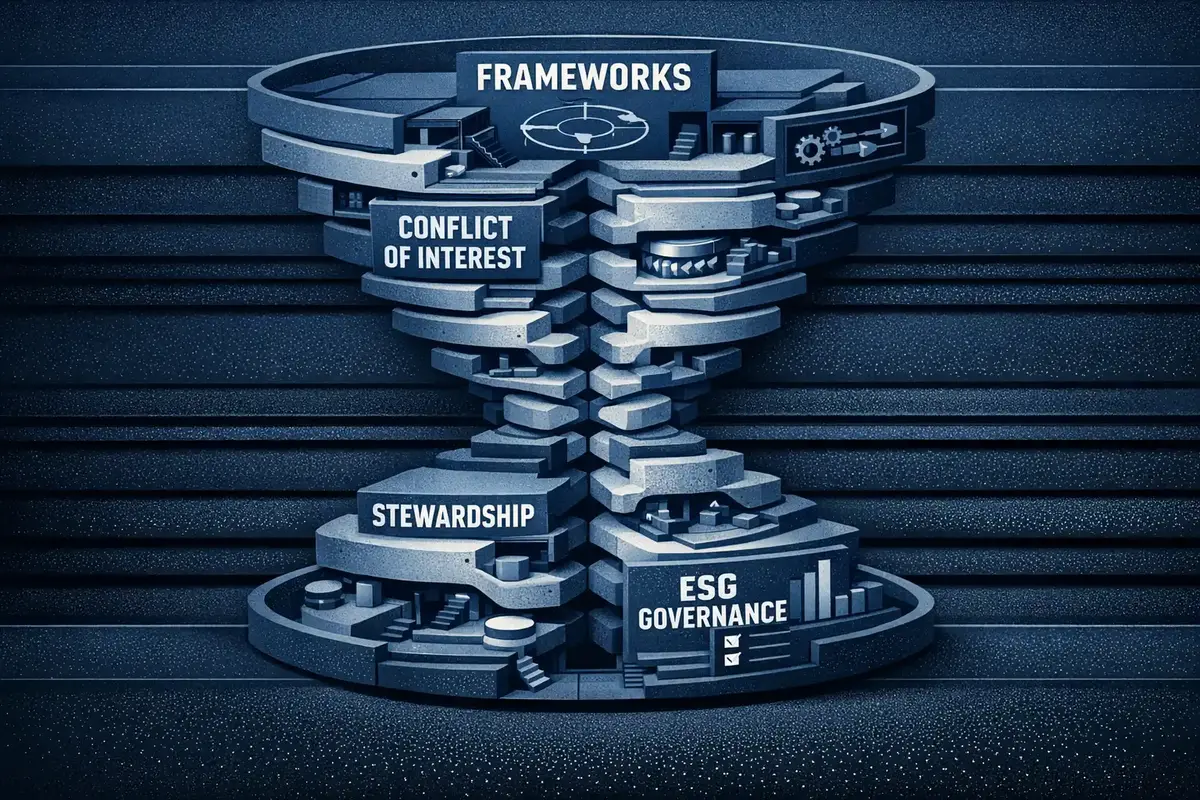
The four lenses model gives boards a way to judge decisions when the legal answer is clear but the governance answer is not. Without it, directors improvise — and improvisation is where bias, hierarchy, and hindsight risk start to run the meeting.
A practical framework begins with a simple split: can we versus should we. Can we is the legal, regulatory, and fiduciary threshold. Should we is the stewardship test: does this action fit the company’s purpose, values, stakeholder obligations, and long-term credibility? The Australian Institute of Company Directors has been explicit on this point: ethical board judgment is not exhausted by compliance, because many of the hardest decisions are lawful and still questionable in substance (AICD).
The four lenses change the conversation
Used well, the four lenses force directors to examine one decision from different angles: results, rules, relationships, and reputation or character. One lens asks about consequences. Another asks what duties or principles apply. A third tests fairness across affected groups. The fourth asks what this choice says about the board and the institution it is shaping.
That matters in live board work. In a mid-market technology company during a budget reset, management proposes cutting customer support in lower-margin segments to protect earnings guidance. The move is lawful. It may even be financially rational in the quarter. But once directors run the issue through four lenses, the discussion gets sharper: what happens to vulnerable customers, what promises has the company made, what precedent does this set for future trade-offs, and how will the board defend the choice if it becomes public six months later?
Instinct still matters. But instinct is not enough.
Research and board guidance from AICD consistently point to the value of structured ethical deliberation because it helps directors surface assumptions, test competing duties, and avoid collapsing complex issues into a quick vote (AICD). That is the real value of an ethical decision-making framework: not moral theater, but better board discipline.
Consistency is a governance asset
A repeatable framework also improves consistency, documentation, and defensibility. Consistency matters because boards face different dilemmas — layoffs, pricing, executive pay, supplier conduct, data use — but should not reinvent their ethical logic every time. Documentation matters because minutes that show the board weighed stakeholder impact, alternatives, and long-term consequences are far stronger than minutes that merely record approval. Defensibility matters because regulators, investors, employees, and courts often judge not only the outcome, but the quality of the process behind it.
A board that can explain how it reached a hard decision is usually in a stronger position than one that can only insist the decision was legal.
This is where many boards discover the harder problem. The framework works cleanly on paper — until a director’s own interests, loyalties, or relationships enter the room. Then the question changes: is the board evaluating the issue fairly, or is someone shaping the frame itself?
How do conflicts of interest actually unfold in real boardrooms?
The four tiers of conflict of interest matter here because most boards still treat conflict as a yes-or-no disclosure issue, while real boardroom conflicts usually move through layers of loyalty, influence, and timing. Many organizations believe that if interests are declared and minuted, the issue is contained; the evidence suggests the harder problem is recognizing when a “managed” conflict is still shaping the room (IMD, 2024).
87.7% of directors said their boards actively manage conflicts of interest (Institute of Directors New Zealand, 2025)
That sounds reassuring. It should also make directors more skeptical. If conflicts are actively managed in most boards, why do so many difficult decisions still leave a residue of doubt?
A conflict rarely arrives fully formed
Take a regional retail company in a quarterly pricing review. An independent director supports a new logistics vendor. On paper, it looks minor: she once worked with the vendor’s founder and says the relationship is old. The chair records the disclosure and moves on.
Then the layers appear.
She helped recruit the COO, who strongly favors the same vendor. The company is under margin pressure, so management wants speed more than debate. Other directors know she has deep sector expertise and do not want to look naïve by challenging her judgment. What began as a manageable disclosure now sits inside a web of professional loyalty, status, and urgency.
This is the practical value of IMD’s model: it shows that conflicts can sit at different tiers, from direct self-interest to more subtle conflicts of duty, role, or perception (IMD, 2024). Boards miss this when they ask only, “Was it disclosed?” The better question is sharper: What is this interest doing to the discussion?
Disclosure is not the same as containment
Some conflicts can be handled through disclosure. Fewer can be handled through disclosure alone. Once a director’s presence changes how others speak, what alternatives get explored, or how quickly the board converges, the issue has moved closer to recusal or formal escalation.
That is where power dynamics in boardroom become decisive. A dominant chair, a founder-director, or a respected committee lead can suppress dissent without saying a word. Silence then gets misread as agreement. It is not agreement. It is often risk avoidance.
Boards need a simple test: if the conflicted director’s influence remains active after disclosure, the board has not solved the problem. It has only named it.
The unresolved conflict is usually the dangerous one
The most damaging conflicts are often the ones everyone senses and no one escalates. They linger across meetings, shape committee work, and distort ordinary conflict management until the board starts defending a process that no longer feels independent.
By then, the formal record may look clean — but the ethical record does not. And when concerns cannot be voiced safely inside the board’s own channels, where do they go instead?
What do whistleblowing systems reveal about board ethics oversight?
In a quarterly audit committee meeting, the dashboard is green until one director asks why employee relations cases are rising while hotline volume is flat. The room goes quiet, because everyone recognizes the implication: the issue may not be misconduct alone, but whether people trust the reporting system at all.
That is why whistleblowing data deserves board attention. NAVEX analyzed 2.15 million reports from 4,077 organizations covering nearly 70 million employees in its 2025 benchmark report, which gives directors a far broader reference point than their own internal trends (NAVEX, 2025).
Reporting volume is not noise. It is signal.
Boards often treat a hotline as a legal safeguard — necessary, reviewed, delegated. That is too narrow. A reporting channel shows what employees believe is safe to raise, how quickly concerns travel upward, and whether management hears about ethical risk before it becomes a control failure.
The global median was 1.57 reports per 100 employees (NAVEX, 2025)
A low number is not automatically good news. In a regional services company during a budget squeeze, a VP may decide not to report pressure from a business unit leader because prior complaints went nowhere. The board then receives a clean dashboard and a false sense of control. That is not silence as health. It is silence as design failure.
Substantiation rates tell boards whether they are listening early enough
If nearly half of substantiated reports prove real, what does that say about the board’s responsibility to listen early? NAVEX reports that the overall substantiation rate reached a record 46% in 2024 (NAVEX, 2025). Directors should read that as a governance fact, not a compliance footnote.
A substantiated case is evidence that the channel surfaced something meaningful. Over time, patterns in allegation type, business unit, reporting path, and closure time become governance input. They help a board test whether its stated board ethics are visible in practice, or whether pressure is being absorbed at lower levels until it breaks somewhere else.
The useful board questions are simple. Are reports concentrated around one leader or one incentive system? Are retaliation concerns suppressing use? Does the board see trend data, or only severe cases after management has filtered them?
That is the real oversight test. Not whether a hotline exists, but whether it produces ethical intelligence the board is willing to act on. And if directors discover the system is underused or mistrusted, where do they begin — policy, process, or board behavior itself?
Where should directors start when they want better ethical judgment?
48.5% of boards received comprehensive reporting on ethical and conduct matters—so why are so few boards treating ethics as a risk that deserves formal assessment? The uncomfortable answer is that many directors still confuse visibility with judgment. They are seeing more. They are not always deciding better.
The contrast is sharp.
Only 8.3% of directors said their board formally assesses ethics risks (Institute of Directors New Zealand, 2025)
That gap should change where directors start. Not with a values refresh. Not with a thicker policy. With a usable sequence the board can run in real time.
Start with a sequence, not a slogan
A practical first step is five moves: identify the issue, map stakeholders, test conflicts, decide on disclosure or recusal, and document the reasoning. In that order. Skip one, and the board usually pays for it later in confusion, rework, or defensiveness.
Picture a mid-market finance company in the annual budget cycle. Management proposes closing a small client segment that is costly to serve and unlikely to grow. The legal case is straightforward. The ethical issue is not. Which clients lose access, which teams absorb the fallout, whether any director has a relationship with the affected channel partner, and what rationale will stand up six months later if the decision is challenged—those are board questions, not management clean-up.
This is where routine matters more than brilliance. If the board cannot name the issue precisely, it will debate the wrong thing.
Build a short list of questions the board always asks
Good boards make ethical judgment less mystical by making it more repetitive. Four questions are especially useful: Who benefits? Who is harmed? What is missing? What would make this decision defensible later?
Those questions slow the rush to closure. They also expose what the room may be avoiding—missing data, absent stakeholders, untested assumptions, or a conflict everyone has politely noted but not really contained. Over time, this discipline shapes board culture more than any statement of principles does.
The evidence suggests most boards have not embedded that discipline yet. The Institute of Directors New Zealand found that while many boards receive conduct reporting, very few formally assess ethics risk (Institute of Directors New Zealand, 2025). That is not a reporting problem. It is a board habit problem.
The chair sets the ethical floor
Ethical quality rises when the chair makes dissent normal. That means inviting challenge before consensus forms, asking the quietest director to speak, and treating escalation as good governance rather than disloyalty. Small moves matter. A chair who asks, “What are we not seeing?” changes the room.
And when that does not happen, boards drift. They become efficient at agreement and weak at judgment.
That is the real threshold. Can the board make room for friction before a decision hardens—or will stewardship be left to chance in the small calls it repeats every quarter?
Ethical stewardship is built in the small decisions boards repeat
The stewardship loop matters because boards rarely lose trust in one dramatic moment; they lose it through repeated weak calls on disclosure, challenge, documentation, and escalation. Revenue slips later. Credibility erodes first. Good people notice the pattern and leave.
What if the real measure of board integrity is not the crisis it avoids, but the habits it repeats before the crisis arrives?
The board’s ethical record is cumulative
In an enterprise technology company during a product-pricing review, a C-suite executive pushes for a launch timetable the board knows is aggressive. No one is lying. No rule is obviously broken. The real test is smaller and harder: does a director name the customer risk clearly, does the chair invite dissent before momentum hardens, does the board minute the trade-off honestly, and does anyone escalate if management keeps narrowing the facts?
That is how ethical stewardship is built. Not in a values statement. In the repeated mechanics of board work.
A board that treats ethics as a crisis tool will always arrive late. The stronger boards treat it as part of ordinary stewardship — the same way they treat capital allocation, succession, or risk appetite. That matters even more as governance expectations widen. The OECD reports that 60% of jurisdictions have established sustainability assurance requirements (OECD, 2025). In practice, that means boards are being asked to stand behind more claims, more judgments, and more evidence than before.
Ethical performance is usually the sum of small decisions made consistently under ordinary pressure.
Process, culture, discipline
The practical standard is straightforward. Process gives the board a sequence. Culture makes challenge safe. Disciplined discussion keeps the room from confusing speed with clarity.
If your board wants better judgment, start there. Review the last five hard decisions. Where did disclosure come late, challenge stay muted, reasoning go undocumented, or escalation stop too soon?
That is the honest next step. Not a slogan — a pattern check. And once you see the pattern, will you call it stewardship, or just habit?
Key Takeaways
- Ethical board decisions are a governance test because judgment quality matters as much as compliance.
- Boards need clear distinctions between actual, potential, and perceived conflicts of interest.
- Repeatable frameworks, disclosure discipline, and strong chair behavior improve ethical judgment.
- Whistleblowing data and routine board habits reveal whether ethics is truly embedded in governance.
Frequently Asked Questions
What makes an ethical issue in the boardroom different from a legal or operational issue?
An ethical issue arises when directors must judge what is fair, responsible, and defensible even though the law does not give a complete answer. It often involves competing duties, such as balancing short-term performance against stakeholder harm, long-term trust, and the organization’s purpose.
How should boards distinguish between actual, potential, and perceived conflicts of interest?
An actual conflict exists now and directly affects a director’s duty, a potential conflict could arise later, and a perceived conflict may not be harmful in substance but can still damage trust. Boards should treat all three seriously because credibility can be weakened even when no rule has been broken.
What is a practical ethical decision framework for boards to use?
A useful framework starts by asking whether the board can act legally and then whether it should act from a stewardship perspective. Many boards use a four-lens approach that tests consequences, duties, fairness across stakeholders, and what the decision says about the board’s character and reputation.
Why are whistleblowing systems important for board ethics oversight?
Whistleblowing systems reveal whether employees trust the organization enough to raise concerns early, before problems become legal or reputational crises. Reporting volume, substantiation rates, and patterns in complaints help boards see whether ethical risk is being surfaced or hidden by fear and silence.
Where should a board start if it wants to improve ethical judgment?
Boards should begin with a repeatable sequence: identify the issue, map stakeholders, test for conflicts, decide on disclosure or recusal, and document the reasoning. Strong chair behavior, open dissent, and regular review of past decisions help turn ethics into a consistent governance habit rather than a one-time discussion.