

Why boards are judged on anticipation, not just response
Boards are now judged less by how well they clean up a crisis than by whether they saw it forming early enough to change the outcome. You know the scene: a quarterly review, a polished dashboard, and a late-breaking issue that was technically visible in fragments but never framed as a board-level threat.
That is the modern governance failure. Not ignorance. Late recognition.
Global employee engagement fell to 20% in 2025, and the world economy lost an estimated $10 trillion in productivity as a result (Gallup, 2026).
Those numbers matter because they show what delayed recognition looks like when it spreads through an enterprise: weaker execution, slower adaptation, and trust that erodes before the board sees a red flag. By the time a risk is measurable in a conventional sense, value has often already leaked out through missed decisions, stalled teams, customer friction, and rising skepticism from investors and employees. This article addresses that gap: how boards move from reviewing risk to anticipating it.
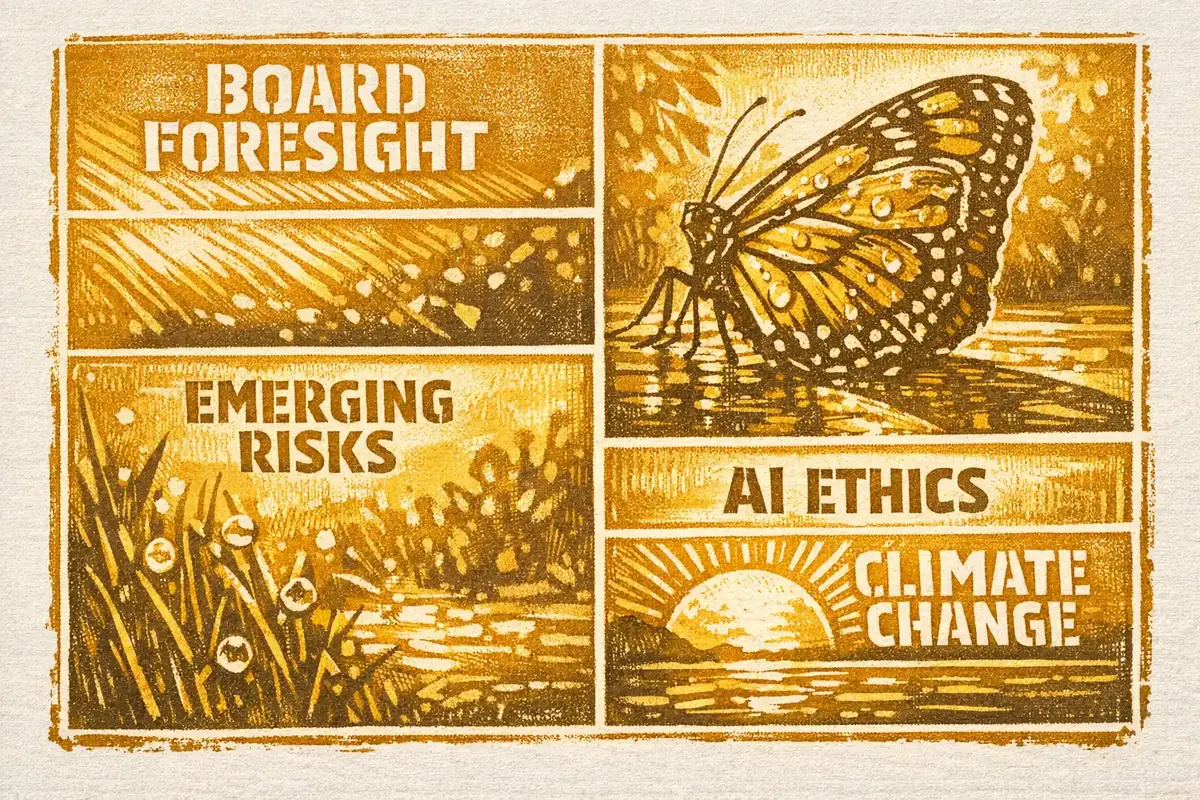
Emerging risk is not just “something new”
A board does not need help noticing that a new issue exists. Management can usually supply a list. What boards need is a better definition of emerging risk.
An emerging risk is uncertainty with strategic consequences. It may not yet have stable probabilities, agreed metrics, or a clear owner. That is precisely why it matters. If it already fits neatly into a risk register, with thresholds, controls, and quarterly reporting, it is no longer emerging in the governance sense. It has become administratively legible.
This is where many boards get trapped. They treat ambiguity as a reason to wait for better evidence, when ambiguity is often the signal that deserves attention first. In practice, the board’s job is not to predict the future with precision. It is to test whether the company is exposed to shifts that could alter assumptions about demand, talent, regulation, technology, or legitimacy. That is the real work of emerging risks.
Foresight is a governance capability, not prediction theater
Consider a regional healthcare provider in budget season. The board sees labor pressure, new AI tools entering clinical workflows, and changing public expectations around data use. None of those issues alone looks catastrophic. Together, they can reshape operating resilience within a year.
That is why foresight belongs inside board governance. Not as a one-off strategy retreat, and not as speculative trend talk, but as a repeatable discipline for surfacing weak signals, challenging assumptions, and deciding what deserves earlier scrutiny.
The cost of getting this wrong is now visible. It shows up in productivity before it shows up in earnings. It shows up in resilience before it shows up in compliance. It shows up in trust before it shows up in headlines.
The hard question is not whether boards should look ahead. It is simpler and more uncomfortable: what counts as a risk, what counts as uncertainty, and what requires foresight before either can be measured?
What is the difference between risk, uncertainty, and foresight?
The OECD Framework on the Management of Emerging Critical Risks matters here because it starts from an uncomfortable question: if boards already oversee risk, why do they still get blindsided? Why do so many boards say they are risk-aware, yet still get surprised by the risks that matter most?
The answer is usually not negligence. It is category error. Boards often treat risk, uncertainty, and foresight as if they were interchangeable, then wonder why a mature risk process fails when the environment stops behaving like the past.
Three terms, three different jobs
Risk is the part of the future you can estimate with some confidence. You have enough history, enough comparable events, and enough operational data to assign likelihood, model impact, and set thresholds. Credit defaults, supplier concentration, cyber incidents with known patterns—these fit the classic board packet because they can be bounded.
Uncertainty is different. Here, the data is thin, the causal chain is unstable, and the probability is not just hard to calculate but hard to define. A new regulatory posture toward AI, a sudden shift in water availability, or a legitimacy crisis triggered by public expectations can all matter materially before anyone can model them cleanly.
That distinction is practical, not academic. If a board asks for precision too early, management will either give false confidence or say nothing.
Foresight is how boards work with ambiguity
In a quarterly review at a mid-market manufacturing company, the CFO can quantify energy cost volatility and inventory exposure. What she cannot quantify with the same confidence is how customer procurement standards, climate disclosure pressure, and industrial policy might combine over 18 months to reshape demand. That is not a failure of analysis. It is a different class of problem.
Foresight is the discipline that sits between vague concern and formal risk measurement. It does not predict the future perfectly. It builds a repeatable way to notice change early, test assumptions, and interpret weak signals before they harden into losses. That is why boards need a foresight process, not just a better forecast.
IMD makes the governance implication plain: boards must prepare for the unexpected, not only optimize for what is already legible in current reporting (IMD).
From ambiguity to better board questions
The OECD’s framework is useful because it treats emerging risk management as a sequence, not a one-off exercise; its seven-step process gives boards a bridge between scattered signals and structured judgment (OECD, 2024). The value is not procedural neatness. The value is that it turns ambiguity into sharper questions: What assumptions are changing? What would we notice too late? Where are we over-relying on historical patterns?
That is the real dividing line. Risk can be monitored. Uncertainty must be explored. Foresight decides which ambiguous signals deserve board attention before dashboards catch up.
And that raises the harder issue: if the board waits for polished metrics, what gets missed in the meantime—noise, or the first evidence that the strategy no longer fits reality?
Why weak signals matter more than polished dashboards
Horizon scanning is the discipline that matters here because dashboards tell boards what has already stabilized, while scanning helps them notice what is only beginning to take shape. Most organizations believe more reporting creates more control; the evidence points to a different problem: boards are rarely short of signals, but often short of a way to interpret them early enough to matter.
That is the blind spot. Not missing data. Missing meaning.
A polished dashboard is reassuring because it converts ambiguity into categories—green, amber, red. But weak signals do not arrive that way. They show up as a regulator using new language, a customer changing procurement criteria, a cluster of employee concerns that do not yet fit HR metrics, or a supplier asking unusual questions about resilience requirements. Each signal is easy to dismiss on its own. Together, they can mark the edge of a new operating environment.
In a quarterly review at a regional financial services firm, the board packet showed stable credit quality, acceptable attrition, and no major compliance breaches. The chief risk officer still raised a concern: three large clients had started asking about AI governance language in contracts, two supervisors had flagged model transparency issues, and a state agency had shifted its tone in informal meetings. None of that was material yet. Waiting for it to become material would have been the mistake.
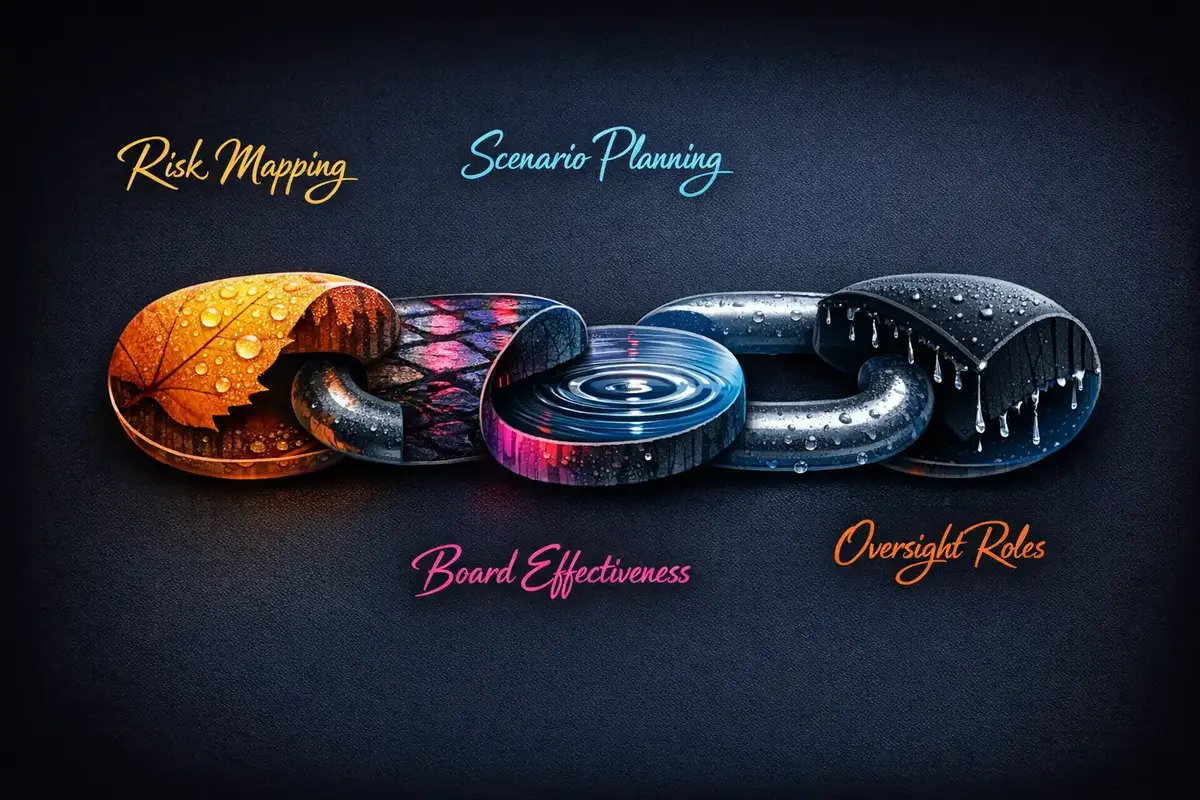
Interpretation is the real governance work
Boards do not need to become trend hunters. They need a method for separating weak but relevant signals from background noise.
The OECD is clear on the practical use of foresight: governments use horizon scanning and strategic foresight to build plausible future operating environments over 5–15 years rather than reacting only to current incidents (OECD, 2024).
Horizon scanning is useful precisely because it extends the board’s field of view beyond the reporting cycle (OECD, 2024).
That matters for governance because strategy usually assumes a future environment without naming it. Scenario planning makes those assumptions visible. A board can ask: if customer expectations harden faster than regulation, what breaks first? If regulation moves first, where are we exposed? If neither happens on schedule, what investments become stranded?
Cadence beats occasional insight
One workshop will not fix this. Neither will an annual strategy offsite.
A workable foresight cadence links three moves: scanning for external shifts, testing those shifts through scenarios, and using the results to shape the board agenda. That is how an emerging issue gets discussed before it becomes a crisis memo. It also changes committee work. Audit, risk, technology, and sustainability stop treating adjacent signals as separate topics and start examining them as one developing pattern.
The hard part is not collecting more information. It is deciding what deserves earlier attention—and who owns that judgment. If boards cannot turn weak signals into a routine, will they keep seeing the future late, or can governance learn to surface it on time?
How do boards turn foresight into a repeatable governance routine?
72% of boards report having one or more committees responsible for risk oversight, yet emerging risks still reach the board late because structure without a process usually produces review, not anticipation (Deloitte). The OECD Framework on the Management of Emerging Critical Risks is useful precisely because, without it, signals get discussed once, parked in a committee memo, and never translated into a board decision (OECD, 2024).
Turn foresight into a sequence, not an agenda item
The practical shift is simple. Stop treating foresight as a periodic conversation and start treating it as a governance routine.
The OECD outlines a seven-step process for managing emerging critical risks (OECD, 2024). In board language, that sequence becomes: scan for external change, assess relevance to the business model, prioritize what could alter strategy, decide what action or contingency is warranted, monitor indicators, and revisit assumptions on a set cadence. The point is not procedural elegance. The point is that each step forces a handoff — from observation to judgment, from judgment to decision, from decision to follow-up.
That is where many boards stall. They hear an early signal, ask management to “keep an eye on it,” and move on. No owner. No trigger for escalation. No return date.
A repeatable routine fixes that. It assigns a time horizon, a decision threshold, and a place where the issue comes back.
Ownership has to be explicit
In a quarterly review at an enterprise retail company, the chief strategy officer flagged a pattern: insurers were changing terms for climate-exposed sites, local regulators were tightening waste rules, and a major customer segment was shifting toward traceability demands. Each issue sat in a different function. No one owned the combined exposure.
That is the governance failure. Not lack of intelligence — lack of ownership.
A board can delegate coordination, but it cannot delegate clarity. Someone must be accountable for convening the scan, synthesizing cross-functional signals, and recommending whether an issue stays in management, moves to committee review, or comes to the full board. Otherwise foresight degrades into compliance theater: lots of documentation, little consequence.
Connect foresight to money and operations
Committees matter. The Deloitte figure shows most boards already have the formal architecture for risk oversight (Deloitte). But foresight works only when that architecture connects to strategy, capital allocation, and operating reviews.
The OECD framework treats emerging-risk management as a multi-step process, not a single discussion (OECD, 2024).
If an emerging issue never affects investment timing, scenario assumptions, or management incentives, the board has not built a routine. It has built a reporting lane.
And this is where the stakes rise. When AI ethics, climate exposure, and geopolitical shifts start interacting, does the board still see separate topics — or one shared source of strategic fragility?
Why AI ethics, climate risk, and geopolitics belong in the same board conversation
66% of respondents said their boards had limited to no knowledge or experience with AI (Deloitte, 2024). That gap is not abstract; it is where revenue gets delayed, trust gets questioned, and strong people leave because leadership cannot explain the rules behind consequential decisions.
How should a board compare a fast-moving AI ethics issue with a climate risk that compounds over years and a geopolitical shock that can hit overnight? Most boards still answer by separating them into different committees, different memos, different reporting cycles. That is tidy. It is also dangerous.
The common problem is not the subject matter. It is the governance condition: high uncertainty, strategic consequence, and weak early signals that cut across functions before they show up cleanly in financial reporting.
In an enterprise technology company during budget season, the CIO wanted faster deployment of generative tools, the chief people officer was fielding internal concern about fairness and surveillance, and procurement had just flagged new exposure in a supplier market affected by export controls. At the same time, a major customer asked for stronger climate disclosures in the renewal process. Four issues on paper. One board problem in practice: the assumptions behind growth, legitimacy, and resilience were shifting at once.
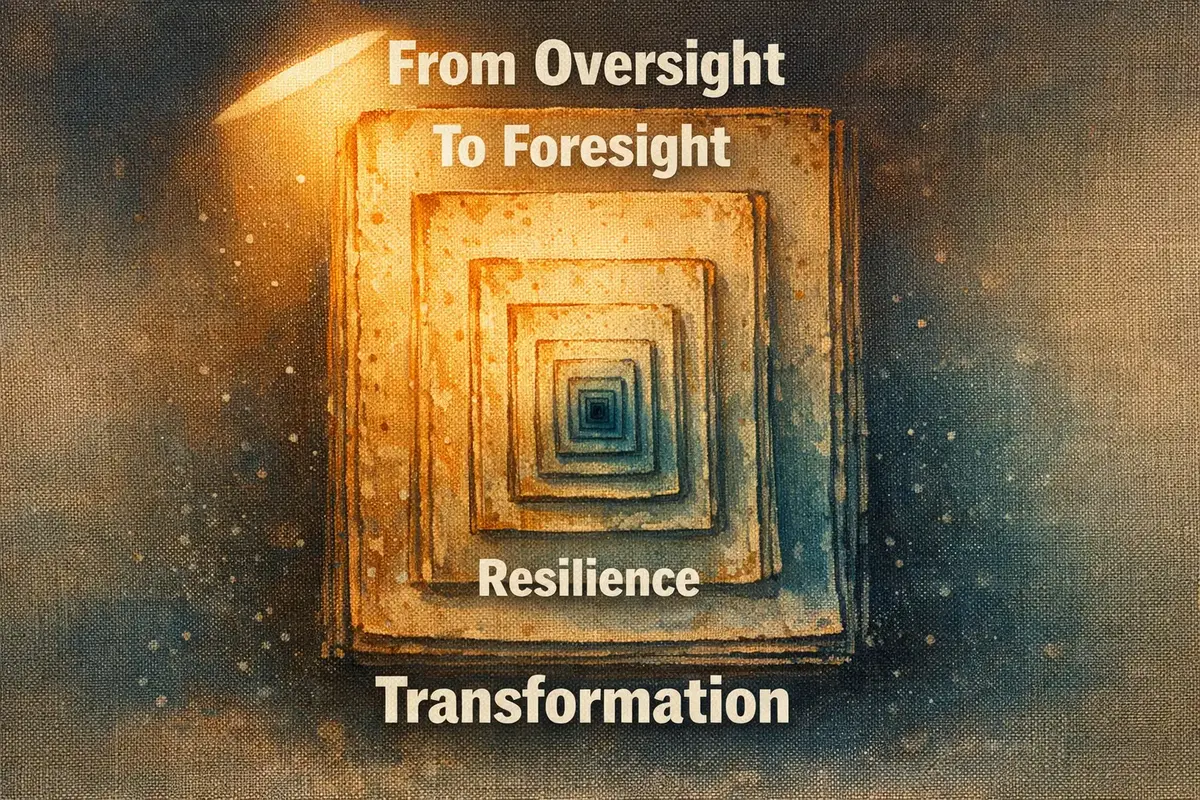
Three risk types, three clocks
AI is the shortest clock. Decisions about model use, explainability, bias, and accountability can become customer, workforce, or regulatory issues in a single quarter. That is why boards need enough fluency to challenge management on AI ethics governance, not just approve an innovation narrative.
Geopolitics runs on two clocks at once. The World Economic Forum found that geoeconomic confrontation was selected by 18% of respondents as the top risk most likely to trigger a material global crisis in 2026 (World Economic Forum, 2026). A tariff change, sanctions shift, or trade restriction can hit overnight, yet the deeper rewiring of supply chains and market access unfolds over years.
Climate risk is slower until it is not. The same World Economic Forum report identified extreme weather events as the most severe long-term risk to 2036 (World Economic Forum, 2026). Boards working on climate risk management have to hold both realities at once: acute disruption now, structural repricing later.
One conversation, not three silos
This is why siloed oversight fails. AI ethics tests legitimacy. Climate tests durability. Geopolitics tests adaptability. But all three test whether the board can govern across multiple time horizons without waiting for certainty.
The next question is sharper than it looks: what should directors ask when the signals are still partial — act early, or explain later?
What should boards ask before an emerging risk becomes a crisis?
Scenario planning matters here because it gives boards a way to ask better questions when prediction is impossible. If the board cannot know which disruption will arrive first, what exactly should it ask to avoid being surprised by it?
Most directors still assume the answer is “more data.” It usually is not. Early in an emerging risk cycle, the issue is rarely a lack of information; it is a lack of discipline about what evidence would actually change a decision.
The World Economic Forum makes the scale of that challenge clear: its Global Risks Report 2026 draws on insights from more than 1,300 experts worldwide—a reminder that foresight is built from many partial signals, not a single authoritative forecast (World Economic Forum, 2026).
A three-question framework boards can use
In practice, boards need a short question framework.
First: what would make this signal stronger? Not “do we believe it?” but what additional customer behavior, regulatory language, supplier action, or workforce pattern would move this from interesting to urgent.
Second: what would change our decision? If no plausible new information would alter capital allocation, operating posture, or risk appetite, the board is not evaluating an emerging risk. It is hosting a discussion.
Third: who owns the next review? This is where many issues drift. A signal without an owner becomes a note in the minutes. A signal with an owner gets a return date, escalation threshold, and decision path.
In a mid-market services company during the annual planning cycle, the CEO flagged rising client questions about data use, while the CFO was focused on margin pressure and the general counsel was watching draft rules in two jurisdictions. The board did not need a perfect forecast. It needed to decide what evidence would justify slowing a product launch, increasing compliance spend, or changing contract terms.
Test strategy against plausible futures
This is where scenario planning earns its place. Done well, it converts uncertainty into a small set of plausible futures that can be tested against strategy, liquidity, talent, and investment timing.
The point is not to guess correctly. The point is to expose where the current plan is fragile.
A resilient board asks: under which future do we fail slowly, and under which do we fail fast? That is the bridge to organizational resilience. Resilience is not optimism. It is preparedness across several credible paths.
And that is the real test of governance—does the board treat foresight as a recurring discipline, or as a sharp conversation that fades once the quarter closes?
The strongest boards build foresight as a habit, not a headline
61% of risk leaders say the average competitor will not last six years without changing its business model (PwC). For boards, that is not a trend statistic. It is a warning about revenue that can thin out quietly, trust that can erode before a crisis, and talent that leaves when leadership keeps reacting late.
What separates boards that merely discuss disruption from boards that are actually prepared for it? Usually not better slide decks. Not more alerts. Not another special session after the market has already moved.
It is repetition.
Credibility comes from cadence
Foresight becomes credible when it shows up in the same places as capital decisions, operating trade-offs, and succession conversations. If it lives only in an annual retreat or a headline-driven board discussion, directors may sound thoughtful without changing the company’s exposure.
In a quarterly review at an enterprise healthcare company, the board was debating a margin reset after labor costs rose faster than expected. At the same time, a VP had flagged a pattern that did not yet look urgent: payer questions were changing, clinical workflow tools were shifting faster than policy, and local trust in data practices was becoming more fragile. The board that treats those signals as “interesting” waits. The board that asks how they affect site investment, hiring, and service design starts governing.
That is the difference. Interpretation tied to decisions.
The advantage is earlier protection, not perfect prediction
The strongest boards do not win because they guess the future more accurately than everyone else. They win because they move earlier on issues that threaten resilience, capital, and legitimacy.
That early move can be small. Delay an expansion. Reprice a risk. Change a vendor standard. Stress-test a product assumption. Tighten oversight before the issue becomes public. This is how boards protect organizational resilience in practice: not through abstract commitment, but through repeated judgment under uncertainty.
The real edge is not seeing more signals. It is deciding sooner which signals deserve action.
PwC’s finding matters because it reframes the board’s task. If business model change is becoming a condition of survival, then the board cannot treat foresight as optional commentary (PwC). It has to become part of how the institution learns.
Build the habit, or chase the noise
Many boards still confuse awareness with readiness. They can name the big disruptions. They can discuss them fluently. Yet they have not built a rhythm for revisiting assumptions, reviewing weak signals, and linking both to real choices.
That rhythm is the habit.
A board does not need to chase every headline. It needs a repeatable way to decide which developments alter strategy, which require monitoring, and which demand action now. In your own boardroom, is foresight something you practice every quarter — or something you admire when the agenda allows?
Key Takeaways
- Boards are judged less on crisis cleanup and more on whether they anticipated the issue early enough to change the outcome.
- Risk, uncertainty, and foresight are different governance jobs, and boards need all three to handle emerging issues well.
- Weak signals matter because they often appear before dashboards, and interpretation is the real governance work.
- The strongest boards build foresight into a repeatable cadence tied to decisions, ownership, and strategy.
Frequently Asked Questions
What is the board’s role in anticipating emerging risks?
The board’s role is to identify strategic threats early, before they become measurable crises, and to test whether current assumptions still hold. This means looking beyond routine risk reporting to assess shifts in technology, regulation, climate, talent, and legitimacy that could alter the business model.
How is emerging risk different from ordinary risk?
Ordinary risk can usually be estimated with historical data, probabilities, and thresholds, while emerging risk involves uncertainty that is not yet stable enough to model well. Emerging risk matters because it can affect strategy before it becomes fully visible in financial or operational metrics.
Why are weak signals more important than dashboards for boards?
Dashboards mainly show what has already stabilized, while weak signals reveal changes that are only beginning to form. Boards that learn to interpret small shifts in customer behavior, regulation, supplier expectations, or employee concerns can act earlier and avoid being surprised later.
How can boards make foresight a repeatable governance practice?
Boards can build a routine that scans for external change, tests implications through scenarios, assigns ownership, and revisits assumptions on a regular cadence. Foresight becomes effective when it is tied to decisions, escalation thresholds, and follow-up rather than treated as a one-time discussion.
Why should boards discuss AI ethics, climate risk, and geopolitics together?
These issues are different in timing, but they all test whether the organization can adapt under uncertainty and maintain trust. AI ethics can affect decisions quickly, climate risk can compound over time, and geopolitical shifts can disrupt operations suddenly, so boards need one integrated view of strategic fragility.