

When a critical role opens, is your next leader already learning?
Most organizations discover the truth about leadership development and succession planning on a bad day. A respected director resigns, a plant manager goes on leave, or a regional VP is pulled into a turnaround — and the supposed backup plan turns out to be a list of high-potential names with no real evidence of readiness.
That gap is expensive. It slows decisions, stretches already overloaded leaders, and forces boards and executive teams into reactive choices they would never make under calmer conditions. The research shows this is not a fringe problem: Korn Ferry reports that most organizations believe they are experiencing a leadership gap, while DDI finds that most lack confidence in their leadership pipeline (Korn Ferry, 2024) (DDI, 2025). This article addresses the practical question underneath those findings: how to align succession planning with development so the next leader is being prepared before the role opens.
Readiness is built before the vacancy exists
Consider a mid-market healthcare company in the middle of a quarterly operating review. A senior operations leader leaves with little notice, and the CEO quickly realizes that the strongest internal candidates know their current jobs well but have never been tested on enterprise trade-offs, cross-functional influence, or crisis judgment.
That is the moment many firms confuse talent with readiness. Having capable people in the business is not the same as having people who can step into a larger role without creating drag around them.
Succession fails quietly long before a resignation makes it visible.
This is why succession planning is often misunderstood. It is not the act of naming a replacement after the fact, nor is it an annual exercise in drawing boxes on an org chart. It is a forward-looking discipline that asks a harder question: if this role opened tomorrow, who has already been learning the work of that future job?
Leadership development is the engine, not the side program
The answer is rarely found in a classroom alone. Leadership development matters when it is tied to the demands of specific future roles — the decisions, scope, ambiguity, and stakeholder complexity those roles require.
In practice, that means development should do more than improve general capability. It should convert potential into observable signals of succession readiness: broader judgment, stronger decision quality, more range under pressure, and the ability to lead beyond one’s formal authority. That is how development becomes the mechanism behind credible succession planning, not a parallel HR activity.
The real issue is not whether your organization has talented people. It is whether your system can tell the difference between promise and preparedness — and why so many organizations still cannot.
Why do so many organizations feel unprepared for leadership transitions?
80% of CEOs say employee skill gaps are a direct threat to their organization (Korn Ferry, 2024). If leaders already see the risk this clearly, why do so many succession plans still collapse into improvisation when a key role opens?
The uncomfortable answer is that many companies still treat succession as an annual talent review, not as an operating risk. They know the exposure exists. They just do not manage it with the same discipline they apply to cash flow, cyber risk, or customer concentration.
That distinction matters. A weak leadership pipeline is not merely an HR inconvenience; it is a business continuity problem that stays hidden until a transition forces it into view. By then, the organization is not choosing from prepared options. It is choosing from constrained ones.
In a regional manufacturing company during budget season, a VP of operations announces retirement three months earlier than expected. The CEO has two plausible internal candidates, but neither has run a full P&L, negotiated cross-plant trade-offs, or led through a margin squeeze. The vacancy is visible; the real problem is older — the company never built development around the actual risks of the future role.
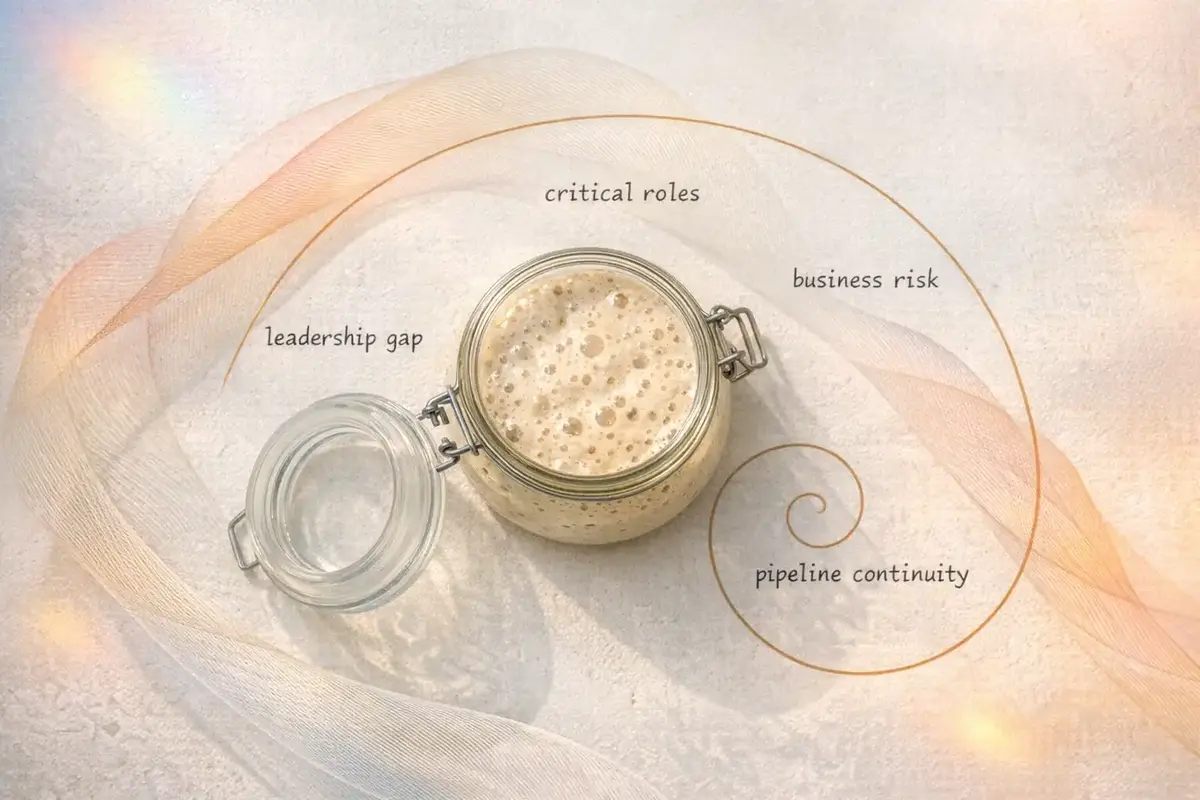
The risk is not only vacancy. It is drift.
When succession is disconnected from development, organizations absorb the cost in slower decisions, delayed promotions, and avoidable external searches. Teams feel it too. They see that advancement depends more on timing than preparation, which quietly weakens confidence in the system.
Organizations rarely lose future leaders all at once; they lose them one stalled progression at a time.
This is where retention becomes part of the succession equation. 94% of employees say they would stay longer if their company invested in their learning and progression (Korn Ferry, 2024). That is not a soft cultural signal. It is a hard warning that development shapes whether strong people picture a future inside the company or somewhere else.
High potentials leave when the path is vague
The risk is sharper for the people firms most want to keep. DDI reports that high-potential talent is 3.7 times more likely to leave without development (DDI, 2025). In practice, that means the same organizations worried about bench strength may be training their best successors to disengage.
A credible leadership pipeline does two jobs at once: it reduces transition risk and gives ambitious leaders evidence that growth here is real. Without that link, succession planning becomes a spreadsheet of names attached to rising flight risk.
And that raises the harder question. Are most organizations actually doing succession planning — or just replacement planning with better language?
What is the difference between succession planning, replacement planning, and leadership development?
Only 35% of companies have a formal succession plan (McKinsey, 2024). That means many organizations that say they “do succession” are often doing something narrower — and far less useful under pressure.
The confusion is common because the language sounds interchangeable. It is not. A list of possible backups, a process for building future leaders, and a set of development activities may all sit in the same talent review deck, but they solve different problems.
Replacement planning fills a vacancy. Succession planning reduces risk.
Replacement planning is reactive. It asks: if this person leaves, who can cover the seat now? That can be necessary, especially for business continuity, but it is still an emergency lens.
Succession planning is broader and earlier. It asks: what roles create disproportionate risk, and who is being prepared to step into them over time? The difference is not semantic. One manages interruption; the other builds capacity.
In a regional financial services firm during a year-end restructure, the CFO asks for successors to two business unit heads. HR produces three names for each role. On paper, that looks like a plan. In practice, none of those leaders has handled investor communication, enterprise prioritization, or a major regulatory issue, so the “bench” is really a shortlist of respected operators.
That is replacement planning wearing succession language.
A name on a chart is not evidence of readiness.
The evidence suggests many firms know this gap exists but have not closed it. PwC reports that just 35% of family businesses have a robust, documented, and communicated succession plan (PwC, 2025). In Central and Eastern Europe, 41% of family businesses have no succession plan at all (PwC, 2024). The issue is not whether leaders talk about succession. It is whether the organization has a usable system.
Leadership development is the mechanism that makes succession real
This is where leadership development fits. It is not the succession plan itself. It is the set of experiences, feedback, stretch assignments, coaching, and support that turns potential into succession readiness.
Without that mechanism, succession planning stays theoretical. You may know who looks promising, but you do not know who can actually absorb larger scope, make harder trade-offs, and lead credibly in unfamiliar conditions. That is why strong organizations link role risk to development moves, then watch for observable proof through succession readiness.
A useful test is simple. If your process starts with “who would replace her?” you are probably replacement planning. If it starts with “what would this future role demand, and who is being developed against that bar?” you are doing succession planning.
The distinction sounds clean on paper. Execution is where most systems break. So how do you turn that definition into a repeatable pipeline — one that defines the role, assesses the gap, and develops people against it?
How does the Define, Assess, Develop model turn planning into a pipeline?
The Define, Assess, Develop model turns succession planning into an operating system. Without it, most organizations default to naming familiar people, then discovering too late that strong performance in one role did not prepare them for the next.
Define: start with future-critical roles, not today’s boxes
Define is where the quality of the whole pipeline is set. If you define roles only by the current org chart, you will build successors for yesterday’s business.
The better question is sharper: which roles will carry disproportionate risk or value over the next two to three years? In a regional technology services firm during annual planning, that may not be the current headcount-heavy roles. It may be the VP role that will need to integrate acquisitions, lead AI-enabled delivery changes, and calm major clients through pricing shifts. The title may already exist. The real job may not.
That is why role definition has to include future decisions, not just current responsibilities. What trade-offs will this leader need to make? What stakeholder complexity will increase? What kind of ambiguity will become normal? When organizations skip that work, they confuse continuity with readiness.
Succession gets real when you define the future job before you choose the future person.
Assess: separate promise from proof
Once the role is defined, Assess becomes more than a talent review conversation. It is the disciplined comparison between what the future role demands and what a candidate has actually shown.
This is where many systems break. Gallup found that only 3% of CHROs strongly agree their organization is excellent at selecting the right candidates for manager positions (Gallup, 2024). That number points to a familiar failure: firms often promote based on visibility, loyalty, or current results, then call the choice a pipeline decision.
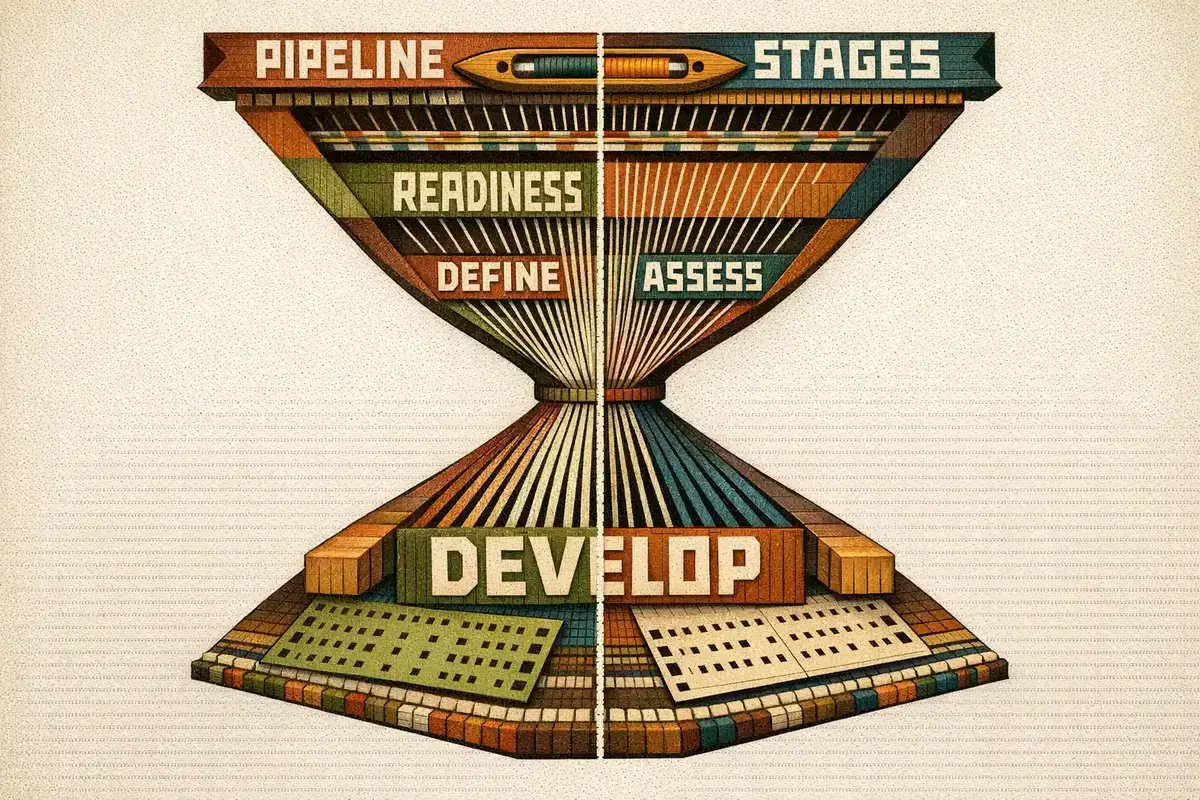
A useful assessment looks for evidence under stretch: judgment across functions, influence without authority, decision quality under pressure, and the ability to learn in public. It should also expose what has not been tested yet. That is the bridge to leadership coaching, because feedback without targeted development rarely changes readiness.
Develop: close the gap on purpose
Develop is where succession either becomes credible or stays theoretical. Development should be built from the assessment gap — not from a generic curriculum and not from what the candidate happens to enjoy.
That may mean a cross-functional assignment, a turnaround project, exposure to board-level communication, or structured leadership coaching tied to specific behaviors. The point is not activity. The point is evidence.
Gallup reports that only 12% of employees strongly agree their organization does a good job developing internal talent (Gallup, 2024). That helps explain why so many succession plans look populated but feel thin.
A pipeline is not built when names are identified. It is built when gaps are defined, tested, and closed. And that leaves the hardest question: what kinds of experiences actually create readiness — and which ones only create the appearance of it?
What actually builds readiness for future roles?
Readiness is lost in the gap between a promotion decision and the work the role actually requires. When organizations get this wrong, revenue slips through slower decisions, trust erodes across teams, and strong people leave after concluding that growth is more talk than path.
If development is supposed to create readiness, the real question is not who looks promotable. It is what experiences change capability.
Readiness grows through exposure, not events
A regional retail company feels this during a client escalation and margin squeeze. The likely successor to a divisional VP is smart, respected, and consistently delivers results — but has never led a turnaround across stores, negotiated trade-offs with finance, or carried a decision that would upset one high-performing unit to protect the whole business.
That leader does not need another generic course. They need experience that forces broader judgment.
This is where too many firms overvalue training events and undervalue role-shaped learning. Formal leadership development has a place, but readiness usually forms when someone is asked to operate at the edge of their current range, then supported well enough not to fail blindly. Stretch assignments do that because they expose the leader to ambiguity, competing priorities, and consequences that cannot be simulated cleanly in a workshop.
Future-role readiness is built when a leader starts carrying tomorrow’s decisions before they inherit tomorrow’s title.

The mechanism is stretch, reflection, and transition
The best stretch assignments are not random hardship. They are chosen because they rehearse the next role: leading across functions, inheriting a fragile team, presenting to skeptical executives, or owning a decision with incomplete information.
Coaching matters here because experience alone does not guarantee learning. Without reflection, many leaders simply repeat familiar habits under more pressure. With targeted coaching, they can see where they narrow too quickly, avoid conflict, or stay too deep in execution when the future role requires enterprise perspective.
Time-in-role transitions matter just as much. The move from expert to manager, manager to enterprise leader, or operator to strategic owner requires identity change as much as skill change. Research from Korn Ferry shows employees stay longer when they see real investment in learning and progression (Korn Ferry, 2024), while DDI finds high-potential talent is far more likely to leave without development (DDI, 2025). People notice whether development is real.
So the better succession question is not who could fill the vacancy on paper. It is which experiences have prepared someone to absorb wider scope without creating new risk.
And that creates a harder test for leadership teams: how do you know whether those experiences are producing a strong bench — or only the appearance of one?
How do you know whether your pipeline is healthy enough for the future?
80% of organizations lack confidence in their leadership pipeline. That should make any executive pause before treating a full succession chart as proof of readiness (DDI, 2025).
Most companies still judge pipeline health by simple headcount: how many names sit behind each critical role, how many people are tagged high potential, how many development plans are technically in place. The evidence points the other way. 77% of organizations believe they are experiencing a leadership gap, which suggests the problem is not whether names exist, but whether those names can carry future scope (Korn Ferry, 2024).
Count readiness, not just people
If the pipeline is supposed to protect the business, what evidence should leaders look for before they trust it?
Start with readiness depth. For each critical role, how many people could step in now, within a year, or after targeted development? Then look at role coverage. Are the most strategy-critical positions actually covered, or only the easiest ones to discuss in talent reviews?
A mid-market technology company often sees this during annual planning. The CEO feels reassured because there are successors listed for every VP role, but a closer look shows three of the most important future jobs — product leadership, enterprise sales, and post-acquisition integration — all depend on the same two people. On paper, the bench looks broad. In practice, it is fragile.
A healthy pipeline is not a list of names. It is a pattern of evidence.
The third test is the quality of development movement. Are people taking on assignments that widen judgment, increase enterprise exposure, and reduce role risk over time? Or are they simply staying busy inside familiar work? Strong talent development should produce visible movement — broader decisions, tougher transitions, more credible successors.
Judge the pipeline against the strategy ahead
This is where many succession systems quietly age out. They prepare leaders for the organization as it exists today, not for the one the strategy is creating.
A strong pipeline is future-facing. It develops leaders for new markets, tighter margins, more cross-functional dependence, faster technology shifts, or a different operating model. If your strategy is moving and your successors are not, the pipeline is already behind.
That is the real mental model. Succession planning is a business continuity system. Leadership development is what keeps it alive.
So when you review your bench next quarter, ask the harder question: are you measuring coverage — or actual readiness for the business you are becoming?
Key Takeaways
- Succession planning works best when it starts before a vacancy exists.
- Leadership development turns potential into observable readiness for future roles.
- Replacement planning fills seats; succession planning reduces business risk.
- A healthy pipeline is measured by readiness, role coverage, and development movement.
Frequently Asked Questions
What is the difference between succession planning and replacement planning?
Replacement planning is reactive: it identifies who can fill a role if someone leaves unexpectedly. Succession planning is proactive: it prepares people over time for future-critical roles by building the skills, judgment, and experience those roles require.
Why do organizations often feel unprepared when a leadership role opens?
Many organizations treat succession as an annual talent review instead of an ongoing business risk process. As a result, they may have names on a list but no real evidence that those people are ready to handle broader scope, ambiguity, or pressure.
What makes leadership development effective for succession planning?
Leadership development is most effective when it is tied to the demands of specific future roles, not just general skill building. The best development uses stretch assignments, feedback, coaching, and cross-functional exposure to turn potential into observable readiness.
How does the Define, Assess, Develop model improve succession planning?
Define identifies the future-critical roles and the challenges they will create. Assess compares those role demands with actual evidence of readiness, and Develop closes the gaps through targeted experiences and support.
How can leaders tell whether their talent pipeline is healthy?
A healthy pipeline is measured by readiness depth, role coverage, and visible development movement, not just by how many names appear on a chart. It should show that multiple people are being prepared for the roles that matter most to the organization’s future strategy.