
Why the wrong leadership assessment creates confident mistakes
53% of HR and L&D professionals say leadership assessments fail because they produce lots of data but no next steps. That is not a measurement problem. It is a decision problem (DDI, 2025).
You have likely seen the scene. A regional healthcare VP walks into a quarterly talent review with a polished assessment report, several charts, and a strong opinion about who is “ready.” Thirty minutes later, the room still cannot answer the only question that matters: ready for what, exactly?
That gap is expensive. Teams lose months debating interpretation, managers default to instinct, and participants leave with feedback that sounds precise but changes nothing. DDI’s finding matters because “lots of data, no next steps” is not a minor execution flaw; it is the predictable result of choosing a tool before defining the decision it must inform (DDI, 2025). This article is a guide to avoiding that mistake by matching the assessment to the decision, not the other way around.
A popular tool can still be the wrong tool.
Start with the decision, not the instrument
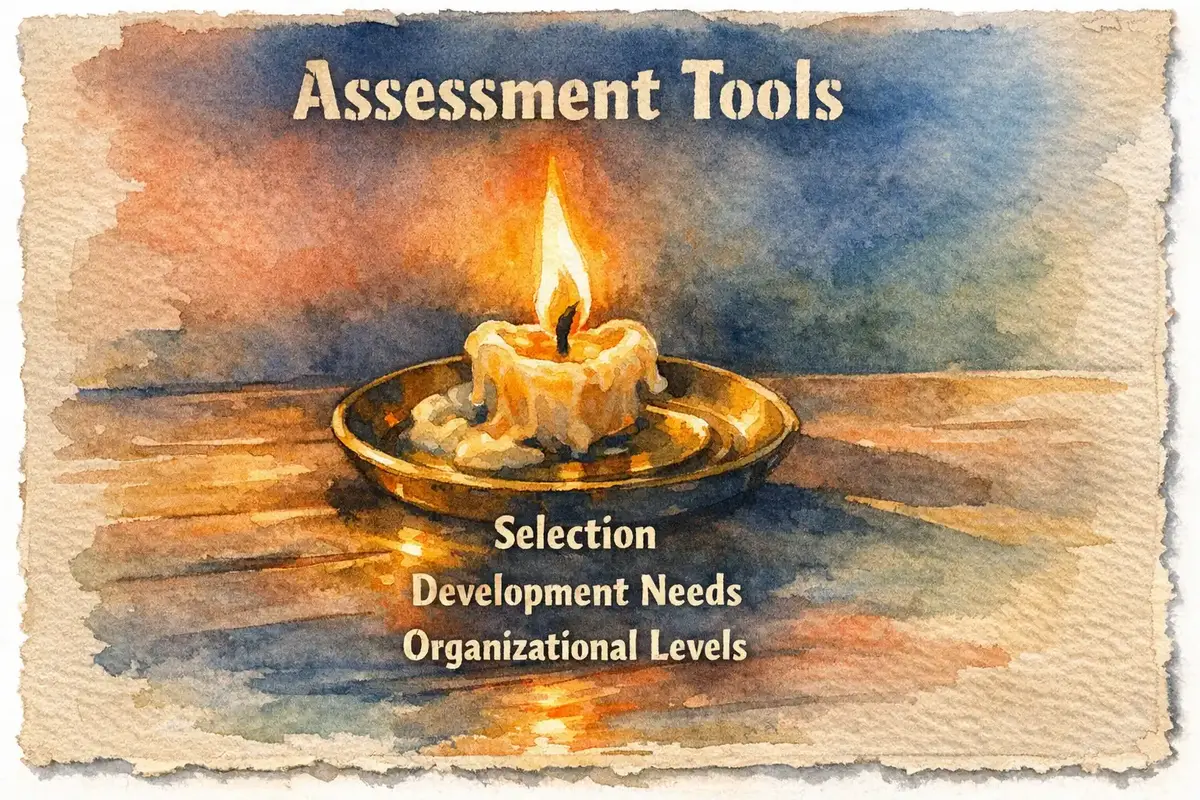
Organizations often shop for leadership assessment tools the way they shop for software: by brand recognition, peer recommendations, or what is easiest to deploy at scale. That is understandable. It is also how confident mistakes get made. The wrong assessment rarely looks wrong at first; it looks rigorous, standardized, and easy to defend.
That is one reason market reputation can mislead buyers. The Center for Creative Leadership says its tools are the global industry standard (Center for Creative Leadership, 2026). That may be true, and standardization has real value. But “industry standard” does not answer whether a tool is suited to coaching a first-line manager, comparing succession candidates, or testing readiness for a larger role. Those are different decisions, and they require different evidence.
If you are evaluating assessment tools, the first filter should be brutally simple: What decision will this result change? If the answer is vague, the tool choice will be vague too.
Separate development from judgment
The most useful distinction comes early. Are you trying to develop a leader, select one, identify a successor, or judge readiness for a near-term move? Many organizations blur these into one process, then wonder why participants become guarded and managers overread the results.
The reason is practical. A tool designed for development should create insight, reflection, and action. A tool used for selection or succession must support comparison and defensible judgment. Mix those purposes, and the conversation shifts from growth to self-protection.
This is where better assessment strategy begins: not with a test manual, but with decision clarity. Are you trying to help someone grow—or decide whether they should move now? Until that line is clear, what exactly is your assessment measuring—and what mistake is it quietly helping you make?
What does each assessment type actually measure?
The question-to-tool framework matters here because most assessment mistakes start with a false assumption: that different tools are competing ways to measure the same thing. If every tool claims to improve leadership, how do you know what each one actually reveals?
That confusion is common because assessment reports often look equally polished. The charts are clean. The language sounds scientific. A buyer can easily assume that a personality profile, a 360, and a simulation are simply different routes to the same answer. They are not.
A more useful starting point is simpler: what question does this tool answer? Center for Creative Leadership has built its assessment work on more than 50 years of pioneering research and one of the world’s largest leadership assessment databases, which is a reminder that mature assessment practice begins with measurement discipline, not branding (Center for Creative Leadership, 2026).
Four layers, four different signals
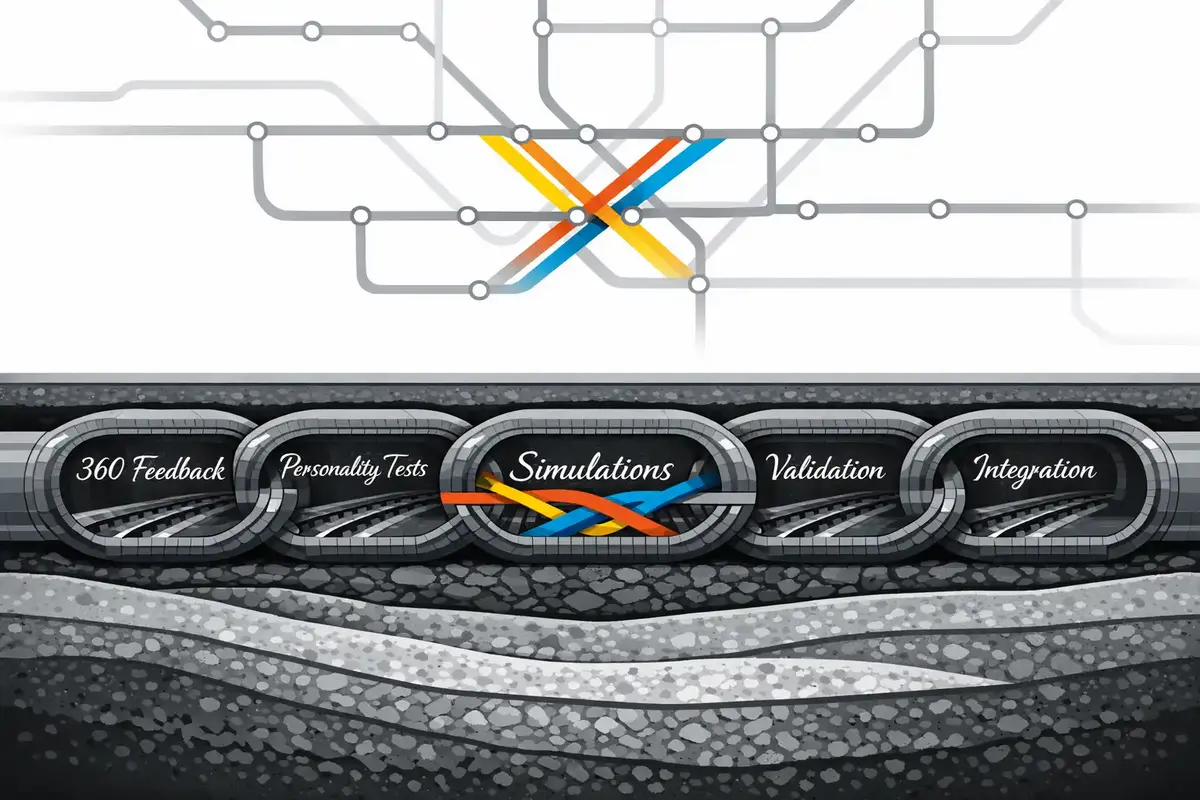
Think of leadership assessments as measuring four distinct layers: self-insight, observed behavior, interpersonal impact, and future readiness.
Personality tests mostly sit in the first layer. They help a leader understand tendencies, preferences, and likely patterns under pressure. That can be valuable in coaching, especially when a new manager keeps misreading their own style. But personality data does not show whether others experience that person as clear, credible, or trustworthy in the flow of work. It describes predisposition more than performance. That is why good personality tests are often best used as reflection tools, not verdicts.
360 feedback measures something different: perceived impact. It gathers how colleagues, direct reports, and managers experience a leader’s behavior. That makes it powerful when the development question is, “How am I landing?” It is less useful when the question is, “Can this person handle a larger, more complex role?”
Where behavior gets tested
A mid-market manufacturing director facing a team restructure may look strong on self-awareness and receive solid upward feedback, yet still struggle when conflict, ambiguity, and trade-offs hit at once. That is where behavioral simulations earn their place.
Simulations measure behavior under designed conditions. They ask the leader to act, not describe themselves. In practice, that means you can observe prioritization, judgment, communication, and adaptability in a realistic scenario. Well-built behavioral simulations are especially useful when the organization wants evidence of how someone responds in motion, not just how they are perceived.
Assessment centers go a step further. They combine multiple exercises, observers, and data points to estimate future readiness. Used well, they are not “better” than other tools. They are broader. They are designed for higher-stakes questions where the organization needs a more rounded view of likely performance in a larger role.
| Assessment type | What it mainly measures | Best used for |
|---|---|---|
| Personality tests | Self-insight, tendencies, preferences | Coaching and reflection |
| 360 feedback | Perceived impact from others | Development and awareness |
| Behavioral simulations | Behavior under designed conditions | Observing action in motion |
| Assessment centers | Future readiness across multiple data points | Higher-stakes readiness questions |
The real distinction is not good tool versus bad tool. It is which layer of leadership the tool is actually measuring.
Miss that, and you will overread self-insight as capability—or confuse reputation with readiness. And that raises the next problem: when does the most popular tool in leadership development, 360 feedback, clarify the picture—and when does it distort it?
When is 360 feedback the right tool—and when is it the wrong one?
53% of HR and L&D professionals say assessments fail when they generate plenty of data but no next steps (DDI, 2025). That matters because 360 feedback is often chosen precisely because it feels practical, scalable, and action-oriented—yet in many organizations it still produces insight without behavior change.
The mistake is not using a 360. It is using it as if it answers every leadership question.
Where 360 feedback is genuinely strong
A good 360 feedback process is built for awareness. It shows a leader how their behavior is experienced by the people around them—manager, peers, direct reports—not how they will perform in a larger role under new pressure. That distinction is easy to blur because multi-rater data looks comprehensive. It is not comprehensive. It is relational.
That makes 360s especially useful when the development question is specific: Do others experience this leader as clear, inclusive, decisive, or defensive? If a regional services company has a director whose team delivers results but turnover is rising, a 360 can surface patterns that self-report tools miss. Maybe peers see strong collaboration while direct reports see avoidance in difficult conversations. That is development gold. It gives the leader something concrete to work on.
Used this way, a 360 is not a verdict. It is a mirror.
Where organizations misuse it
Problems start when companies treat multi-rater feedback as a selection tool or a proxy for readiness. Popular leaders can score well because they are easy to work with. Hard-driving leaders can score poorly during a tough turnaround because they are asking more of people. Neither pattern tells you enough, on its own, about who should run a bigger business unit.
That is why 360s are weak for high-stakes talent calls. They capture perception in a current context. They do not test judgment, learning agility, or performance in unfamiliar complexity. DDI’s Global Leadership Forecast 2025, drawing on 2,185 HR professionals and 10,796 leaders, reinforces the scale of this challenge: organizations have a lot of leadership data, but not always the right evidence for the decision in front of them (DDI, 2025).
What makes a 360 actually useful
The real value comes after the report. A leader needs help interpreting patterns, separating signal from noise, and choosing two or three behavior goals that others will notice. Without that step, the report becomes one more document in a quarterly review.
Manager involvement matters just as much. If the boss never revisits the feedback, the organization has quietly told the participant that reflection is optional. Pair the process with focused leadership coaching, regular check-ins, and observable commitments, and the odds of change improve.
So the boundary is clear. Use a 360 to improve how a leader shows up now—or misuse it to guess who will succeed next. And if a tool is popular but not valid for the decision, what exactly is making it feel trustworthy?
Why validity matters more than tool popularity
What happens when a familiar assessment is trusted more than the evidence behind it? A well-known tool can still lead a smart team to the wrong conclusion. That matters because confidence is easy to manufacture; validity is not.
You can see the trap in a budget-cycle meeting. A finance enterprise is reviewing development spend for its director population, and one option keeps rising to the top because everyone has heard of it, several executives have used it before, and the report looks polished. No one asks the harder question yet: does this instrument measure the thing we need to decide?
That is where assessment quality stops being a branding issue and becomes a governance issue.
Popularity is not evidence
Center for Creative Leadership says its tools are the “global industry standard” and built on “more than 50 years of pioneering research” (Center for Creative Leadership, 2026). Both claims may be true. Neither claim, on its own, tells you whether a specific tool is valid for coaching a struggling manager, comparing internal candidates, or informing a succession slate.
A tool earns trust in a narrower way. Reliability asks whether it produces stable results. Validity asks whether those results support the decision you want to make. If either is weak, the assessment may still look rigorous while quietly measuring the wrong construct.
That distinction gets missed all the time. Teams confuse a clean report with a sound inference.
The wrong construct creates expensive certainty
Consider a regional finance firm choosing a familiar assessment for succession discussions at the VP level. The instrument is excellent for self-reflection and useful in coaching conversations. It is not designed to estimate readiness for broader enterprise leadership. Months later, the talent review stalls because the data says a lot about style and very little about judgment under complexity.
The cost is not abstract. The firm loses a quarter debating interpretation, line leaders revert to instinct, and participants start treating development feedback as a hidden selection screen.
Even market visibility can distort judgment. Korn Ferry’s guide to leadership assessments is clearly circulating widely—its page shows “249 Shares” (Korn Ferry, 2024)—but shared content is not the same as decision-grade evidence. A tool can be respected, common, and still misaligned with the use case.
If the purpose is development, use an instrument that helps a leader build specific leadership skills. If the purpose is selection or succession, the bar changes. The evidence must support comparison, defensibility, and role-relevant prediction.
That is the real test. Not “Have we heard of it?” but “What decision can this tool legitimately support?” And once that is clear, a harder choice appears: which tools fit a frontline manager, a director, and a future enterprise leader—without forcing one method to do every job?
How should organizations choose tools by leadership level and development goal?
61% of employers now say leadership and social influence is a core workforce skill for 2025, which means the cost of using generic assessment logic is rising, not falling (World Economic Forum, 2025). In a quarterly talent review, this is the moment you recognize: one team wants a simple tool for everyone, while the business is asking very different things of a new supervisor, a director, and a future GM.
That gap is getting wider.
The World Economic Forum also reports that leadership and social influence saw a 22 percentage-point increase in the share of respondents calling it a core skill (World Economic Forum, 2025). Korn Ferry’s Workforce 2025 survey draws on more than 15,000 professionals worldwide, which matters because the pressure to scale decisions is real — but scale is exactly where one-size-fits-all assessment choices start to distort judgment (Korn Ferry, 2025).
Match the tool to the level
At the early-career manager level, the development need is usually not strategic foresight. It is self-awareness, feedback, and a clearer read on how their behavior affects a team. A 360, a focused personality instrument, or manager-led feedback process can work well here because the question is immediate: How am I showing up in the role I just entered?
At the mid-level leader level, that same tool often becomes insufficient. Directors and functional heads are usually not struggling with awareness alone; they are struggling with behavior change under pressure — delegation, cross-functional influence, conflict, prioritization. Here, simulations, stretch-role observation, and targeted leadership development plans tend to outperform reflection-only tools because they show whether insight turns into action.

For senior leaders, the center of gravity shifts again. The question is less about current style and more about readiness, judgment, and enterprise range. A well-liked VP may score strongly in feedback but still lack the ability to make trade-offs across markets, capital, and talent. At that level, broader assessment methods — including simulations, panel-based exercises, and multi-method readiness reviews — are usually more defensible.
Match the tool to the decision
Level matters. So does purpose.
If the goal is development, choose tools that create insight and specific behavior commitments. If the goal is succession, use methods that allow comparison across candidates. If the goal is selection, the evidence has to stand up to scrutiny. If the goal is team effectiveness, individual profiles alone will not be enough; you need data on interaction patterns, role clarity, and collective blind spots.
The same assessment can be smart for a first-line manager — and weak for a succession slate.
That is why a combined approach usually works better than a single instrument. Leadership is multi-dimensional. One tool may show tendencies, another observed behavior, another likely readiness. Used together, they reduce overconfidence.
Used badly, they create it.
And that leaves the harder question: once you have the data, what turns it into actual growth — disciplined follow-through, or just another report in the system?
What should happen after the assessment if development is the goal?
53% of HR and L&D professionals say assessments fail when they generate plenty of data but no next steps (DDI, 2025). That is how trust gets eroded: money spent, leaders labeled, teams disrupted — and six months later, nothing in the work has changed.
If the assessment is finished but the leader is unchanged, what was actually accomplished?
Turn findings into a short list of visible behaviors
Assessment data is not development. It is raw material.
In a mid-market technology company during budget season, a director receives a strong report on strategic thinking and weaker feedback on cross-functional follow-through. The common mistake is to discuss the pattern, admire the insight, and move on. The useful move is narrower: define two or three observable behaviors that colleagues can actually see. For example: closes decisions within 48 hours, names trade-offs in staff meetings, and resets priorities with peers before deadlines slip.
That translation step is where most systems break. Research from SHRM, based on 1,615 HR professionals, 238 HR executives, and 471 U.S. workers, is a reminder that workplace systems are judged in lived experience, not in design intent (SHRM, 2025). Leaders do not improve because a report is accurate. They improve because the report changes what they practice next week.
Build a development cycle, not a reporting event
The strongest setups connect assessment results to coaching, manager involvement, and follow-through. A good leadership coaching process helps the leader interpret patterns without becoming defensive. The manager’s role is different and just as important: reinforce priorities, notice progress, and challenge drift.
Keep the goal count low. Three is usually enough. More than that, and the plan becomes a document instead of a discipline.
Development starts when feedback becomes a repeated expectation in real work.
Treat the assessment as the first mile of a cycle: insight, choice, practice, review. Not the finish line. So look at your own process honestly — does it end with a report, or with a leader doing something differently that other people can name?
Key Takeaways
- The right leadership assessment starts with the decision, not the instrument.
- Personality tests, 360 feedback, simulations, and assessment centers measure different layers of leadership.
- 360 feedback is strongest for awareness and development, not for selection or readiness decisions.
- Assessment results only create value when they lead to visible behaviors, coaching, and follow-through.
Frequently Asked Questions
How do you choose the right leadership assessment tool?
Start by defining the decision the assessment must support, such as development, selection, succession, or readiness. The best tool is the one that measures the specific leadership question you need answered, not the one that is most popular or easiest to deploy.
What do different leadership assessment tools measure?
Different tools measure different layers of leadership. Personality tests focus on tendencies and self-insight, 360 feedback captures how others experience a leader, behavioral simulations show action under designed conditions, and assessment centers combine multiple data points to estimate future readiness.
When is 360 feedback the right choice for leadership development?
360 feedback is best when the goal is awareness and behavior improvement, because it shows how a leader is perceived by managers, peers, and direct reports. It is less suitable for high-stakes selection or succession decisions because it reflects current relationships more than future performance in a larger role.
Why does validity matter more than popularity in leadership assessments?
A popular tool can still measure the wrong thing, which creates confident but inaccurate decisions. Validity matters because it shows whether the assessment results actually support the decision you want to make, while reliability only shows whether the results are stable.
What should happen after a leadership assessment if development is the goal?
Assessment results should be translated into a short list of visible behaviors, such as clearer decision-making or better follow-through. The leader should then practice those behaviors with coaching, manager support, and regular review so the feedback leads to measurable change.