

Why AI Budget Decisions Are Now CEO Decisions
71% of CEOs say AI is a top investment priority—which is exactly why the CEO capital allocation framework now matters. Without it, companies buy AI faster than the business can absorb it, and the gap between spend and value widens (KPMG, 2025).
This is no longer an innovation-sidecar issue delegated to IT or a digital team. In the budget cycle, AI competes with every other use of capital: margin protection, growth bets, operating resilience, and leadership capability. KPMG also finds that 69% of CEOs plan to allocate 10–20% of their budget to AI over the next 12 months (KPMG, 2025). That is not pilot money. It is operating-model money. It changes who decides, what gets measured, and how quickly weak assumptions become expensive. This article addresses the core decision CEOs now face: how to fund AI, skills, governance, and adoption as one system rather than as disconnected line items.
In a quarterly review at a regional manufacturing company, the CEO approves a new AI platform after a strong vendor demo. Six months later, usage is uneven, managers have rewritten no workflows, legal is slowing deployment, and frontline teams still rely on manual workarounds. The software is live. The organization is not.
The investment case is bigger than software
The scale of the opportunity explains the urgency. IBM projects that AI could add USD 4.4 trillion to the global economy (IBM, 2026). But macro value does not automatically become enterprise value. Inside companies, returns depend on whether AI is tied to process redesign, management discipline, decision rights, and workforce readiness.
That is why balanced investment is not a soft argument for “people spending.” It is a hard argument about absorption capacity. If you fund models and licenses without funding training, governance, workflow redesign, and manager adoption, you are not accelerating transformation. You are creating implementation drag.
CEOs are really deciding the organization’s rate of change
The practical question is not whether AI deserves capital. The market has already answered that. The real question is whether the enterprise can convert AI spend into repeatable performance gains before complexity, risk, and internal friction consume the upside.
That is the standard CEOs should use. Not tool count. Not pilot volume. Organizational readiness.
A disciplined CEO capital allocation framework helps because it forces one integrated view: technology, talent, governance, and adoption rising together. Buy too slowly and you lose ground. Buy too fast—and the system rejects the investment. So what does balanced AI investment actually look like in practice?
What Does Balanced AI Investment Actually Mean?
The AI investment portfolio framework starts with an uncomfortable number: 92% of companies plan to increase AI spending over the next three years. That makes the real question sharper, not simpler: if nearly everyone is spending more, what separates a disciplined portfolio from a scattered one (McKinsey, 2025)?
Balanced AI investment is not a 50/50 split between software and training. It is a coordinated allocation across five categories: infrastructure, priority use cases, talent development, change management, and governance. The point is not symmetry. The point is to keep one part of the system from outrunning the others.
A regional healthcare provider offers a familiar example. In the annual budget cycle, the CFO approves funding for clinical documentation AI and data integration, but the operating leaders defer manager training and redesign work to “phase two.” Three quarters later, the tools exist, but adoption is patchy, compliance reviews are slow, and clinicians have created workarounds that cancel much of the time savings. The investment was real. The capability was incomplete.
Think in portfolios, not purchases
This is why CEOs should treat AI investment as a portfolio decision, not a procurement event. Some spending keeps today’s business running better: automation in service operations, copilots for internal workflows, analytics that reduce cycle time. Other spending builds tomorrow’s capacity: data foundations, leadership fluency, role redesign, and the human talent development needed to absorb more advanced use cases later.
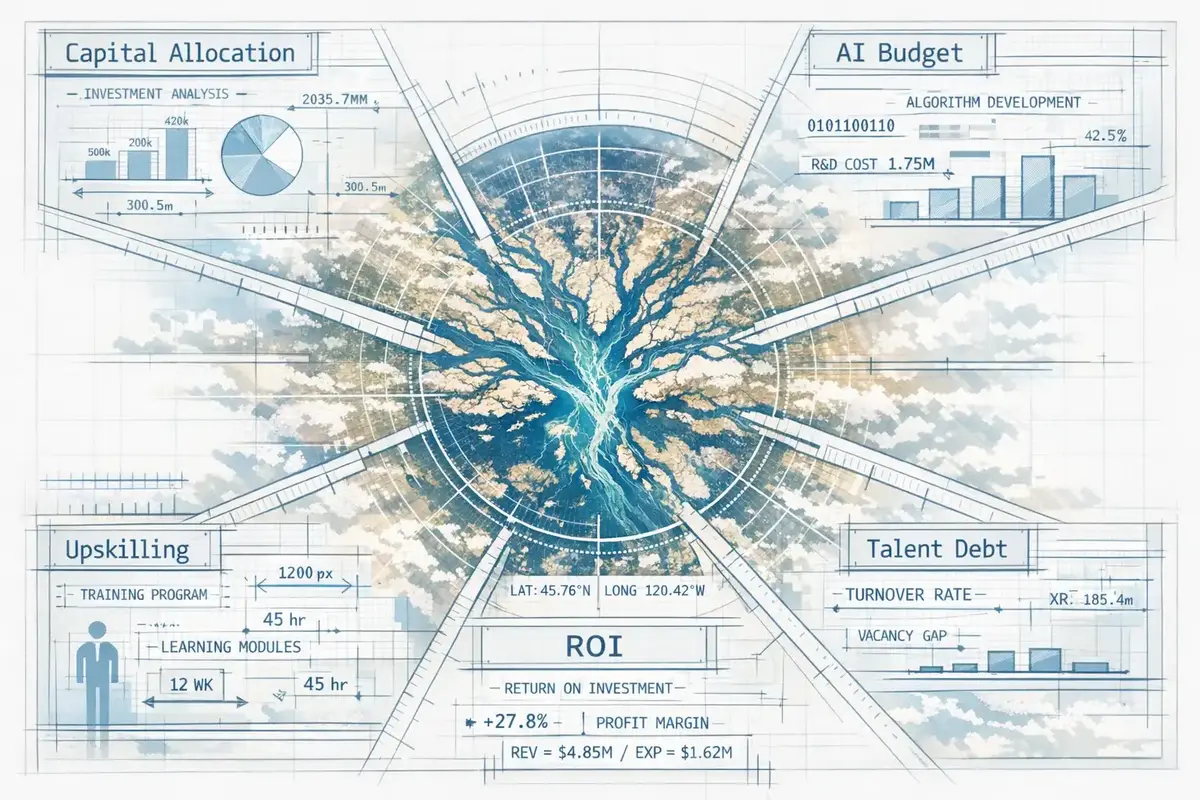
The distinction matters because the constraints are different. Efficiency investments usually need clear owners, fast deployment, and measurable operating gains. Capability investments often look slower at first — because they are building the conditions for scale. CEOs who lump both into one bucket often overfund visible tools and underfund the less visible enablers that determine whether those tools stick.
46% of leaders identify workforce skill gaps as a significant obstacle to AI adoption (McKinsey, 2025)
The right balance is coordinated, not equal
Deloitte’s finding is even more revealing: only 5% of executives strongly agree their organization is investing enough in helping people learn new skills (Deloitte, 2024). That gap explains why “balanced” should be read as sequenced and connected. You may spend more on infrastructure this year than on training. Fine. But if governance is thin, managers are unprepared, or frontline roles are unchanged, the portfolio is still unbalanced.
That is the CEO test: are you buying tools, or building capability? Because once the technology is in place, the next bottleneck is rarely compute or licenses. It is whether the workforce can actually use the system at the speed the strategy requires.
Why the Skills Gap Becomes the Real Bottleneck
39% of workers’ existing skill sets are expected to be transformed or become outdated by 2030. For CEOs, that means the constraint on AI returns is shifting from tool access to workforce adaptability (World Economic Forum, 2025).
You have seen the moment. A VP in a regional financial services firm walks into a quarterly review with a new AI assistant already licensed across the business, only to find that managers are still unsure where it fits, teams are using it inconsistently, and no one has rewritten the approval steps that slow the work.
The bottleneck moves from procurement to capability
This is why the skills gap is not a soft concern sitting somewhere under HR. It is an operating issue. KPMG reports that 77% of CEOs say workforce AI readiness and upskilling will affect prosperity over the next three years (KPMG, 2025). That is a blunt signal: leaders increasingly understand that value realization depends on whether people can absorb change at the speed capital is being deployed.
Only 19% of employees strongly agree they have the skills they need to succeed (Accenture, 2025)
That number should change how CEOs read adoption dashboards. Low usage is often diagnosed as resistance, weak communication, or a tooling problem. In practice, many organizations are asking employees to use AI inside workflows that were never redesigned, under managers who were never trained to coach new ways of working, with performance expectations that still reward the old process.
The result is predictable. Deployment happens. Adoption stalls. ROI softens.
Managers are the conversion layer
The most underfunded layer is usually manager enablement. Senior leaders approve the platform. Frontline employees feel the disruption. Managers sit in the middle and translate strategy into daily work — or fail to. If they cannot decide which tasks should change, what good output looks like, where human review still matters, and how to coach judgment, the organization defaults to partial use.
That is why leadership development belongs in the AI budget, not beside it. The same goes for structured reskilling. These are not support programs. They are throughput investments.
Treat workforce readiness as you would any other operating constraint: plant capacity, regulatory approval, or data quality. If the organization can only absorb change at a certain rate, then overbuying technology does not create speed. It creates friction.
And that raises the harder question. When AI does work, where does the productivity actually come from — the model itself, or the redesign of work around it?
What the Research Shows About AI, Productivity, and Work Redesign
3x higher growth in revenue per employee is already showing up in industries more exposed to AI, which means the cost of getting this wrong is not abstract. It is revenue left on the table, credibility lost after overhyped deployments, and strong people walking out when the work becomes more confusing instead of more effective (PwC, 2025).
That is the right way to read the current evidence. If AI can lift productivity, why do some companies still see little return from their spending? Because the gains do not come from software sitting on top of old work. They come from work redesign.
Productivity shows up first where work actually changes
PwC’s 2025 AI Jobs Barometer draws from close to a billion job ads across six continents. That matters because it moves the discussion beyond pilot anecdotes and into labor-market scale (PwC, 2025). The signal is clear: AI-exposed sectors are not just experimenting more; they are starting to convert that exposure into stronger output economics.
Industries more exposed to AI are seeing 3x higher growth in revenue per employee (PwC, 2025)
A C-suite team at a mid-market retail company sees this tension in a budget review. The merchandising group has AI tools for forecasting and content generation, yet margin gains remain thin because planners still follow the same approval chain, merchants still reconcile data manually, and store operations still escalate exceptions the old way. The tool works. The system around it does not.
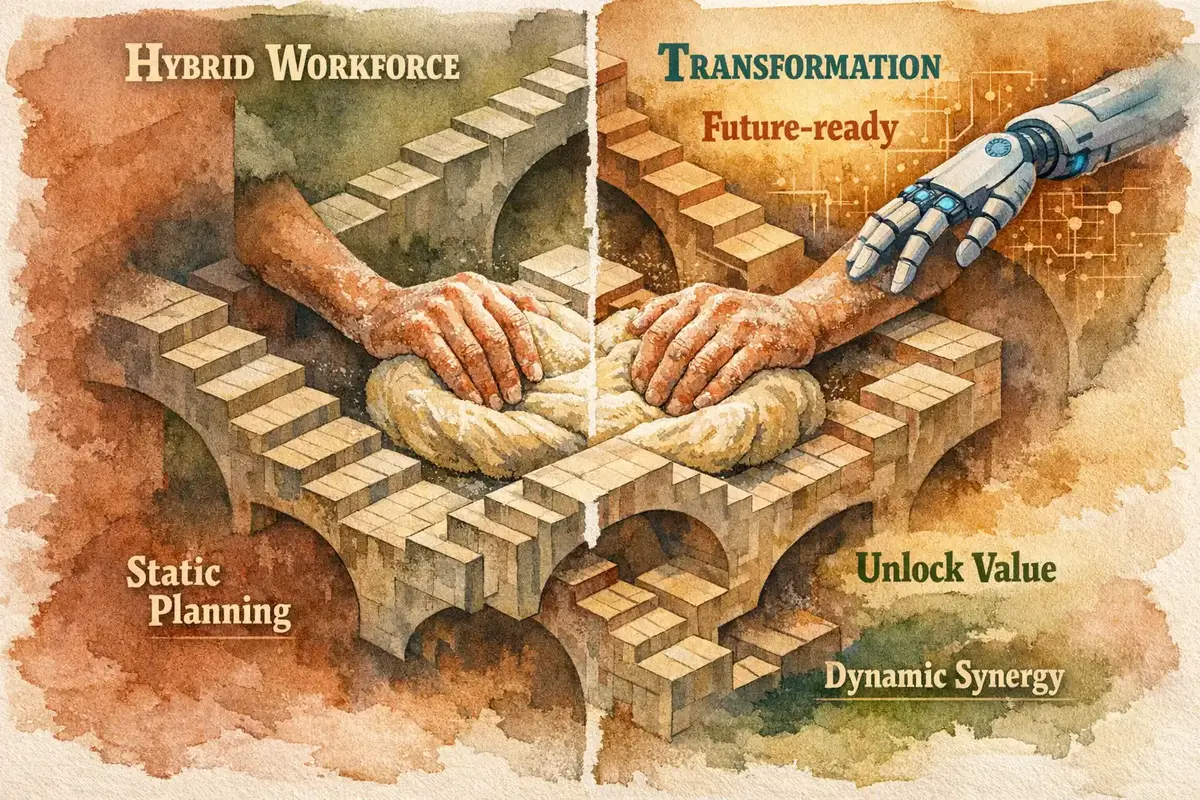
This is why CEOs should treat productivity data as a design signal. The question is not “Where can we automate a task?” It is “Which decisions, handoffs, and review layers should exist now that AI can do part of the work faster?” That is a different conversation — and a more valuable one.
The labor market is signaling a shift in job content
The labor evidence points the same way. Skills for AI-exposed jobs are changing 66% faster than for other jobs, which tells you that AI is reshaping roles from the inside rather than simply removing them (PwC, 2025). Job content changes first: more judgment, more exception handling, more orchestration across systems, less routine production.
The pay signal reinforces it.
Workers with AI skills command a 56% wage premium (PwC, 2025)
That premium is not just a talent-market curiosity. It is a capital allocation clue. Companies are paying more for people who can combine AI output with domain judgment, risk awareness, and operating context. In other words, the market is rewarding human capability paired with AI, not AI in isolation.
For CEOs working through AI adoption, the implication is practical: fund workflow redesign, manager judgment, and role clarity alongside the tools. That is what turns experimentation into workforce transformation.
The hard part comes next. If value depends on redesign, not just deployment, where should capital go first — the use cases with visible savings, or the capabilities that let those savings scale?
How Should CEOs Decide What to Fund First?
A services CEO sits in the budget meeting with four credible asks on the table: a new model layer, better data plumbing, manager training, and risk controls. The wrong answer is to pick the most impressive line item. The right answer is to fund what the organization can actually absorb first.
By 2025, 44% of employees said their organization had implemented AI (Gallup, 2025). That sounds like momentum. It should also sound like a warning: implementation is now common enough that the real differentiator is no longer whether you bought AI, but whether people use it well. Gallup also reports that 45% of U.S. employees used AI at work at least a few times a year (Gallup, 2025), while 32% regularly work with AI agents (Accenture, 2025). Usage is spreading. Readiness is uneven.
Sequence the spend, don’t spread it
The first funding decision should balance deployment need with organizational absorption. If your data environment is too weak to support a priority use case, fund the minimum viable infrastructure. Not the perfect stack. Just enough to make the first wave reliable.
Then fund the few use cases with clear economic value — cycle time reduction, error prevention, pricing support, service productivity. After that, fund the capabilities that let those wins scale: manager training, role redesign, governance, and targeted reskilling. This is the sequence many CEOs reverse. They buy broad capability first, then discover the business has no proof point strong enough to pull adoption through.
A regional healthcare CEO sees this in a quarterly review. The clinical team wants ambient documentation tools. Compliance wants stronger controls. HR wants AI training for managers. The disciplined move is not to say yes to all three at once. It is to ask which combination gets one high-value workflow into production safely — and teaches the organization how to repeat the process.
Use three tests for every budget line
Every AI-related budget line should answer one of three questions: does it increase adoption, improve decision quality, or build reusable capability? If it does none of the three, it is probably discretionary.
That filter sharpens AI adoption decisions fast. A narrow governance investment may matter more than another license expansion if it removes approval delays across multiple use cases. A manager-enablement program may outperform a larger software purchase if it lifts usage in teams already equipped.
The best allocations reduce stranded technology risk by tying each dollar to a measurable business outcome — not to activity, enthusiasm, or vendor pressure.
That is the real sequencing question: fund what launches the first win, or fund what makes the tenth win possible? The strongest CEOs do both — but not at the same time.
Why the Hybrid Workforce Is the Real End State
The hybrid workforce model matters here because it forces a harder question than most AI plans ask: if AI handles more routine work, which human capabilities become the new strategic advantage?
Many executives still act as if the destination is one-sided — either more automation or more training. That assumption breaks down fast in practice. The end state is not an AI-heavy company with fewer people decisions. It is an organization where machines expand capacity, while people supply judgment, trust, coordination, and adaptation.
The value shifts upward, not away
As AI takes on drafting, summarizing, pattern detection, and first-pass analysis, the scarce work moves elsewhere. Someone still has to decide what good looks like, when an output is reliable enough to use, how to explain a decision to a client, and when to override the system. Those are not residual tasks. They become the work.
Harvard Business Impact’s 2025 Global Leadership Development Study shows the shift clearly. 56% of respondents said leaders are now expected to use AI in strategic decision-making and 58% were already using AI to generate data-driven insights in leadership development (Harvard Business Impact, 2025). That is the signal many companies miss: AI is not reducing the need for leadership capability. It is raising the standard for it.
A director at a mid-market technology company sees this during a team restructure. Engineers now use AI to accelerate documentation and code support, so output rises. But escalations also rise, because product managers and team leads have not been trained to set review thresholds, resolve ambiguity faster, or coach teams through changed workflows. The bottleneck moves up the chain.
The compounding effect comes from integration
This is why separate programs underperform. One budget funds AI fluency. Another funds leadership training. A third talks vaguely about future roles. Each may be sensible on its own. Together, if unconnected, they leave value stranded.
The more credible strategy links leadership development to AI fluency and role redesign at the same time. It treats human talent development as part of the operating model, not as a cultural side initiative. Accenture’s own scale makes the point tangible: 85,000+ AI and data professionals now work at Accenture (Accenture, 2025). That is not just a technology build. It is a workforce design choice.
The winning model is not human or machine. It is human with machine — by design.
And that creates the final CEO test: will you fund isolated capabilities, or one investment thesis that compounds? The difference sounds subtle. In capital allocation, it is where the winners separate.
The CEOs Who Win Will Treat AI and Talent as One Investment Thesis
About one-third of vacancies across 10 OECD countries are now in occupations highly exposed to AI, which means the cost of getting this wrong is no longer theoretical: revenue slips when work slows, trust erodes when decisions become inconsistent, and good people leave when the organization feels harder to work in, not easier (OECD, 2024). If AI exposure is rising faster than skill supply, responsible CEO stewardship is not about spending more. It is about funding the whole system that must change.
Measure the system, not just the spend
One reason this matters now: globally, only 1.5% of online vacancies required AI skills from 2021 to 2024 (World Bank, 2025). Read that carefully. Demand is moving into AI-exposed work faster than formal skill signals are spreading through the labor market. That gap is where many companies get trapped — buying for a future capability they have not yet built internally.
A C-suite team at an enterprise services firm sees it during the annual planning cycle. The technology budget is approved. The operating model is not. Six months later, the company has more tools, but also more exceptions, more rework, and longer decision paths because managers are still judging AI-supported work with pre-AI rules.
That is why the strongest CEOs track three things together: adoption, skill growth, and workflow redesign. Financial return still matters. Of course it does. But a clean ROI number can hide weak foundations if usage is shallow, role expectations are unclear, or cycle times improve in one function while risk and confusion rise in another.
The real hedge is organizational capacity
This is also a talent issue, not just a technology issue. Global employee engagement fell in 2024 and fell again in 2025 (Gallup, 2026). In that environment, overbuilding technology while underbuilding clarity, capability, and managerial support is a costly mistake. People do not disengage because software arrived. They disengage when the work changes and leadership fails to make the new standard usable.
A balanced approach lowers that risk. It gives the company a better chance to scale workforce transformation without creating a second problem while solving the first. It also disciplines capital allocation: fewer symbolic purchases, more coordinated bets, and clearer evidence about what the organization can absorb next.
That is the closing test for CEOs. Not whether AI deserves funding, but whether your capital logic treats technology and human capability as one investment thesis.
That is what future readiness looks like in practice — disciplined spend, stronger managers, redesigned work, and a workforce that can actually use what you buy. So in your next budget review, what are you really funding: more AI, or a company that can turn AI into performance?
Key Takeaways
- AI budget decisions are now CEO decisions because spend, governance, skills, and adoption rise or fail together.
- Balanced AI investment means coordinating infrastructure, use cases, talent development, change management, and governance.
- The skills gap and manager enablement are major bottlenecks to AI value realization.
- The strongest CEOs treat AI and talent as one investment thesis, not separate initiatives.
Frequently Asked Questions
What does strategic capital allocation mean for AI investment and human talent development?
It means funding AI, skills, governance, workflow redesign, and adoption as one connected system rather than as separate budget items. The goal is to make sure technology spending is matched by the organizational capacity needed to turn it into measurable performance gains.
Why is balanced AI investment important for CEOs?
Balanced investment prevents companies from buying AI faster than they can absorb it, which often leads to low adoption and weak returns. CEOs need to align infrastructure, use cases, talent development, change management, and governance so that each part of the organization advances together.
What is the biggest bottleneck to AI value realization in most organizations?
The biggest bottleneck is usually the skills gap, especially manager enablement and workforce readiness. If employees and managers are not trained to use AI inside redesigned workflows, the technology may be deployed but the business value will stall.
How should CEOs decide what AI-related spending to fund first?
They should sequence spending based on what the organization can absorb first, starting with the minimum infrastructure needed for a high-value use case. After that, they should fund the capabilities that make the gains repeatable, such as training, governance, role redesign, and targeted reskilling.
Why should AI and talent be treated as one investment thesis?
AI creates value only when people, processes, and decision rights change along with the technology. Treating AI and talent as one thesis helps companies build a hybrid workforce where machines handle routine work and people provide judgment, coordination, and adaptation.