


ESG Is No Longer a Reporting Topic—It Is a Board Leadership Test
Integrated governance is the discipline of treating ESG as part of how the board directs the business, not as a separate disclosure stream. You see the test in real time: a quarterly board meeting, rising stakeholder pressure, and directors asking whether ESG belongs in the strategy debate or only in the annual report. The answer is straightforward. Boards create sustainable value when ESG is built into strategy, risk, incentives, and accountability—not parked in a reporting appendix.
That distinction matters because a compliance-only approach feels busy while changing very little. A regional manufacturing company can spend weeks preparing sustainability slides for the board pack, yet still make capital allocation, supply chain, and talent decisions as if ESG were someone else’s agenda. IFAC’s guidance is clear: relevant sustainability and ESG matters belong in purpose, governance, strategy, decision-making, risk management, and accountability reporting. This article is about how boards close that gap before it becomes a governance failure.

The real issue is not intent. Most boards already support ESG in principle. The problem is fragmented ownership—audit sees disclosure, risk sees controls, management sees operations, and no one owns the full picture. That is where oversight weakens, even in otherwise strong board governance models.
When ESG sits outside the core agenda, the board is not leading change; it is documenting delay.
Holistic leadership starts when directors stop asking, “Do we have an ESG report?” and start asking, “Where does ESG change our choices?” If that sounds obvious, why do so many boards still struggle to make it operational—strategy by strategy, committee by committee?
Why Do So Many Boards Talk About ESG but Still Struggle to Integrate It?
Integrated ESG governance—a board operating model that connects ESG to strategy, risk, incentives, and oversight—is already on the calendar in many companies. Yet without that model, discussion turns into repetition: the board reviews updates, management presents activity, and few core decisions actually change. EY found that 49% of boards discuss the ESG agenda and reporting at every meeting (EY, 2022). If ESG is already on the agenda, why does execution still feel fragmented?
Because board cadence is not the same as board capability. BCG and INSEAD reported that 70% of directors see themselves as only moderately effective or not effective at integrating ESG into company strategy and governance. That gap explains a pattern many directors recognize: ESG appears often enough to signal seriousness, but not clearly enough to shape trade-offs.
A mid-market technology company in budget season makes the problem visible. The board approves cyber investment, debates hiring plans, and reviews supplier concentration risk. ESG appears in a separate deck at the end. No one asks how energy use affects product architecture, whether talent retention changes execution risk, or how procurement standards alter margin assumptions. The issue is not attention. It is design.
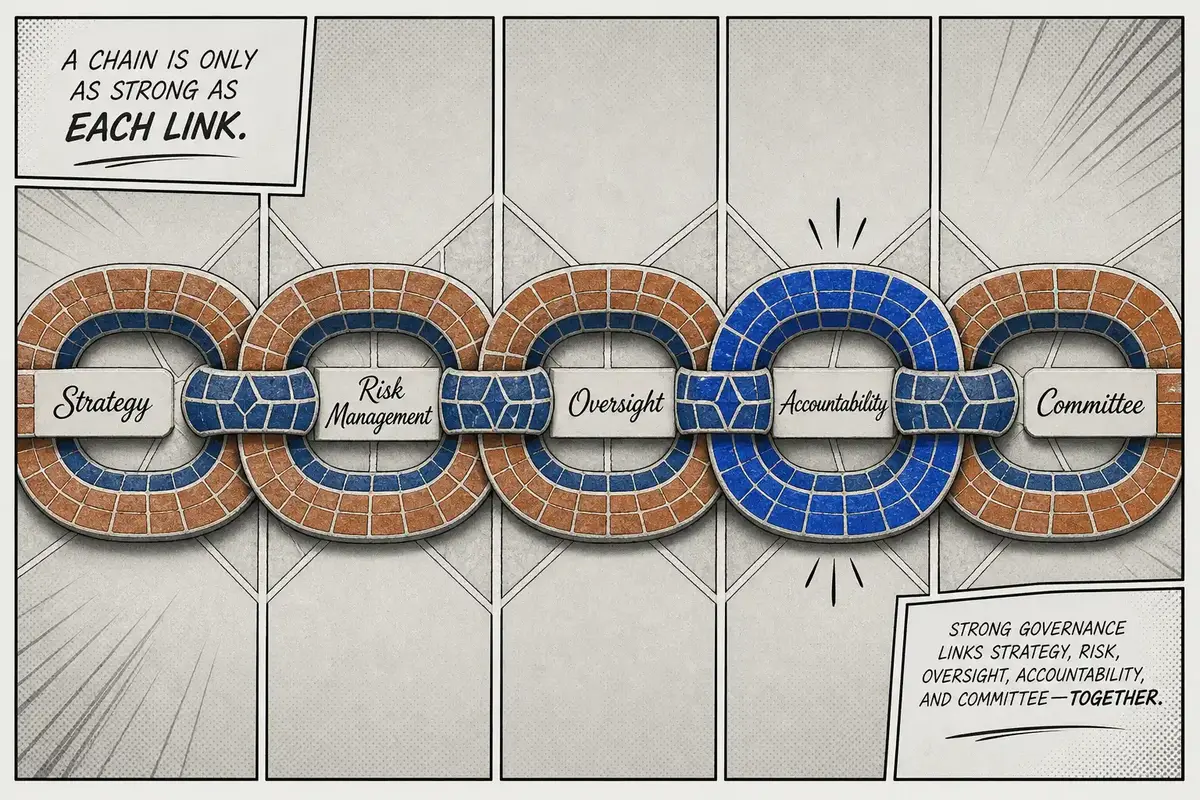
Boards usually struggle in three places:
- They treat ESG as a topic to review, not a lens for making choices.
- They assign pieces to committees without defining cross-board ownership.
- They expect management to integrate what the board itself has not framed.
A board does not integrate ESG by talking about it more. It integrates ESG by making different decisions because of it.
That is why stronger boards learn to constructively challenge executives on assumptions, not just disclosures. They ask where ESG changes capital allocation, operating priorities, and acceptable risk—not whether the latest report is complete.
The practical implication is simple: many boards have awareness, but not yet a repeatable operating model. And until that model is explicit, who decides what—board or management?
What Does Integrated ESG Governance Actually Look Like in Practice?
Integrated ESG governance is an operating model that embeds environmental, social, and governance considerations into the board’s core responsibilities—connecting purpose, strategy, risk, metrics, and accountability rather than treating ESG as a standalone topic. This approach addresses a persistent gap: even when ESG is discussed, it can remain peripheral if not structurally woven into the board’s decision-making processes.
A key distinction is that integrated ESG governance is not about increasing the volume of ESG discussions, but about changing their location and impact. Instead of siloed reports or one-off presentations, ESG factors are incorporated into the main agenda—shaping how the board defines organizational purpose, allocates capital, sets risk appetite, and evaluates executive performance. According to IFAC, the standard for effective governance is that “relevant sustainability and ESG matters are incorporated into purpose, governance, strategy, decision-making, risk management, and accountability reporting”. This means ESG is not an afterthought but a lens through which all major decisions are tested.
Division of Labor:Integrated ESG governance clarifies roles. The board sets direction, approves strategy, defines material priorities, and holds management accountable. Committees—such as audit, risk, or sustainability—translate those priorities into oversight domains, ensuring specialized focus on issues like climate risk or workforce equity. Management, in turn, is responsible for operationalizing board direction: aligning business plans, executing initiatives, tracking metrics, and reporting progress.
Practical Mechanisms:
- Committee Ownership: Committee charters are explicit about ESG oversight, with clear mandates for reviewing relevant risks and opportunities.
- Board Calendar Design: ESG-linked trade-offs are reviewed in regular board meetings—not as add-ons, but as part of core agenda items such as strategy, budgeting, and risk.
- Management Updates: Updates are structured around key decisions and outcomes, not generic narratives, ensuring that ESG performance is evaluated alongside financial and operational results.
For example, a regional healthcare provider redesigned its annual budget process so that ESG factors—like workforce stability and energy resilience—were discussed within the same agenda as financial planning. This integration ensured that ESG risks and opportunities were considered in real time, influencing capital allocation and executive incentives.
Trends and Implications:The shift toward integrated governance is accelerating. As of 2024, two-thirds of companies by market capitalization had a board-level committee overseeing sustainability risks, and 70% had boards overseeing climate-related issues (OECD, 2025). This trend reflects growing recognition that ESG issues are material to long-term value and risk.
Ultimately, integrated ESG governance is about embedding sustainability into the organization’s DNA—ensuring that every major decision is informed by ESG considerations, and that accountability is clear from the boardroom to the front line. This model prevents ESG from becoming fragmented or superficial, making it a driver of strategy and performance rather than a compliance exercise.
Which ESG Choices Belong in the Boardroom—and Which Belong in Management?
77.2% of S&P companies now incorporate ESG performance into executive compensation design (The Conference Board, 2024). That matters because when boards blur oversight and execution, the cost is not abstract: priorities drift, trust erodes, and management teams learn that ESG language can survive without operational consequences.
The line is simple. The board owns choice architecture—the material ESG priorities, the risk appetite, the strategic trade-offs, and the incentives that tell the organization what really counts. Management owns execution—operating plans, process changes, data collection, supplier actions, and day-to-day delivery. If directors start designing initiatives themselves, they weaken accountability. If they stay at the level of slogans, they weaken governance.
A regional financial services firm in budget season makes this visible. The board should decide whether climate exposure, conduct risk, and workforce resilience are material enough to affect capital allocation and leadership scorecards. It should not decide which reporting workflow the sustainability team uses on Tuesday morning.
A board adds value by setting the terms of the decision, not by taking the decision away from management.
This is why executive compensation matters. If the board wants accountability rather than aspiration, ESG has to show up where executives feel consequences. The market is already moving that way: 77.2% of S&P companies are using ESG metrics in pay design (The Conference Board, 2024). Incentives are not a communications device. They are a governance signal.
Capability Determines Whether Oversight Is Real
Structure alone is not enough. Boards can only challenge management on ESG trade-offs if they understand the business implications well enough to test assumptions. PwC found that only 32% of C-suite respondents believe their boards have the right mix of skills and expertise (PwC, 2025). That is the practical constraint behind many weak ESG discussions.
Management depth matters too. KPMG reports that 56% of G250 companies had a dedicated sustainability leader. That role can sharpen execution, but it does not replace informed board governance. A capable board asks better questions: Which metric changes behavior? Which trade-off protects long-term value? Which claim sounds good but does not survive scrutiny?
Boards do not need to run ESG. They need to govern it well enough that management cannot treat it as optional. And when that happens, the upside is larger than cleaner oversight—because reputation, resilience, and value creation start to move together.
Why ESG Integration Strengthens Reputation, Risk Management, and Long-Term Value
The quarterly review is running long. A regional services CEO has just finished the numbers when a director asks the question everyone in the room recognizes: if we say ESG matters, where does that show up in the decisions we defend under pressure?
Disclosure is no longer the differentiator. It is the baseline. In 2024, 91% of listed companies by market capitalization disclosed sustainability-related information, which tells boards that ESG now sits inside mainstream capital-market expectations, not at the edge of them (OECD, 2025). KPMG shows the same pattern from another angle: 96% of G250 companies reported on ESG or sustainability.
That changes the board’s job. When nearly everyone reports, reputation is shaped less by publication and more by credibility—whether disclosures match governance, whether oversight matches claims, and whether risk signals are acted on before they become trust failures.
Trust is not built by saying the right things in the report. It is built when the organization behaves as if those statements are true.
This is where resilience becomes a board issue. A board that connects disclosure to oversight is not protecting image; it is protecting decision quality under stress—supplier disruption, talent pressure, regulatory scrutiny, or capital repricing. That is how ESG moves from narrative to long-term value.
In practice, sustainable value creation follows a simple rule: what the board measures, the organization learns to become. If directors track only short-cycle outputs, culture and risk posture will follow. If they measure the few ESG indicators that signal future strength, the business changes shape over time.
And that leaves one hard question. What, exactly, should a board measure if it wants a different future—not just a better report?
Holistic Leadership Starts with a Board That Measures What It Wants to Become
Integrated governance is the framework that matters here because the cost of getting ESG wrong is immediate: trust erodes, good people leave, and strategy starts leaking value before the numbers make it obvious. IFAC’s standard is plain: relevant sustainability and ESG matters belong in purpose, governance, strategy, decision-making, risk management, and accountability reporting.
In a quarterly review at a regional retail company, the board can approve targets, incentives, and risk limits that point in different directions—or force coherence. The difference is not theoretical: when oversight, incentives, and strategy are aligned, the organization avoids costly contradictions and builds a culture of accountability. For example, a board that rewards only short-term financials will struggle to retain leaders who care about long-term impact, while one that ties incentives to ESG progress signals seriousness to employees and investors alike.
Boards do not shape the future by what they endorse. They shape it by what they measure and reward.
That is the real shift: ESG is not a communications exercise but a leadership discipline. Coherence between board oversight, incentives, and strategy is how boards shape both culture and value for the long term. The question is not what your board says, but what it actually builds—alignment, or drift?
Key Takeaways
- When ESG sits outside the core agenda, the board is not leading change; it is documenting delay.
- A board does not integrate ESG by talking about it more. It integrates ESG by making different decisions because of it.
- A board adds value by setting the terms of the decision, not by taking the decision away from management.
- Trust is not built by saying the right things in the report. It is built when the organization behaves as if those statements are true.
Frequently Asked Questions
What are the key steps for integrating ESG principles into boardroom decision-making processes effectively?
Effective ESG integration starts by defining which ESG issues are material to the business, then embedding them into strategy, risk oversight, incentives, and board agendas. Boards should assign clear committee ownership, require management to report on ESG-linked outcomes, and review trade-offs in regular decision-making rather than in a separate reporting track.
How does the incorporation of ESG principles by the board impact long-term sustainable value creation for a company?
When boards incorporate ESG into governance, they improve decision quality on capital allocation, talent, supply chains, and risk management. This helps the company build resilience, protect reputation, and create value that is more durable over time.
Why is holistic leadership important when embedding ESG criteria in corporate governance at the board level?
Holistic leadership is important because ESG affects multiple parts of the business at once, including strategy, operations, risk, and accountability. Without an integrated approach, boards can end up with fragmented oversight that looks active but does not change core decisions.
Which ESG factors should board members prioritize to enhance corporate reputation and risk management?
Boards should prioritize the ESG factors that are most material to the business, such as climate and energy exposure, workforce stability, supply chain standards, conduct and ethics, and governance controls. The right priorities are the ones that most affect trust, operational continuity, regulatory exposure, and long-term performance.
Can the integration of ESG principles in the boardroom reduce financial and operational risks for organizations?
Yes. Integrating ESG into board oversight can reduce financial and operational risks by surfacing issues earlier, improving scenario planning, and aligning incentives with long-term performance. It also helps boards spot risks such as disruption, compliance failures, and talent loss before they become costly.