
The Coaching Cost Curve Changes Faster Than Most Leaders Expect
Nearly 80% of organizations expect to increase leadership development budgets, according to the Center for Creative Leadership—but the cost-per-employee framework breaks down fast when delivery still depends on scarce human coaching capacity (Center for Creative Leadership, 2019). That is what many leadership teams miss: demand scales with headcount, while coach availability does not.
The strain shows up long before budgets are exhausted. In many companies, the queue forms around access. A regional healthcare provider, for example, may approve development funds for frontline managers during annual planning, then discover by Q2 that external coaches can only cover a small slice of the population. The result is familiar: high-potential leaders get support, everyone else gets workshops, and the organization calls that a development strategy. Yet 50% of leadership development spending already goes to external providers (Center for Creative Leadership, 2019), which means many firms are paying premium rates and still not reaching enough people. This article addresses that gap by examining which coaching delivery model remains economical as headcount rises.
That distinction matters because the core issue is no longer whether coaching works. Research and practice have settled that debate.
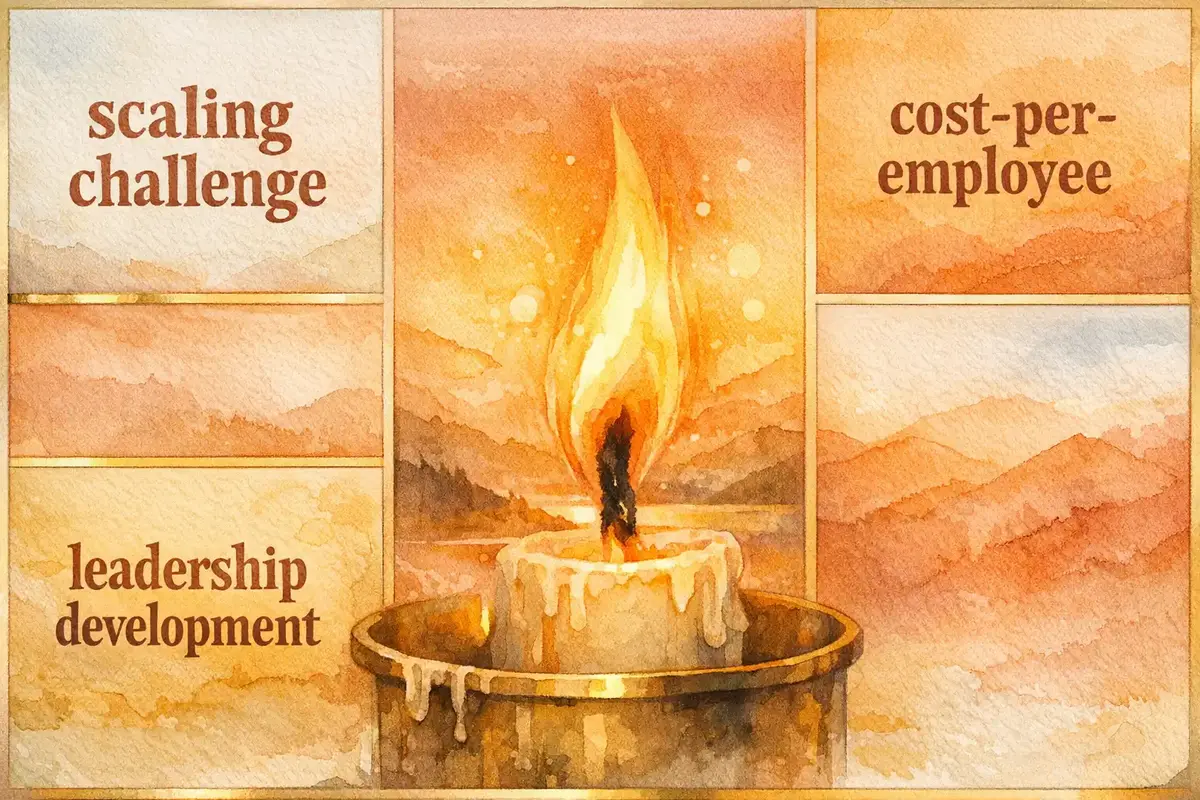
The harder question is economic design. If you are trying to support 80 leaders, one-to-one coaching can feel manageable. At 800, the math changes. At 8,000, it becomes a systems problem—procurement, scheduling, consistency, and uneven quality control all start to matter as much as developmental intent. That is why the conversation has shifted from “Should we coach?” to “How do we expand coaching without letting unit cost explode?”
Nearly 80% of organizations plan to raise leadership development budgets, even as half of current spend already flows to outside providers (Center for Creative Leadership, 2019).
For executives evaluating scaling coaching, this is the real decision frame. Not tools versus tradition. Not innovation versus skepticism. It is coverage, quality, and cost moving together—or pulling apart.
And once you view coaching through that lens, one question becomes unavoidable: what exactly changes in the economics when coaching is no longer limited by human bandwidth?
What Is AI Coaching, and Why Does It Change the Economics?
$109.1 billion in U.S. private AI investment is not a niche signal; it is a market saying the underlying capability is already being industrialized at scale (Stanford HAI, 2024). If AI adoption is now mainstream, the real question for leadership teams is narrower and more practical: what changes when that capability is applied to development rather than generic productivity tools?
In plain language, AI coaching is software that guides reflection, asks follow-up questions, surfaces patterns, and supports behavior change through repeated interaction. It is not just a chatbot with better manners. Done well, it functions as a structured coaching layer that employees can access when they need it—before a difficult one-on-one, after a tense meeting, or during a stretch assignment. That is why the right frame is not replacement, but AI coaching as a coverage model.
The economic shift is about access, not novelty
The economics change because software scales differently than human time.
A human coach can deepen judgment, read subtext, and challenge a leader in ways software still cannot reliably match. But that value comes with a hard ceiling: hours, calendars, and availability. AI changes the shape of the delivery model by making support available to far more people at once, with no equivalent scheduling bottleneck.
That matters in ordinary operating moments, not just in formal programs. Picture a mid-market manufacturing company in budget season. The operations director wants coaching support for 120 frontline leaders after a plant reorganization, but the approved budget only stretches to a handful of external coaching engagements. With AI, the company can extend structured support across the full population, then reserve scarce human coaching for the smaller set of leaders facing the most complex transitions.
Why marginal cost behaves differently
This is where the cost curve bends.
When one more employee enters a traditional coaching program, the organization usually needs more coach time, more coordination, or both. When one more employee uses an AI-based system, the added cost is typically far flatter. Not zero. But flatter enough to change the economics as populations grow.
That is not a theoretical shift. 78% of organizations reported using AI in 2024 (Stanford HAI, 2024), and the supply side is moving fast: in 2023, industry produced 51 notable machine learning models, versus 15 from academia (Stanford HAI, 2024). In other words, the capability base is expanding under commercial pressure, not waiting for the leadership development market to catch up.
The implication is simple. AI makes broad coaching access economically plausible.
The harder question remains. If AI is best at scale and human coaching is best at depth, where does each actually belong when the stakes rise—routine development, or the moments that can change a leader’s trajectory?
Why Traditional Coaching Still Wins in High-Stakes Development
44% of managers worldwide say they have received management training—which means most organizations are still asking managers to carry people risk with limited support (Gallup). In a quarterly review after a failed product launch, a VP does not need generic prompts; she needs someone who can read what is not being said in the room, challenge her interpretation, and help her decide what to do before trust erodes further.
That is where traditional coaching still earns its place. Not everywhere. In the moments where context is dense, consequences are real, and the leader’s blind spots are part of the problem.
A human coach can hold contradiction without flattening it. A finance executive navigating a board transition may be dealing with political tension, succession anxiety, and a team that has started to mirror her defensiveness. Software can help her reflect. A skilled coach can notice the pattern, test it, and stay with it long enough for the leader to act differently under pressure. That is why organizations continue to invest in traditional coaching even when the unit cost is higher: in high-stakes development, the issue is rarely information. It is judgment.
The real premium is trust and accountability
Manager development is also more under-served than many budgets suggest. If only 44% of managers report receiving management training, the pipeline problem is obvious: many people leaders are promoted into complexity before they have built the habits to handle it well (Gallup). Human coaching persists partly because companies know the risk sits in the middle layer—new directors, stretched VPs, critical managers—not just at the top.
And the return is not confined to the coaching hour itself. The value comes from relationship depth, from having someone who remembers prior patterns, names avoidance, and creates accountability that survives the session. That matters because trust is operational, not abstract. Employees who strongly agree they trust their organization’s leadership are 3.5 times as likely to be engaged (Gallup).
Employees who strongly trust leadership are 3.5x as likely to be engaged (Gallup).
So no, human coaching is not obsolete. It is selective—and expensive for a reason.
The harder issue is allocation. If human coaching should be reserved for the moments that can change a leader’s trajectory, how much should an organization spend to protect that depth—and at what scale does that model stop working?
What the Benchmarks Say About Leadership Development Spend by Scale
The cost-per-employee framework starts with a simple fact: nearly 8 in 10 organizations expect to increase leadership development budgets, with an average increase of 10% (Center for Creative Leadership, 2019). Without that framework, bigger budgets create false comfort—spend rises, but leaders still cannot tell whether they are buying depth for a few people or usable coverage across the whole management population.
That distinction matters because benchmark data already shows the market does not treat leadership development as a flat expense. It behaves like a portfolio.
The benchmark pattern is segmentation, not equality
The Center for Creative Leadership data shows clear per-leader differences by level: $4,140 annually for executives, $3,560 for mid-level leaders, $3,080 for first-level leaders, and $2,610 for individual contributors and professionals (Center for Creative Leadership, 2019).
Executives receive $4,140 per year in leadership development spend, versus $2,610 for individual contributors and professionals (Center for Creative Leadership, 2019).
That spread is not random. It reflects an operating assumption most companies already make: some roles justify more intensive investment because the consequences of poor judgment travel farther and faster. A regional retail company reviewing next year’s talent budget sees this every autumn. The COO may approve premium coaching for a small group of VPs, structured programs for store managers, and lighter-touch development for emerging supervisors—not because one group matters and another does not, but because the economics of risk differ by layer.
This is the practical value of leadership development benchmarks. They show that organizations already segment by audience. The real question is whether delivery models are segmented with the same discipline.
Rising budgets increase pressure for better allocation
More money should improve decisions. Often it just hides weak ones.
If budgets are rising by an average of 10%, the burden on leadership teams is not merely to spend more, but to spend with sharper logic (Center for Creative Leadership, 2019). In a company of 300 leaders, uneven allocation may be tolerable for a year or two. In a company of 3,000, it compounds into a structural problem: too much spend concentrated at the top, too little support where day-to-day management quality is actually formed.
That is why scale changes the benchmark conversation. The issue stops being “What do we spend on leadership development?” and becomes “What do we spend per segment, and what delivery method fits that segment?”
Mixed delivery is already normal
Most organizations do not run leadership development through a single channel. They combine internal programs, external providers, workshops, assessments, and selective coaching. That matters because a hybrid model is not a radical departure from current practice; it is an extension of how companies already buy development.
Once you see the budget as a segmented portfolio, the opening for AI becomes obvious. Not everywhere. In the layers where consistency, access, and frequency matter more than bespoke depth.
So where is the break point—human coaching, AI support, or a hybrid mix? At what headcount does premium development stop being selective investment and start becoming inefficient design?
Where Does AI Coaching Become More Cost-Effective Than Human Coaching?
$874 per learner is now the average annual training spend, up from $774 a year earlier (Training Magazine, 2025). Get the allocation wrong, and that extra spend does not just miss the mark; it shows up as delayed manager decisions, avoidable attrition, and trust that erodes one team at a time.
The breakpoint, though, is not one magic headcount. It moves.
The breakpoint is a moving line, not a fixed threshold
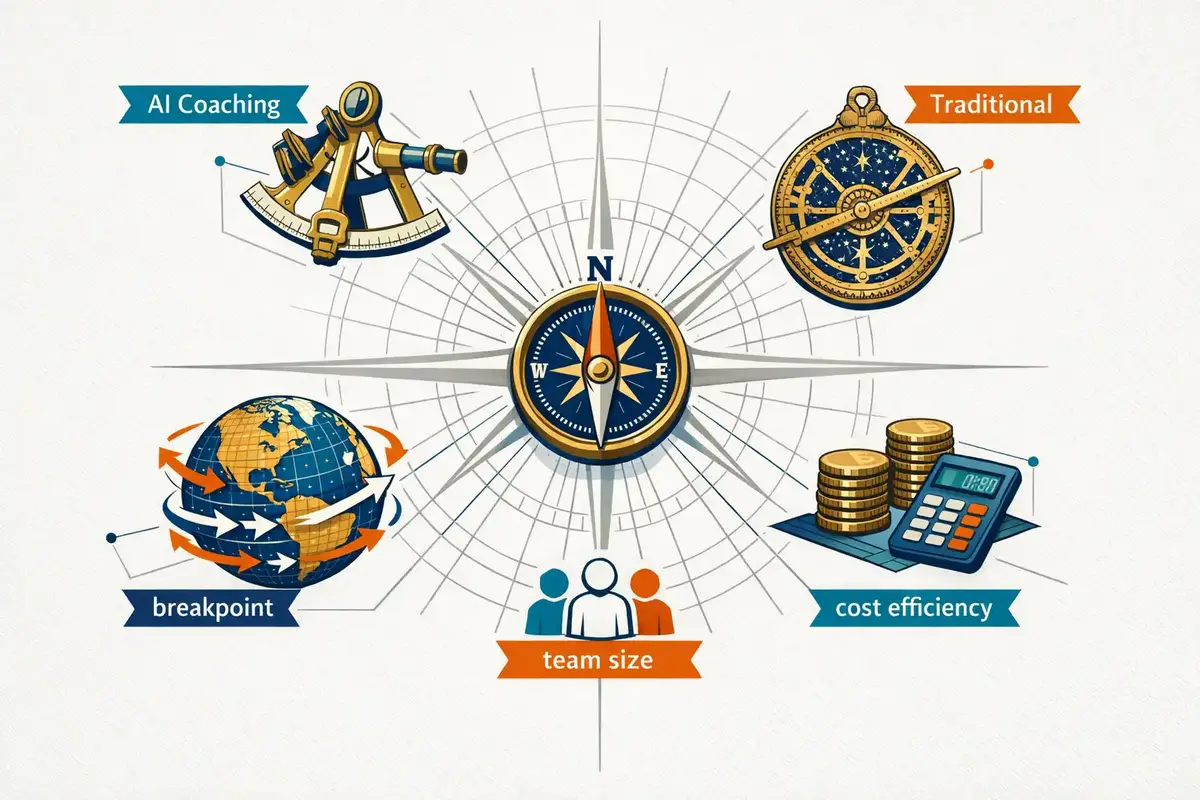
At what point does the economics shift from human coaching is worth it to AI coaching is the only way to cover everyone? The answer depends on three variables: population size, coaching frequency, and personalization depth.
If you are coaching 25 executives six times a year, human coaching can still make economic sense because the audience is small and the stakes justify the premium. If you are supporting 600 managers who need regular help with feedback, delegation, and team conversations, the math changes fast. The issue is not whether human coaching has value. It is whether the organization can afford enough of it, often enough, to change behavior at scale.
That pressure is easier to see when training budgets are already stretched across broader learning demands. Employees received 40 hours of training per year, down from 47 the prior year (Training Magazine, 2025). In practice, that means many companies are trying to do more development in less time. Coaching models that require calendars, contracting, and session logistics start to lose ground.
Marginal cost is where the curve really breaks
A mid-market technology company in a post-reorg quarter knows this moment well. The CHRO can fund one-to-one coaching for 30 directors, or provide lighter-touch support to 400 managers who are suddenly leading changed teams. Choosing the first may feel more premium. Choosing the second may protect more of the business.
This is why marginal cost matters more than average cost. Human coaching tends to rise in near-linear fashion: more people usually means more coach hours, more coordination, and more vendor management. AI flattens that curve. Once the system is in place, the cost of serving the next 100 or 1,000 employees is usually far lower than adding the equivalent human capacity. That is the heart of the coaching cost curve.
The market is already moving toward digitally delivered development. 34% of training hours are now delivered through online or computer-based technologies, and AI-specific hours rose from 0.8% to 2% (Training Magazine, 2025).
34% of training hours are now delivered digitally, while AI-related hours more than doubled year over year (Training Magazine, 2025).
The pattern is clear. AI becomes more cost-effective as the audience widens—from executives, to managers, to the broader employee base.
But cost-effective for whom, and for what kinds of leaders? Broad coverage, or deep intervention—that is the allocation question that decides whether the model works.
How Should Organizations Allocate AI, Human, and Hybrid Coaching by Employee Segment?
78% of organizations reported using AI in 2024 (Stanford HAI, 2024). That should end the false debate about whether AI belongs in leadership development; the real question is where it belongs, and where it does not.
A one-size-fits-all coaching model is usually a budgeting mistake dressed up as fairness. Different employee segments create different kinds of value and risk. Treating a first-time supervisor, a business-unit VP, and a succession-ready executive as if they need the same coaching intensity wastes money in one part of the system and under-supports another.
Segment by business criticality, not by preference
The most economically rational answer is often hybrid coaching.
Senior executives and high-impact leaders usually justify more human coaching because their decisions carry wider organizational consequences. A C-suite leader handling a strategy reset, a divisional VP rebuilding trust after a failed integration, or a finance chief preparing for board scrutiny needs challenge, nuance, and judgment in real time. That is expensive support. It is also often the right expense.
Broader manager and contributor populations are different. They benefit less from bespoke depth than from frequent, accessible support around recurring leadership work: feedback, delegation, prioritization, difficult conversations, and team communication. That is where AI coverage earns its place. In a regional services company during annual planning, the CHRO may realize that coaching 40 senior leaders intensively and giving 900 managers no support is not a premium strategy. It is a coverage failure.
Why hybrid is the practical middle path
The market is already pointing this way. The Center for Creative Leadership found that organizations expect 38% growth in both face-to-face and digital delivery over the next five years (Center for Creative Leadership, 2019). That is not a vote for one channel winning. It is evidence that mixed delivery is becoming the operating model.
Organizations project 38% growth in both face-to-face and digital leadership development delivery (Center for Creative Leadership, 2019).
The same report shows 50% of leadership development spending goes to external providers (Center for Creative Leadership, 2019). That matters because external human coaching is often the costliest layer in the portfolio. Used selectively, it can be high value. Used broadly, it can become lazy allocation.
This is why a hybrid coaching model often wins: AI for scale, human coaching for consequence, and blended pathways for the middle. The portfolio logic is simple. Match coaching intensity to business criticality.
Get that match right, and cost starts serving development. Get it wrong, and the organization pays twice—once in budget, and again in uneven leadership quality. The final question is harder: when coverage, quality, and cost pull in different directions, which one should actually lead?
The Real Decision Is Coverage, Quality, and Cost Working Together
The most expensive coaching decision is often the one that looks cheapest on paper. When development misses the managers who shape daily work, the bill arrives elsewhere—slower execution, weaker trust, and good people deciding they have had enough.
That is why the closing question is not whether AI is cheaper than human coaching. It is this: when the budget cycle ends, what matters more—the lowest per-employee cost, or the model that actually changes leadership behavior at scale?
Cheap coverage can still be costly
Consider a regional retail company in a year of margin pressure. The leadership team chooses the lowest-cost development option, rolls it out broadly, and congratulates itself on efficiency. Six months later, store managers are still avoiding hard performance conversations, high performers are leaving for competitors, and district leaders are spending their time cleaning up preventable people issues.
Nothing about that outcome is efficient.
The cheapest option fails when it reaches the wrong population, solves the wrong problem, or offers support too shallow to change behavior. Human coaching can be overpriced if it is reserved for leaders who do not need that level of depth. AI can be underpowered if it is deployed without clear use cases, manager expectations, or escalation paths for more complex situations. Cost-effective is not the same as low-cost. It means the method fits the decision, the audience, and the consequence.
Trust is the operating test
If you want one practical test for whether development is working, start with manager capability and leadership trust.
Gallup has shown that employees who strongly trust their organization’s leadership are far more likely to be engaged (Gallup). That matters because engagement is not a soft outcome; it shows up in discretionary effort, retention, and the willingness to stay with a difficult strategy when conditions tighten. Gallup also reports that many managers still have not received formal management training (Gallup). In plain terms, organizations are still asking underprepared people to carry a large share of the culture.
That is where coaching economics become strategic. If your model cannot reliably improve the judgment and consistency of managers, it is not really a development system. It is a budget line.
Think portfolio: access, depth, governance
The better frame is access, depth, and governance.
Access asks who can get support when they need it. Depth asks where human nuance is essential. Governance asks who owns standards, privacy, escalation, and quality control as AI becomes more embedded in work. That last point is no longer optional: Stanford HAI notes that AI-related regulation has accelerated sharply in recent years (Stanford HAI, 2024). As adoption grows, governance stops being a legal footnote and becomes part of program design.
So the next step is sober, not flashy. Map your leadership populations by scale, audience, and risk. Then decide where broad access matters, where depth is worth paying for, and where tighter governance is non-negotiable.
Not AI or human. Not cheap or premium. The real question is simpler: which model will your managers actually use—and which one will make them better?
Key Takeaways
- Leadership development budgets are rising, but cost-per-employee models break down when coaching still depends on scarce human capacity.
- AI coaching changes the economics by expanding access and flattening marginal cost, especially for broader manager populations.
- Traditional coaching still matters most in high-stakes situations where judgment, trust, and accountability are critical.
- The strongest approach is usually a hybrid portfolio that matches access, depth, and governance to employee segment and business risk.
Frequently Asked Questions
What is the main difference between AI coaching and traditional coaching in leadership development?
AI coaching uses software to provide structured reflection, prompts, and ongoing support at scale, while traditional coaching relies on human judgment, nuance, and real-time challenge. AI is usually better for broad access and frequent support, while human coaching is better for complex, high-stakes development.
Why does the cost-per-employee model break down as leadership programs scale?
The model breaks down because human coaching capacity does not scale with headcount the way demand does. As more employees need support, organizations face higher scheduling, coordination, and delivery costs, which can make unit economics rise quickly.
When does AI coaching become more cost-effective than human coaching?
AI coaching becomes more cost-effective when the audience is large and the support needed is frequent, routine, or moderately personalized. The breakpoint depends on population size, coaching frequency, and how much depth each employee needs.
When is traditional coaching still the better choice?
Traditional coaching is usually the better choice for senior leaders, critical transitions, and situations where trust, judgment, and accountability matter most. In these cases, the value comes from human insight and the ability to work through complex context that software cannot fully interpret.
What is the best way to allocate AI, human, and hybrid coaching across employee groups?
A hybrid model is often the most effective approach: use human coaching for high-impact leaders and AI coaching for broader populations that need accessible, recurring support. This portfolio approach matches coaching intensity to business criticality, improving coverage without sacrificing depth where it matters most.