
Why COO-Led Culture Change Starts With the Work System, Not the Mood
Your operational team can be capable, experienced, and still move like it no longer trusts the work. That usually is not a motivation problem; it is a work system problem, meaning the way priorities, decisions, handoffs, and accountability are designed.
You see it in the quarterly review. A mid-market manufacturing director has solid supervisors, acceptable staffing, and no obvious crisis, yet output slows, decisions get deferred, and people start protecting themselves instead of solving problems. The mood looks flat, but the real issue is structural: unclear trade-offs, too many approvals, and constant interruption from urgent work.
That cost compounds fast. When the operating model keeps pulling leaders back into short-cycle firefighting, teams learn caution before they learn ownership. Even at the top, the pattern is familiar: day-to-day demands crowd out the work of redesigning how the business runs, which is why so many COOs struggle to protect strategic focus (PwC, 2024). This article addresses that exact gap—why low motivation in operations is often a systems failure showing up as an individual behavior problem.
A COO does not directly “motivate” people. A COO changes the conditions that shape motivation: role clarity, decision rights, management cadence, escalation paths, and whether the COO role is used to absorb noise or remove it.
People do not disengage from hard work first; they disengage from work that feels unsafe, incoherent, or unwinnable.
That is the thesis for the rest of this piece. If the team looks slow, is the problem attitude—or has the system trained smart people to hold back?
How Low Engagement Becomes a Performance Drain Before Leaders Notice
$10 trillion in lost productivity is Gallup’s estimate of what weak global engagement costs the world economy when only 20% of employees are engaged (Gallup, 2025). If engagement is this low globally, what looks like an execution problem in operations is often an early signal that the workforce has stopped giving discretionary effort.
That is why engagement matters to a COO. It is not a soft sentiment score; it is a leading indicator of whether people still bring attention, judgment, and energy to the work before output, quality, and speed visibly slip. Gallup reports that just 31% of U.S. employees were engaged in 2024, the lowest level in a decade (Gallup, 2024). For leaders running throughput-dependent teams, that should read less like HR data and more like operating risk.
Engagement drops before performance breaks
In a regional healthcare operator’s quarterly review, the warning signs rarely arrive as open resistance. A director sees more rework, slower handoffs, and fewer frontline suggestions for fixing recurring bottlenecks. The team is still compliant. It is no longer invested.
That distinction matters. Low engagement means people do the required work without much extra care, initiative, or problem-solving. Active disengagement is more corrosive: people withdraw, spread frustration, or quietly undermine execution. Gallup found 17% of U.S. employees were actively disengaged in 2024 (Gallup, 2024). In operational settings, that shows up as avoidable escalations, brittle cross-functional coordination, and errors that should have been caught one step earlier.
Performance usually weakens in the margins first — in the effort people no longer volunteer, the issue they no longer raise, the handoff they no longer protect.
For a COO, this is the real cost of weak employee engagement: not drama, but drag. The harder question comes next. When morale, engagement, motivation, and culture all look similar from a distance, which problem are you actually trying to solve?
What Is the Difference Between Morale, Engagement, Motivation, and Culture?
The satisfaction-to-culture ladder matters because leaders often diagnose the wrong problem. In a quarterly review at a regional retail operator, the COO sees decent pulse-survey scores, low open conflict, and a team that says it is “fine” — yet response times slip and ownership stays shallow.
Here is the plain answer: morale is how people feel, engagement is how much of themselves they bring to the work, motivation is the energy directed toward action, and culture is the repeatable environment that shapes all three. Confuse them, and you end up treating a system issue as a mood issue.
CIPD’s Good Work Index makes that distinction hard to ignore. 59% of UK workers said they were satisfied with their job, while 18% said they were dissatisfied (CIPD). Satisfaction clearly matters. It just does not tell you whether people are stretching, improving, or committing beyond the minimum.
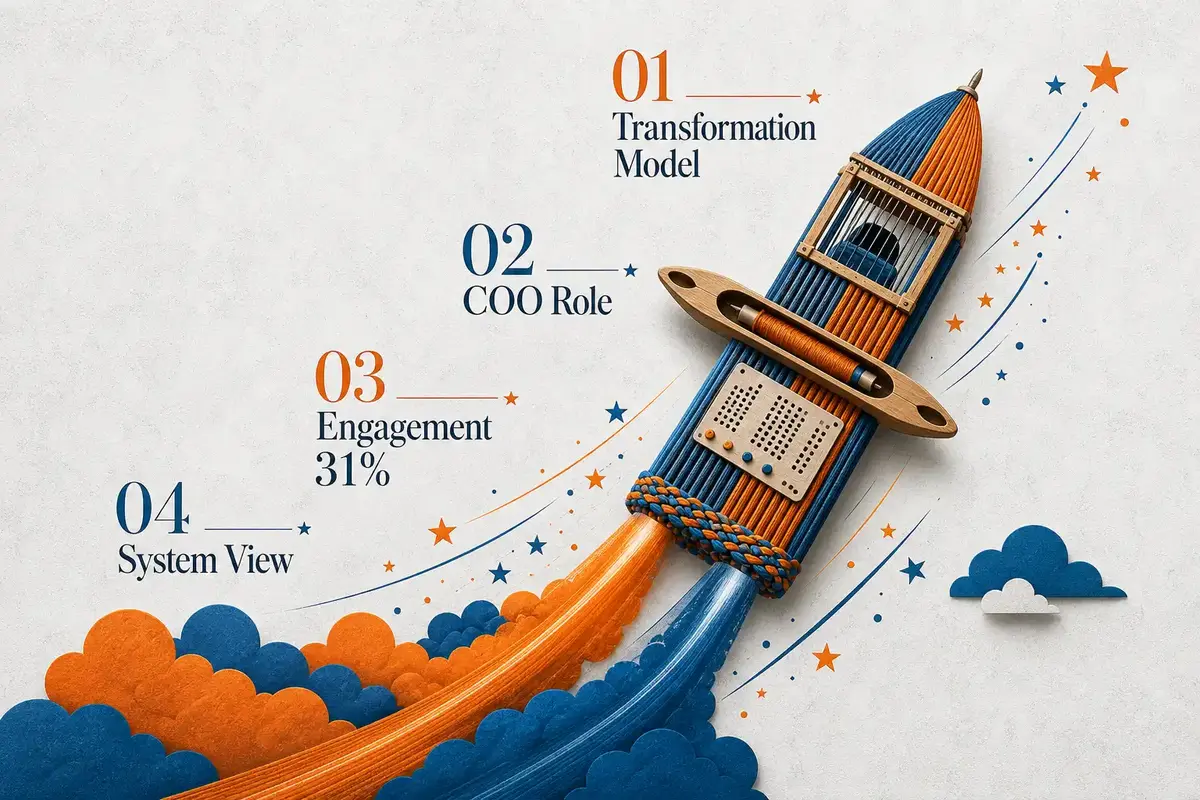
A simple ladder leaders can use
Think of the terms in sequence:
- Satisfaction: “This job is acceptable.”
- Morale: “This feels manageable today.”
- Engagement: “I care enough to apply judgment and effort.”
- Motivation: “I am willing to act, persist, and solve.”
- Culture: “This is how work really gets done here.”
Motivation is usually the signal. Culture is the source.
That is why operational teams can sound satisfied and still underperform. They may like their colleagues, value stability, and have few complaints, while working inside weak decision rights, slow escalations, and norms that punish initiative. The result is polite underperformance.
A COO leading culture change has to separate sentiment from operating reality. If output is lagging, is the team unmotivated — or has the system taught them that extra effort will not matter?
Which COO Levers Actually Change Behavior in Operational Teams?
The operating system lens matters here because it forces a harder question: what changes first — the team’s attitude, or the conditions that shape behavior every day? Most leaders still overestimate messaging. They assume people work differently once the strategy is explained more clearly, the values are repeated more often, or the town hall lands with enough conviction.
That is rarely where behavior turns. In practice, culture shifts when the work starts rewarding different choices.
Korn Ferry found that the right leadership characteristics and team environment can lift engagement scores by up to 42 percentile points — a reminder that people respond to the climate leaders create, not just the words they hear (Korn Ferry). For a COO, that climate becomes visible through decision rights, manager cadence, recognition, escalation paths, and workflow clarity.
In a quarterly review at an enterprise services firm, the COO sees a familiar pattern: supervisors say accountability is weak, but every non-routine issue still climbs three layers for approval. The team has learned the real rule. Do not decide early; escalate safely.
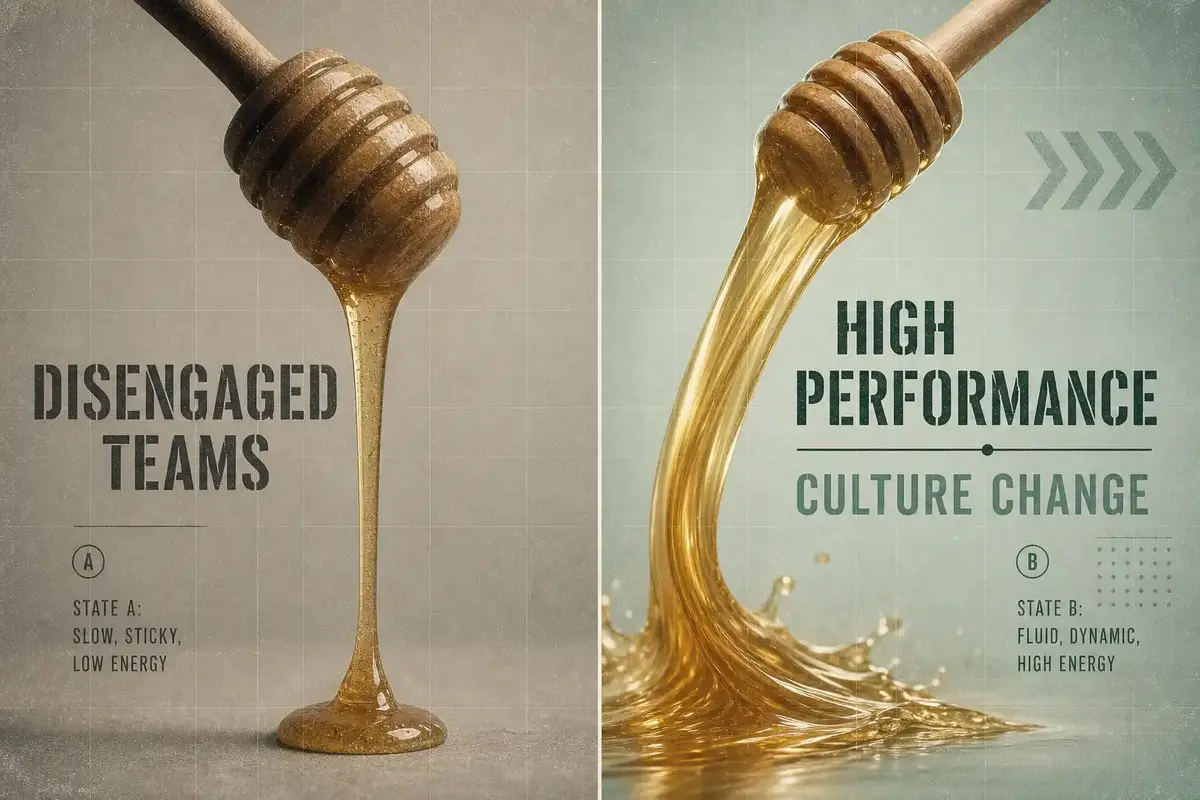
What actually changes daily behavior
The practical test is simple: can people see the new culture in the mechanics of the day? If not, it is still aspiration.
| Common approach | What it changes in daily behavior |
|---|---|
| Slogans and communications | Little, unless routines and trade-offs change with them |
| Individual incentives | Short bursts of effort, often at the expense of team coordination |
| Manager coaching | Better judgment in the moment when it happens consistently |
| Vague accountability | Delay, defensiveness, and upward delegation |
| Clear decision rights | Faster calls, cleaner ownership, fewer protective escalations |
A COO changes leadership behavior by redesigning the moments where managers spend attention. That means tighter huddles, fewer status meetings, explicit thresholds for escalation, and recognition tied to problem-solving across operational teams — not heroics that rescue broken processes.
Decision rights are especially powerful: when teams know exactly what they can decide, ambiguity drops and accountability rises. For example, a manufacturing COO might clarify that frontline supervisors can halt a line for safety concerns without director sign-off, signaling trust and speeding action.
Manager cadence—the rhythm of check-ins, standups, and feedback—shapes how quickly issues surface and are resolved. A weekly operational review focused on learning from misses, not blame, can shift the team from risk avoidance to proactive improvement.
Recognition reinforces the right behaviors. When a COO spotlights a team for cross-functional problem-solving, it demonstrates that collaboration, not siloed heroics, is what gets noticed and rewarded.
Escalation paths and workflow clarity ensure that teams don’t default to upward delegation or stall in ambiguity. When escalation is only for true exceptions, teams build confidence in their own judgment.
Culture becomes believable when the routine, not the speech, tells people what matters.
The question is no longer whether the team cares. It is whether the system measures, rewards, and protects the right behaviors — and how a COO would know in the first 90 days if that shift is actually taking hold. For COOs, the levers that change operational behavior are visible, structural, and measurable—embedded in the daily flow of work, not in the posters on the wall.
What Should a COO Measure in the First 90 Days of Cultural Turnaround?
In the second month of a turnaround, the dashboard often looks deceptively normal. The quarterly numbers have not moved much, but the operating review feels different — fewer excuses, faster calls, cleaner ownership.
That is the point to measure. In the first 90 days, a COO should track leading indicators of behavior change, not wait for lagging financial proof.
PwC found that 86% of COOs say day-to-day tasks that pull time away from long-term strategic thinking make it harder to achieve priorities (PwC, 2024). That matters because a cultural turnaround fails quietly when the COO keeps announcing change but does not protect attention for follow-through.
Measure the system where culture shows up
The most useful early scorecard is operational, not symbolic. Track whether managers run the same cadence, whether issues are escalated at the right level, whether handoffs hold, and whether teams surface problems sooner.
A practical first-90-day set usually includes:
- Engagement signals: participation in huddles, suggestion volume, and issue-raising rates
- Manager consistency: completion and quality of weekly check-ins and team reviews
- Escalation speed: time from issue identification to decision
- Workflow reliability: rework rates, missed handoffs, and exception volume
Early progress in culture is visible first in how people work, not in what they say about the change.
For example, in a mid-market technology company during a budget reset, one COO saw output stay flat while escalation time dropped and cross-team rework eased. That was real progress. The team was starting to trust the system again.
Deepen insight with qualitative signals
Quantitative metrics are essential, but qualitative signals provide early warning. Are employees surfacing previously unspoken issues in meetings? Do managers give and receive feedback more candidly? Is there visible cross-functional collaboration, or do silos persist? These “soft” indicators, when tracked systematically, reveal whether the culture is shifting beneath the surface.
Protect leadership attention or the metrics will drift
Leadership stress is not a side issue here. DDI reports that 71% of leaders experienced significantly greater stress after entering their current role, and 40% of those stressed leaders had considered leaving leadership roles to protect their wellbeing (DDI, 2025). Under that pressure, leaders revert to triage.
So measure one more thing: whether the COO and direct reports are actually keeping time for redesign work, coaching, and performance improvement. If strategic attention keeps collapsing into daily noise, are you changing the culture — or just managing fatigue more efficiently?
Practical implications
A COO who builds this early measurement discipline can spot positive momentum before it appears in the numbers. They can intervene quickly if engagement or manager consistency slips, or if leadership attention is being hijacked by daily firefighting. Over time, these early signals become the foundation for sustainable performance gains — and for a culture that can weather future shocks.
Why Sustainable High Performance Depends on Reinforcing the New Operating Norms
Revenue slips, trust thins, and good operators leave when leaders mistake a temporary push for a durable culture shift. Sustainable performance comes from reinforced operating norms—the repeated rules, routines, and consequences that make the new way of working stick.
In a regional financial services firm during a team restructure, a VP can get a short burst of energy from a strong message. Then the old pattern returns: exceptions bypass the process, managers tolerate slow decisions, and frontline judgment narrows again. The speech was clear. The system was louder.
That is the COO’s real job. Not chief motivator. Architect of the environment in which motivation can survive pressure, ambiguity, and fatigue.
Korn Ferry’s broader warning on leadership is useful here: many investors do not believe current private-sector leadership is fit for what comes next, and very few executives are seen as truly great leaders (Korn Ferry). The gap is not usually inspiration. It is disciplined reinforcement.
Culture holds when managers repeat the standard after the kickoff meeting is over.
So the closing test is simple: when pressure rises, does your operation fall back to personality and heroics—or to clear norms, steady cadence, and decisions people can trust?
Key Takeaways
- People do not disengage from hard work first; they disengage from work that feels unsafe, incoherent, or unwinnable.
- Performance usually weakens in the margins first — in the effort people no longer volunteer, the issue they no longer raise, the handoff they no longer protect.
- Motivation is usually the signal. Culture is the source.
- Culture becomes believable when the routine, not the speech, tells people what matters.
Frequently Asked Questions
How does a COO’s leadership influence cultural transformation to improve engagement and productivity in underperforming operational teams?
A COO influences cultural transformation by redesigning the work system that shapes daily behavior: decision rights, handoffs, escalation paths, meeting cadence, and accountability. When these mechanics become clearer and faster, engagement and productivity improve because people can act with more confidence and less friction.
Why is cultural transformation critical when addressing motivation issues in operational teams from a COO’s perspective?
Cultural transformation is critical because low motivation in operations is often a symptom of a broken system, not a simple attitude problem. If the environment feels unclear, unsafe, or unwinnable, people reduce effort and initiative even when they are capable and experienced.
Which cultural change initiatives have proven most effective for COOs aiming to boost performance in demotivated operational teams?
The most effective initiatives are those that change routine behavior: clarifying decision rights, tightening manager cadence, improving escalation rules, and recognizing cross-functional problem-solving. These actions work because they reward ownership, reduce ambiguity, and make the new operating norms visible in daily work.
Can a COO successfully increase operational team performance without addressing underlying cultural issues related to motivation?
Short-term performance gains are possible through pressure or incentives, but they usually do not last if the underlying culture remains unchanged. Sustainable improvement requires fixing the norms and systems that shape how people decide, collaborate, and solve problems.
Is there a measurable impact on operational efficiency after a COO leads a cultural transformation targeting low motivation in teams?
Yes. Measurable improvements often appear first in leading indicators such as faster escalation times, fewer missed handoffs, lower rework, more consistent manager check-ins, and higher issue-raising rates. These changes usually show up before financial results improve, making them useful early signs of a successful transformation.