


The Customer Never Sees Your Org Chart—Only the Breaks in the Journey
The one value stream model is not a collaboration slogan; it is an operating choice about how the company shows up to the customer. When production, service, and logistics run as separate worlds, the customer experiences the seams before your leaders even name the problem.
You have seen the scene. A customer calls support after a delayed order, hears that the item has left production, then gets a different answer from operations, and a third version from logistics by email. No one inside the business thinks they are failing the customer; each team is reporting its own truth. But the customer does not buy departmental truth. They buy one promise, and they judge one brand.
That is the gap this article addresses: production and customer service integration is not about making teams friendlier to each other. It is about removing the hidden breaks that turn normal internal variation into customer-visible friction.
A regional manufacturing VP usually discovers this during a quarterly review, not in a workshop. Output looks acceptable. Service volumes look manageable. Yet escalations keep clustering around the same moments—late change notices, partial shipments, unclear replacements, promises made before inventory is actually stable. What appears inside the business as a minor sequencing issue becomes, outside the business, a reliability problem.
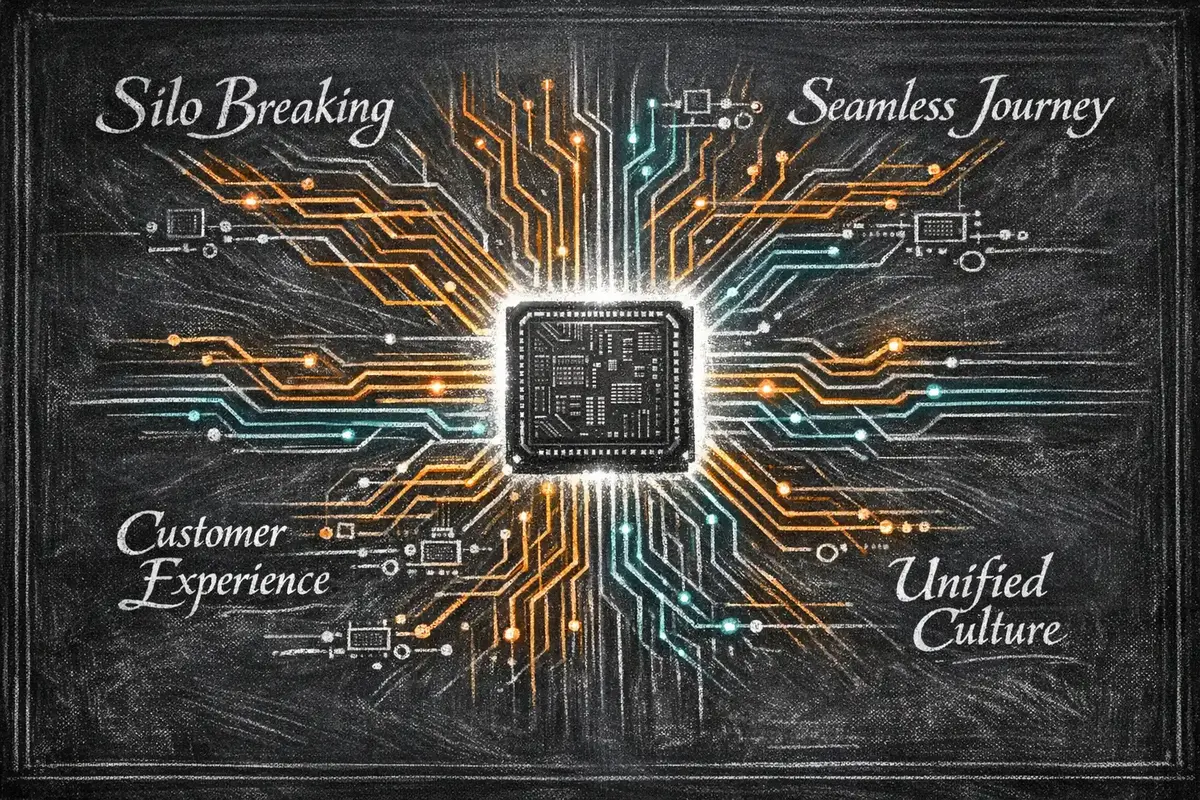
Customers rarely see the process that failed them. They only see the promise that did not hold.
This is why handoffs matter so much. A handoff is never just an internal transfer of information, inventory, or accountability. It is part of the customer experience architecture. If production updates move slowly, service speaks with stale information. If service logs recurring complaints but production never sees the pattern, defects repeat in a more expensive form—through returns, rework, and avoidable distrust.
Integration Is an Operating-Model Decision
Leaders often frame silo breaking as a communication issue. That is too small. The real question is whether the business is designed to act on one shared version of demand, constraint, and customer impact.
That design choice shapes consistency, because customers hear one answer or many. It shapes speed, because exceptions either move across functions cleanly or stall in queues. And it shapes trust, because trust is built less by perfection than by coherent response.
This is also where leadership alignment stops being abstract. If leaders define success locally, teams protect their own targets. If leaders define success across the journey, teams start managing the same outcome.
The customer experience does not break at the point of contact. It breaks much earlier—when the company decides to operate in pieces.
And that raises the harder question: if silos feel internal, why do customers feel them so quickly?
Why Do Silos Become Customer Problems So Quickly?
83% of respondents say silos undermine innovation by blocking cross-department sharing of ideas (IBM Institute for Business Value). If ideas cannot move, neither can judgment—and that failure shows up fast in the customer journey.
This is why silo damage travels faster than leaders expect. The issue is not only that teams know different things. It is that they act on different versions of reality, at different speeds, with different definitions of what “resolved” means.
The Customer Feels the Delay Before the Business Names It
In a mid-market manufacturing company, a service director usually sees this first during a quarterly review. Contact volume rises after a product change, but production reports stable output and acceptable scrap. Service starts writing workarounds, operations starts correcting orders by email, and account managers begin escalating cases that should never have become cases in the first place.
That is duplicate work. It is also decision drag.
The IBM Institute for Business Value found that nearly 77% of respondents agree or strongly agree that data silos hinder real-time analytics and data-driven decisions (IBM Institute for Business Value). In practice, that means customer service is often speaking from yesterday’s production status while production is solving today’s exception. The customer hears the gap immediately.
Silo problems become customer problems the moment the company needs one answer and produces three.
The speed of failure matters here. A defect, delay, or specification change does not need to be large to create visible friction. It only needs to cross a handoff where ownership is blurred and information gets translated instead of transferred.
Handoffs Are Where Small Variations Become Big Experience Failures
Most executives underestimate the handoff because no single team owns it. Production closes its task. Service opens a ticket. Planning updates a system. Each step looks reasonable in isolation.
The customer experiences the seam.
A shipment split across two dates, a replacement approved without the latest quality note, a complaint coded as “service issue” when it began as process variation—these are not separate events. They are one broken chain. This is the operational face of data silos: information exists, but not in a form that supports shared action.
The deeper problem is the blame loop that follows. Service says production did not update status. Production says service promised too early. Planning says the system was accurate at the time. Everyone can defend their step, while the customer is left managing the company’s internal ambiguity.
Service Demand Often Starts Upstream
Leaders often treat service volume as proof of customer need. Often, it is proof of operational variation. A surprising share of inbound demand is not new demand at all; it is rework in verbal form—calls, emails, follow-ups, clarifications, escalations.
That is why the IBM Institute for Business Value finding on innovation matters beyond strategy. When 83% say silos block cross-functional idea sharing, the hidden cost is not just slower improvement (IBM Institute for Business Value). It is slower pattern recognition. And if production and service cannot see the same pattern early, what exactly does “better collaboration” even mean—shared intent, or shared facts?
What Does Integration Mean Beyond ‘Better Collaboration’?
The shared operating model is the framework that makes integration real. Without it, production and customer service may cooperate occasionally, yet still force the customer to absorb delays, contradictions, and avoidable escalation.
That distinction matters. Collaboration is often event-based: a meeting, a Slack thread, a helpful manager stepping in. Integration changes the default path of work — how data moves, who can decide, when exceptions escalate, and which metric wins when functions disagree.
Research from Deloitte helps explain why some cross-functional teams stick while others slide back into departmental habits. 83% of digitally maturing companies report using cross-functional teams, versus 71% of developing companies and 55% of early-stage organizations; just as important, 73% of digitally maturing companies say they create an environment where those teams can succeed, compared with 48% and 29% respectively (Deloitte). The point is not that teams alone solve the problem. It is that mature organizations build the conditions around them.
Integration Changes the Flow, Not Just the Tone
In a regional healthcare provider, this usually becomes obvious during a service redesign. A director can put operations, scheduling, and patient support in the same room and still get the same old result: each team leaves with a different trigger for action and a different threshold for escalation.
That is collaboration without integration.
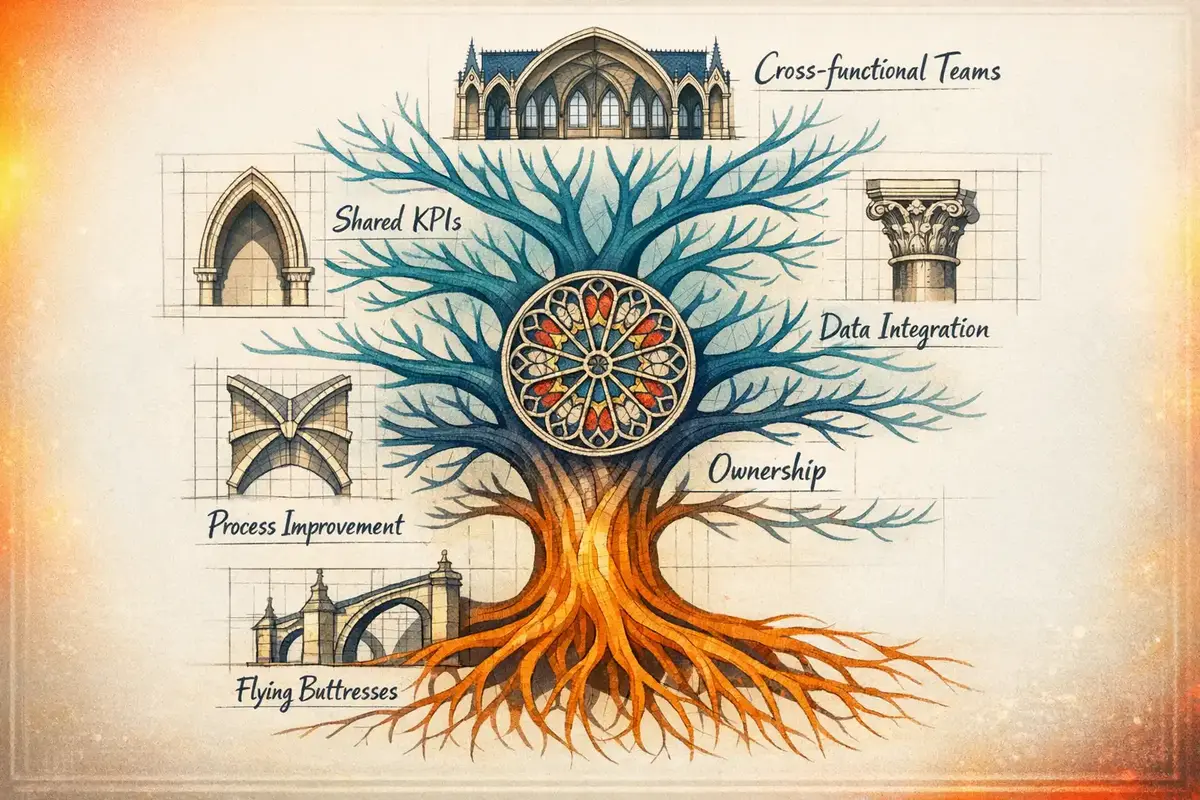
An integrated model is more specific. It defines decision rights so service knows when it can promise a replacement, when production must confirm capacity, and when a case moves to a higher level. It sets shared metrics so one team is not rewarded for output while another absorbs the cost in complaints and rework. It creates escalation paths that move exceptions fast, instead of letting them die in inboxes because no function owns the gray area.
Integration begins when the handoff stops being a gap and starts being a designed part of the work.
End-to-End Ownership Is the Missing Discipline
Most siloed organizations have plenty of responsible people. What they lack is end-to-end ownership.
Someone must be accountable for the journey across functions, not just for production yield or service response time. That role does not need to centralize every decision. It needs the authority to resolve trade-offs across the value stream — especially when local success creates downstream pain.
This is where many executives hesitate. They create cross-functional teams but leave accountability untouched, so the team can discuss problems it still cannot fix. And once metrics remain local, what happens when production hits target but service volume spikes — is that success, or just cost moved out of sight?
Why Customer Experience Breaks When Internal Metrics Stay Local
29% of consumers say they stopped using or buying from a brand because of poor customer experience (PwC, 2025). That should unsettle any leadership team still reading customer dissatisfaction as a frontline coaching issue rather than a system signal.
Most organizations do the opposite. They see missed satisfaction scores, rising complaints, or repeat contacts and assume service quality slipped at the point of contact.
The evidence points somewhere harder. In many cases, the customer is reacting to internal misalignment—slow confirmations, conflicting updates, partial answers, and promises made from incomplete operational facts. The agent becomes the visible face of a failure that started upstream.
Local Wins Can Still Produce a Broken Experience
A retail enterprise VP sees this during a quarterly review. Production celebrates shorter cycle times, logistics reports improved dispatch efficiency, and customer service shows acceptable average handle time. Then retention softens, escalations rise, and key accounts complain that “no one owns the whole issue.”
That is not a contradiction. It is the predictable result of local metrics doing exactly what they were designed to do.
If production is rewarded for throughput, it will push volume. If logistics is rewarded for shipment speed, it will optimize movement. If service is rewarded for closing tickets fast, it will resolve the contact in front of it. Each function can improve on paper while the customer experience degrades in practice because the customer does not buy throughput, movement, or ticket closure in isolation. They buy reliability across the journey.
A company can get more efficient at each step and still become harder to do business with.
This is where leaders misread the data. They ask which team underperformed when the more useful question is whether the metrics themselves are shifting work across boundaries. A faster shipment that arrives incomplete creates service demand. A closed ticket without production confirmation creates a second contact. A high output week followed by a spike in exceptions is not efficiency; it is deferred friction.
Shared KPIs Expose Whether the System Is Improving
The fix is not more dashboards. It is fewer local metrics and better shared KPIs.
Shared measures force the organization to see what customers already feel: order-to-resolution time, repeat contact rate after fulfillment issues, percentage of cases caused by upstream variation, and recovery speed for cross-functional exceptions. Those metrics show whether the system is removing friction or merely relocating it.
They also matter as automation expands. 58% of consumers say they are only somewhat or not at all comfortable using AI tools to engage with brands (PwC, 2025). If the underlying handoffs are fragmented, adding AI will not create trust—it will scale inconsistency faster, especially in moments where customers need one coherent answer, not a more efficient deflection.
That raises the real leadership challenge. How do production and service build one feedback loop strong enough to catch friction early—before local success turns into customer loss?
How Do Leaders Build One Feedback Loop Across Production and Service?
A service manager closes the same complaint for the fourth time in a month, while the plant supervisor insists the line is running to spec. By Friday, both teams are irritated, the customer is still waiting, and no one can say whether the problem is a defect, a promise failure, or a bad handoff.
That is the real cost of weak feedback design. Only 31% of U.S. employees were engaged in 2024, the lowest level in a decade, while actively disengaged employees reached 17% (Gallup, 2024). If people are already operating with less energy and less trust, adding more ambiguity between production and service does not just slow coordination; it hardens defensive behavior.
Turn Complaints Into Process Signals
Leaders build one feedback loop by changing the status of service data. A recurring complaint should not sit in the CRM as a closed case history. It should enter operations as evidence.
In a mid-market technology manufacturer, this often becomes visible during a quarterly review. Support shows a rise in “configuration confusion” tickets after a product update, but engineering sees no major issue because returns remain low. The mistake is treating each contact as an isolated service event rather than a pattern in the customer journey. Once the cases are grouped by product change, order type, and installation step, the business can see what was previously hidden: service demand is tracing the outline of an upstream process flaw.
The complaint is rarely the problem. It is the receipt for a problem the business has not owned yet.
That is why regular cross-functional review matters. Production, quality, and service should look at the same defect codes, escalation themes, and repeat-contact patterns on a fixed cadence. Not to share updates. To decide what changes.

Measure Production by the Demand It Creates
Most firms still evaluate production on output, cost, and schedule adherence. Necessary, but incomplete.
A better question is blunt: how much avoidable service demand did this decision create downstream? If a packaging change cuts line time but doubles replacement calls, the system did not improve. It exported cost. This is where many operational silos survive — each function can defend its own result because no one is measuring the friction left for the next team.
Gallup also found employee engagement fell by two percentage points from 2023 (Gallup, 2024). That decline matters operationally. When ownership is unclear, lower engagement shows up as slower escalation, thinner judgment, and more “not my issue” behavior. Integrated workflows do the opposite: they reduce frustration because people can see where a case goes, who decides, and why the work matters.
Build a Review Rhythm That Changes Decisions
The practical mechanism is simple. Weekly for acute issues. Monthly for structural ones.
Review three things together: defects leaving production, escalations entering service, and recurring friction across the journey. Then assign one owner for the corrective action, one date for verification, and one measure that proves the issue actually disappeared. Without that discipline, feedback becomes commentary.
And commentary does not break patterns. What should a COO change first — the meetings, the metrics, or the ownership model underneath them?
What Should a COO Change First to Break the Silo Pattern?
Journey mapping is the right first move because it tests a hard assumption: is the problem really the org chart, or is it the way work crosses it? What changes first: the org chart, the metrics, or the way leaders make decisions together? Most COOs think they know the answer until they trace one customer issue from order promise to final resolution and see how many functions touched it without anyone owning the whole path.
The first surprise is usually not where failure starts. It is where failure accumulates.
A regional services COO often discovers this during a team restructure. Service looks overloaded, operations says process compliance is fine, and IT insists the data exists somewhere. Then the journey map shows the real pattern: the customer request crosses five teams, status changes are re-entered three times, and the same exception gets interpreted differently at each handoff.
Start With the Journey, Not the Structure
Map the customer journey end to end, but do it operationally, not theatrically. Follow one order, one complaint, one replacement, one delay. Mark where work changes hands, where data stops moving cleanly, and where the customer has to wait because one team cannot act without another team’s confirmation.
That exercise sounds simple. It is not.
It forces leaders to see the business as a flow of commitments rather than a set of departments. It also creates a common fact base, which is exactly what most siloed organizations lack. The World Economic Forum’s Future of Jobs survey drew on 1,043 global company responses representing more than 14.1 million employees, and the survey itself ran across 38 questions in 12 languages—useful context because the operating challenge here is not local or anecdotal; it is broad, repeatable, and visible across large systems (World Economic Forum).
If you cannot point to where the handoff fails, you are not managing a value stream. You are managing explanations.
Then Redesign Governance Around the Flow
Once the map is visible, change governance before you redraw reporting lines. Clarify decision rights: who can approve a workaround, who must confirm capacity, who owns the exception when production and service disagree. Build short escalation paths. Remove the gray zones where issues sit because everyone is involved and no one is accountable.
Then align the measures. Shared outcomes matter more than functional pride. This is where leadership alignment becomes practical, and where shared KPIs stop being a dashboard exercise.
Use one diagnostic across the whole journey: where do handoffs break, where does data stop, and where do incentives diverge? Start there.
Because the final test is tougher than redesign. When pressure rises—during a shortage, a defect spike, a major account escalation—does the organization still behave like one team, or does it snap back into functions?
The Real Test of Integration Is Whether the Organization Feels Like One Team
Revenue is lost long before it shows up in the quarterly numbers. Trust erodes earlier still—when customers start double-checking your promises, employees start working around each other, and strong people decide the friction is not worth staying for.
If the customer journey is one continuous experience, the organization behind it cannot behave like disconnected parts. That is the real test.
Integration Has to Survive Pressure
A regional retail CEO usually sees this during a client escalation, not during a strategy offsite. A key account has a stock issue, service is trying to protect the relationship, operations is defending availability assumptions, and production is focused on the next run. Everyone is busy. No one is wrong in isolation. Yet the customer hears a company arguing with itself.
That is why silo breaking has to be treated as a design choice, not a collaboration campaign. Campaigns create energy for a quarter. Design changes what happens on an ordinary Tuesday, under deadline, when no senior leader is in the room.
Research is useful here because it confirms what many operators already know from experience. IBM found that data silos undermine innovation by blocking cross-department sharing of ideas (IBM, 2024). In practice, the same blockage also slows judgment. Teams cannot solve together if they are not seeing together.
One company does not mean one department. It means one shared reality when the customer needs an answer.
One Operating Rhythm Changes the Feel of the Business
The strongest organizations do something simple and difficult at the same time: they connect production quality, service insight, and leadership alignment into one operating rhythm.
That rhythm shows up in recurring habits. Service patterns are reviewed as operational signals, not anecdotal noise. Production issues are discussed in terms of downstream customer effect, not only internal variance. Leaders settle trade-offs against the whole journey, not the loudest function in the meeting.
This is where customer experience stops being a brand aspiration and becomes an operating discipline. Customers feel consistency because the business is speaking from one set of facts. Employees feel clarity because ownership is visible. The business sees fewer avoidable failures because problems are being resolved at the source, not narrated after the fact.
The commercial stakes are not abstract. PwC reports that consumers stop buying from brands because of poor experience (PwC, 2025). That should sharpen the leadership question: are your internal boundaries merely inconvenient, or are they teaching customers that your promises are unreliable?
What “One Team” Actually Feels Like
When integration works, the culture changes in ways dashboards only partly capture.
Meetings get shorter because fewer issues arrive half-defined. Escalations get cleaner because people know who decides. Frontline teams stop writing defensive notes and start surfacing patterns earlier. The organization becomes easier to work in because it has become easier to work across.
That is the point many leaders miss. Integration is not proven by a steering committee, a new workflow, or a better tone between departments. It is proven when handoff failures become rarer, ownership becomes clearer, and the company feels coherent under stress.
Customers trust companies that sound whole. Employees stay in companies that act whole.
So the honest next step is not to ask whether production and service are collaborating more. Ask something harder: when pressure rises, does your business still feel like one company—or does it revert to parts?
Key Takeaways
- Production and customer service integration is an operating choice that removes customer-visible breaks in the journey.
- Silos become customer problems quickly because they create different versions of reality, slower decisions, and weak handoffs.
- Shared operating models, end-to-end ownership, and shared KPIs help align production, service, and leadership around one outcome.
- Journey mapping and cross-functional review turn complaints into process signals and help the organization act like one team under pressure.
Frequently Asked Questions
What does production and customer service integration mean?
It means designing production, service, and related functions to operate from one shared view of demand, status, and customer impact. The goal is not just better communication, but a single operating model that reduces handoff failures, conflicting answers, and avoidable delays.
Why do silos quickly become customer experience problems?
Silos create different versions of reality, so teams act on stale, incomplete, or conflicting information. Customers feel this immediately as delays, inconsistent updates, repeated contacts, and promises that do not hold.
How do local metrics damage the customer journey?
Local metrics can make each department look successful while shifting cost and friction to another part of the process. For example, faster production or faster ticket closure can still increase complaints, rework, and repeat contacts if the whole journey is not measured.
What is the best way to build a feedback loop between production and service?
Treat recurring complaints as process signals, not just service cases, and review them regularly across functions. Group issues by product change, order type, defect pattern, or handoff point so leaders can fix root causes instead of only closing tickets.
What should leaders change first to break silo behavior?
Start with journey mapping to trace one customer issue end to end and identify where handoffs, data flow, and decision rights break down. Then align governance, escalation paths, and shared KPIs so accountability follows the customer journey rather than individual departments.