
Why AI Coaching Only Improves When the Feedback Loop Does
Only 21% of U.S. employees strongly agree they received meaningful feedback in the last week, and that is the right starting point for evaluating any continuous feedback loop in AI coaching—not the model demo, but what breaks after deployment (Gallup, 2022). If the loop is weak, the system may keep answering, yet stop learning anything useful.
That gap gets expensive fast. Gallup also found employees are 3.6 times more likely to strongly agree they are motivated to do outstanding work when managers provide daily rather than annual feedback (Gallup). In practice, the same logic applies to AI coaching: when learning cycles are infrequent, the tool becomes a static responder in a dynamic environment. Picture a mid-market healthcare director during quarterly reviews. The AI coach sounds polished, but it keeps missing the emotional pattern behind staff resistance because no one has translated user reactions into model updates. Time is lost. Trust thins out. This article explains how a continuous feedback loop keeps AI coaching relevant without letting it drift into generic advice.

Two Kinds of Feedback, Often Confused
Most teams say they are “using feedback” when they are really collecting signals about user experience. Was the conversation clear? Did the interface feel helpful? Would the user come back? Those signals matter, but they do not automatically improve the model.
Model-improving feedback is different. It asks whether the system’s underlying judgments, prompts, classifications, and coaching responses should change—and under what conditions. That requires more than thumbs-up ratings. It requires examples, interpretation, and a method for deciding whether a pattern is noise, edge-case behavior, or a real weakness in the coaching logic.
The operational question is not whether users responded. It is whether the organization learned something precise enough to justify changing the system.
Refinement Is a Process, Not a Byproduct
This is where many AI coaching programs stall. Leaders assume the model will improve simply because people are using it. It will not. Continuous refinement depends on four disciplines working together: collection, interpretation, validation, and release control.
Collection means capturing the right signals, not just the loudest complaints. Interpretation means reading those signals through the lens of coaching quality, not product convenience alone. Validation means testing whether a proposed change actually improves outcomes without weakening the method. Release discipline means deciding what should ship now, what needs more evidence, and what should remain stable.
That last point matters more than it seems. In coaching, not every update is progress. If the system becomes more pleasing but less grounded in Integral Coaching principles, is it improving—or just becoming easier to like?
What Makes Integral Coaching Different When AI Starts Learning?
Integral Coaching raises an uncomfortable question: if the model keeps changing, what exactly is supposed to stay the same? Many teams assume the answer is obvious. It is not.
An AI coach can improve its phrasing, timing, and pattern recognition while quietly losing the method that made it useful in the first place. That is the real risk when people talk about “learning” as if all iteration were progress.
The Method Is More Than Tone
In plain language, integral coaching is a developmental approach that looks at the whole person in context—not just goals, not just behavior, and not just mindset. It asks what the person is doing, how they are making meaning, what practices might help, and what conditions around them are reinforcing the pattern. The Integral Institute draws a sharp distinction here: coaching quality is not only about producing helpful answers, but about supporting deeper human development with discernment and context sensitivity (The Integral Institute).
That matters for AI refinement because a generic coaching model tends to optimize for immediate usefulness. Integral methodology asks for something harder: developmental fidelity. The system should not merely sound supportive. It should keep orienting the conversation toward whole-person awareness, embodied practice, perspective-taking, and the interaction between individual habits and system pressures.
A regional manufacturing VP reviewing leadership bench strength during a quarterly talent review will recognize the difference fast. A generic AI coach may suggest clearer delegation scripts. An integral one may notice that the leader’s control pattern shows up in language, decision cadence, and team design at the same time. One response solves a symptom. The other works on the structure producing it.
What Must Stay Stable While the System Evolves
This is the simplest way to think about it: the surface can adapt; the frame cannot drift.
The ICF’s practical guide on AI and coaching makes the case for preserving coaching standards, professional judgment, and clear boundaries as AI becomes more embedded in practice (ICF, 2025). In an integral context, that means some elements should remain stable even as prompts, classifiers, and response models improve: the developmental lens, the commitment to context, the distinction between observation and interpretation, and the discipline of offering practices rather than premature conclusions.
When refinement changes the method instead of strengthening it, the system may become more fluent while becoming less trustworthy.
This is where many teams get confused. They treat Integral Coaching as a style layer—something added through wording—when it is really an operating framework for how the coach sees change. Once that is clear, the next question becomes unavoidable: how does a feedback loop actually refine the system without rewriting the philosophy underneath it?
How Does a Continuous Feedback Loop Actually Refine an AI Coach?
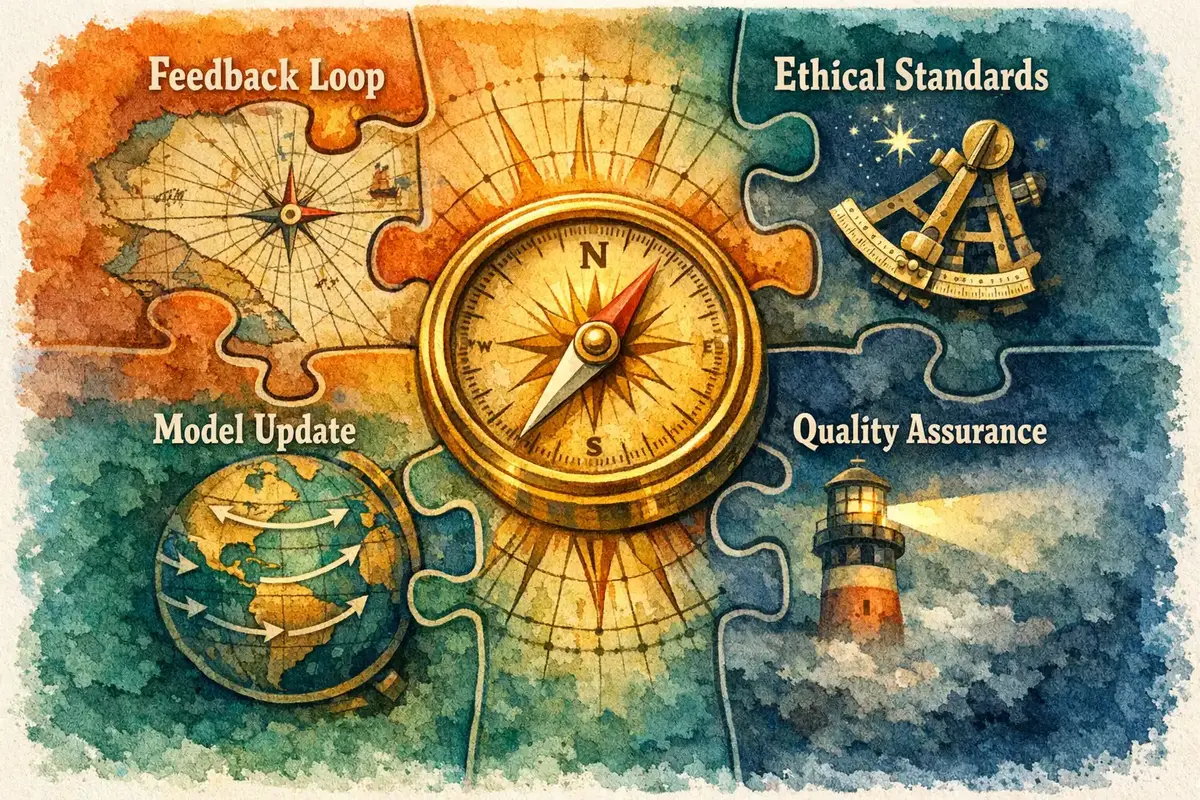
The capture → interpret → refine → validate → redeploy loop is what turns an AI coach from a responsive interface into a learning system. Without that loop, the product can feel smarter in conversation while repeating the same underlying mistakes.
That distinction matters because surface-level personalization is easy to overestimate. A coach that remembers your role, mirrors your tone, and offers cleaner phrasing may look improved. If it still misreads the developmental pattern, confuses stress with resistance, or gives the same intervention to different contexts, nothing important has changed.
Start by Separating the Signals
A continuous loop works only when teams collect different kinds of feedback for different layers. Session experience tells you whether the interaction felt clear, timely, and usable. Content quality tells you whether the advice was relevant, grounded, and appropriate to the coaching moment. Model behavior tells you whether the system is making the right distinctions underneath—classifying situations well, choosing the right response path, and staying within method.
Gallup’s guidance on coaching-style feedback is useful here because it emphasizes specificity, timeliness, and practical relevance over generic reaction alone (Gallup, 2022). The same principle applies to feedback in AI coaching: “helpful” is too vague to train on. “The coach pushed action before understanding the team dynamic” is usable.
Consider a regional retail director using the system during a team restructure. After several sessions, users report that the coach feels supportive. Reviewers, however, notice a pattern: it keeps framing store-manager conflict as a communication issue when the real problem is role ambiguity created by the new operating model. The experience layer looks fine. The reasoning layer does not.
Then Change the Right Thing
This is where teams often blur three very different update types.
UX adaptation changes how the system presents itself. It may shorten responses, ask better follow-up questions, or improve navigation. Useful, but not the same as learning.
Knowledge-base updates change what the system can reference. New policies, internal frameworks, or approved coaching examples can improve relevance fast. SHRM’s reporting on AI coaching in performance contexts points to this practical demand for more current, in-the-flow support rather than static review-cycle guidance (SHRM, 2023).
Model retraining is deeper. It changes how the system detects patterns and selects responses across cases. That should happen only when repeated evidence shows a stable weakness, not because a few users preferred a different style. Gallup’s work on fast feedback reinforces the value of short learning cycles, but speed is only useful when the signal is interpreted correctly (Gallup, 2021).
Validation Decides Whether Refinement Is Real
Before redeployment, proposed changes need to be tested against real coaching scenarios—not just accepted because they sound better. That is the discipline behind serious model refinement: compare outputs, review edge cases, and check whether the update improved judgment or merely improved likability.
That is where the pressure starts. If the loop keeps producing change, who decides which changes are safe—and which ones quietly push the coach off method?
Why Responsible AI Governance Is the Difference Between Improvement and Drift
50% of executives say the biggest barrier is turning Responsible AI principles into operational processes (PwC, 2025). That should reset the conversation for any team refining an AI coach: the hard part is rarely agreeing on values; it is deciding who can change what, based on which evidence, under what review.
Most organizations still behave as if iteration is governance. They collect feedback, spot a pattern, and push an update. The assumption is simple: more responsiveness means more improvement. The evidence says otherwise. PwC found that nearly 60% of executives report Responsible AI improves ROI and efficiency, and 55% report gains in customer experience and innovation (PwC, 2025). In other words, governance is not drag on the system. It is part of the performance model.
Responsible AI is not a compliance layer added after refinement. It is the mechanism that decides whether refinement is legitimate.
Principles Do Not Protect a Model; Processes Do
This is where many AI coaching programs get exposed. A team may have clear principles—fairness, transparency, human oversight, methodological fidelity—but no operating process that translates those principles into release decisions. No threshold for evidence. No escalation path for edge cases. No distinction between a harmless prompt adjustment and a change that alters coaching judgment.
A mid-market technology VP sees this during budget planning. Product wants faster updates because users are asking for more direct advice. Coaching leadership pushes back because the requests may reward immediacy over developmental depth. Without a review structure, that disagreement gets settled by urgency, not by method. The model changes anyway.
Good AI coaching governance makes that decision reviewable. It defines which feedback signals can trigger UX changes, which require expert evaluation, and which should be blocked until broader validation is complete. That is how a system keeps learning without letting the loudest signal rewrite the coaching frame.
Validation Is a Gate, Not a Formality
Not every feedback signal deserves a model update. Some reflect temporary user preference. Some expose a real weakness. Some point to a tension the system should preserve rather than smooth away.
That is why validation has to sit between feedback and deployment. Research consistently shows that when teams skip this step, they confuse popularity with quality. In an integral context, that is especially risky: a response can feel more satisfying in the moment while becoming less disciplined over time. Governance is what forces the harder question—did the change improve the coach, or just make it easier to approve?
And once that discipline is in place, another issue becomes unavoidable: what parts of the system should keep evolving—and what parts should remain deliberately hard to change?
What Changes, What Stays Stable, and What Should Never Be Updated Lightly?
The three-layer refinement framework matters here because most teams still treat feedback as if it points to one obvious fix. But when feedback arrives, how do you know whether to adjust the experience, the content, or the model itself? Get that wrong, and a reasonable request can trigger the wrong kind of change.
That is where methodological drift usually starts. Not with a dramatic failure, but with a category error.
A Simple Taxonomy Prevents Expensive Mistakes
The first layer is prompt updates. These shape how the coach asks, sequences, and frames. If users say the coach feels too abstract in first-session conversations, a prompt change may be enough. You are improving delivery, not altering judgment.
The second layer is knowledge-base changes. These update what the system can draw from—approved practices, internal language, policy context, or curated examples. If a services firm changes its leadership framework during annual planning, the coach may need fresher reference material, not a new model.
The third layer is model-level retraining. This is the deepest intervention. It changes how the system detects patterns and chooses responses across many cases. That should be rare, because it can also change the coaching logic in ways that are hard to see at first.
The safest question is not “What should we update?” but “Which layer is this feedback actually about?”
The ICF makes the case for preserving coaching standards, boundaries, and professional judgment as AI becomes more embedded in practice (ICF, 2025). In operational terms, that means classifying the signal before touching the system.

Use a Decision Lens Before You Use a Release Cycle
A practical lens is simple: safe, useful, or premature.
Safe changes improve clarity without changing the developmental frame. Think prompt wording, response length, or better follow-up questions. Useful changes add relevant context through the knowledge layer. They strengthen relevance while leaving the method intact. The model refinement process should treat both as controlled but routine.
A regional finance director sees the difference during a client escalation. Reviewers notice the AI coach keeps offering solid reflection questions, but misses a recurring pattern of status anxiety in senior managers. If the issue appears across cases, that may justify deeper review. If it shows up in one narrow context, retraining is premature.
The Integral Institute draws a clear line here: effective AI coaching depends on staying grounded in a coherent developmental method, not just producing plausible answers (The Integral Institute). That is the standard. Not user preference alone.
And once a team can sort safe updates from premature ones, a harder question appears: how do you prove the changes are actually making coaching better—or just making it sound better?
How Can Teams Tell Whether Refinement Is Actually Making Coaching Better?
80% of employees who say they received meaningful feedback in the past week are fully engaged (Gallup, 2021). That is a high bar for any AI coach claiming improvement: not “users liked it,” but “the coaching produced feedback people could actually use.”
Satisfaction Is a Weak Test
If the system says it improved, a skeptical manager should ask one question first: did coaching quality improve, or did the interface simply become easier to like?
Those are not the same outcome. User satisfaction can rise because responses are shorter, warmer, or more confident. None of that proves the coach is helping a manager make better judgments, frame clearer expectations, or turn a vague concern into an actionable next step. In practice, the strongest validation standard is whether refinement increases the quality of decisions and conversations around work.
Better coaching shows up when feedback becomes more specific, more usable, and more consistent from one case to the next.
That is why teams evaluating performance management coaching should track three things together: usefulness, consistency, and alignment with coaching standards. Usefulness asks whether the output helps someone act. Consistency asks whether similar situations receive similarly sound guidance. Alignment asks whether the advice still reflects the coaching method rather than drifting toward generic management tips.
What Validation Looks Like in the Real World
Take a regional healthcare team lead during quarterly reviews. The first version of the AI coach produces polished summaries, but managers still rewrite most of the feedback before using it with staff. After refinement, reviewers test a sample of cases again. Now the system distinguishes performance gaps from workload constraints, suggests clearer next-step language, and avoids overconfident conclusions when evidence is thin.
That is measurable progress. Rewriting time drops. Manager confidence rises. More important, the feedback becomes easier for employees to act on.
SHRM reports that 57% of organizations deploying AI tools for performance management use them to help managers provide more comprehensive and actionable feedback (SHRM, 2025). That matters because actionability is where many systems fail. A coach that sounds insightful but does not help a manager say what should change by next week is not refined. It is just fluent.
The Evidence Standard Has to Stay Tough
A credible AI coaching system should improve outputs and hold its line under pressure. One strong session proves little. The real test is repeatability across managers, teams, and review cycles.
Because once refinement starts optimizing for approval instead of standards, the system faces its hardest question: is it still learning to coach better—or learning to tell people what they want to hear?
The Real Test of AI Coaching Is Whether It Learns Without Losing Its Method
A coaching system can quietly destroy value long before it visibly fails. Revenue slips when managers act on shallow guidance, trust erodes when the advice shifts without explanation, and strong people leave when the tool meant to support judgment starts weakening it.
That is the real test: what separates a coaching system that keeps improving from one that slowly drifts away from what made it credible?
Learning Is Not the Same as Maturity
A regional services firm in the middle of a client escalation will recognize the pattern. The AI coach has been updated often. Users say it feels faster, smoother, more decisive. But account leaders begin to notice something else: the system now pushes toward resolution before it has properly surfaced the relational pattern underneath the conflict. It sounds better. It coaches worse.
This is why continuous feedback loops should be treated as a discipline, not a feature. A feature collects reactions. A discipline decides what those reactions mean, which ones deserve action, and which ones should be resisted because they would dilute the method. The strongest systems do not confuse motion with learning.
The ICF is clear that AI in coaching has to remain anchored to standards, boundaries, and professional judgment, not just convenience or scale (ICF, 2025). The Integral Institute makes the parallel point from the methodological side: coaching quality depends on preserving a coherent developmental lens, not merely generating plausible responses (The Integral Institute).
A system becomes trustworthy not when it changes often, but when it can explain why it changed and what it refused to change.
Stewardship Is the Operating Model
That puts governance, learning, and fidelity in the same frame. They are not separate workstreams. They are one operating requirement.
PwC’s work on Responsible AI shows the practical challenge is moving from principle to practice (PwC, 2025). In AI coaching, that means the team behind the system must be able to answer simple but uncomfortable questions: What evidence triggered this update? Who reviewed it? What part of the method was held constant? Where is the line between adaptation and drift? Good governance in AI coaching exists to make those answers visible.
The most durable AI coaching systems stay open to correction without becoming captive to every new preference. They learn. But they also remain legible, faithful, and accountable.
That is stewardship. Not freezing the model in place, and not letting it wander.
So in your own context, the honest next step is not asking whether your system is improving. It is asking a harder question: is it learning in ways you can still defend—or only changing in ways users happen to like?
Key Takeaways
- AI coaching improves only when the feedback loop captures, interprets, validates, and redeploys the right signals.
- Integral Coaching requires developmental fidelity, not just better phrasing or faster responses.
- Teams should separate prompt updates, knowledge-base changes, and model retraining before making changes.
- Responsible AI governance is what keeps refinement legitimate, reviewable, and aligned with coaching standards.
Frequently Asked Questions
What is a continuous feedback loop in AI coaching?
A continuous feedback loop in AI coaching is a repeat cycle of collecting user signals, interpreting what they mean, validating proposed changes, and redeploying improvements. It helps the system learn from real use instead of staying fixed after initial training.
How is model-improving feedback different from general user feedback?
General user feedback describes the experience, such as whether the interface felt clear or helpful. Model-improving feedback identifies whether the system’s underlying judgments, prompts, classifications, or coaching responses should change.
What makes Integral Coaching different when an AI coach is being refined?
Integral Coaching focuses on the whole person in context, including behavior, meaning-making, practices, and surrounding conditions. During refinement, the system should improve its surface behavior without losing that developmental lens or drifting into generic advice.
Which parts of an AI coaching system should be updated first?
Feedback should be sorted into three layers: prompt updates, knowledge-base changes, and model-level retraining. Prompt and knowledge updates are usually safer and faster, while retraining should be reserved for repeated evidence of a stable weakness.
How can teams tell whether AI coaching refinement is actually working?
Refinement is working when coaching becomes more useful, more consistent, and more aligned with coaching standards across cases. Stronger validation shows up in better decisions, clearer next steps, and less rewriting by managers, not just higher user satisfaction.