
The COO-CEO Partnership Is the Real Transformation Engine
A transformation stalls when the CEO and COO sponsor the same ambition but run it through different priorities, decisions, and pace. It scales only when the CEO sets direction and the COO turns that direction into an operating rhythm the business can actually follow.
You see the pattern fast in a quarterly review. The CEO is pressing for speed, the COO is protecting delivery stability, and the room leaves with apparent agreement but no shared call on tradeoffs, sequencing, or who decides when pressure rises. That gap is where transformation loses force.
Research supports the importance of the partnership itself: CEOs widely view the COO as a critical strategy partner (PwC). But that headline can hide the real issue. A strong executive partnership is not proven by alignment in principle; it is proven when strategy survives contact with budgets, handoffs, and competing priorities across the business.

The cost is not abstract. When leaders are misaligned, managers hedge, teams wait, and frontline adoption thins out. Gallup’s finding that global engagement remains low is a useful warning here: people do not commit to change because it was announced; they commit when leadership makes the change legible in daily work (Gallup, 2024).
Transformation does not fail from lack of vision. It fails when vision never becomes a repeatable way of deciding.
That is why alignment is a system, not a personality match. It is built from mandate, decision rights, cadence, escalation paths, and reinforcement. If those mechanisms are weak, even a trusted executive partnership becomes interpretive rather than operational.
The hard question is not whether the CEO and COO agree. It is what, exactly, they are aligned on—and how the rest of the organization can tell.
What Does Strategic Alignment Between a CEO and COO Actually Mean?
76% of CEOs say their COO is a highly effective partner in driving strategy. That sounds reassuring, but it leaves the harder question untouched: if alignment is not the same as agreement, what are they actually aligned on?
Strategic alignment is disciplined coordination: a shared direction, clear ownership, and a standing cadence to recalibrate when facts change. It is not chemistry. It is not two executives finishing each other’s sentences. It is a practical operating arrangement the rest of the business can read.
That distinction matters. Agreement means leaders hold the same view in the moment. Alignment means they can debate methods, timing, or risk and still protect the same outcomes, priorities, and decision rules.
Alignment is not the absence of friction. It is friction contained by a shared aim.
In a mid-market healthcare company during budget season, the CEO may push for faster expansion into a new service line while the COO argues for a slower rollout to protect staffing stability. They are not misaligned if both are still working from the same priorities: growth target, service quality threshold, and the point at which execution risk triggers a reset.
The roles are different by design. The CEO sets direction and provides air cover — the political and organizational backing that keeps the transformation from being diluted at the first sign of resistance. The COO translates that direction into sequence, tradeoffs, and cross-functional execution, often through sharper COO role clarity.
When those roles blur, teams improvise. When they are clear, disagreement becomes useful. But what happens when useful disagreement turns personal — or starts slowing decisions at exactly the wrong moment?
Why Healthy Tension Makes the Partnership Stronger, Not Weaker
23% of newly appointed CEOs previously held the COO role, which tells you something important: the best operators are not there to echo the chief executive; they are there to test whether ambition can survive execution. In the Monday meeting after a board update, the CEO pushes for a faster rollout, the COO pauses on capacity risk, and everyone in the room can feel the tension before anyone names it.
That moment is not the problem. Unclear ownership is.
Healthy tension strengthens a partnership because it surfaces trade-offs while they are still cheap to resolve. A regional services company deciding whether to centralize client onboarding does better when the CEO argues for speed and the COO presses on service continuity, compliance load, and manager bandwidth before launch—not after escalations start.
Strong partnerships do not avoid friction. They make friction useful early, while choices are still reversible.
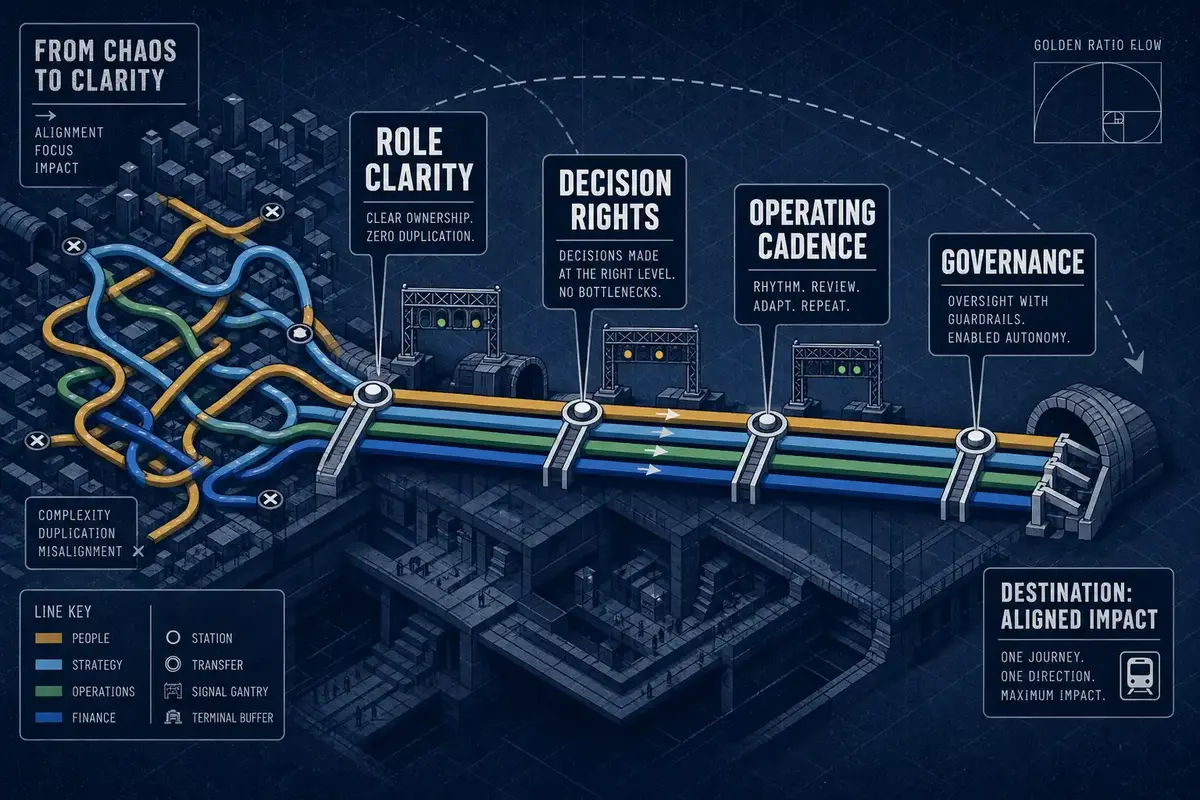
Destructive friction looks different. It shows up when both leaders step into the same decision, or neither does. Then debate turns into overlap, decisions drift, and the organization starts asking who actually owns the change. What looks like interpersonal strain is often a design flaw in CEO-COO alignment.
The downstream cost is real. 70% of the variance in employee engagement can be traced to manager influence (Gallup, 2024), which means executive ambiguity does not stay at the top; it gets translated by managers into mixed signals, hesitant priorities, and weaker adoption.
The COO’s job, then, is not to dilute the CEO’s authority. It is to challenge assumptions in a way that sharpens commitment, sequencing, and risk calls the business can actually execute. But if tension is useful, what keeps it from consuming time when priorities collide?
Which Governance Model Keeps Transformation Moving When Priorities Compete?
88% of projects with excellent change management meet or exceed objectives, which is why the right governance model is not administrative overhead but the operating system of transformation (Prosci). Without it, competing priorities turn into slow decisions, duplicate interventions, and a change story that mutates as it moves down the organization.
The model that holds up best is simple: fixed decision rights, explicit escalation rules, a standing operating cadence, and visible metrics tied to adoption. That is what makes strategic alignment durable under pressure rather than dependent on executive chemistry.
| Alignment mechanism | What it solves | Failure mode |
|---|---|---|
| Decision rights | Clarifies who decides on scope, timing, and trade-offs | Parallel decisions and political end-runs |
| Cadence | Creates a repeatable forum to review progress and reset priorities | Drift between strategy reviews and operating reality |
| Escalation | Moves blocked issues quickly to the right level | Delays disguised as consensus-building |
| Metrics | Shows whether change is being adopted, not just announced | Activity without behavioral shift |
A mid-market manufacturing company in a budget cycle offers a familiar example. The CEO wants to protect growth investments; the COO sees plant constraints and talent bottlenecks. In a weak governance model, that conflict lingers across meetings. In a strong one, the trade-off is surfaced in one forum, assigned to one decision owner, and resolved against pre-agreed thresholds.

The evidence is blunt. Only 26% of transformations are very or completely successful overall, but success rises to 58% when leaders use a rigorous, action-oriented approach (McKinsey, 2021). Governance is how rigor shows up in practice.
Transformation starts moving again when trade-offs become explicit instead of personal.
The COO usually carries this into the business through cross-functional routines: weekly risk reviews, monthly milestone resets, and a metric stack that tracks adoption, cycle time, exception volume, and manager follow-through. But even clean governance leaves one hard question: how do those mechanisms reach the frontline and change behavior at scale?
How Do CEOs and COOs Turn Vision Into Adoption at Scale?
88% of projects with excellent change management meet or exceed objectives, while weak execution burns revenue, erodes trust, and sends good operators out the door when the change story keeps shifting around them (Prosci). What does the partnership look like on Monday morning when the strategy deck is finished but adoption has not begun? It looks like three practical moves: define the mandate, assign decision rights, and lock in a recalibration rhythm.
The mandate comes first. The CEO states the few outcomes that cannot be compromised. The COO turns that into sequence, milestones, and adoption routines the business can actually run through strong transformation leadership. One owns the narrative and sponsorship; the other owns the path and the pace.
In a regional retail company during a team restructure, the CEO announces a new service model to protect margin and customer retention. By Tuesday, store directors are asking who can waive staffing targets, which pilots go first, and what happens if service scores dip. That is the COO’s ground.
The first operating week usually needs a short list:
- Define the non-negotiable outcomes.
- Clarify who decides scope, timing, and exceptions.
- Set a weekly reset on risks, signals, and manager feedback.
Adoption scales when leaders stop repeating the vision and start reducing local ambiguity.
That last point is where many transformations break. 70% of the variance in employee engagement can be traced to manager influence (Gallup), so frontline adoption depends less on the launch message than on whether managers reinforce new priorities in scheduling, coaching, and escalation. And if alignment must survive beyond one strong week—what keeps it steady when pressure rises, fatigue sets in, and the market shifts again?
The Best COO-CEO Partnerships Treat Alignment as a Discipline, Not a Mood
79% of completed transformations were successful in organizations that saw the full change journey through; for the reader, that is the real point: success is not created by executive rapport at kickoff, but by the operating discipline that carries change through to completion (McKinsey, 2021). Most companies still act as if alignment is a mood — strong when the top team is in sync, fragile when pressure rises. The evidence points elsewhere.
The best COO-CEO partnership works as a system. The CEO defines the few outcomes that matter most. The COO converts them into sequence, tradeoffs, and management routines. Role clarity starts the work, strategic alignment keeps choices coherent, governance resolves collisions, and adoption turns intent into behavior.
That progression is what makes transformation scalable rather than heroic. McKinsey found that overall success reaches 58% when leaders use a rigorous, action-oriented approach (McKinsey, 2021). Rigor here is not bureaucracy. It is the discipline of making the same priorities visible in planning, reviews, escalation, and manager conversations.
Consider a global logistics company facing supply chain disruptions. The CEO sets a bold target for on-time delivery; the COO, seeing operational bottlenecks, translates that ambition into specific process changes, clear escalation paths, and regular performance check-ins. When a crisis hits, their alignment is stress-tested—not by whether they agree on every detail, but by whether their shared routines and decision rules hold up under pressure. This is what distinguishes partnerships that deliver consistent results from those that falter when stakes are highest.
The partnership is strongest when neither leader has to guess how the other will handle pressure.
That is the standard. Not harmony, but repeatability. The most effective COO-CEO teams make productive disagreement part of their operating rhythm, using it to clarify priorities and accelerate execution. In your context, is alignment still dependent on personalities — or has it become an operating discipline the business can trust?
Key Takeaways
- Transformation does not fail from lack of vision. It fails when vision never becomes a repeatable way of deciding.
- Alignment is not the absence of friction. It is friction contained by a shared aim.
- Strong partnerships do not avoid friction. They make friction useful early, while choices are still reversible.
- Transformation starts moving again when trade-offs become explicit instead of personal.
Frequently Asked Questions
How do transformation-focused COOs establish strategic alignment with CEOs during organizational change initiatives?
Transformation-focused COOs establish strategic alignment by agreeing with the CEO on a shared direction, clear decision rights, and a regular cadence for reviewing progress and trade-offs. The CEO sets the destination, while the COO translates that direction into operating priorities, sequencing, and execution routines that the organization can follow.
What mechanisms do COOs use to manage strategic tensions with CEOs while driving large-scale transformation programs?
COOs manage strategic tension through explicit governance mechanisms such as decision rights, escalation paths, operating cadences, and performance metrics tied to adoption. These tools keep disagreement productive by surfacing trade-offs early and preventing ambiguity from slowing execution.
Why is CEO-COO vision alignment critical for the success of enterprise-wide change led by COOs?
CEO-COO vision alignment is critical because enterprise-wide change fails when strategy and execution pull in different directions. When the CEO and COO share priorities, trade-offs, and decision rules, managers receive consistent signals and the transformation is more likely to become repeatable behavior across the business.
Which collaboration frameworks enable COOs and CEOs to jointly lead transformational change effectively?
The most effective collaboration frameworks combine role clarity, shared goals, a fixed review cadence, escalation rules, and visible adoption metrics. This creates a practical operating system in which the CEO sponsors the change and the COO converts it into coordinated execution.
What best practices help COOs maintain continuous strategic alignment with CEOs throughout complex change processes?
Best practices include defining non-negotiable outcomes, clarifying who decides on scope and exceptions, reviewing risks on a regular cadence, and using metrics to track adoption rather than just activity. Continuous alignment works best when the partnership is treated as a discipline, not a one-time agreement.