

Why the Best CEO-COO Partnerships Are Built on Productive Friction
What if the tension in a CEO-COO partnership is not the problem, but the proof that both leaders are doing their jobs? When a company needs to move faster, the CEO often pushes for speed, signal, and strategic commitment while the COO pushes for sequence, capacity, and operational reality. Both are trying to protect growth. The friction starts when each reads the other’s instinct as drag rather than discipline.
You see it in ordinary moments, not dramatic blowups. A regional healthcare company enters a quarterly review with pressure to expand into two new markets; the CEO wants a visible move before competitors do, and the COO wants to stabilize staffing before adding complexity. The meeting ends with apparent alignment, but the executive team leaves with mixed signals, priorities blur, and execution slows because no one knows which tension was actually resolved. This article is about how CEO-COO tension becomes useful—rather than expensive—when it is designed into the operating model.
The first mistake is to treat this relationship as a chemistry issue. It is not mainly about whether two leaders “click.”
It is an operating partnership. That means the real question is not whether the CEO and COO like each other, but whether they have a workable way to process competing truths under pressure. In practice, one leader is often carrying the external narrative while the other is carrying internal coherence, and both roles touch strategy, execution, and organizational credibility at the same time.
Overlap Is Not a Flaw
High-performing CEO-COO pairs are supposed to have some overlap. If there were no overlap, there would be no useful challenge function at the top.
That overlap creates friction because the boundaries are never perfectly clean. Strategy affects operations immediately. Execution reshapes strategy just as quickly. Public visibility, board expectations, talent decisions, and resource tradeoffs all sit in the shared zone, which is why the partnership needs more than goodwill; it needs explicit rules for how disagreement gets surfaced, tested, and closed.
The healthiest executive tension is not hidden tension. It is tension that has a job.
This is also why the conversation about trust in executive partnership is often too soft. Trust matters, but trust without operating clarity simply makes confusion more polite. Strong partnerships do not remove tension; they make it legible.
Productive Friction Is a Design Choice
The best CEO-COO relationships do not aim for constant harmony. They aim for productive friction—enough challenge to sharpen judgment, enough structure to prevent drift, and enough mutual respect to keep disagreement from turning into politics.
That raises the harder question. If friction is normal, what exactly is this partnership supposed to solve: speed, clarity, accountability—or all three at once?
What Does the CEO-COO Relationship Actually Need to Solve?
The decision-rights framework matters here because titles alone do not tell people who decides, who shapes, and who breaks a deadlock. Most organizations assume that if “CEO” and “COO” are clearly labeled on the org chart, the working relationship will sort itself out; the evidence is more basic than that. Plain-language role definitions from both Rollins Crummer Graduate School of Business and the U.S. Chamber of Commerce show the distinction at a high level, but they also make clear why confusion persists: both roles sit close to strategy, people, and performance at the same time (Rollins Crummer Graduate School of Business) (U.S. Chamber of Commerce).
That is the gap.
Titles explain hierarchy. They do not explain handoffs.
The Real Problem Is Not Job Description, but Operating Design
A CEO is usually expected to set direction, represent the company externally, and make the biggest strategic calls. A COO is usually expected to turn direction into coordinated execution and keep the business running with discipline (Rollins Crummer Graduate School of Business). Useful as that is, it still leaves the hard questions unanswered: Who owns cross-functional tradeoffs? Who can slow a launch? Who resolves conflict between quarterly targets and long-term bets?
In a mid-market technology company during budget season, this is where drift starts. The CEO pushes for faster investment in a new product line. The COO sees that customer support, hiring capacity, and implementation teams are already stretched. If no one has defined whether the COO has veto power, advisory power, or only delivery responsibility, the disagreement does not stay at the top. It spreads downward as mixed signals, duplicated work, and delayed commitments.
Role clarity is not about drawing cleaner boxes. It is about preventing uncertainty from cascading through the business.
This is why role clarity in leadership is not an HR exercise. It is a growth control mechanism.
Overlap Is Expected — Confusion Is Optional
The U.S. Chamber of Commerce notes that executive titles often sound neat in theory but vary widely in practice (U.S. Chamber of Commerce). That variation is not a flaw. It reflects reality. Strategy changes operating priorities, and operating constraints reshape strategy, so some overlap between CEO and COO role is inevitable.
What matters is whether the overlap is governed. Strong partnerships define three things explicitly: decision rights, cadence, and escalation paths. Decision rights answer who decides what. Cadence determines where issues get surfaced before they become political. Escalation paths define what happens when the two leaders cannot close a call quickly.
That is why the CEO-COO relationship should be understood as a system, not a loose collaboration. A system can absorb pressure. A vague partnership cannot.
And once leaders assume the system is obvious, a more dangerous problem appears: they stop checking whether they are actually interpreting each other the same way—or merely believing they are.
Why Trust Breaks Down When Leaders Assume They Already Understand Each Other
Only 19% of employees globally strongly agree that they trust their organization’s leadership. If you assume your top team is exempt from that reality, what are you basing that confidence on (Gallup, 2025)?
The more uncomfortable number may be this one: 75% of executives believe they understand frontline employees, while only 20% of workers agree (World Economic Forum, 2025). That gap is not a communications problem in the narrow sense. It is evidence that senior leaders often mistake access to each other for understanding of the organization.
In a CEO-COO partnership, that mistake is expensive. When two leaders have worked together for a while, they start compressing conversations, finishing each other’s sentences, and assuming shared meaning where only familiar language exists. The board may hear alignment. The company may experience ambiguity.
Familiarity Can Hide Misalignment
Trust breaks down fastest when leaders rely on implied understanding instead of tested understanding. A CEO says, “We need to move now,” meaning market commitment. A COO hears, “Absorb the execution risk and sort it out later.” Neither is acting in bad faith. Both are reading from different operating assumptions.
That is why trust in executive partnership cannot be treated as interpersonal warmth. It is a discipline of checking whether the same words still point to the same decisions.
Consider a manufacturing enterprise in the middle of a team restructure. The CEO privately pushes for faster consolidation to protect margin. The COO privately argues for a phased shift to avoid plant disruption. They leave the meeting with a verbal compromise, then present “unity” to the executive team without clarifying what changed, what did not, and who will make the next call if disruption rises.
The VP layer then fills in the blanks. Operations slows decisions waiting for cover. Finance assumes the cost target still stands. HR hears urgency but no sequence. What looked like executive cohesion becomes organizational guesswork.
When leaders skip clarification at the top, the company pays for interpretation in the middle.
Trust Is an Execution Asset
This is the practical point many teams miss: trust changes the speed of execution. When people trust that the CEO and COO are genuinely aligned, they escalate issues earlier, commit faster, and spend less time decoding political subtext. When they do not, every decision carries an invisible tax.
Gallup’s low trust figure should be read as an operating warning, not a culture footnote (Gallup, 2025). The World Economic Forum’s reporting on the executive-worker perception gap shows why confidence at the top is such a weak proxy for clarity below (World Economic Forum, 2025).
So the issue is not whether CEO and COO ever disagree. They should. The real question is harder: how do they disagree in ways the organization experiences as clarity rather than camps — as disciplined debate rather than politics?
How Do Strong CEOs and COOs Disagree Without Creating Politics?
49% of emerging leaders struggle with managing conflict, which means many executives reach the top without a reliable method for handling disagreement under pressure (DDI, 2024). That gap is costly: trust erodes, strong operators leave, and commercial decisions stall while the organization tries to read the politics between two senior voices.
The damage rarely starts with a dramatic fight. It starts when a CEO and COO disagree in ways the company cannot interpret.
Healthy Tension Is Not the Same as Role Conflict
A regional services company in the middle of a client escalation offers a familiar picture. The CEO wants an immediate concession to protect the account. The COO wants to slow down long enough to test delivery impact, margin exposure, and staffing capacity. If that exchange stays focused on the decision, it sharpens judgment. If it slips into “who owns this call,” the issue changes from business risk to role conflict.
That distinction matters. Healthy tension improves the quality of a decision because each leader is testing a different variable. Role conflict creates ambiguity because people below them no longer know whether they are watching debate, turf protection, or a pending power shift.
The organization can absorb disagreement. It struggles to absorb uncertainty about who is really in charge.
This is one reason managing tension in leadership is a learned discipline, not a personality trait. DDI’s finding should concern boards as much as HR teams: if nearly half of emerging leaders struggle with conflict, many future CEOs and COOs will default to avoidance, overcontrol, or public contradiction unless they build better habits early (DDI, 2024).
The Norms That Keep Friction From Turning Political
Strong pairs usually follow three simple rules.
First, disagree privately before speaking publicly. The point is not secrecy. It is containment. Hard objections should be aired where both leaders can challenge assumptions without forcing the executive team to choose sides in real time.
Second, align publicly on the decision, not on fake unanimity. Teams do not need the theater of perfect agreement. They need a clear call, the rationale behind it, and confidence that the debate is over for now.
Third, define an escalation path before a crisis. If the CEO and COO cannot close a decision within a set window — 24 hours, one operating review, one board-prep cycle — the matter moves to a predefined mechanism. That might be a board chair, a lead director, or a documented decision rule. The key is that escalation is procedural, not emotional.
A useful test is simple: after a disagreement, does the executive team move faster or become more cautious? If people start triangulating, lobbying, or waiting for one leader to reverse the other, politics has already entered the room. That is where executive conflict management stops being interpersonal and becomes operational.
The harder question is what makes these differences useful over time — not just containable in the moment. When strengths are genuinely complementary, why do some pairings create lift while others create drag?
What Makes Complementary Strengths Actually Work in Practice?
45% of COOs say making their function a more strategic business partner to the CEO is a high priority (PwC, 2024). That number matters because it shows the old division of labor—one leader thinks, the other executes—is no longer enough for a company that wants to grow without creating fragility.
That is the first correction. Complementary strengths are not a personality compliment. They are an operating design.
If both leaders are strong, why does the partnership still need deliberate design to become complementary instead of competitive? Because raw capability creates overlap before it creates lift. Unless that overlap is mapped to decisions, meeting cadence, and accountability, the company gets two forceful interpretations of the same problem.
Complementarity Has to Be Assigned a Job
In a retail enterprise during annual planning, the CEO pushes for a faster store-format expansion while the COO sees that supply chain variability will break the economics if rollout timing is wrong. The useful question is not who is “more strategic.” It is who frames the market bet, who tests operating readiness, who can delay commitment, and who owns the final integration plan.
That is where many partnerships fail. They describe strengths in adjectives—bold, disciplined, analytical, decisive—when they should be describing them in mechanisms.
A strong pair often looks asymmetric in style but aligned in effect. One leader may think out loud, decide with incomplete information, and pull the organization toward motion. The other may narrow options, pressure-test assumptions, and protect coherence across functions. Different tempo. Same outcome: better decisions made faster.
Complementary leadership works when difference reduces error, not when difference becomes identity.
What the Business Gets When the Pairing Is Designed Well
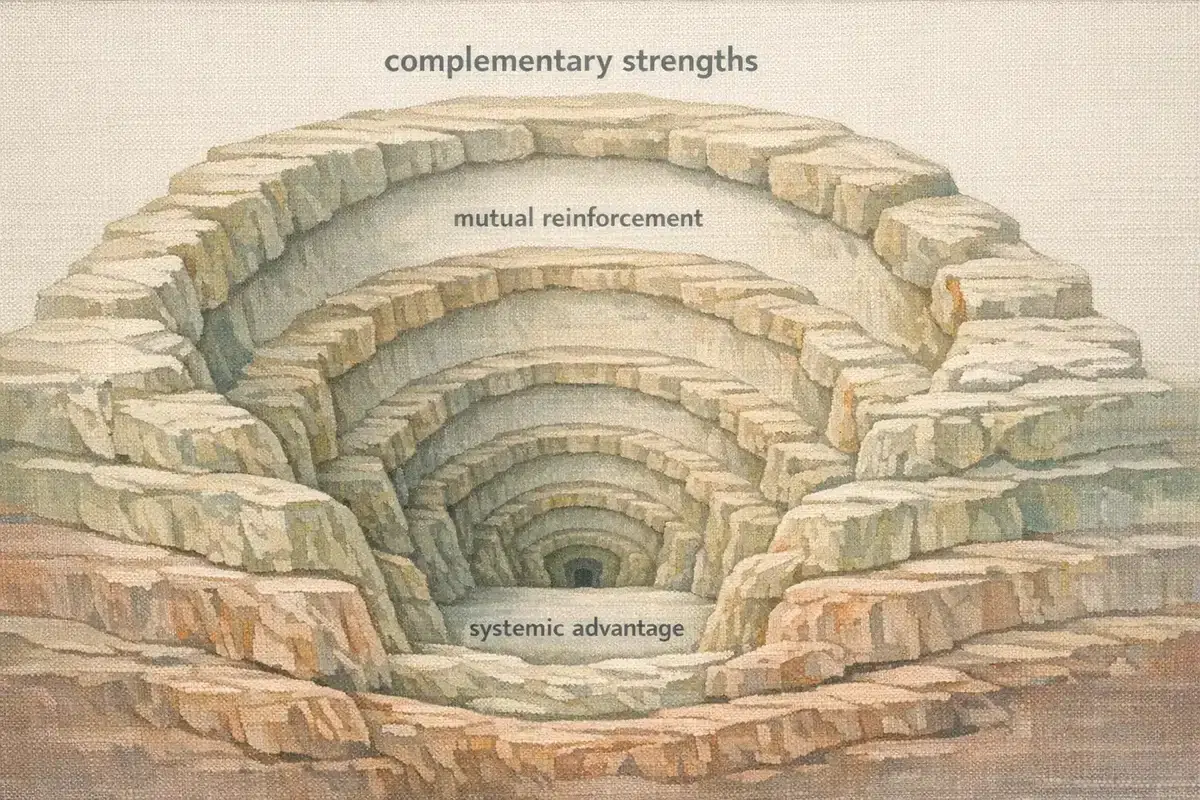
Done well, complementary strengths improve speed because fewer decisions bounce between strategy and execution waiting for translation. They reduce blind spots because each leader is expected to challenge a different failure mode—market overreach on one side, operational overconfidence on the other. They also create a more resilient leadership system because the company is less dependent on one executive’s pattern of judgment.
This is why the PwC finding is more than a role trend (PwC, 2024). It signals that COOs are being pulled further upstream, into strategic interpretation rather than downstream delivery alone. That shift only helps if the partnership is explicit about where joint work begins and where individual accountability still holds.
The real test is simple. When pressure rises, does the CEO-COO difference create sharper calls—or slower ones? If the answer is “it depends,” then the partnership still lacks rhythm — and rhythm is what the next move must solve.
Which First Steps Help a CEO and COO Turn Friction Into Rhythm?
In the Monday operating review, the CEO thinks the expansion decision was made last week. The COO thinks last week only approved further analysis, so the executive team spends the first 20 minutes discovering that “alignment” meant two different things.
This is exactly where structure starts to matter. Executive coaching is not an unusual intervention reserved for breakdowns; it is already part of how organizations support senior leaders. 57% of coaching engagements are organization-sponsored, and 25% of coaching clients are executives, according to the ICF global study (ICF, 2025).
That matters because the first problem is rarely personality. It is translation.
Start With the Smallest Useful Operating Rules
The first move is to define decision rights in plain language. Not a long RACI buried in a shared drive. A short list of recurring calls: market entry, hiring pace, pricing exceptions, capital allocation, customer concessions. For each one, specify who decides, who recommends, who must be consulted, and what happens if the two leaders disagree.
This is where role clarity in leadership stops being conceptual and becomes practical. If the CEO owns the strategic bet but the COO can delay commitment based on readiness thresholds, say so explicitly.
The second move is to set a sync cadence that matches the business, not the calendar. In a mid-market finance company during budget cycle, I would expect at least one weekly CEO-COO decision meeting, separate from broader executive reviews. The purpose is narrow: close open loops, surface emerging friction early, and prevent unresolved issues from leaking into the rest of the team as mixed signals.
Tension becomes expensive when leaders improvise the process every time the stakes rise.
Build an Escalation Path Before You Need One
Third, agree on escalation rules while the relationship is calm. How long can a disagreement stay open — 24 hours, one planning cycle, one board-prep window? What evidence is required to reopen a call? When does the issue move to the chair, lead director, or a predefined governance mechanism?
Fourth, revisit assumptions on a fixed rhythm. Monthly is often enough. The question is simple: what are we each assuming about growth, capacity, risk, and timing that may no longer be true? That review is especially important as the COO role expands beyond delivery into broader strategic judgment.
A coach can help here, but only if the work stays operational. The goal is not better chemistry. It is a repeatable rhythm that makes disagreement faster to process and safer for the business.
Because once the rhythm exists, tension stops being a relationship issue and starts becoming a governance asset — or it should. The harder question is whether most executive teams are prepared to treat it that way.
Why the Strongest Executive Partnerships Treat Tension as a Governance Tool
39% is the performance upside companies see when executive teams are more diverse, while those in the bottom quartile for both gender and ethnic diversity are 66% less likely to outperform financially (McKinsey, 2023). For a CEO and COO, that should make the stakes plain: when difference at the top is mishandled, the cost is not just friction — it is missed growth, slower decisions, and talent that stops betting on leadership.
If executive diversity and difference can improve performance, the implication is straightforward. Difference is not the risk. Undesigned difference is.
Tension Becomes Useful When It Is Visible
Consider an enterprise technology company in a market shift. The CEO wants to accelerate a platform bet before competitors reset the category. The COO sees implementation strain, customer migration risk, and a support model that is not ready. If that tension stays vague, the organization experiences it as hesitation. If it is structured — what is being debated, who decides, what would change the call — the same tension becomes governance.
That is the real distinction at the end of this discussion. Trust, role clarity, and disagreement norms do not work as separate virtues. They work as a single operating system.
Trust lets each leader surface a hard objection without reading it as disloyalty. Role clarity keeps challenge from turning into territorial behavior. Disagreement norms make sure debate ends in a decision the company can actually follow.
Strong partnerships do not eliminate tension. They give it rules, timing, and a purpose.
Complementary Leadership Is a Discipline
This is why the best CEO-COO pairings should be judged less by chemistry and more by repeatability. Can they process a strategic conflict without creating a political afterlife? Can they show the executive team that two strong views can sharpen a call rather than split the room?
McKinsey’s findings on performance and diversity are useful here precisely because they resist the fantasy of sameness (McKinsey, 2023). Better outcomes do not come from reducing difference at the top. They come from making difference legible, bounded, and productive.
That is the discipline. Not coincidence. Not personality luck.
So the honest closing question is simple: in your own leadership system, is tension still something to manage around — or has it become a tool you know how to use?
Key Takeaways
- The best CEO-COO partnerships use productive friction to sharpen judgment, not to create politics.
- Role clarity, decision rights, cadence, and escalation paths turn overlap into a workable operating system.
- Trust is an execution asset because it reduces ambiguity and speeds up decisions.
- Complementary strengths work best when difference is designed, visible, and tied to accountability.
Frequently Asked Questions
What is productive friction in a CEO-COO partnership?
Productive friction is the constructive tension that comes from a CEO and COO challenging each other on strategy, execution, and risk. It is useful when disagreement is structured, time-bound, and tied to better decisions rather than personal conflict.
Why is role clarity so important between the CEO and COO?
Role clarity prevents confusion about who decides, who advises, and who escalates when priorities compete. Without it, overlap at the top can create mixed signals, duplicated work, and slower execution throughout the organization.
How can trust break down between senior leaders even when they work closely together?
Trust often breaks down when leaders assume they already understand each other and stop testing whether they mean the same thing. Familiarity can hide misalignment, so the same words may be interpreted differently and lead to conflicting actions.
How should CEOs and COOs disagree without creating politics?
They should disagree privately before speaking publicly, align on the final decision rather than fake unanimity, and use a predefined escalation path if they cannot resolve the issue quickly. This keeps debate focused on the business problem instead of turning it into a power struggle.
What makes complementary strengths work in practice for a CEO and COO?
Complementary strengths work when each leader’s differences are assigned a clear job, such as one pushing strategic speed and the other protecting operational readiness. The partnership becomes effective when those differences reduce error, improve speed, and strengthen accountability.