
Why the cheapest coaching option can become the most expensive one
31%. That is how many U.S. employees were engaged in 2024, according to Gallup—a 10-year low that should make any coaching buying decision feel less like procurement and more like risk control (Gallup, 2024).
You know the scene. A mid-market technology VP is in a quarterly review, a manager issue has just escalated, and the approved coaching option looks affordable on paper but cannot be accessed until next week. By then, the conversation has hardened, the team has filled the silence with its own story, and what looked like a low-cost support decision has already started compounding into delay, distraction, and avoidable management drag.
That is the first mistake in most coaching comparisons: treating session price as the cost. It is only the visible layer. The real number sits underneath it, in access, continuity, and decision quality—whether support is available when judgment is under pressure, whether people actually use it, and whether the intervention improves the next decision rather than merely documenting the last one.
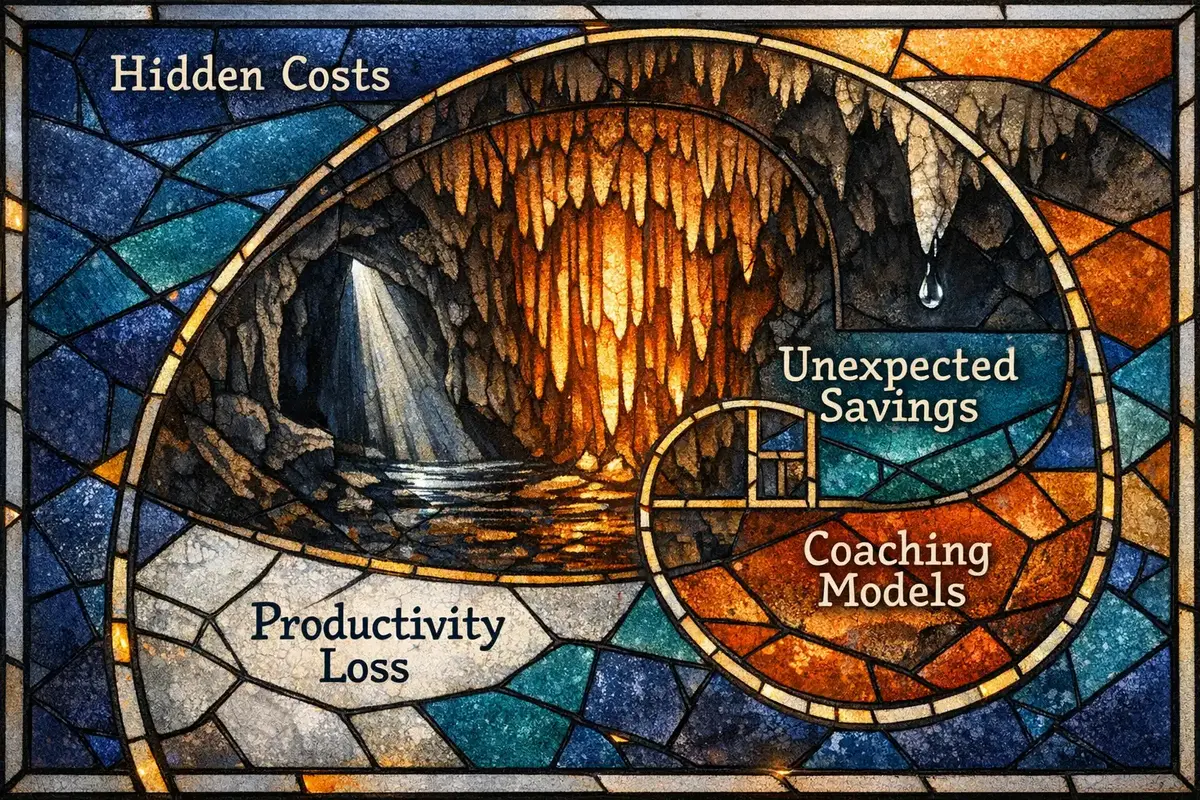
The stakes are not abstract. Gallup reported that engagement in the second quarter of 2024 rose only slightly to 32%, after dipping to 30% earlier in the year (Gallup, 2024). When engagement is already this fragile, any coaching model that adds friction—calendar coordination, delayed follow-up, inconsistent support, or simple underuse—can quietly raise the total bill. This article is about how to measure that bill with a total cost of coaching lens rather than an AI-versus-human ideology.
The hidden costs that distort the comparison
Executives usually see the invoice. They do not always see the operating friction around it.
A cheaper coaching option can become expensive when managers spend extra time scheduling, rescheduling, summarizing context, waiting for the next session, or failing to act because support arrived after the decision window closed. None of that appears in a vendor quote. All of it shows up in slower execution, repeated mistakes, and support programs that are technically available but practically underused.
This is why the right question is not “Which option costs less per session?” It is “Which model reduces wasted time, improves action quality, and gets used at the moment of need?” That is a very different financial test.
Price is easy to compare. Value is harder—and more important.
Some coaching investments fail because they are weak. Others fail because they are mistimed, hard to access, or too cumbersome to fit real work.
That distinction matters. If the support arrives after the decision, was it cheaper—or simply late?
What does AI coaching actually cost compared with human coaching?
3.3%. That is the share of learning activity tied to teaching, mentoring, and coaching in 2024, according to the World Economic Forum—small enough to look manageable in a budget, large enough to be mispriced if you compare options badly (World Economic Forum, 2025).
So why do so many coaching comparisons stop at price when the real spend often sits in the system around the coaching session? Why does an AI subscription look obvious, while a human coaching budget often feels harder to pin down? The answer is not quality. It is structure.
The visible line items are not the same
Start with the simplest side-by-side view.
AI coaching is usually priced through subscriptions, seat-based licensing, or enterprise platform fees. The buyer sees a monthly or annual number, often tied to user count, access tier, or feature depth. The direct delivery cost looks clean because the model scales without adding a new coach hour every time another employee logs in.
Human coaching is usually priced through hourly fees, multi-session packages, or retainers. That sticker price is higher because it bundles several things into one line item: the coach’s expertise, live time, preparation, judgment, and the ability to respond in real conversation. You are not just buying minutes. You are buying scarce professional attention.
That difference matters. AI often appears cheaper not only because it may be cheaper on a unit basis, but because its economics are easier to see.
| Model | Typical pricing structure | What the buyer sees | What is bundled |
|---|---|---|---|
| AI coaching | Subscriptions, seat-based licensing, or enterprise platform fees | Monthly or annual number tied to user count, access tier, or feature depth | Scalable access and software delivery |
| Human coaching | Hourly fees, multi-session packages, or retainers | Higher sticker price per engagement | Expertise, live time, preparation, judgment, and real conversation |
Why the AI number feels simpler
A regional healthcare director reviewing next year’s leadership budget will recognize the pattern. One proposal shows a platform license for 200 managers. The other shows a smaller cohort working with external coaches over six months. The AI option looks straightforward; the human option looks expensive before the comparison has even started.
That is partly an accounting effect. AI separates software cost from the user’s time. Human coaching compresses delivery, expertise, and interaction into one visible fee. The result is a distorted first impression: one model looks like technology procurement, the other like premium labor.
Deloitte reported more than $673 million in direct training investment in 2025, a reminder that development spending is already substantial before coaching-specific overhead is added (Deloitte, 2025)
This is why smart buyers treat the choice as a cost structure question. What scales with usage? What stays fixed? What requires scarce human capacity? What can be spread across a population without multiplying delivery cost?
Compare the architecture, not the ideology
Human coaching carries a higher visible price because it includes judgment and live interaction by design. AI coaching carries a different profile: lower marginal delivery cost, broader access, and pricing that behaves more like software than professional services.
Neither fact settles the value question. It only clarifies the baseline economics.
And this is where many decisions go wrong. Once you move past the invoice, the harder question appears: which costs are missing from the comparison entirely—and which ones only show up after rollout? For that, you have to look beneath the visible price into the hidden costs in coaching.
Which hidden costs do most coaching comparisons miss?
22% is the starting point in the hidden-cost framework: if leaders spend only that share of their time on long-term growth, coaching that adds coordination load is already consuming scarce strategic capacity rather than protecting it (McKinsey, 2024). Without this framework, buyers mistake the invoice for the cost and miss what the coaching process itself drains from calendars, decisions, and follow-through.
The framework is simple. Count four things: coordination cost, utilization cost, opportunity cost, and implementation overhead. Most comparisons stop at the vendor fee because it is easy to see. The harder costs sit in the work around the service.
Coordination cost is real work, not background noise
A regional manufacturing director in budget season rarely experiences coaching as a neat 60-minute block. It arrives as email chains, calendar conflicts, reschedules after plant issues, pre-read requests, post-session notes, and sometimes travel time if support is in person. Each item looks trivial. Together, they become operating drag.
That drag matters because managerial time is already constrained. If only 22% of leadership time is reaching long-term growth work, every extra administrative touch around coaching competes with planning, hiring, and execution (McKinsey, 2024).
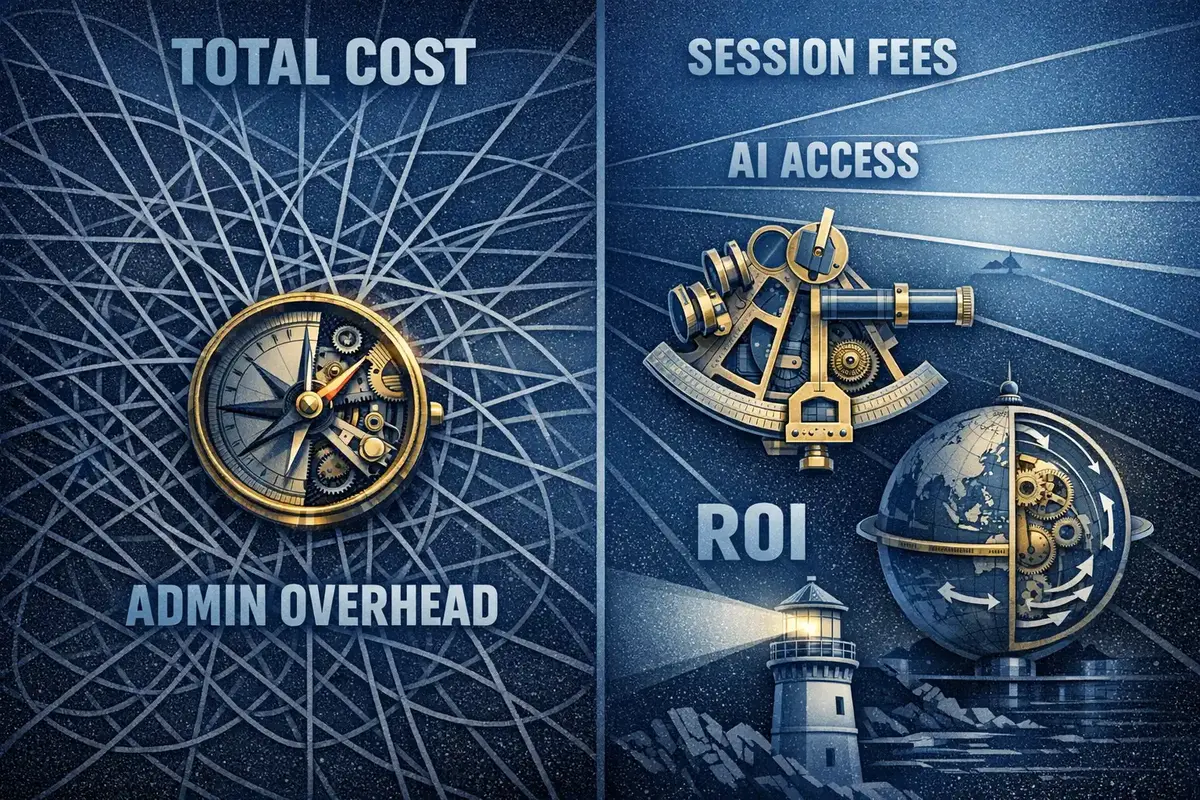
This is where a “premium” service can become expensive in a second way: not just because the session costs more, but because the system around it asks the user to do more unpaid work.
Utilization cost hides inside access friction
A coaching service can be excellent and still be financially weak if people do not use it when the need is live.
That is the utilization cost problem. When access depends on booking windows, matching processes, manager approval, or waiting for the next session, usage drops. Not because the need disappeared, but because work moved on. Research consistently shows that tools embedded into daily workflow get adopted more readily than support that requires extra effort to reach. McKinsey’s 2025 workplace research points in the same direction: 68% of managers said they had recommended a gen AI tool to help a team member in the past month, which suggests that immediacy and practical accessibility now shape support behavior at work (McKinsey, 2025).
That is why coaching utilization is not a side metric. It is the economic test.
Opportunity cost and rollout friction change the math
Every coaching model consumes time differently. A live session may create depth, but it also displaces other work. A delayed session may preserve the calendar this week, yet postpone a hard conversation, a staffing call, or a behavior correction that should have happened today.
The hidden bill is often paid in delayed decisions, not higher fees.
Then there is implementation overhead. Procurement review, privacy checks, onboarding, communications, manager training, and change management can make a low-price model expensive in practice. If employees need repeated nudges to adopt it, or if leaders must explain when and how to use it, the “cheap” option starts accumulating invisible labor.
So the real question is sharper than price. Which model creates less friction at the moment of need—and which one turns access itself into another management task?
Can 24/7 AI access create savings that traditional coaching cannot?
68% of managers said they had recommended a gen AI tool to help a team member in the past month, which tells you something practical: many organizations still buy coaching in scheduled blocks, while managers increasingly solve support needs in real time (McKinsey, 2025).
Most companies still treat access as a convenience feature. It is not. It is a cost variable.
The savings start in the gap between question and action
Picture a mid-market retail operations director at 6:40 p.m., two days before a regional promotion launch. A store manager has mishandled a staffing conflict, morale is slipping, and the director needs to decide now: intervene directly, coach the manager, or reset expectations with the whole team. Waiting until next Tuesday’s coaching session is not neutral. It means another shift, another rumor cycle, another avoidable escalation.
That is where immediate problem-solving creates economic value. Not because AI is magically better, but because it can compress the time between uncertainty and action. A manager who can think through a conversation in ten minutes often avoids the larger cost of delay—rework, emotional spillover, and the need for a more intensive intervention later.
The feature is availability. The value is avoided drift.
Continuity matters more than most buyers model
Traditional coaching often loses money in the spaces between sessions. Context fades. Notes get buried. The manager returns two weeks later and spends the first part of the conversation rebuilding the situation before moving it forward.
Between-session reinforcement changes that equation. Always-on support can remind a leader what they committed to, help rehearse a difficult conversation before it happens, and capture the next development while it is still fresh. That continuity reduces the need to re-explain the same team dynamics again and again. It also makes coaching more usable in the flow of work, which is where most behavior change either sticks or disappears.
Research from Frontiers in Psychology adds an important nuance here: in a single session, there was no statistically significant difference in working alliance between human coaches and AI coaches—human coaches scored 74.50 versus 72.73 for AI, with p = 0.48 (Frontiers in Psychology, 2025).
If the relationship quality is closer than many executives assume, then access itself starts to carry more financial weight.
That is the real offset behind 24/7 coaching access and the broader AI coaching benefits. Fewer missed moments. Less waiting. Broader reach across managers who would never get a live coach at all.
But access does not settle the decision by itself. If AI can reduce delay and extend continuity, the harder question becomes sharper: when is that still not enough—and when does human judgment earn its premium?
When does human coaching still justify the premium?
A finance VP has just left a board prep meeting where her CEO challenged her readiness for a larger role. She does not need faster access in that moment. She needs someone who can hear what was said, what was meant, and what fear is about to distort in her next move.
That is where human coaching still earns its price.
PwC found that workers who feel supported to build new skills are 73% more motivated than those who feel the least supported (PwC, 2025). That matters because support is not only a delivery issue. In the moments that shape confidence, trust, and behavior, how support is interpreted can matter as much as whether it is available.
The premium is really for interpretation
The cleanest way to think about this is a four-part test: ambiguity, emotion, trust, and accountability.
If the issue is clear and the action is straightforward, lower-cost support often works well. If the issue is politically loaded, emotionally charged, or tied to identity, human coaching becomes a different kind of asset. A skilled coach can detect hesitation, contradiction, self-protection, and overconfidence in real time. That is not just expertise. It is interpretation under pressure.
A regional healthcare director managing a team restructure, for example, may say the problem is communication. In practice, the real issue may be grief, status loss, or avoidance of one specific conversation with a high performer. Software can help prepare the conversation. A human coach can tell when the stated problem is a cover story.

Trust-building changes the economics
This is especially true when the coaching goal is not productivity but behavioral change others must believe.
57% of workers say their manager supports them in building new skills, according to PwC (PwC, 2025).
That number implies a trust gap. And trust gaps are expensive. When a leader is trying to rebuild credibility after a failed reorganization, repair a relationship with a peer, or prepare for a promotion that depends on executive presence, the work is relational before it is procedural. In those cases, the human coaching value sits in helping the leader face what they would rather rationalize away.
Human coaches also create a stronger form of accountability. Not reminder-based accountability. Relational accountability. The kind that makes a leader return to the missed conversation, the avoided feedback, or the pattern they keep explaining instead of changing.
Strategic necessity, not sentimental preference
The mistake is to frame this as human versus AI. The better question is narrower: where does the cost of misreading the situation exceed the premium for better judgment?
That is the real allocation problem. Not which option feels more advanced—but which one belongs in which moment. And once you see that, the next question becomes unavoidable: how should leaders compare AI, human, and hybrid support on total value rather than instinct?
How should leaders compare AI, human, and hybrid coaching on total value?
The Five-Layer Value Stack is the right framework here. Without it, leaders compare delivery formats as if they were products on a shelf—and miss where value is created, lost, or delayed.
The practical answer is often a hybrid coaching model: AI for scale, speed, and continuity; human coaches for ambiguity, sensitive judgment, and high-stakes moments. That is not compromise. It is portfolio design.
Compare five layers, not one invoice
Start with direct delivery cost. This is the visible spend: platform fees, coach fees, retainers, licenses. It matters, but it is only layer one. That limitation is easy to forget when coaching itself represents a small share of formal learning activity—teaching, mentoring, and coaching accounted for 3.3% of learning activity share in 2024 (World Economic Forum, 2025).
Then look at coordination cost. How much manager time is spent booking, briefing, rescheduling, and re-entering context? A startup founder in a quarterly board cycle does not feel this as administration. They feel it as lost decision time.
Third is utilization cost. If people cannot or will not use the support when the issue is live, the nominally cheaper model becomes expensive through underuse. This is where AI often wins on frequency. A manager may use it ten times between two human sessions. That changes the economics.
The real differentiator is escalation logic
Fourth comes escalation cost: what happens when the first layer of support is not enough? A good hybrid system routes routine reflection, rehearsal, and follow-up to AI, then escalates complex cases to a human coach. A bad system forces every issue into the same channel.
That is the false tradeoff hybrid avoids.
Fifth is outcome cost. What is the price of a delayed conversation, a mishandled promotion, a preventable resignation, or a manager who keeps repeating the same mistake? Deloitte reported more than $673 million in direct training investment in 2025 (Deloitte, 2025). At that scale, the bigger financial risk is not overpaying for coaching. It is funding support that does not change outcomes.
The breakeven question is simple: when does faster, broader support prevent enough delay and rework to justify the system?
Use-case fit decides the answer. High-frequency, lower-complexity needs often favor AI. Low-frequency, high-consequence moments often favor humans. Most organizations need both—allocated intentionally, not politically.
That is how to think about total cost, total value, and coaching ROI: not as a vendor comparison, but as an operating model. The hard part comes after that—what does a financially literate decision actually look like when budgets are tight and leadership risk is rising?
What should a financially literate coaching decision look like now?
20%. That is the global employee engagement level in 2025, according to Gallup—which means the cost of choosing the wrong support model is not theoretical anymore; it shows up in slower execution, weaker trust, and people quietly deciding to leave (Gallup, 2025).
If access, continuity, and working alliance can be comparable in some settings, what should actually drive the final coaching decision? Not ideology. Not novelty. Not the lowest visible price. The right question is simpler and harder: which model creates the best total value for this specific use case?
Start with the cost of the problem, not the cost of the vendor
A regional services firm in annual planning offers a familiar example. The CHRO can fund broad AI access for frontline managers or reserve budget for a smaller pool of senior leaders to work with human coaches. The wrong move is to force that into a single winner. The financially literate move is to ask where delay is expensive, where interpretation is essential, and where broad access will prevent small issues from becoming expensive ones.
That is the article’s core lesson. Hidden costs change the economics. Access changes utilization. Continuity changes whether behavior actually shifts between moments of support. A coaching option that looks efficient on paper can become costly if people do not use it, cannot reach it when needed, or lose momentum between sessions.
The evidence should make leaders more precise, not more dogmatic. In the Frontiers in Psychology study, there was no statistically significant difference in working alliance between human coaches and AI coaches in a single session—human coaches scored 74.50 and AI coaches 72.73, with p = 0.48 (Frontiers in Psychology, 2025).
If alliance can be closer than many buyers assume, then the decision has to turn on fit, timing, and consequence—not habit.
Use a sharper decision lens
A practical test helps.
Ask four questions:
- What is the actual job to be done?
- What is the cost of waiting for support?
- What is the cost of misreading the situation?
- What level of follow-through is required for behavior to change?
If the need is frequent, time-sensitive, and relatively clear, lower-friction support often creates better value. If the issue is politically sensitive, identity-level, or high stakes, paying for human judgment may be the cheaper decision in the end.
That applies whether you are buying for an enterprise, designing an HR program, or deciding how to support your own growth.
Treat coaching like capital allocation
Coaching is not a one-time purchase. It is an investment in behavior change. And behavior change pays back only when the support matches the moment.
So before you approve the cheaper option—or defend the premium—ask the question that matters: are you buying hours, or are you buying better decisions when the cost of getting them wrong is real?
Key Takeaways
- The cheapest coaching option can become expensive when access, continuity, and decision quality are weak.
- AI coaching often looks cheaper because its cost structure is easier to see and scale.
- Human coaching still matters most when ambiguity, emotion, trust, and accountability are high.
- The best decision is usually based on total value for the use case, not the lowest visible price.
Frequently Asked Questions
What hidden costs make a cheap coaching option more expensive in practice?
The biggest hidden costs are coordination, underuse, opportunity cost, and implementation overhead. If people spend extra time scheduling, waiting, re-explaining context, or missing the right moment for support, the real cost rises even when the session fee is low.
How does AI coaching typically cost compared with human coaching?
AI coaching is usually sold through subscriptions, seat-based licenses, or platform fees, which makes the pricing look simple and scalable. Human coaching is usually priced per hour, package, or retainer, because it includes live time, preparation, judgment, and real-time interaction.
Why can access and continuity matter more than the session price?
Support that arrives late or is hard to reach often fails to change the decision that needed help in the first place. Continuous, on-demand access can reduce delay, improve follow-through, and prevent small issues from becoming larger and more expensive problems.
When is human coaching still worth the premium over AI coaching?
Human coaching is most valuable when the issue is ambiguous, emotionally charged, politically sensitive, or tied to trust and accountability. In those cases, interpretation and relational judgment can be more important than speed or scale.
How should leaders compare AI, human, and hybrid coaching on total value?
Leaders should compare direct delivery cost, coordination cost, utilization cost, escalation cost, and outcome cost rather than focusing only on the invoice. A hybrid model often creates the best value by using AI for frequent, lower-complexity needs and human coaches for high-stakes or nuanced situations.