


Why Culture Breaks Merger Value Before the Systems Do
Only 20% of U.S. employees strongly agree they feel connected to their organization’s culture. That should unsettle any CEO entering a merger, because it means most workforces are already operating with a weak cultural bond before integration stress even begins (Gallup, 2026).
In practice, the warning signs rarely show up first in the org chart or the systems roadmap. They show up in a quarterly review when a regional services VP realizes the newly combined leadership team is using the same words—customer focus, accountability, speed—but making different decisions from them. One side escalates every exception. The other expects local judgment. The structure says “one company.” Daily behavior says otherwise.
That gap is expensive. Global M&A reached $4.8 trillion in 2025, the second-highest annual total on record, which tells you how much value is being placed on integration bets across the market (Korn Ferry, 2025). Yet the earliest value leakage in many mergers does not come from ERP delays or duplicated functions. It comes from hesitation, second-guessing, and political reading of decisions that should have been routine. Meetings get longer. Approvals stack up. Good people wait to see which legacy power center will win. This article addresses that problem directly: why the CEO has to treat culture as a core integration mechanism, not a soft-side communication exercise.
Culture Is Not Sentiment. It Is Execution Logic.
Executives often say culture matters, then manage the merger as if behavior will naturally follow the new design. It will not. Culture is the invisible operating logic that tells people what gets rewarded, what gets challenged, how fast decisions move, and whose judgment counts when the script runs out.
That is why the CEO cannot delegate culture to HR and move on to “hard” integration work. In a merger, culture determines whether the new structure produces aligned action or just formal compliance. If you want one budget process, one customer promise, or one leadership standard, you need shared norms strong enough to survive ambiguity.
Resilience Is the Real Test
The useful frame is resilient culture as an operating capability, not an aspiration. A resilient culture can absorb uncertainty without losing trust, decision quality, or execution speed. That matters most when roles are shifting, legacy identities are still active, and people are watching leadership for cues they can believe.
The real question is not whether culture matters. It is whether your combined company can stay coherent under pressure—or whether every tough decision will expose that no one agreed on how the business should actually run.
What Does Resilient Culture Actually Mean After a Merger?
The Preserve-Change-Combine Test
The preserve-change-combine framework matters here because most CEOs think they are aligning values when they are really leaving operating behavior undefined. If culture is not a slogan, what exactly survives the merger? And what, in practical terms, has to stop?
That ambiguity is where integration drifts. Leaders often assume that if communication is frequent and morale is stable, culture is taking care of itself. It is not. Research in Harvard Business Review argues that building a unified culture after a merger is an executive design task, not a symbolic exercise (Harvard Business Review).
In plain English, resilient culture is the shared pattern of behavior people use when the answer is not obvious. It shows up in how decisions get made, how conflict gets handled, how quickly teams escalate issues, and what people do when two legacy norms collide. If you want a useful shorthand, use this: engagement is how people feel, communication is what leaders say, and culture is what the company repeatedly rewards and tolerates.
A regional healthcare provider offers a familiar example. During a post-merger team restructure, one legacy business expected directors to resolve patient-service issues locally; the other expected nearly every exception to move upward. Same meeting. Same stated commitment to quality. Completely different instincts under pressure. The problem was not intent. It was the absence of a shared rule for judgment.
Culture Becomes Real in Repeated Choices
That is why the CEO needs a sharper lens than “best of both.” Bain & Company’s work on post-merger integration emphasizes a sequence from diagnosis to design (Bain & Company). That sequence matters because you cannot combine cultures intelligently until you know which behaviors create performance, which create drag, and which are simply legacy habits dressed up as principles.
The real operating question is simple: what must be preserved, what must change, and what should be combined into the new norm?
Preserve the behaviors that protect trust and execution. Change the ones that slow decisions, blur accountability, or reward internal politics. Combine the strengths that neither company could scale alone. That is the practical core of culture integration.
This is also where leadership in mergers stops being abstract. The CEO is not there to bless a values statement. The CEO has to decide which behaviors become nonnegotiable in the new company—and which legacy norms lose institutional protection.
Because once those choices are left vague, someone else makes them. Usually the loudest operator, the strongest legacy power center, or the team under the most pressure. Delegated culture—or designed culture? That is the line that decides whether integration holds.
Why the CEO Cannot Delegate Culture Integration
The CEO Accountability Model starts with a hard market fact: 81% of CEOs who made a significant acquisition in the past three years plan to make one or more acquisitions in the next three years (PwC, 2025). That matters because if culture integration is treated as a staff workstream instead of a chief executive responsibility, the same avoidable failure pattern gets repeated at scale.
What if the biggest merger mistake is assuming culture can be handed off to HR, communications, or integration teams?
Symbolic Sponsorship Is Not Enough
A CEO can delegate messaging. The CEO cannot delegate meaning.
In a merger, people watch for one thing above all: what the top leader actually backs when trade-offs appear. Not the town hall script. Not the slide on shared values. They watch who gets promoted, which conflicts are confronted, how decision rights are settled, and whether legacy power centers are allowed to keep operating by old rules. That is why the CEO role becomes non-transferable in culture integration.
Research from the Harvard Law School Forum on Corporate Governance makes this point in governance terms: merger accountability sits with the CEO and requires board-level oversight, because integration choices affect enterprise risk, leadership credibility, and long-term value creation (Harvard Law School Forum on Corporate Governance).
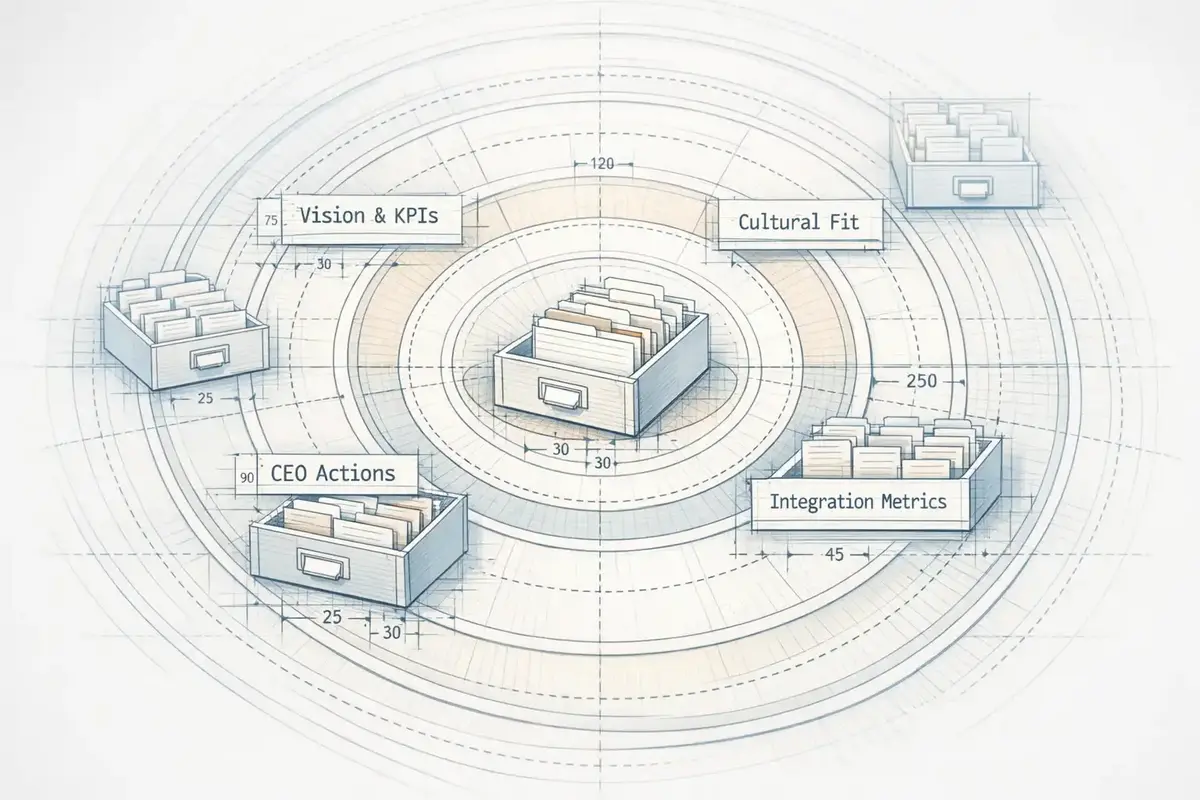
That changes the frame. Culture integration is not an HR initiative with executive sponsorship attached. It is a governance issue expressed through operating choices.
Where CEO Ownership Shows Up
Consider a mid-market manufacturing company in its first post-merger budget cycle. A divisional VP pushes to preserve duplicate approval layers “for control” while another argues for faster plant-level decisions to protect customer delivery. HR can facilitate the conversation. Communications can explain the outcome. Only the CEO can decide which behavior the new company will reward—and make that decision stick across the leadership team.
This is where change management leadership becomes practical rather than ceremonial. Decision rights, escalation norms, meeting conduct, performance reviews, succession calls—these are the mechanisms through which culture becomes real. If the CEO is absent from those moments, the merger does not produce one culture. It produces negotiated exceptions.
In mergers, the strongest cultural signal is not what leaders announce. It is what the CEO repeatedly tolerates, prioritizes, and rewards.
The Standard Must Be Modeled Under Pressure
The test comes in ambiguity. A client threatens to leave. Two legacy executives disagree in public. A high performer violates the new standard but still delivers numbers. In those moments, the CEO is teaching the company how power works.
That is why active integration beats symbolic sponsorship. The board may oversee. HR may enable. But the CEO has to model the standard in conflict, in trade-offs, and in visible personnel calls.
If that ownership is missing, what does the organization measure next—engagement, or quiet withdrawal? Retention, or the start of selective exits?
What the Numbers Say About Culture, Engagement, and Retention
Employees who strongly agree they feel connected to their organization’s culture are 4.3 times as likely to be engaged at work (Gallup, 2026). That should change how any CEO reads a merger plan, because most integration teams still treat culture as a communications stream when the evidence says it is a performance variable.
That is the gap. Many organizations assume engagement will recover once reporting lines settle, systems stabilize, and the new structure becomes familiar. Gallup shows the opposite logic: people engage when they feel connected to how the organization actually works, not when they are simply informed about it (Gallup, 2026).
Engagement Is Not a Mood Metric
In a merger, engagement is often discussed as if it were a soft indicator sitting somewhere downstream from the real work. It is not. It affects whether managers raise issues early, whether teams solve problems without waiting for permission, and whether execution keeps moving when the integration plan hits friction.
Picture a regional technology company in its first post-merger quarterly review. A product VP sees delivery risk building across two legacy teams, but the room is cautious. One side is still reading political signals; the other is waiting to see whose process now carries more weight. Nobody is openly resisting. They are simply less willing to commit discretionary effort into an environment they do not yet trust. That is what weak cultural connection looks like operationally.
Employees who strongly agree they feel connected to their organization’s culture are 47% less likely to be watching for job opportunities or actively looking for another job (Gallup, 2026).
Retention Risk Starts Before Resignations Do
This matters because post-merger instability rarely begins with a wave of exits. It begins with selective withdrawal. High-value people stop volunteering for stretch work. Strong managers hedge. Critical experts keep options open.
That makes culture a retention lever, not a branding issue. If people do not believe the combined company has a coherent way of making decisions, rewarding performance, and resolving conflict, they start protecting themselves. In merger terms, that is expensive: the business loses continuity at the exact moment it needs institutional memory, informal influence, and execution discipline.
Research on organizational agility points in the same practical direction. Companies adapt faster when people trust the operating environment enough to act without constant defensive calculation.
Burnout Is an Integration Problem Too
The least discussed number may be the most important. Employees who strongly agree they feel connected to their organization’s culture are 62% less likely to feel burned out at work very often or always (Gallup, 2026).
Burnout after a merger is not just about workload. It is often the result of ambiguity, duplicated effort, unresolved norms, and the fatigue of navigating two legacy systems of power at once. People can handle hard work. What drains them is unclear judgment.
So the CEO’s culture problem is not abstract. It is measurable: lower engagement, higher flight risk, and less energy for execution. The question is no longer whether culture matters — it is how you turn it into daily operating reality before the merger starts consuming the very capacity meant to make it succeed.
How Do You Turn Culture Into Daily Operating Reality?
The Operating Rules Framework
The Operating Rules Framework matters here because it forces a harder question than most CEOs ask: if culture is so important, what changes first when it moves from aspiration into management practice? Not the values slide. Not the launch memo. Not even the integration town hall.
What changes first is control.
Research from Bain & Company on post-merger culture integration points to a stepwise path from diagnosis to design, which is useful precisely because it prevents leaders from trying to harmonize everything at once (Bain & Company). FranklinCovey makes the complementary point from the behavior side: resilience is built through repeatable leadership habits, not one-time declarations (FranklinCovey). Put those together and the implication is clear. Culture becomes real when it is embedded in decision rights, leadership routines, recognition systems, and manager expectations.
A regional retail company offers a familiar example. In the first post-merger budget cycle, a store operations VP notices that two legacy groups are still running different approval norms for markdowns and staffing exceptions. One side rewards local judgment. The other rewards escalation. The issue is not philosophical. It is operational: every inconsistent approval adds delay, invites political workarounds, and teaches managers that the old rules still apply.
Start With a Few Visible Behaviors
The practical mistake is overreach. Leaders often try to align language, symbols, rituals, and processes all at once. That usually creates noise.
A better move is to standardize a small number of visible behaviors early: who decides, how conflicts escalate, what gets discussed in weekly reviews, and what managers are expected to coach. Those signals travel fast because employees do not infer culture from statements; they infer it from repeated patterns. If the merger needs faster cross-functional decisions, then meeting agendas, approval thresholds, and performance check-ins should all reward speed with accountability—not caution disguised as collaboration.
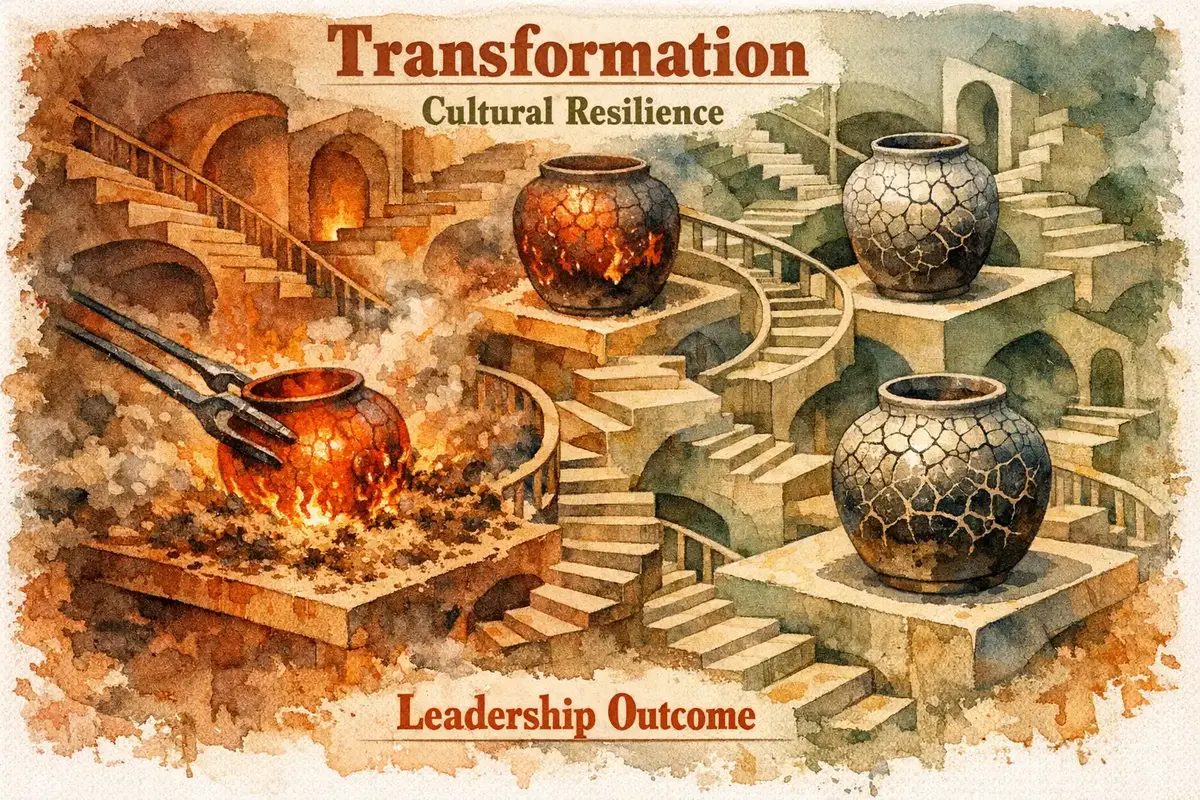
Incentives Reveal the Truth
This is where many integrations become self-defeating. The CEO says the new company wants collaboration, but bonuses still reward silo performance. Leaders call for shared accountability, but promotion decisions still favor legacy loyalty. The organization notices.
The fastest way to expose whether a merger culture is real is to ask: which behaviors get rewarded when results and norms come into tension?
That is a governance question as much as a leadership one. Incentives, scorecards, talent reviews, and operating cadences should reinforce the few behaviors the merger cannot succeed without. Everything else can follow later.
Because once culture is translated into operating rules, the next pressure point arrives quickly: what should the CEO personally do in the first 30, 60, and 90 days—set the pace, or lose it?
What Should a CEO Do in the First 30, 60, and 90 Days?
Global M&A totaled $4.8 trillion in 2025, up 41% over 2024 (Korn Ferry, 2025). That kind of volume creates a dangerous illusion: once the deal closes, scale itself will force alignment. It will not.
When the deal closes, the CEO’s first job is not to announce a new culture. It is to prevent drift.
Days 1–30: Diagnose Before You Declare
In the first 30 days, the CEO should run a fast cultural fault-line diagnosis. Not a broad listening tour with vague takeaways. A targeted read on where the two organizations will predictably clash: decision speed, escalation norms, customer promises, talent standards, and how bad news moves upward.
A regional finance company offers a familiar example. In the first post-close client escalation, one legacy executive team expects immediate central review; the other expects frontline leaders to solve the issue within hours. Same intent. Different operating reflex. If the CEO does not surface those differences early, managers will default to legacy habits and call it prudence.
This is also the window to name a short list of non-negotiable behaviors. Three to five is enough. Plain language matters here. So does purpose. Why did this merger happen, and what must now be true in how the combined company works? The CEO should communicate that directly — without consultant vocabulary, without abstraction. That is the foundation of real culture integration.
Days 31–60: Turn Intent Into Management Routine
By 60 days, the work has to move from diagnosis to visible operating norms.
This is where many integrations stall. Leaders agree on principles, then keep running old meetings, old approvals, and old exceptions. The CEO should reset leadership routines: what gets reviewed weekly, who decides what, when issues escalate, and which cross-legacy conflicts must be resolved in the room rather than deferred.
In PwC’s 2025 outlook, the volume of deals greater than $1bn increased by 17% in 2024, while smaller and mid-sized deals fell by 18% (PwC, 2025).
That matters because larger deals create more complexity, more symbolic scrutiny, and less room for informal alignment. Managers need to know what good looks like now, not after six months of interpretation. If decision rights are still fuzzy by day 60, the organization starts inventing its own constitution.
Days 61–90: Test Behavior, Then Correct the System
By 90 days, the CEO should stop asking whether the message landed and start asking whether behavior changed.
Are meetings ending with clear owners? Are legacy leaders following the same escalation rules? Are promotions, incentives, and budget calls reinforcing the stated standard? If not, the problem is rarely communication. It is usually governance.
That is the moment to adjust scorecards, talent calls, and incentives so the new culture has institutional backing, not just executive endorsement. Otherwise the merger gets a polished narrative and a divided operating system.
And that is the real test: is the new culture being built through repeated choices — or merely described? Because what the CEO tolerates in the first 90 days does not fade. It hardens.
Why the Strongest Merger Cultures Are Built, Not Announced
Value is lost long after the press release, when customers feel inconsistency, trusted operators leave, and managers start protecting their legacy turf instead of building the new company. If the merger is over on paper but not in behavior, what exactly has been integrated?
Culture Shows Up in What Holds Under Pressure
A resilient culture is not declared at kickoff. It is built in the moments when the organization is tired, under scrutiny, and forced to choose between old loyalties and new standards.
That is why the strongest merger cultures do not depend on a memorable launch message. They depend on repeated leadership choices: who gets backed in conflict, which trade-offs are accepted, whether one set of rules applies across legacy lines, and whether governance keeps reinforcing the same expectations. Harvard Business Review has been clear on this point: a unified culture after a merger is central to value realization, not separate from it (Harvard Business Review).
Consider an enterprise technology company during its second post-merger product planning cycle. A C-suite leader asks for one roadmap, but two inherited leadership teams still use different standards for prioritizing customer requests. One protects strategic accounts at all costs. The other protects engineering discipline. The meeting ends with apparent agreement, yet the next month brings the same conflict in a different form. That is not a communication problem. It is a culture problem left unbuilt.
The CEO’s Real Legacy Is Organizational Trust
The CEO’s lasting contribution is not simply getting the deal done. It is making the combined company trustworthy, adaptable, and execution-ready when conditions get harder, not easier.
That standard matters because employees read the merger through lived experience. Do leaders make decisions the same way every time? Are expectations stable across teams? Can people raise risk without political fallout? Gallup’s research consistently ties culture connection to stronger engagement, lower burnout, and better retention outcomes (Gallup, 2026). In other words, culture is not the atmosphere around execution. It is part of execution.
The merger succeeds when people stop asking which legacy company is winning and start trusting how the new company works.
Manage Culture With the Same Discipline as the Deal
This is the closing discipline. Manage culture with the same seriousness you give strategy, capital allocation, and integration milestones.
Not because culture is softer. Because it is stickier.
Once the organization learns that exceptions are tolerated for top performers, that legacy politics still shape decisions, or that stated values disappear under pressure, those lessons harden fast. The reverse is also true. When the CEO consistently aligns governance, talent calls, and operating choices, the company becomes more coherent than either predecessor was on its own.
That is the real architecture of post-merger leadership. Not announcement, but construction.
So the honest next step is simple: when your next difficult integration choice arrives, will you treat culture as commentary on the merger — or as part of the merger itself?
Key Takeaways
- Culture breaks merger value before systems do because daily behavior, not structure, determines how the combined company actually runs.
- Resilient culture is an operating capability: it shows up in decision rights, conflict handling, escalation, and what leaders reward.
- The CEO cannot delegate culture integration; ownership must be visible in trade-offs, routines, incentives, and personnel decisions.
- The strongest merger cultures are built through repeated choices and governance discipline, not announced in a launch message.
Frequently Asked Questions
What does a resilient culture mean after a merger?
A resilient culture is a shared way of working that helps the combined company stay coherent under pressure. It shows up in how decisions are made, how conflict is handled, how quickly issues are escalated, and whether people trust the rules that guide behavior.
Why does culture often destroy merger value before systems do?
Systems can be integrated on paper, but culture determines how people actually use them in daily work. When legacy teams keep different decision habits, approval norms, or power dynamics, the result is hesitation, longer meetings, and slower execution long before technology problems appear.
Why is the CEO responsible for culture integration after a merger?
The CEO is the only leader who can make the new cultural standard stick across the top of the organization. People watch who gets rewarded, which conflicts are resolved, and whether legacy habits are allowed to continue, so culture integration becomes a direct leadership and governance responsibility.
How can a CEO turn culture into daily operating reality?
The CEO should translate culture into visible operating rules such as decision rights, escalation paths, meeting routines, performance expectations, and incentives. Culture becomes real when those systems consistently reward the behaviors the merged company needs, not when values are only announced.
What should a CEO do in the first 90 days after a merger to protect culture?
In the first 30 days, diagnose likely cultural fault lines and define a few non-negotiable behaviors. By 60 days, reset leadership routines and decision-making norms, and by 90 days, check whether behavior, incentives, and talent decisions are reinforcing the new standard.