

Why stakeholder alignment is a CEO operating system, not a soft skill
Thirty percent of a CEO’s time already goes to external stakeholders—yet many leadership teams still run strategy as if board updates, investor messaging, and employee direction were separate jobs (McKinsey, 2024). That is the tension: time is being spent, but coherence is still missing.
You know the scene. It is the week before a quarterly review at a mid-market technology company: the board wants sharper capital discipline, investors want a cleaner growth story, and employees are reading a hiring pause as a signal that management has lost conviction. The CEO is not facing a communication problem. The CEO is facing a systems problem.
That distinction matters because fragmentation is expensive. McKinsey found that CEOs spend 30% of their time with external stakeholders on average, and 30% of CEO respondents said they were more successful when they had strengthened those relationships in the two years before becoming CEO (McKinsey, 2024). Time with stakeholders is not peripheral work; it is core operating work. Yet PwC’s latest CEO survey adds an important twist: only 25% of CEOs said lack of board support was even a moderate constraint on reinvention (PwC, 2024). In practice, the board is often not the bottleneck executives assume it is. The harder problem is turning multiple audiences into one durable strategic logic. This article is about how CEOs do that without watering strategy down.
One strategy, three tests
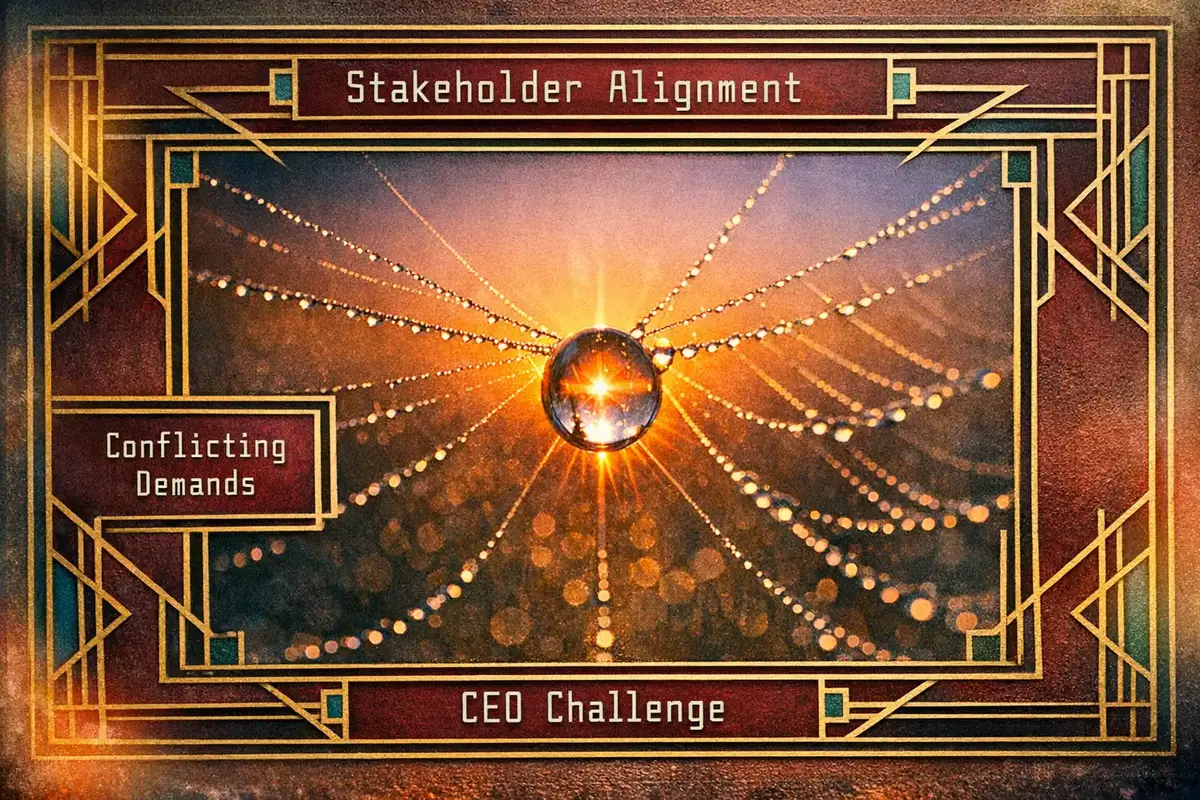
Real stakeholder alignment is not consensus. It is one coherent strategy that can survive board scrutiny, sustain investor confidence, and earn employee commitment at the same time. If those three groups hear different versions of the company’s priorities, the strategy is not aligned; it is being translated into contradiction.
That is why alignment belongs in the CEO operating system, not in the soft-skills bucket. It shapes capital allocation, sequencing, risk tolerance, and the pace of change. Communication still matters, of course, but only after the underlying choices are clear. A polished narrative cannot rescue a strategy whose tradeoffs are hidden or shifting. This is also where disciplined stakeholder alignment becomes practical rather than abstract.
The CEO’s real job
The CEO is not there to make every group happy. The job is to make tradeoffs legible while protecting long-term enterprise value.
That means saying, in effect: here is what we will prioritize, here is what we will defer, here is why the sequence matters, and here is what success should look like from each seat in the system. Strong CEOs do not erase tension. They organize it.
The hard question is not whether alignment matters. It is what alignment actually looks like when the board wants proof, investors want speed, and employees want meaning—is it agreement, or something more demanding?
What does stakeholder alignment actually mean in practice?
The Three-Layer Alignment Model is the most useful way to make stakeholder alignment operational. Without it, CEOs default to audience-specific messaging—one story for the board, another for investors, and a third for employees—and the strategy starts breaking at the seams.
That is why alignment is better understood as decision architecture, not a slogan (Research Brief strategic educational insight). If alignment is not consensus, what is the CEO actually building across these groups? A system in which different stakeholders can evaluate the same strategic logic from their own seat without finding contradictions.
Alignment is tradeoff discipline, not agreement
In practice, stakeholder alignment means disciplined tradeoff management. Not universal approval. Not identical talking points. And certainly not a lowest-common-denominator strategy designed to offend no one.
Take a regional healthcare provider in the middle of a budget cycle. The board wants tighter oversight on expansion risk. Investors want a credible path to margin improvement. Frontline leaders need to know whether staffing models will change in the next two quarters. The CEO does not solve that by making everyone equally happy. The CEO solves it by making one set of choices legible: what gets funded, what gets delayed, what risk is acceptable, and what evidence will show the plan is working.
That distinction is easy to miss. Stakeholder management is often about maintaining relationships, reducing friction, and handling expectations. Useful, but incomplete. Stakeholder alignment is harder: it requires one coherent strategy that survives three different tests. That is the real standard behind one coherent strategy.
The three layers CEOs actually have to align
The model works because it separates alignment into three layers (Research Brief strategic educational insight).
First is the governance layer: board clarity, role boundaries, and oversight. This is where the company decides who approves what, how risk is framed, and where management judgment ends and board challenge begins.
Second is the capital layer: investor narrative, risk framing, and credibility. Here, the issue is not optimism. It is whether the market can understand the economic logic of the strategy and believe management will execute it with discipline.
The strongest executive guidance consistently emphasizes trust, transparency, role clarity, and a clear link between governance and strategic performance (Research Brief synthesis).
Third is the execution layer: employee understanding, manager cascade, and behavioral consistency (Research Brief strategic educational insight). Employees do not need every board-level detail. They do need to know what priorities have changed, what has not, and how decisions should now be made.
When one layer says “focus,” another says “growth,” and the third experiences cost cuts, divergence is already underway. So why do these gaps emerge so predictably—miscommunication, or something more structural?
Why do board, investor, and employee interests diverge so often?
86% of respondents said directors should engage with employees below the top team—which should make any CEO ask a harder question: if that need is so widely recognized, why do leaders still treat misalignment as a messaging failure rather than a structural one (Heidrick & Struggles, 2024)? And if the board is expected to hear more of the organization directly, what exactly is diverging—intent, or vantage point?
Usually, it is vantage point. The board, investors, and employees are not evaluating the same problem on the same clock. They sit at different distances from risk, and that changes what looks rational from each seat.
Different clocks, different definitions of risk
A board is paid to test assumptions, not to absorb operating ambiguity on faith. Investors tend to focus on capital allocation, reinvention, and whether management can make a credible case that today’s choices will produce tomorrow’s returns. Employees live somewhere else entirely: in the weekly reality of priorities, workload, reporting lines, and whether the company’s decisions feel fair enough to follow.
That is why divergence is normal. Oversight is not partnership, and partnership is not execution.
In a mid-market manufacturing company during budget season, the CEO may frame an automation investment as disciplined reinvention. The board sees governance questions: timing, downside exposure, execution risk. Investors see a capital story: margin improvement, productivity, credibility. Plant supervisors hear something more immediate—role redesign, training gaps, and whether next quarter’s targets still hold. Same decision. Three legitimate interpretations.
The real culprit is information asymmetry
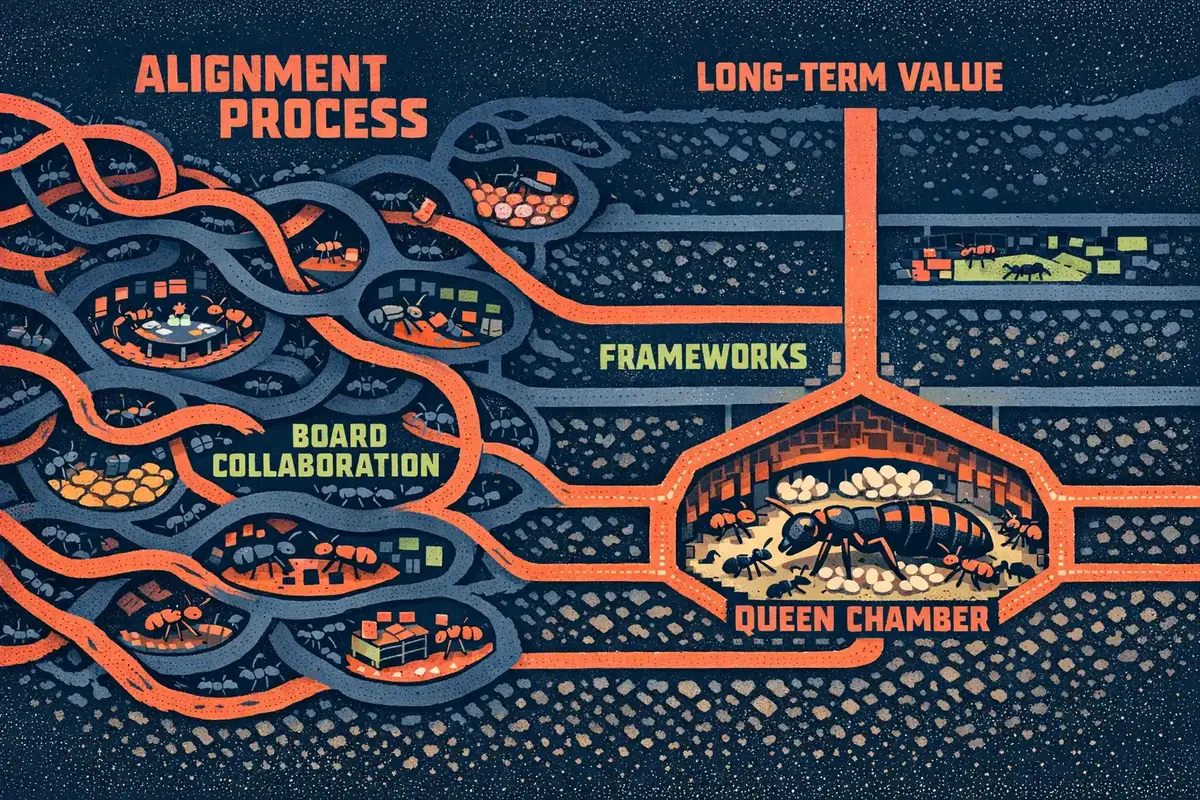
Most of the time, these gaps do not come from bad intent. They come from uneven access to context.
PwC found that only 30% of CEOs said the same level of pressure came from internal stakeholders, a useful reminder that external and internal groups are often reacting to different evidence sets (PwC, 2024). Employees rarely see the full capital logic. Investors rarely see the daily friction of implementation. Boards often get curated management views unless the CEO deliberately broadens the aperture through stronger board dynamics.
Heidrick & Struggles makes the governance implication hard to ignore: 82% of CEOs agreed directors should engage with employees below the top team (Heidrick & Struggles, 2024). Not because directors should run the business, but because employee understanding is not just a culture issue. It is a governance signal.
When those signals diverge, the cost is not abstract. Strategy starts looking inconsistent—disciplined to the board, compelling to investors, destabilizing to employees. And once each group begins correcting for what it cannot see, misalignment compounds. The real question is no longer why divergence happens. It is what it starts to cost when nobody resolves it.
What does the research show about the cost of misalignment?
$10 trillion in lost productivity is the price of low engagement globally—roughly 9% of world GDP (Gallup, 2026). For a CEO, that is not a culture footnote; it is revenue unrealized, execution weakened, trust thinned out, and talent made easier to lose.
Engagement is an operating risk, not a morale sidebar
The most useful shift here is conceptual. Low employee engagement is often discussed as if it were mainly about sentiment—how people feel, whether energy is up, whether managers are connecting. Gallup’s data points somewhere harder-edged. When engagement falls, output falls with it, and so does the organization’s ability to absorb pressure without fragmenting (Gallup, 2026).
Global employee engagement fell to 20%, down from its 2022 peak of 23% (Gallup, 2026).
That three-point drop matters because it changes how CEOs should read internal alignment. If employees are less connected to priorities, less clear on why tradeoffs are being made, or less convinced leadership is acting consistently, the cost does not stay inside HR dashboards. It shows up in slower decisions, weaker handoffs, more second-guessing, and lower resilience when the business has to change course quickly.
In a regional services company during a team restructure, a division VP may believe the strategy is clear: protect margins, simplify the portfolio, and reset incentives. The board hears discipline. Investors hear focus. Frontline managers hear ambiguity—who has authority now, what work matters most, and whether this quarter’s targets still apply. That gap is where productivity leaks out.
The scale of the data changes the CEO’s job
This is why employee alignment belongs in corporate strategy, not only in engagement programs. Gallup’s long-run dataset covers 5,754,327 respondents from 2009 through 2025, including 2,616,488 employed respondents (Gallup, 2026). At that scale, the signal is hard to dismiss as anecdotal, sector-specific, or driven by one unusual labor market.
Large datasets do not tell a CEO what to say in the next all-hands. They do settle a more basic question: whether engagement is soft or structural. It is structural.
That has practical implications. If the workforce does not understand the logic behind strategic tradeoffs, the company pays twice: once in execution drag, and again in credibility loss when leaders have to repeat or reverse decisions. This is why serious CEOs treat employee alignment and leadership development as performance infrastructure, not support functions.
The balancing act gets sharper here. If misalignment carries enterprise-level cost, how does a CEO create trust across board, investors, and employees without softening the strategy—or splitting it into three different stories?
How do CEOs translate strategy into trust across all three groups?
What happens when each audience hears a different story about the same strategy? Trust breaks before performance does, because people can tolerate hard choices far longer than they can tolerate mixed logic.
Most CEOs assume trust is built by tailoring the message. It is not. Trust is built when the board, investors, and employees each hear a version suited to their role but still recognize the same underlying bet. That is the CEO’s real work: not simplification, but translation (Research Brief original angle).
One strategy, three interpretations
In an enterprise retail company during a market shift, the CEO decides to close weaker locations, fund digital fulfillment, and slow expansion. The board needs to hear the governance case: why this risk is acceptable, what assumptions management is testing, and where oversight matters. Investors need the economic case: how the move sharpens the investor narrative and what signals will show the thesis is holding. Employees need the operating case: what changes now, what stays stable, and how decisions should be made in the field.
Different emphasis. Same logic.
That is narrative coherence. Research Brief describes stakeholder alignment as the discipline of making one strategy legible across distinct audiences rather than inventing separate stories for each of them (Research Brief executive summary).

Sequence matters more than most CEOs admit
The order matters. Board alignment comes first because oversight cannot be retrofitted after the story is already in market. Then comes the investor conversation, where credibility depends on showing that the strategy has been tested, not merely announced. Employees come next—not because they matter less, but because execution clarity is strongest when governance and capital logic are already settled.
Get the sequence wrong and each group starts discovering the strategy through someone else’s reaction. That is when confidence erodes.
Transparency is not overexposure
Many CEOs still confuse transparency with full disclosure. The better standard is narrower and more useful: explain the tradeoffs, the decision criteria, and the uncertainties that still remain. Research Brief shows that transparency reduces conflict when it helps stakeholders understand why a choice was made, not when it floods them with detail (Research Brief strategic educational insight).
This is how leaders manage conflict without flattening differences. They do not pretend interests are identical. They make the logic visible enough that disagreement stays productive.
And when trust is already thin, where does a CEO begin — with the loudest stakeholder, or with the first decision that can restore coherence?
Where should a CEO start when interests are already in tension?
The Stakeholder Tension Map is the right starting point when alignment is already under strain. Most organizations begin with messaging—who needs reassurance, what should be said, how fast to say it—but the evidence points somewhere more basic: map the system before you try to calm it (Research Brief educational landscape analysis).
That means sorting stakeholders on three axes: influence, time horizon, and decision impact. Who can stop the decision? Who will judge it over quarters versus years? Who has to change behavior next week for the strategy to work? Practical guidance from Research Brief keeps returning to this point: alignment improves when CEOs use simple frameworks to make tradeoffs visible early, rather than improvising explanations after tension surfaces (Research Brief strategic educational insight).
Start with the map, not the message
In a regional finance company during a budget cycle, the CEO may feel pressure to “get everyone on the same page” after a cost reset triggers board concern, investor questions, and employee rumor. The first move is not an all-hands. It is a one-page stakeholder mapping exercise.
List the board, top investors, and key employee groups. Then force three judgments:
- how much influence each group has over the decision,
- how quickly each group feels the effects,
- what decision or behavior you need from them next.
That changes the conversation. A board committee may need downside scenarios. Investors may need sequencing and milestones. Employees may need role clarity and near-term operating priorities. Same strategy. Different decision needs.
Practical template example: Use a simple matrix with stakeholders on the Y-axis and the three criteria (influence, time horizon, decision impact) on the X-axis. Assign a rating (e.g., high/medium/low) for each. This visual makes misalignments and pressure points explicit, enabling the CEO to prioritize which conversations and tradeoffs must happen first.
Build cadence before conflict hardens
Tension gets worse when every conversation feels ad hoc. Research Brief’s knowledge gap matrix is useful here because it asks the practical question many CEOs skip: what should be shared, when, and with whom (Research Brief knowledge gap matrix)?
A workable cadence is simple. Pre-wire the board before formal meetings when tradeoffs are material. Speak to investors after governance challenge has sharpened the logic. Brief managers before broad employee communication so the organization does not learn strategy through speculation. A disciplined communication cadence reduces surprise, and surprise is often what people label as misalignment.
Example in practice: At a technology firm facing a product pivot, the CEO scheduled a weekly 30-minute board update (focused on scenario planning), a monthly investor call (focused on milestones and capital allocation), and biweekly manager briefings (focused on operational impact). This rhythm helped surface concerns early and allowed each group to process tradeoffs in context, not in crisis.
The best practical frameworks consistently center on trust, transparency, and role clarity—not volume of communication (Research Brief educational landscape analysis).
Reduce friction through role clarity and information design
Most visible conflict starts earlier as design failure. Too much detail to the wrong audience creates noise. Too little context to the right audience creates suspicion.
So define roles explicitly. What is for board approval, what is for investor understanding, and what is for employee execution? Then design information accordingly: decision memo for directors, thesis-and-milestones for investors, priority-and-implication brief for employees (Research Brief strategic educational insight).
Practical implication: CEOs who use tailored templates—such as a two-page board memo with explicit asks, a one-page investor update with key metrics, and a manager FAQ—reduce ambiguity and friction. This structure also helps clarify where disagreement is about facts, timing, or values, making it easier to address the real source of tension.
This is the real first move. Not harmony—structure.
And once that structure is in place, a harder question emerges: should the goal be tighter agreement, or better-managed difference?
Why long-term value creation depends on preserving real differences
Revenue is lost when strategy gets softened to avoid conflict. Trust erodes and strong people leave when leaders pretend disagreement has disappeared when it has only gone underground.
What if the healthiest organizations are not the ones with the least disagreement, but the ones that manage it best?
Productive tension is a strategic asset
A CEO who tries to make the board, investors, and employees want the same thing usually ends up with something worse than conflict: vagueness. The board stops pressing where risk is real. Investors hear a polished story but not a credible one. Employees sense that tradeoffs are being hidden from them and fill the gap with their own explanations.
That is why alignment should never mean sameness. It should mean that disagreement stays useful, bounded, and tied to a shared strategic logic. Research Brief is clear on this point: alignment is not consensus; it is disciplined tradeoff management (Research Brief original angle).
In an enterprise healthcare company during a market shift, the CEO may decide to slow expansion, protect clinical quality, and redirect capital into core operations. The board may push harder on downside exposure. Investors may question the pace. Regional leaders may worry about morale and workload. Those are not signs of failure. They are signs that different parts of the system are doing their job.
Coherence matters more than harmony
The stronger test is whether those differences can coexist without pulling the company off course.
The best CEOs create narrative coherence across governance, capital, and execution without pretending each group is seeking the same outcome (Research Brief original angle). They act as translators, not just messengers, converting one strategy into role-specific meaning while keeping the underlying bet intact (Research Brief competitive differentiation).
That is what long-term value creation actually requires: not permanent agreement, but an organization that can absorb pressure without losing direction.
If you are leading through tension now, the question is simple. Are you trying to eliminate disagreement—or make it useful?
Key Takeaways
- Stakeholder alignment is a CEO operating system because it shapes capital allocation, sequencing, risk tolerance, and change pace.
- Alignment is not consensus; it is one coherent strategy that can survive board, investor, and employee scrutiny.
- Divergence often comes from different clocks and information asymmetry, not bad intent.
- CEOs create trust by translating one strategy into role-specific meaning while preserving narrative coherence.
Frequently Asked Questions
What does stakeholder alignment mean for a CEO?
Stakeholder alignment means building one coherent strategy that can withstand board scrutiny, investor confidence tests, and employee execution at the same time. It is not about making everyone agree; it is about making tradeoffs clear and keeping the underlying logic consistent across audiences.
Why do board, investor, and employee interests often diverge?
They diverge because each group evaluates the business from a different vantage point and on a different time horizon. Boards focus on oversight and risk, investors focus on capital allocation and returns, and employees focus on day-to-day priorities, workload, and fairness.
What is the cost of poor stakeholder alignment?
Poor alignment weakens execution, reduces trust, and creates productivity loss when people do not understand or believe in strategic tradeoffs. Research on employee engagement shows that low engagement is associated with large-scale economic losses and slower organizational performance.
How can a CEO communicate one strategy to different stakeholders without creating confusion?
A CEO should translate the same strategy into role-specific language while preserving the same core logic. Boards need governance and risk clarity, investors need the economic case and milestones, and employees need operational priorities and decision rules.
Where should a CEO start when stakeholder interests are already in tension?
The best starting point is to map stakeholders by influence, time horizon, and decision impact before changing the message. That makes it easier to decide who needs what information first, how to sequence conversations, and where the real tradeoffs are.