
AI Is Already Improving Learning Outcomes—The Real Question Is How Far It Can Scale
AI-powered personalized learning improved outcomes by 10% in a pilot tracked by the World Economic Forum—but pilots do not fail because the model is weak; they fail because the operating system around them never changes (World Economic Forum, 2024). That is the decision in front of most leaders now: not whether AI belongs in learning, but whether they are buying a tool, extending a course catalog, or redesigning how learning actually adapts.
The risk is practical, not philosophical. In a quarterly budget review, a regional healthcare provider’s L&D director may see one team using AI to generate quizzes, another using it to summarize policies, and a third still pushing the same annual modules with better branding. Activity rises. Capability does not. The gap gets expensive fast: time spent in training grows while skill transfer remains uneven, managers lose confidence in the program, and the organization mistakes content volume for learning progress. This article addresses that gap by showing what separates AI-enhanced delivery from an adaptive learning model that can scale.
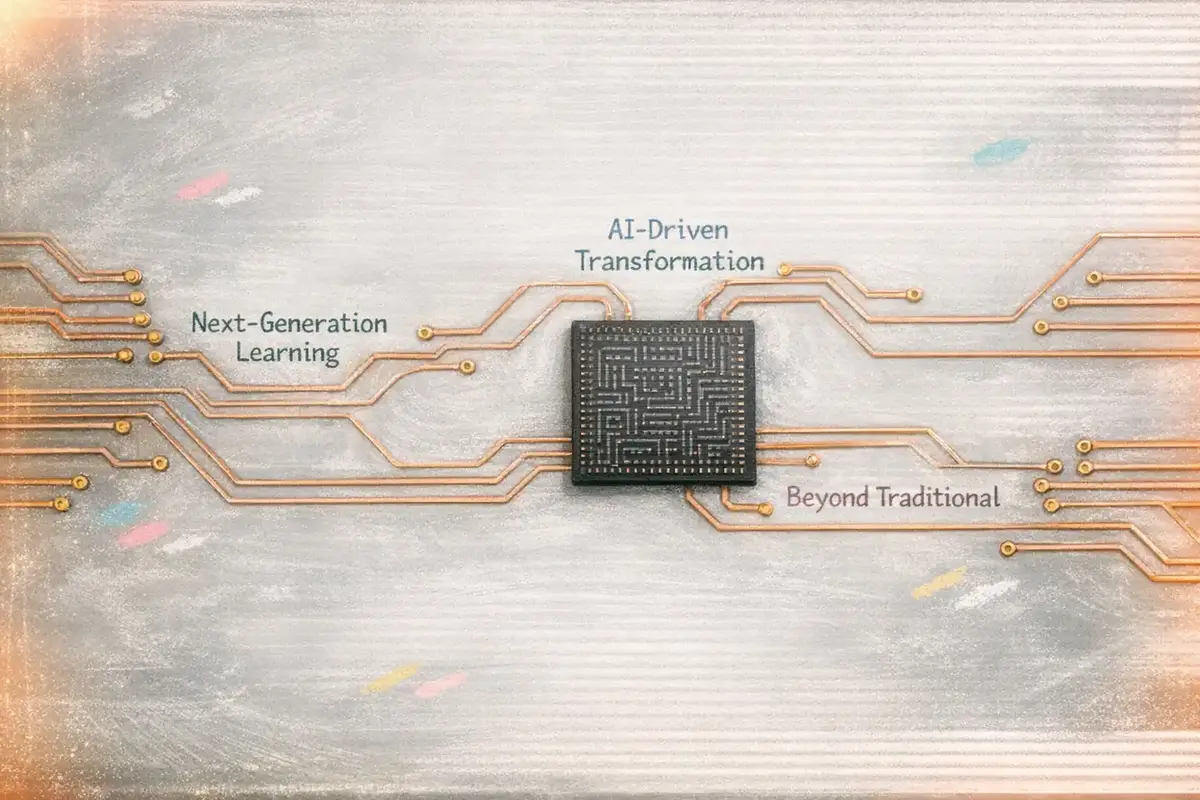
What changes with AI is not simply automation. It is the shift from static delivery to systems that can observe performance, adjust difficulty, surface the next best intervention, and return signals quickly enough for a learner—and a manager—to act on them. That is why the useful comparison is no longer “AI versus instructor.” It is fixed sequence versus responsive system.
The Real Shift Is Architectural
This is already happening in ordinary classrooms and workplace settings.
60% of teachers are already using AI in class for grading multiple-choice assessments, tracking progress, and generating practice exercises (World Economic Forum, 2024)
That number matters less as a novelty signal than as an adoption signal. AI has moved inside the workflow. The question is whether those workflows are coherent enough to produce better decisions about who needs what support, when, and why.
Human judgment does not disappear in this model. It becomes more valuable. Someone still has to define success, interpret edge cases, decide when a learner needs coaching rather than another prompt, and protect against false confidence. The strongest AI learning systems do not replace expert oversight; they make that oversight more targeted. The same is true of durable personalized learning experiences: personalization is only useful if it improves the next decision.
Evaluate the Model, Not the Feature List
Executives should assess AI learning as an operating model. Feature lists are easy to buy and hard to govern. What creates value is adaptation quality and feedback speed—how quickly the system detects a gap, adjusts the path, and gives a learner or manager something usable.
That raises the harder question. If adaptation is the source of value, what makes one learning path measurably better than another—static content, or a system that changes with the learner?
Why Adaptive Learning Outperforms Static Course Delivery When Goals Are Measurable
The Adaptive Pathway framework starts with a hard number: AI-powered personalized learning improved outcomes by 10% in one pilot tracked by the World Economic Forum (World Economic Forum, 2024). That result matters because it suggests the gain did not come from more content, but from changing what happened next for the learner.
When every learner starts from a different baseline, a fixed sequence is a blunt instrument. Static course delivery assumes the same lesson, in the same order, at the same pace, will serve the novice, the high performer, and the employee who only needs one missing concept corrected. It rarely does. The practical test for adaptive learning is simpler: after a learner acts, does the system make a better next decision than a standard course would?
That is the methodology shift.
In a quarterly operating review, a VP at a mid-market manufacturing firm may see two safety-training cohorts complete the same module with similar completion rates. One group still makes repeat errors on the floor. The other does not. A static program records completion and moves on. An adaptive system reads behavior, performance, and pace together, then changes the path—more practice for one learner, a harder scenario for another, a shorter route for the person who has already shown mastery.
What Executives Should Actually Measure
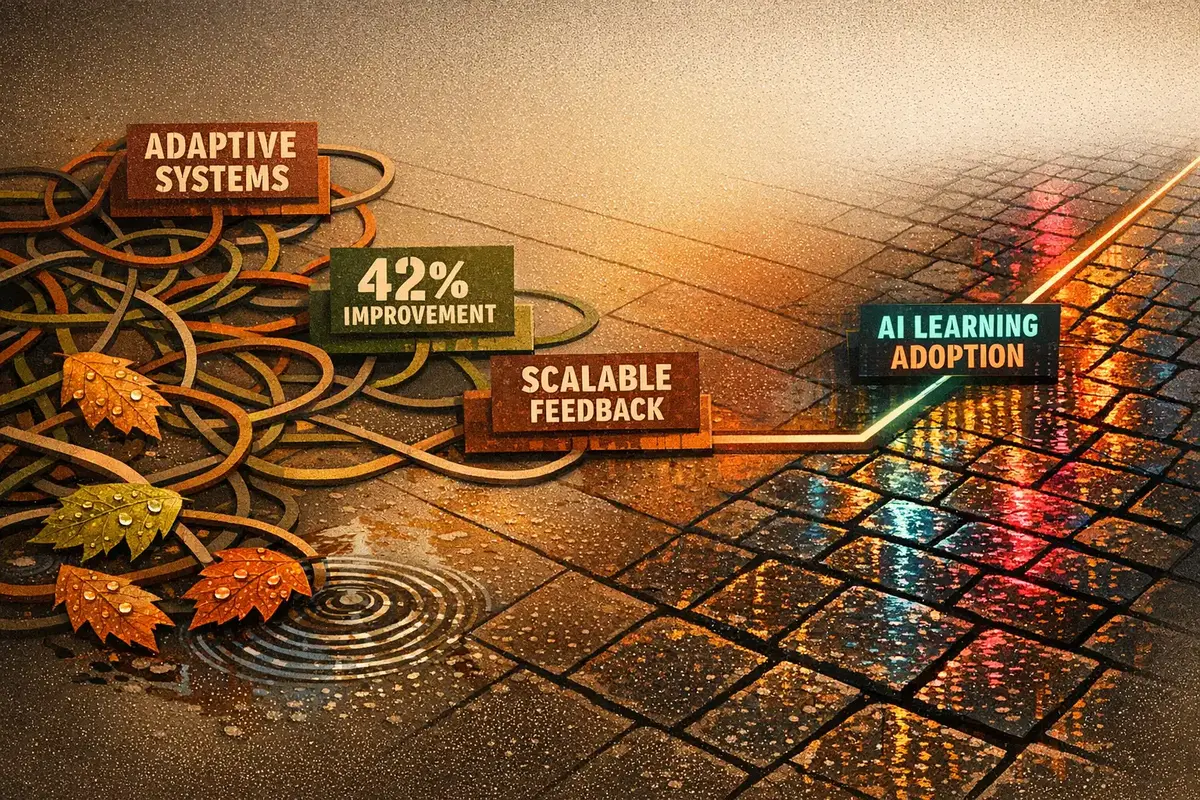
The wrong question is how much material the platform can hold or generate. Storage is cheap. Generation is abundant. What matters is personalization quality—whether the system can interpret signals continuously and route each learner to the most useful next step.
That is why measurable goals matter so much. If the objective is vague, adaptation becomes cosmetic. If the objective is clear—fewer compliance errors, faster onboarding to proficiency, better diagnostic accuracy—then adaptive pathways can be judged against a business outcome rather than a feature list. The World Economic Forum finding is useful here not as a universal benchmark, but as proof that responsive pathways can outperform one-size-fits-all delivery when the intervention is designed around learner differences, not content volume (World Economic Forum, 2024).
A 10% improvement in learning outcomes is not a content story; it is a decision-quality story (World Economic Forum, 2024)
Why This Is the First AI Learning Model to Test
Executives evaluating AI learning systems should test adaptation before anything else. It is the clearest way to see whether the system can convert learner data into better sequencing, better pacing, and better support.
If it cannot do that, more generated content will only scale noise. And if content is no longer the constraint, what becomes the real differentiator—the library, or the system deciding what deserves attention now?
What Makes Intelligent Content Curation More Valuable Than Endless Content Generation?
A services director has seen this movie before: a new AI tool arrives, the content library doubles in weeks, and employees still ask the same basic questions in client escalations. At the next budget check-in, the problem is obvious. There is more material everywhere, but less clarity about what any given person should study now.
The usage pattern already points to the real value. 68% of teachers who reported using AI said they use it to efficiently learn about and summarise a topic, while 64% said they use it to generate lesson plans or activities (OECD, 2025). That matters because it shows where AI becomes useful first: not as a machine for infinite instruction, but as a system for reducing noise and shaping what deserves attention.
Relevance Beats Volume
This is the core distinction behind intelligent content curation. The job is not to produce more assets. The job is to select the right asset under real constraints—time available, role requirements, current skill gap, and the learning objective tied to performance.
A regional retail operations VP, preparing for a seasonal hiring surge, does not need fifty onboarding modules for store managers. She needs the six that reduce early mistakes fastest, sequenced in the order managers will actually face decisions on the floor. That is a curation problem, not a generation problem.
68% of AI-using teachers report using it for summarisation, not full automation (OECD, 2025)
The signal is practical. When people are under pressure, they do not want abundance. They want compression, prioritization, and context.
Why AI Curation Scales Better Than Human-Only Selection
Human experts can curate well for a small group. They struggle when the audience expands across roles, locations, and changing needs. AI adds value when it can filter, sequence, and contextualize content faster than a manual workflow can keep up.
That means matching a learner with a concise explainer instead of a full course, surfacing a scenario-based exercise after a repeated error, or summarizing a policy update in the language of a frontline role. Good systems do this continuously. They do not just recommend content; they narrow the field to what is most useful now.
That is why content generation alone is a weak moat. If every platform can create material instantly, the advantage shifts to decision quality—what gets surfaced, in what order, and with what framing. And once the right content is finally in front of the learner, a harder question appears: is the real accelerator the asset itself—or the speed and precision of the feedback that follows?
Why AI-Powered Feedback Loops Change Learning Velocity More Than Content Alone
The Closed-Loop Learning model matters here because when feedback arrives too late, the cost shows up in missed revenue, weaker client trust, and capable people walking out after weeks of avoidable frustration. What happens when learners no longer wait days or weeks to find out whether they are improving? Learning stops being an event and starts acting like a control system.
A finance team lead at a fast-growing startup sees it during month-end close. A new analyst submits three forecast revisions, repeats the same margin error each time, and waits until Friday for manager comments. By then, the mistake is no longer a learning issue; it has become a reporting risk. The old model treats feedback as a batch process. The better model treats it as flow.
That is why AI-powered feedback mechanisms matter more than content depth alone. Content can explain a concept. Feedback changes behavior — quickly, specifically, and in context.
The Real Gain Is Shorter Time-to-Correction
In practice, the engine is simple: action, signal, correction, repeat. If that cycle compresses, learning velocity rises. If it stretches, people rehearse errors.
The World Economic Forum points to where AI is already proving useful in that cycle: 60% of teachers are using AI in class for tasks such as grading multiple-choice assessments, tracking progress, and generating practice exercises (World Economic Forum, 2024). Read that less as an education statistic and more as an operating clue. Assessment, tracking, and practice are not side features. They are the mechanics of a functioning feedback loop.
60% of teachers are already using AI for grading, progress tracking, and practice generation (World Economic Forum, 2024)
A strong system does three things well. It detects where performance breaks down. It returns guidance while the learner still remembers the decision they made. And it creates another chance to apply the correction immediately. That is how feedback loops become measurable rather than aspirational.
Better Feedback, Not More Noise
This is the evaluation question executives should press on: does the system improve the quality and frequency of feedback without flooding people with prompts they learn to ignore?
Over-automation is a real risk. If every click triggers a suggestion, signal quality collapses. If every assessment is scored but nothing is interpreted, managers still have to do the hard work of deciding what matters. Good AI narrows attention. It does not create another dashboard graveyard.
That tension matters because the next comparison is unavoidable: if AI can accelerate correction at scale, where does it still fall short of a skilled human tutor — and where might it be good enough?
Can AI Learning Match Human Tutoring—or Only Approximate It at Scale?
0.37 standard deviations is the pooled effect size for traditional tutoring, which means the benchmark is not “Does AI work?” but “How much of tutoring’s value can it reproduce at scale?” (World Bank, 2024). If that number still defines the gold standard, how close does AI need to get before the economics start to shift?
That is the harder question. Not whether AI can imitate a tutor’s tone, but whether it can deliver enough of the learning gain, for long enough, across enough learners, to change a deployment decision.
The most useful comparison so far is narrower and more serious. In Ghana, an AI tutor improved math achievement by 0.26 standard deviations after 6 months (World Bank, 2025). That does not equal the pooled tutoring benchmark. It does something more operationally interesting: it puts AI within range of a result executives can evaluate against cost, reach, and consistency.
| Approach | Effect size | Time horizon |
|---|---|---|
| Traditional tutoring | 0.37 standard deviations | Pooled benchmark |
| AI tutor in Ghana | 0.26 standard deviations | After 6 months |
Traditional tutoring: 0.37 standard deviations. AI tutoring in Ghana after 6 months: 0.26. The gap matters — but so does the distance already closed (World Bank, 2024; World Bank, 2025).
What the Numbers Actually Mean for Deployment
A regional healthcare COO reviewing next year’s workforce budget does not buy “human-like learning.” She buys coverage, speed, and risk reduction. If a human tutoring model produces stronger gains but only reaches a fraction of the workforce, the decision is not academic. It is financial.
This is why effect size alone is incomplete. Duration matters because short-term lift can fade. Scale matters because a high-touch model often breaks under staffing constraints. And deployment quality matters because a weak rollout can make a strong intervention look average. The World Bank figures give leaders a disciplined frame: compare interventions by effect size, time horizon, and addressable population, not by marketing claims (World Bank, 2024; World Bank, 2025).
Substitute, Amplifier, or Human-Only?
In practice, AI fits three roles.
First, substitute: structured practice, foundational knowledge checks, and repeatable coaching prompts. Here, AI coaching can handle volume well.
Second, amplifier: preparing learners before a manager or instructor steps in, so human time goes to diagnosis, motivation, and edge cases.
Third, human-only: judgment under ambiguity, ethical tradeoffs, and moments when the learner’s problem is not knowledge but confidence, resistance, or context.
That boundary will decide enterprise value. Not whether AI can tutor, but whether the program has enough governance to know when not to let it. And if that line is unclear, what else in the system is still not ready for scale?
What Governance Signals Tell You Whether an AI Learning Program Is Ready for Enterprise Use
The Enterprise Readiness Gate starts with a blunt number: nine in ten respondents reported using AI tools in their professional work, which means adoption is already ahead of governance in many institutions (UNESCO, 2025). Without that gate, AI learning programs scale faster than the rules for data use, escalation, and accountability—and that is where trust breaks.
This is the executive mistake to avoid. Widespread use is not the same as controlled use.
Adoption Is a Signal. Governance Is the Test.
UNESCO’s survey drew 400 responses from UNESCO Chairs and UNITWIN Networks across 90 countries, which makes the pattern hard to dismiss as a niche experiment (UNESCO, 2025). AI is no longer sitting in isolated pilots. It is moving into institutional workflows.
Only 19% of respondents said their institutions already have a formal AI policy (UNESCO, 2025)
That gap matters more than enthusiasm. In a quarterly risk review, a technology enterprise’s CIO may discover that learning teams are already using AI for onboarding support, knowledge retrieval, and assessment drafting, while legal, HR, and security are each working from different assumptions about acceptable use. The result is predictable: inconsistent learner experience, unclear ownership when outputs fail, and delays every time a program tries to move beyond one business unit.
A policy helps. It does not solve the problem.
What Mature Governance Actually Looks Like
UNESCO reports that 42% of respondents said AI guiding frameworks are under development (UNESCO, 2025). That is a healthy sign of motion, not proof of readiness. A mature program needs three things before scale.
First, data quality. If learner records are incomplete, outdated, or disconnected from performance data, the system will personalize badly and report false confidence.
Second, oversight. Someone must own model behavior, exception handling, and review thresholds—especially when recommendations affect progression, certification, or manager decisions. This is the practical core of governance in AI learning.
Third, institutional alignment. The learning team, IT, compliance, and business leaders need one operating view of what the system is allowed to do, what it must never do, and when a human steps in.
That is the readiness check. Not “Do we have a policy?” but “Can we govern decisions at scale?”
Because once governance is in place, a harder issue emerges: where should AI stop advising and a human start coaching—too early, or too late?
The Next Frontier Is Not AI Courses, but AI-Supported Coaching That Preserves Judgment
Bad AI learning design does not just waste training spend. It erodes trust, slows decisions, and quietly pushes strong people out when development starts to feel mechanical.
That is why the next frontier is not another AI course library. It is AI-supported coaching that helps people think better while keeping judgment — especially managerial judgment — unmistakably human.
Scale the Guidance, Not the Authority
If AI can scale guidance, what should remain unmistakably human in the learning experience? In my view, the answer is clear: interpretation, context, and consequence.
A director at a mid-market services firm sees this during a team restructure. High-potential managers are getting plenty of learning prompts, summaries, and practice exercises, yet promotion decisions still stall because the real question is not knowledge recall. It is whether someone can handle ambiguity, coach a struggling peer, or make a sound call when incentives conflict. No course settles that. Good coaching does.
This is where leadership development becomes the real test case. AI can surface patterns, prepare reflection prompts, summarize prior feedback, and help a coach spot drift before it becomes performance decline. The World Economic Forum has already shown that AI can improve learning outcomes and support core instructional tasks in live settings (World Economic Forum, 2024). Useful, yes. Sufficient, no.
The strategic question is not whether AI can deliver instruction at scale. It is whether it can improve the quality of guidance without weakening accountability.
Build for Continuous Development
The strongest systems will not be the ones that automate the most. They will be the ones that compress feedback loops, preserve trust, and make human intervention more timely.
That requires a different design instinct. Use AI to sharpen observation. Use it to reduce administrative drag. Use it to keep development continuous rather than episodic. But do not ask it to own moments that depend on judgment, credibility, or moral weight.
The World Economic Forum’s reporting matters here for a practical reason: it shows AI is already embedded in day-to-day learning work, not waiting for some distant future state (World Economic Forum, 2024). The decision now is architectural. Are you building a system that produces more instructional output, or one that helps managers and coaches give better guidance when it counts?
That is the closing test for any AI learning strategy. Does it make people easier to process — or better able to grow?
Key Takeaways
- AI improves learning most when it changes the next decision, not when it simply adds more content.
- Adaptive learning, intelligent curation, and feedback loops matter more than feature lists or content volume.
- AI can approximate tutoring at scale, but effect size, time horizon, and reach all shape the deployment decision.
- Governance and human judgment remain essential for enterprise-ready AI learning programs.
Frequently Asked Questions
What is AI’s role in next-generation learning methodologies?
AI’s role is to make learning more adaptive, responsive, and data-driven. It can observe learner performance, adjust difficulty, recommend the next best activity, and provide faster feedback so learning becomes a continuous process rather than a fixed sequence.
How does adaptive learning differ from static course delivery?
Static course delivery gives every learner the same content in the same order, regardless of prior knowledge or pace. Adaptive learning uses performance signals to change what happens next, such as adding practice, skipping mastered material, or increasing challenge when a learner is ready.
Why is intelligent content curation more valuable than generating more content?
More content does not automatically improve learning if learners cannot quickly find what is relevant. Intelligent curation uses AI to filter, sequence, and contextualize materials so each learner gets the most useful resource for their current role, skill gap, and objective.
How do AI-powered feedback loops improve learning outcomes?
AI-powered feedback loops shorten the time between action and correction, which helps learners fix mistakes while the experience is still fresh. They improve learning velocity by combining assessment, progress tracking, and immediate guidance instead of delaying feedback until later review.
What governance is needed before scaling AI learning programs in an organization?
Enterprise-ready AI learning programs need clear data quality standards, human oversight, and alignment across learning, IT, compliance, and business leaders. Governance should define what the system can do, what it must not do, and when a human must step in to review or decide.