


When Strategy Looks Right on Paper but Fails in Practice
What happens when a leadership team approves a strategically attractive initiative that quietly violates the organization’s own values? The plan usually looks disciplined in the board deck and unstable everywhere else. A new partnership promises reach. A market entry strengthens the growth story. A cost move improves the quarter. Yet in the room, someone hesitates—not because the strategy is weak, but because it does not fit what the company says it stands for.
That tension is more common than most teams admit. The failure point is rarely a lack of analysis or a shortage of options. It is that values-based decision-making is often treated as a slogan rather than an operating discipline, so the real criteria stay implied. When that happens, decisions drift toward politics, habit, or short-term pressure. Harvard Business Review notes that more than half of decision-making processes fail to achieve their desired results (Harvard Business Review, 2024). This article addresses the gap behind that pattern: how to make values explicit enough to guide strategic choices under pressure.
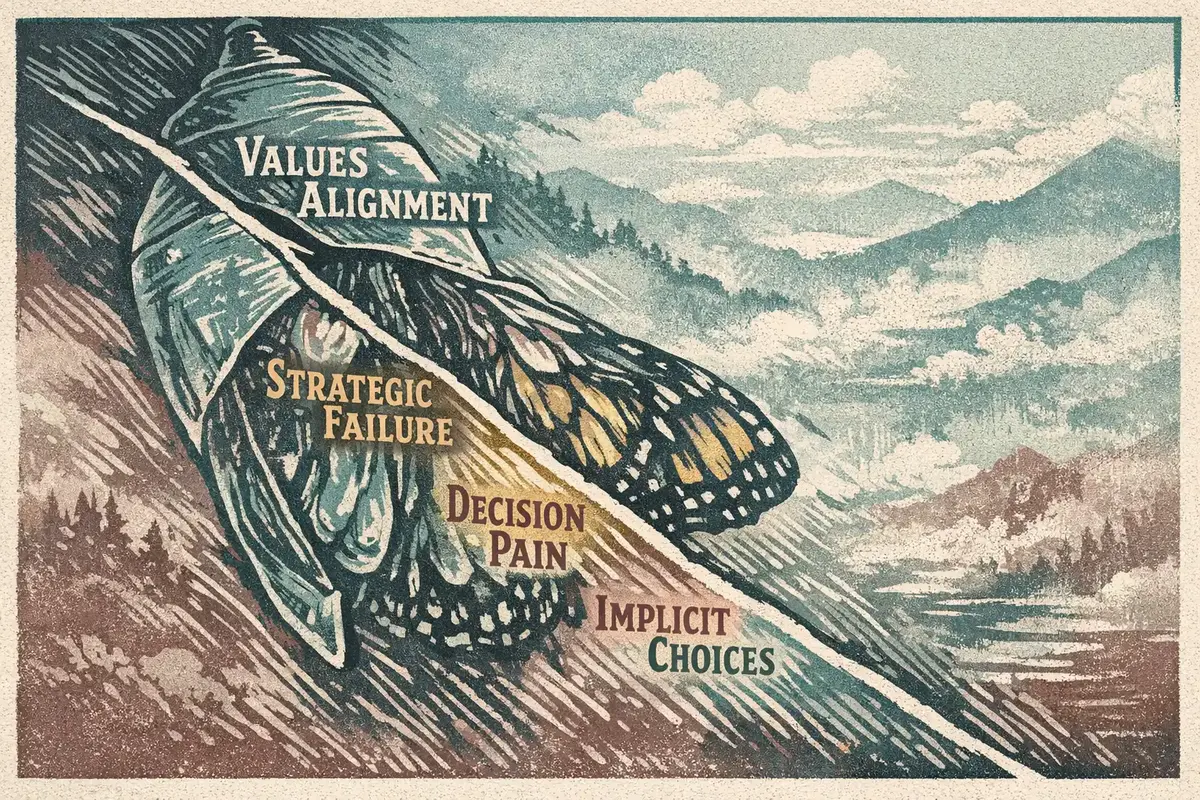
Consider a regional healthcare provider in an annual planning cycle. The executive team backs a vendor relationship that improves efficiency and expands access. On paper, it is hard to argue with. But the operations VP keeps raising concerns about patient dignity, staff burden, and transparency. The debate goes nowhere because those concerns live in the category of “soft issues,” while revenue, speed, and scale are scored as “real” criteria.
Strategy breaks down when the standards are invisible.
A values-based decision-making matrix solves a practical problem: it turns abstract commitments into visible criteria that can be compared, challenged, and defended. Instead of asking whether a proposal merely looks smart, the team can test whether it aligns with stated organizational values in a way others can inspect later.
That changes the quality of the conversation. It also changes accountability.
Because once values are explicit, a harder question appears: which values actually belong in the matrix—and how do you translate them without flattening their meaning?
What Is a Values-Based Decision-Making Matrix, and Why Does It Matter Now?
Only 21% of executives say their strategies pass four or more of McKinsey’s Ten Tests of Strategy. That should worry any leadership team that assumes strategy alone is enough to keep decisions coherent (McKinsey).
A values-based decision-making matrix is a structured tool that turns stated organizational values into decision rules for strategic initiatives: specific criteria, relative weights, and minimum thresholds. In plain terms, it tells a team how to judge a proposal before the room starts negotiating from instinct, hierarchy, or urgency.
The distinction matters. Values are the principles the organization refuses to trade away lightly. Strategic objectives are the outcomes it is trying to achieve, such as growth, margin, or market position. Scoring criteria are the practical tests used to evaluate an option. Values should shape those tests. They do not replace strategy, and they should not compete with it.
That is where many teams get confused. They say “customer trust matters,” then score only speed, cost, and projected revenue. Or they say “innovation” is a value when it is actually a strategic preference for a given period. A matrix forces cleaner thinking: which beliefs are enduring, which goals are time-bound, and which measures will show whether a proposal honors both?
Values are not the alternative to strategy. They are the rules that keep strategy from drifting under pressure.
Consider a mid-market technology company in a quarterly investment review. The COO is choosing between two partnership options—one accelerates distribution, the other offers slower growth but stronger data-governance standards. Without a matrix, the discussion can swing with whoever speaks last. With one, the trade-off is visible: growth potential, yes, but also trust risk, implementation burden, and fit with the company’s operating principles.
This is why the tool matters now. McKinsey found that only 41% of respondents say their organizations’ decisions align with corporate strategy (McKinsey). A values-based matrix improves consistency across projects, partnerships, and market entries because it reduces ad hoc judgment and makes exceptions easier to spot—and harder to rationalize.
But clarity creates its own challenge. Once values are on the table, how do you translate them into criteria without reducing them to bland, generic scorecards?
How Do You Turn Values Into Criteria Without Losing the Meaning?
The Values-to-Criteria Ladder is the simplest way to do this well. Without it, teams either keep values abstract and unusable, or reduce them to scorecard language so thin that nobody trusts the result.
What if the real challenge is not choosing values, but translating them into criteria people can actually use? The answer is to move in sequence: values, then observable signals, then thresholds, then scoring. That is how values-based decision-making becomes operational without becoming mechanical.
Start with signals, not slogans
Begin with three to five core values. Fewer than that, and the matrix misses real tensions. More than that, and every proposal starts to look equally “aligned.”
Then ask a harder question: What would this value look like in an actual decision? If the value is customer trust, the signal might be clear consent, plain-language communication, or limits on data use. If the value is accountability, the signal might be named ownership, auditability, and visible escalation paths.
That translation step matters because people do not evaluate values directly. They evaluate evidence.
In a quarterly capital review, a manufacturing VP choosing between two automation investments may say safety is a value. Fine. But the usable criterion is not “supports safety.” It is something like: reduces manual exposure at critical handoff points without increasing unplanned workarounds. Now the room can assess it consistently.
A practical build sequence usually looks like this:
- Name the value in plain language.
- Define two or three observable decision signals for that value.
- Convert those signals into one assessable criterion.
- Set a minimum threshold or scoring rule.
A value keeps its meaning only when people can recognize it under pressure.
Separate hard filters from weighted trade-offs
Not every value belongs in a points model. Some should be non-negotiables — hard filters that eliminate an option before scoring begins. Legal integrity, employee safety, or commitments to customer privacy often belong here.
Other values can sit inside a weighted model because reasonable trade-offs exist. Speed, learning potential, partner fit, and implementation burden are common examples. The mistake is treating every value as equally negotiable. It rarely is.
This is also where teams create false precision. Harvard Business Review notes that more than half of decision-making processes fail to achieve desired results (Harvard Business Review, 2024). One reason is overconfidence in neat-looking numbers. If your matrix has 27 criteria, five decimal-weightings, and scoring debates no one can explain afterward, it is not rigorous. It is bureaucratic theater.
Keep criteria specific enough to guide judgment, but broad enough to survive real-world ambiguity. For example, instead of scoring “innovation” on a 1-5 scale with no context, define what innovation looks like for this decision: “introduces a new process that reduces cycle time by at least 20%.” This makes scoring less subjective and more actionable.
Practical implications
Operationalizing values through observable criteria builds trust in the process and reduces the risk of decisions reverting to power dynamics or gut feel. Teams that clarify non-negotiables up front avoid wasting time on options that should never be considered. Weighted trade-offs, when transparently defined, help stakeholders understand why a decision was made—even if their preferred value was not maximized. Ultimately, the discipline of translating values into criteria is what turns organizational principles from wall art into real-world results.
Why Trust and Culture Change the Economics of Strategic Choices
93% of business executives say building and maintaining trust improves the bottom line. That should end the old habit of treating trust as a soft benefit rather than an economic variable (PwC, 2024).
Most organizations still behave as if trust will follow once the strategy is approved. The evidence says otherwise. PwC found that 94% of executives face at least one challenge when building trust with stakeholders (PwC, 2024). In other words, leaders broadly agree trust matters, yet their decision processes still make it hard to earn.
That gap usually shows up in the moment after the announcement. A decision may be rational on paper, but if people cannot see how it was made—or why one principle outweighed another—they fill the silence with suspicion. This is where stakeholder trust is won or lost: not in the values statement, but in the traceability of the choice.
People rarely call a decision unfair because they lost. They call it unfair because the logic changed depending on who was in the room.
Culture is part of execution, not an afterthought
Culture is often discussed as mood, morale, or employer brand. That is too shallow. Culture is the pattern of behaviors people believe will be rewarded, tolerated, or punished when real trade-offs appear.
In a quarterly budget review at an enterprise retail company, a divisional VP pushes through a store-tech rollout that promises faster conversion. The matrix says customer clarity and frontline usability matter, but the final call ignores both. The result is predictable: store managers comply publicly, improvise privately, and adoption drags for two quarters. The strategic initiative did not fail at launch. It failed in culture.
Deloitte found that organizations with improved culture scores are 1.6x more likely to achieve higher net profit margins (Deloitte, 2024). That is not a morale story. It is an execution story.
A matrix is also a governance tool
A governance mechanism is a way to make decisions reviewable, consistent, and less dependent on personality. That is what a values-based matrix becomes when leaders use it visibly.
It does three things especially well:
- It shows stakeholders which criteria mattered before debate began.
- It makes exceptions explicit instead of quietly political.
- It gives teams a record they can revisit when outcomes disappoint.
Used this way, the matrix does more than express integrity. It builds confidence that integrity will survive pressure.
And that raises the practical question. If the tool can improve trust, culture, and follow-through, what does a strong matrix actually look like when a leadership team puts one on the table?
What Does a Strategic Values Matrix Look Like in Practice?
The Strategic Values Matrix is the working model here: it gives leaders a repeatable way to compare real options when the room is split and the clock is running. In a quarterly portfolio review, a regional services CEO is staring at three choices on one slide—fund a new client platform, sign a channel partner, or enter a neighboring market—and everyone is arguing from a different logic.
Here is the plain answer: a strong matrix puts initiative options across the top, values-based criteria down the side, and applies the same weights, thresholds, and scoring rules to each option before leadership judgment enters. That discipline matters because only 41% of respondents say their organizations’ decisions align with corporate strategy, and just 21% of executives say their strategies pass four or more of the Ten Tests of Strategy (McKinsey, 2024).
A practical decision matrix is not a spreadsheet trick. It is a governance format. The structure should be simple enough that a VP can explain it in two minutes and strong enough that a board member can audit the logic six months later.
| Value | Criterion | Weight / Threshold | Decision Rule |
|---|---|---|---|
| Customer trust | Improves clarity, reliability, or service experience | 25% | Score 1–5 based on defined evidence |
| Operational accountability | Has clear owner, metrics, and escalation path | 20% | Must score at least 3 to proceed |
| Financial discipline | Meets return and payback expectations | 25% | Weighted against other criteria |
| Legal or ethical integrity | Avoids unacceptable compliance or conduct risk | Non-negotiable | Any failure removes the option |
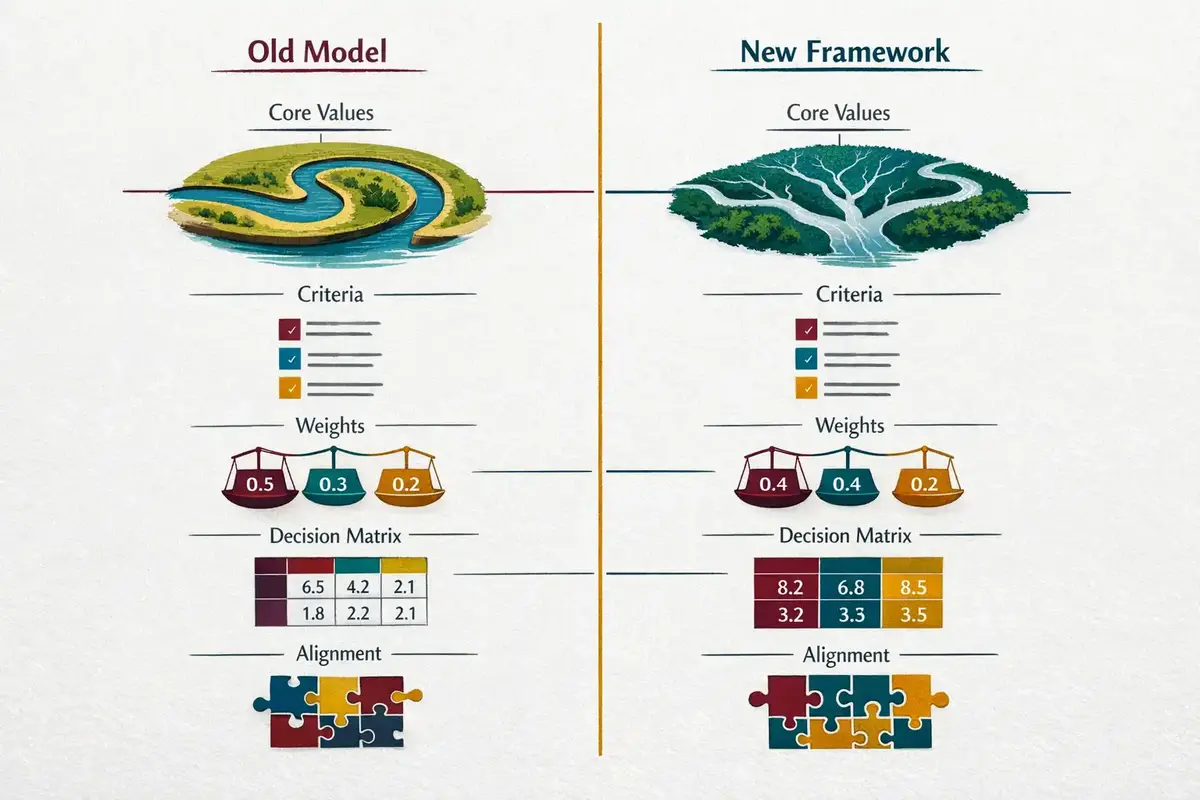
The same logic can travel across initiative types. A new project may be tested for execution burden and learning value. A partnership may put more weight on trust transfer and control. A market entry may emphasize regulatory fit and brand consistency. The underlying values stay stable; the evidence used to score them changes with the decision context.
That is the part many teams miss. They rebuild the whole model every time, which turns values into preferences.
A matrix should not make the decision for leaders. It should make their reasoning visible.
Where judgment still belongs
Scoring is not the final act. It is the point where judgment becomes more honest.
Use leadership override in only two cases:
- Two options score within a narrow band and the strategic timing difference is real
- A non-negotiable value is breached, even by the highest-scoring option
- New information changes the risk profile after scoring is complete
When leaders override, they should record why in plain language. That is how a decision matrix stays credible instead of performative.
And that is the real test: is the matrix clarifying trade-offs—or simply giving politics a cleaner-looking table?
How Do You Prevent the Matrix From Becoming a Political Tool?
83% of employees say they would trust their company more if their direct supervisor involved them in important decisions. So ask the uncomfortable question: if your matrix is sound, why are people still skeptical of the outcome (PwC, 2024)?
That skepticism usually has less to do with the spreadsheet than with the sequence. Teams assume politics enters when people argue over scores. In practice, it enters earlier — when weights are adjusted after options are visible, when key stakeholders are left out until the review meeting, or when the matrix is used to bless a decision leadership already made.
The pattern is familiar. In a mid-market finance company during annual planning, a VP brings a “completed” matrix to the investment committee. The favored initiative scores highest. Only later does the risk lead discover that customer-impact criteria were reduced from 25% to 10% after the shortlist was set. The document looks disciplined. The process is not.
A matrix becomes political the moment it stops testing a decision and starts defending one.
Protect the process before scoring begins
The fix is governance, not better formatting. Set weights before options are scored. Record non-negotiables in writing, including what disqualifies an initiative outright. Involve the people who will carry the consequences — not just the people with budget authority.
A practical control set should include three things:
- A dated version of criteria, weights, and thresholds approved before option review
- Named participants from strategy, operations, risk, and the affected business area
- A short override log explaining any departure from the original scoring logic
The most common failure modes are subtle but corrosive. Post-hoc weighting — adjusting criteria after seeing early results — allows bias to creep in under the guise of refinement. Stakeholder exclusion, especially of those with operational or customer-facing experience, leads to blind spots and erodes buy-in. And most insidiously, using the matrix to justify a decision already made turns a potentially objective process into a rubber stamp. Each of these shortcuts signals to the organization that the process is for show, not substance.
This is where the trust gap matters. PwC found that 86% of executives say they highly trust employees, while only 60% of employees feel highly trusted (PwC, 2024). That gap widens when participation is symbolic. It narrows when leaders show real leadership accountability — who shaped the criteria, who challenged the assumptions, and who owns the final call.
Review the matrix like a governance system
A matrix should not be frozen. Strategy shifts. Risk changes. Values stay more stable, but the evidence used to assess them often does not.
Review the matrix on a set cadence — typically after a major planning cycle, a failed initiative, or a material market change. Ask three blunt questions: Did any criterion create noise instead of clarity? Were any non-negotiables too vague to enforce? Did the scoring reflect how the organization actually defines success now?
In practice, this means involving a cross-functional group to debrief after decisions, analyzing where the process broke down, and updating the matrix accordingly. For example, after a product launch fails, revisit whether the original risk criteria were too narrow or if certain voices were marginalized during scoring. Documenting these lessons and feeding them back into the next cycle prevents drift and reinforces the matrix as a living governance tool.
If those answers stay private, the matrix will drift back into theater. If they become habit, the tool starts shaping leadership behavior itself — which is the real point. When that discipline becomes embedded, the matrix ceases to be a project artifact and becomes how leaders decide every day.
Values-Based Decision-Making Works Best When It Becomes a Habit of Leadership
Low engagement costs the world economy about $10 trillion in lost productivity — roughly 9% of global GDP. For any executive, that is the real price of misalignment: slower execution, weaker trust, and good people quietly checking out (Gallup, 2026).
If disengagement and misalignment are so costly, what would change if leaders treated values as part of the decision system itself? The answer is practical: the matrix stops being a worksheet and becomes a leadership habit.
Consider a quarterly budget review at an enterprise technology company. The C-suite may think it is debating investment logic, but often it is really revealing whether the organization has a repeatable way to make trade-offs that people recognize as fair. That is why values-based decision-making works best when it shows up in recurring choices — portfolio reviews, hiring trade-offs, restructures, and strategic prioritization.
The sequence is not complicated. It just requires discipline:
- Define the values that are meant to hold under pressure.
- Translate them into usable criteria—clear, actionable standards for decisions.
- Set weights and thresholds before options are debated, so priorities are explicit.
- Apply judgment openly, including any override, so exceptions are transparent.
- Review outcomes and refine the model to ensure learning and adaptation.
When this process is habitual, values are not just slogans—they become the backbone of decision-making. For example, a healthcare organization facing budget cuts might use its stated value of “patient-first care” as a non-negotiable criterion, ensuring that any cost-saving measures do not compromise clinical quality. Over time, this discipline builds credibility: employees and stakeholders see that values are operational, not ornamental.
The best leadership systems do not remove tension. They make it discussable.
Gallup reports global employee engagement fell to 20% in 2025 (Gallup, 2026). That is a warning. When people cannot see how decisions connect to stated principles, they stop trusting both.
The best matrices do not simplify reality. They help leaders face complexity with more consistency, transparency, and accountability. So the honest next step is simple: in your next major decision, will values be visible in the process — or only mentioned after the fact?
Key Takeaways
- Strategy breaks down when the standards are invisible.
- Values are not the alternative to strategy. They are the rules that keep strategy from drifting under pressure.
- A value keeps its meaning only when people can recognize it under pressure.
- People rarely call a decision unfair because they lost. They call it unfair because the logic changed depending on who was in the room.
Frequently Asked Questions
What are the key steps to develop a values-based decision-making matrix for strategic initiatives?
Start by defining the core values that should hold under pressure, then translate each value into observable decision criteria, thresholds, and scoring rules. Set non-negotiable filters first, assign weights to trade-offs, and review the matrix after major decisions so it stays aligned with strategy and organizational values.
How can organizations embed core values into their decision-making matrix for new projects?
Organizations embed core values by converting abstract principles into specific signals that can be evaluated consistently, such as customer trust, accountability, or ethical integrity. Each value should become either a hard filter or a weighted criterion with clear evidence requirements, so project choices reflect the organization’s real priorities.
Why is a values-based decision-making matrix important for aligning strategic initiatives with organizational purpose?
A values-based matrix makes the organization’s purpose visible in everyday decisions, reducing the risk that strategy drifts toward short-term pressure, politics, or habit. It improves consistency, accountability, and trust by showing how each initiative supports both strategic goals and stated values.
Which criteria should be included in a values-based decision-making matrix for evaluating market entry opportunities?
Market entry matrices should include criteria such as strategic fit, customer trust, regulatory or ethical risk, operational feasibility, and financial return. The most important values should be treated as non-negotiable thresholds, while other criteria can be weighted to reflect trade-offs specific to the market decision.
Who should be involved in creating a values-based decision-making matrix to ensure it reflects organizational values?
The matrix should be built with input from strategy, operations, risk, and the business area affected by the decision. Including people who will carry the consequences helps ensure the criteria are practical, the values are interpreted correctly, and the process earns trust across the organization.