
Why Value Conflicts Are Really Purpose Decisions
Purpose-first leadership matters here because most value conflicts are not solved by better debate; they are resolved by clarifying purpose, naming the competing values, and deciding which principle should guide the choice. What looks like a people problem is often a purpose decision in disguise.
You see it in ordinary leadership moments. A regional healthcare director is in a quarterly review, hearing one respected leader argue for speed of patient access and another push for stricter quality controls. Both are right. Both are protecting something the organization claims to value. But one decision cannot fully satisfy both.
That is why these conflicts drain teams. When leaders treat a clash of principles as if it were just misalignment or poor communication, people keep arguing the surface issue while trust erodes underneath. Purpose-driven leadership creates space to align individual and organizational values, but that only helps if purpose is used as a decision lens rather than a slogan (Center for Creative Leadership, 2026). This article shows how to tell when you are facing a real value conflict — and what to do with it.

A true value conflict is different from an ordinary disagreement. It is a trade-off between principles you would normally want together: fairness and performance, transparency and confidentiality, loyalty and accountability. In purpose-driven leadership, purpose comes first, which means the question is not “Who wins?” but “What best serves why we exist?”
Purpose does not remove the tension; it gives the tension a judge.
That shift matters. Purpose helps employees find meaning in their work and build commitment around shared goals (Center for Creative Leadership, 2026), but it does not spare leaders from hard choices. It changes how they judge, prioritize, and resolve them. The next challenge is sharper: are you looking at competing values — or just competing interests and power?
How Do You Tell a Value Conflict from an Interest or Power Problem?
Only 12% of leaders show high proficiency in managing conflict (DDI, 2024). That matters because if conflict is common but diagnosis is weak, leaders keep treating the wrong condition.
The scale is not the surprise. The skill gap is. A quarter of workers experienced at least one form of workplace conflict in the previous year, and 49% of leaders say they struggle with effective conflict management (DDI, 2024). Prevalence does not create competence.
A value conflict is a clash between principles people believe should guide action. An interest conflict is about who gets what — budget, headcount, visibility, time. A power problem is about who has authority to decide. A process dispute is about how the decision gets made: pace, sequence, input, or rules.
Most “values” disputes are not values disputes.
In a mid-market technology company during budget season, a VP says the fight is about “innovation versus discipline.” Listen longer and the real issue appears: two product teams want the same engineers, finance has not clarified decision rights, and each leader is protecting influence. That is not a moral collision. It is a resource and power contest wearing ethical language.

Use a simple diagnostic lens before you mediate any value conflict. Ask:
- What principle is each side claiming to protect?
- What resource, status, or decision right might they lose?
- Is the friction about the outcome, or about the process used to reach it?
When leaders confuse principle with position, they reward the loudest case instead of resolving the real stake.
Get this wrong and you escalate politics while calling it culture. Get it right and a harder question appears: when two legitimate values really do collide, how do you choose without flattening one into a slogan?
What Framework Helps Leaders Resolve Competing Values Without Flattening Them?
The three-mode resolution framework helps leaders resolve value conflicts because it turns moral language into a decision sequence. Without it, teams default to compromise too early, blur real principles, and call the result alignment.
Start with three questions. What values are in conflict? Are both legitimate in light of purpose? Which resolution mode fits: acceptance, differentiation, or integration? That sequence matters because purpose-led organizations perform better when purpose is used to guide choices, not decorate them (Center for Creative Leadership, 2026).
Acceptance means naming a real loss. You choose one value as primary in this case and openly acknowledge the cost to the other. In a regional retail chain during a client escalation, a director may choose employee safety over immediate customer accommodation. No one should pretend both were equally served.
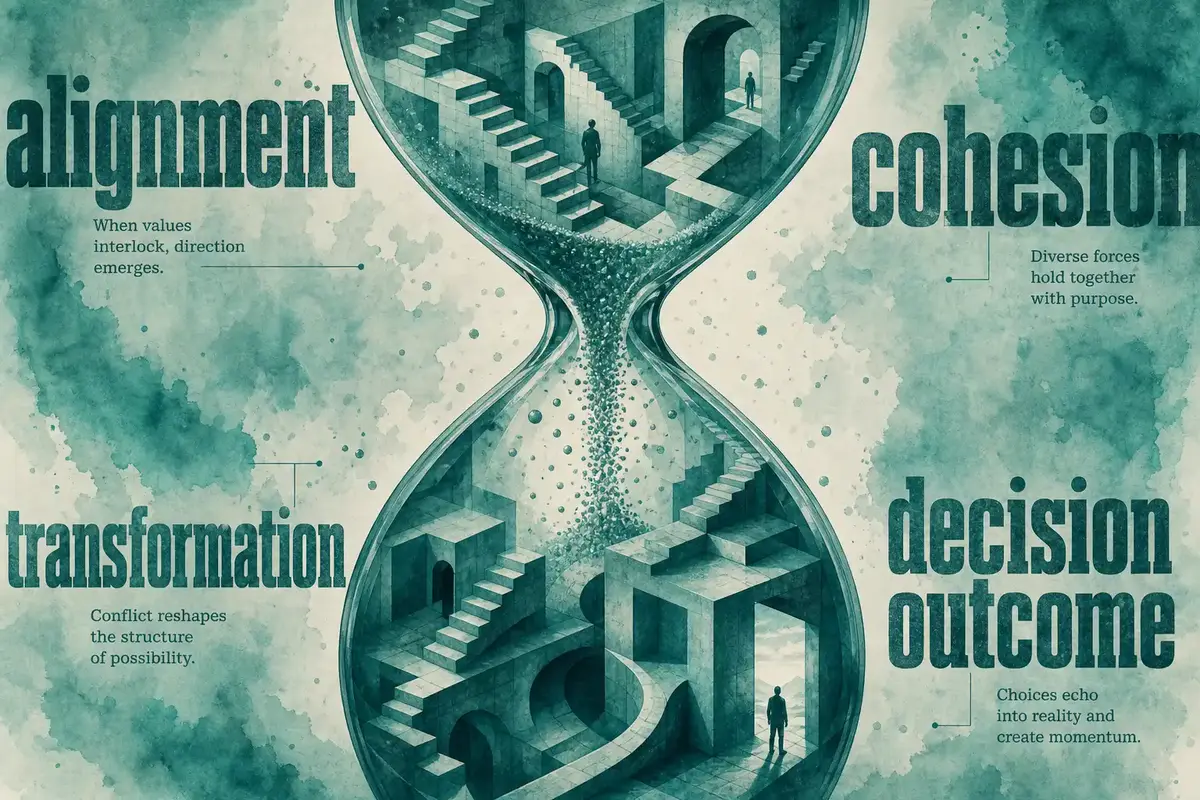
Differentiation means separating where each value governs. A manufacturing VP can decide that efficiency rules routine production, while safety overrides in maintenance shutdowns. Different contexts. Different lead values. One explicit rule set. This is often more honest than a vague leadership framework that says everything matters equally.
Integration is the hardest mode. It asks whether a redesigned process can protect both values at once. Think transparency and confidentiality through tiered communication, not all-or-nothing disclosure.
The point is not to make every value equal. It is to make the trade-off visible, deliberate, and repeatable.
Compromise has a place when the issue is preference, timing, or resource allocation. It damages trust when the issue is principle, because splitting the difference can look like splitting integrity. That is why 79% of business leaders say purpose is fundamental to success. The real test comes later: when purpose collides with revenue, loyalty, or team pressure, what gives first?
When Does Purpose Override Revenue, Preference, or Team Pressure?
Why do some teams become more aligned after a hard decision, while others lose trust? The difference is rarely courage alone. It is whether the leader used purpose as a real decision filter or as cover for a choice already made.
Purpose overrides revenue, preference, or team pressure when those forces ask the organization to act against the reason it exists. That is the line. Purpose-driven leadership is not about making work feel noble after the fact; it is about aligning individual and organizational values so people can see why one trade-off was necessary and another would have been a betrayal (Center for Creative Leadership, 2026).
In a mid-market financial services firm during a market dip, a C-suite leader faces a familiar temptation: push a product that will lift quarterly results but is poorly suited to a vulnerable client segment. Revenue argues yes. Purpose says no. The deciding question is not “Can we defend this?” but “Does this serve the people and promise our mission commits us to protect?” That is the practical core of ethical leadership.
If a decision strengthens this quarter by weakening your reason to be trusted, purpose has already been overruled.
Stakeholder obligations make the test harder. Many value conflicts spill beyond the immediate team — to customers, regulators, partners, communities, and future hires. Good leaders widen the frame before they decide; that is disciplined stakeholder management, not indecision.
Systems matter too. Incentives, reporting lines, sales targets, and escalation rules often manufacture the very conflicts leaders blame on personalities. Center for Creative Leadership notes that purpose creates space for alignment between employee and organizational values (Center for Creative Leadership, 2026). When that alignment keeps breaking, the system is talking. The next test is immediate: what do you say in the room when the pressure is live?
What Should Leaders Do in the First Conversation?
A director has everyone on the call, the issue is hot, and people are already arguing solutions before they agree on the problem. In that first conversation, the leader’s job is not to settle the conflict fast; it is to slow it down enough to diagnose it well.
That discipline matters because engagement is already thin. Gallup found that 31% of U.S. employees and 21% of global employees were engaged in 2024, which means many teams are entering hard conversations with little reserve of trust or discretionary effort to absorb sloppy handling (Gallup, 2024).
Use a simple first-conversation sequence. First, name the conflict in neutral terms: “We are balancing speed, risk, and fairness.” Second, separate facts from values: what is known, what is assumed, and what principle each side is trying to protect. Third, surface the purpose at stake: “Which option best serves why this team or organization exists?” That is the opening move in serious conflict resolution.
The questions matter. In an enterprise services firm during a team restructure, a VP can quickly test the type of conflict by asking:
- “What outcome are we trying to protect?”
- “What evidence would change your view?”
- “If we choose your option, who bears the cost?”
- “Is this mainly an ethical, strategic, or relational concern?”
The first conversation should reduce heat and increase definition.
End with a reusable decision checkpoint: Are we trading off principles, choosing a strategy, or repairing a relationship? If the room cannot answer that clearly, no decision should be finalized. Rush past that checkpoint and compromise comes cheap. Clarity comes later — or not at all.
Purpose Does Not Remove Tension; It Makes Leadership Clearer
Leaders lose revenue, trust, and good people when they treat every hard choice as a problem to smooth over. The real cost is not tension itself; it is false harmony that hides what the organization is actually willing to stand for.
In a regional healthcare system during an expansion decision, a senior leader may have to choose between faster access and tighter clinical safeguards. Both are legitimate goods. That is normal. In purpose-driven organizations, conflict often appears because people are protecting something worthy, not because they are misaligned.
That is why the work is sequential. Diagnose the conflict correctly. Use purpose as the filter — the practical test of what the organization exists to do. Then choose the right resolution mode: accept a real trade-off, differentiate where each value governs, or integrate when process redesign can honor both.
Purpose-driven leadership is not about removing disagreement. It is about helping people find meaning in the work and commit to shared aims even when the decision is costly (Center for Creative Leadership, 2026).
Strong cultures do not avoid hard choices; they make them in ways people can understand and respect.
Cohesion comes from clarity, not from pretending differences disappeared. In your next live conflict, what would change if you stopped chasing comfort — and named the governing purpose instead?
Key Takeaways
- Purpose does not remove the tension; it gives the tension a judge.
- When leaders confuse principle with position, they reward the loudest case instead of resolving the real stake.
- The point is not to make every value equal. It is to make the trade-off visible, deliberate, and repeatable.
- If a decision strengthens this quarter by weakening your reason to be trusted, purpose has already been overruled.
Frequently Asked Questions
What are the key steps in a framework for resolving value conflicts in purpose-driven leadership?
The key steps are to identify the values in conflict, determine whether both are legitimate in light of organizational purpose, and choose the right resolution mode: acceptance, differentiation, or integration. This approach makes the trade-off explicit instead of hiding it inside vague compromise.
How can leaders identify internal value conflicts within their teams to align with organizational purpose?
Leaders can diagnose a value conflict by asking what principle each side is trying to protect, whether the issue is really about resources or authority, and whether the disagreement is about outcome or process. If the conflict is truly about competing principles, purpose should be used as the decision lens.
Why is resolving value conflicts important for maintaining cohesion in purpose-driven leadership?
Resolving value conflicts protects trust because teams can see that decisions are being made deliberately rather than through politics or confusion. When purpose is used to guide hard choices, people are more likely to understand the trade-off and stay committed to shared goals.
Which methods are most effective for mediating differing personal and team values in leadership contexts?
The most effective methods are acceptance, differentiation, and integration. Acceptance acknowledges a real trade-off, differentiation assigns different values to different contexts, and integration redesigns the process so both values can be protected where possible.
Can a structured framework help leaders balance conflicting values while staying true to organizational purpose?
Yes. A structured framework helps leaders separate true value conflicts from interest, power, or process problems, then choose a response that fits the organization’s purpose rather than defaulting to compromise.