

Why AI Coaching ROI Must Be Proven in Business Terms, Not Learning Terms
66% of organizations report productivity and efficiency gains from AI—so when a CFO asks what AI coaching is worth, “people liked it” is already the wrong answer (Deloitte, 2026). You have likely been in that budget meeting: the CHRO describes stronger manager capability, the business leader nods, and finance asks the only question that matters—what moved?
That gap is where most AI coaching programs lose credibility. Not because the experience is weak, but because the proof standard is wrong. Executives are not trying to decide whether coaching is useful in the abstract; they are deciding whether it changes retention, performance, and profitability in ways they can defend in an operating review.

The stakes are higher now because AI itself is no longer a speculative line item. PwC found that 58% of executives say Responsible AI improves ROI and organizational efficiency (PwC, 2025). Once that expectation is set, every AI-enabled initiative—including coaching—is judged against business performance, not learning sentiment. This article shows how to make that case in terms finance, operations, and the board will trust.
From learning activity to operating lever
A common mistake is to evaluate AI coaching like a training program: completion rates, satisfaction scores, self-reported confidence, maybe a manager testimonial. Those measures can describe adoption. They do not establish economic value.
The stronger lens treats AI coaching as an operating lever. If it helps frontline managers handle feedback better, the relevant question is not whether they felt more prepared. It is whether regrettable attrition fell, ramp time shortened, customer escalations dropped, or team output improved. In a regional services business, for example, a VP does not need another dashboard showing engagement with prompts; she needs evidence that coaching changed manager behavior in ways that reduced avoidable cost during a quarterly review.
That is the shift from learning logic to business logic. It is also the difference between a program that survives scrutiny and one that gets cut when budgets tighten.
What boards actually hear
Boards rarely fund “development” on faith. They fund risk reduction, margin improvement, execution speed, and leadership capacity when those outcomes can be tied to enterprise priorities. That is why measuring the ROI of AI coaching has to start with business outcomes first, then work backward to behavior change—not the other way around.
If AI already earns its place through productivity, AI coaching must show where that productivity appears—in labor efficiency, manager effectiveness, retention, or revenue protection.
The real question is not whether coaching works. It is which outcomes it should own—and which of those outcomes are strong enough to stand up in a board pack.
What Business Outcomes Should AI Coaching Be Held Accountable For?
21%. If global employee engagement is that low, what exactly should count as proof that AI coaching is working for your business—not just your learners (Gallup, 2024)? Most leaders still answer too quickly. They jump to usage, satisfaction, or self-reported confidence because those numbers arrive first and look clean in a dashboard.
But low engagement changes the baseline. It means many organizations are already operating with hidden drag: slower decisions, weaker manager conversations, avoidable exits, and teams doing the minimum required. In that environment, the real question is not whether people liked the coaching. It is whether coaching changed the conditions that produce business results.
Start with the outcome chain, not the platform metrics
The most defensible chain is simple: manager effectiveness improves first, then employee retention, team performance, and productivity follow. That sequence matters because AI coaching rarely creates value directly. It changes how managers run one-on-ones, handle conflict, set priorities, and give feedback. Those are operating behaviors. The business value appears one level downstream.
A regional healthcare provider in a quarterly review offers a familiar example. HR wants to show that nurse managers are using the coaching tool regularly. Finance does not care. The COO cares about vacancy pressure, overtime strain, and inconsistent team execution across units. In that setting, “active users” is not an outcome. A reduction in regrettable turnover among high-pressure teams is. So is faster stabilization of newly promoted managers. So is fewer performance issues escalating to HR.
That is why talent retention belongs near the center of the model, not at the edge.
Treat engagement as a leading indicator, not the finish line
Engagement matters because it tells you whether the soil is fertile enough for performance to improve. Gallup’s finding that global engagement fell to 21% in 2024 should concern any executive funding coaching, because disengagement is not a culture problem in the abstract; it is a cost structure problem (Gallup, 2024).
When engagement is weak, coaching should be expected to move the managerial behaviors that shape effort, commitment, and discretionary performance—not merely produce positive feedback.
Still, engagement is a leading indicator. It signals whether better outcomes are plausible. It does not prove economic value on its own. The lagging proof sits elsewhere: lower attrition, better team throughput, fewer execution misses, stronger manager bench strength.
Match outcomes to stakeholder intent
Different stakeholders are buying different forms of value. HR usually cares most about retention, internal mobility, and manager consistency. Finance wants productivity, labor efficiency, and avoided replacement cost. Senior executives often care about something harder to see but deeply consequential: decision quality and execution speed.
That last point is no longer soft. 53% of organizations report improved insights and decision-making from AI (Deloitte, 2026). If AI coaching helps managers make better calls faster—on staffing, prioritization, escalation, or performance management—that belongs in the value case. Not as a vague leadership claim, but as a business outcome with operational consequences.
Choose the wrong outcomes, and the program looks busy. Choose the right ones, and it starts to look material. The harder question remains: how do you prove those results came from coaching—and not from everything else happening at the same time?
Which ROI Model Makes AI Coaching Board-Ready?
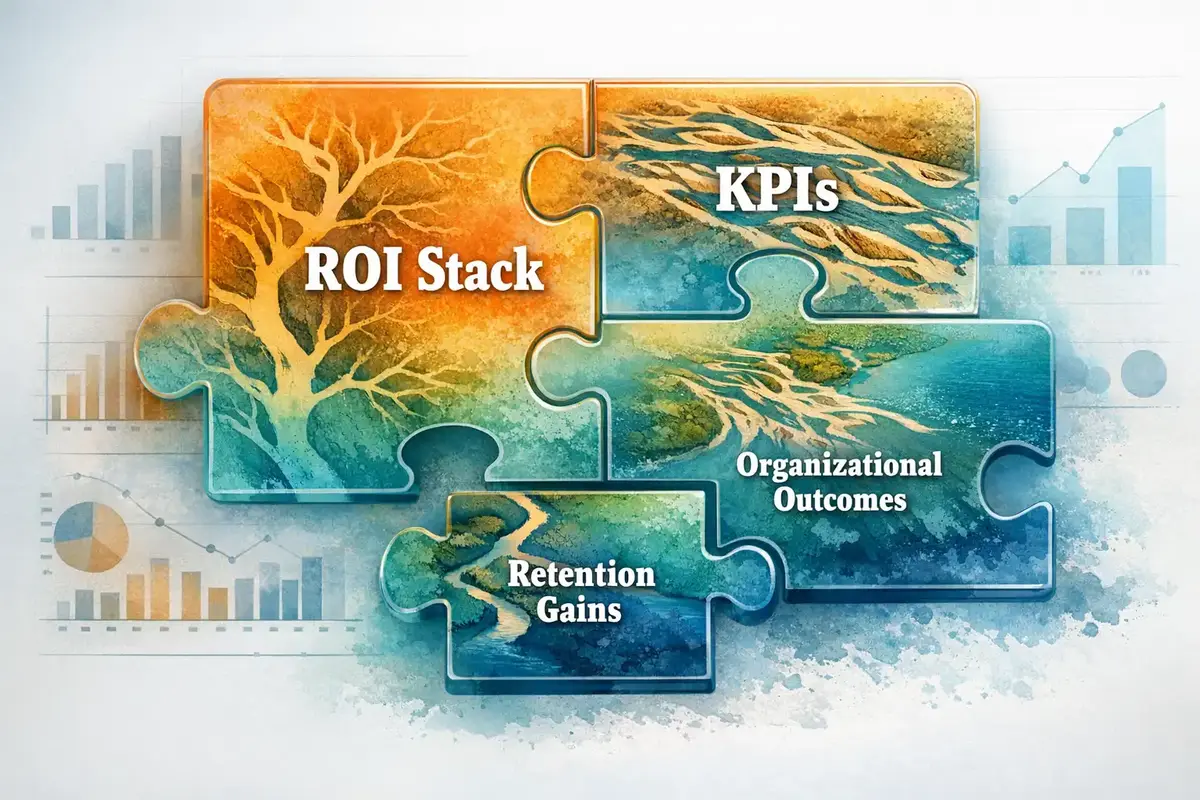
The three-horizon ROI model is the one that makes AI coaching board-ready. Without it, leaders collapse usage, behavior change, and financial impact into one blurry story—and that is exactly where credibility breaks.
A board does not need a bigger dashboard. It needs a cleaner chain of proof.
The model works because it separates three distinct questions. Horizon 1 asks whether people are actually using the coaching in the intended workflow. Horizon 2 asks whether that usage changed manager capability and on-the-job behavior. Horizon 3 asks whether those changes created measurable economic value. That structure sounds simple, but it prevents a common executive error: treating participation as if it were return.
Horizon 1: prove adoption without pretending it is value
Start with adoption. Logins, session frequency, repeat use, completion of coaching sequences, and manager-level participation all belong here. They matter because no behavior changes at scale without consistent use.
But this is where many teams overclaim. A mid-market manufacturing company in budget season may report that 72% of frontline supervisors used the tool in the first month. Useful. Not enough. If the board pack stops there, finance hears activity, not impact.
That is why the first horizon should be reported as a gating condition, not a success claim. It tells executives whether the program had enough reach to justify deeper measurement. The AI coaching measurement framework is useful here because it reinforces that early indicators are necessary, but not sufficient.
Horizon 2: show behavior change where operations can feel it
The second horizon is where the case gets stronger. Here, you measure competency and behavior change: better quality one-on-ones, faster conflict resolution, more consistent feedback, stronger delegation, cleaner escalation decisions.
This is the missing middle in most ROI models. Skip it, and any financial gain looks coincidental. Include it, and you can show mechanism. ICF’s research is helpful not because it proves your program worked, but because it shows coaching can produce economic return when measured seriously: 86% of organizations tracking coaching ROI said they made back their investment or more, and the median return was 5–7x the cost of coaching (ICF, 2024).
The board-ready move is not to borrow those returns as your own. It is to use them as proof that coaching can be measured financially—then show your own behavioral evidence in between.
Horizon 3: translate effects into finance language
The third horizon converts coaching effects into net benefit, payback period, and avoided cost. This is where reduced attrition becomes replacement-cost avoidance, faster manager ramp becomes labor productivity, and fewer execution errors become margin protection.
That translation matters because boards already expect AI to show up in operating results. McKinsey found that 39 percent of respondents attribute some level of EBIT impact to AI (McKinsey, 2025). AI coaching will not earn trust by sounding adjacent to that standard. It has to connect to it.
So the model is staged by design: adoption first, behavior second, enterprise value third. Clean logic. Harder claims, later.
And that creates the next problem. Once you have a plausible ROI chain, how do you prove the gains came from coaching—not from a new leader, a comp change, or a stronger quarter?
How Do You Separate AI Coaching Impact From Everything Else?
Most organizations overclaim impact the moment results improve after coaching launches. That is exactly why executives stop trusting the story.
The usual pattern is familiar: AI coaching goes live, manager sentiment rises, attrition softens, and someone declares success. But in the same quarter, the company may also have changed incentives, replaced a divisional leader, tightened performance management, or slowed hiring. The evidence does not show a clean win. It shows a crowded system.
Attribution fails when measurement starts too late
In a quarterly budget review at a mid-market retail company, the CHRO and CFO are looking at the same slide and seeing different things. HR sees stronger store-manager capability. Finance sees a period that also included scheduling changes, a new district structure, and a revised bonus plan. The question is not whether outcomes moved. It is whether coaching caused enough of that movement to deserve more funding.
That is the hard part. Attribution is always more demanding than reporting improvement, because leadership interventions rarely arrive alone. They sit inside broader operating changes.
This is where many teams confuse correlation with causation. If coached managers improved more than the business average, that is interesting. It is not yet proof. You need a design that can explain why the difference appeared and whether another factor could plausibly account for it.
Use comparison by design, not by hindsight
The cleanest approach is to build comparison into the rollout. Start with a pre/post baseline for the target group: what did team performance, retention patterns, escalation rates, or manager effectiveness look like before coaching began? Then compare that change with a similar group that did not receive coaching during the same period.
A control group does not have to be perfect to be useful. It has to be credible. Similar span of control, similar operating conditions, similar business pressure. If a regional sales team gets coaching while another comparable region does not, you have the beginnings of an attribution case. If both improve, but the coached group improves earlier or more consistently, the story gets stronger.
Cohort comparisons help when a formal control group is politically difficult. Compare newly promoted managers who used coaching with the prior promotion cohort that did not. Compare business units with high coaching adherence against units with low adherence. The point is not academic purity. It is reducing executive doubt.
Good attribution does not ask leaders to “believe” in coaching. It shows what changed, for whom, against what comparison.
PwC’s research makes the operational point clear: the barrier is often not intent but execution, with executives citing the challenge of translating Responsible AI principles into operating processes (PwC, 2025). The same discipline applies here. If you want AI coaching to earn trust, you need measurement rules that survive scrutiny, not a narrative assembled after the fact. That matters even more because executives also associate Responsible AI with stronger ROI and efficiency (PwC, 2025).
The next question is sharper still: once you have cleaner attribution, which measures actually matter enough to signal enterprise value—and which ones still belong in the appendix?
Which KPIs Actually Predict Enterprise Value?
Most AI coaching dashboards are built to reassure sponsors, not to predict value. You see this in the quarterly review when a VP in a regional financial services firm is asked whether the program is working, and the only clean answers on the slide are usage counts and favorable comments.
That is the wrong hierarchy. Enterprise value is usually visible only when you separate individual, team, and enterprise KPIs and show how movement at one level compounds into the next. ICF’s client research is directionally useful here: coaching is associated with better work performance and positive return, but those findings matter most when they push you to build a sharper internal measurement stack, not a softer success story (ICF, 2024).
Build the KPI stack from the ground up
At the individual level, the best leading indicators are not generic engagement scores. They are signs that a manager is using coaching in the flow of work and changing how decisions get made: better prepared one-on-ones, clearer feedback, faster escalation calls, fewer avoidable reversals after a difficult conversation. This is where AI coaching metrics become useful only if they capture behavior, not just activity.
A manager who opens the tool often but still mishandles performance conversations is not creating value. A manager who uses it less often but improves judgment probably is.

At the team level, look for lagging effects that operations leaders already trust: steadier throughput, fewer escalations, cleaner handoffs, lower regrettable attrition, stronger new-manager stabilization. These are not “people metrics” in the narrow HR sense. They are operating metrics with a people mechanism behind them.
The KPI question is not “did coaching happen?” It is “did manager behavior improve in a way the business can already recognize?”
Leading indicators first, lagging claims later
The order matters. Leading indicators should include coaching engagement, observable manager behavior change, and decision quality before anyone claims impact on retention, productivity, or profitability. That sequence protects credibility because it shows mechanism before outcome.
ICF reports that most coaching clients see positive ROI and improved work performance (ICF, 2024). Useful evidence. But inside an enterprise, those claims become believable only when finance can trace them through existing measures rather than a parallel coaching dashboard.
That is why vanity metrics are so dangerous. Session volume, completion rates, and satisfaction can tell you whether the program is alive. They do not tell you whether it is economically relevant. The stronger approach is to map coaching effects onto metrics the business already reviews every month—service levels, error rates, manager span stability, time to proficiency.
Once you know which KPIs predict value, the practical problem gets harder. How do you build a measurement cadence that is fast enough for operators, credible enough for finance, and simple enough to survive the first ninety days?
What Does a Practical 90-Day Measurement Plan Look Like?
66% of organizations report productivity and efficiency gains from AI—so why do so many leaders still treat the first 90 days of AI coaching as a branding exercise instead of a measurement window (Deloitte, 2026)? And if 53% already say AI improves insights and decision-making, what exactly should you expect to see by day 30, day 60, and day 90—without pretending you have proven annual ROI (Deloitte, 2026)?
This is where discipline matters. The first quarter is not for making big financial claims. It is for proving that the program is real, used, and changing manager behavior in ways worth tracking.
Days 0–30: lock the baseline before the story starts
A practical plan begins before launch. Define a small set of baseline metrics tied to the business problem: manager participation rates, frequency of coaching use, quality of one-on-ones, escalation patterns, time to decision, and one or two team outcomes already reviewed by operations.
In a mid-market technology company during a quarterly review, a director rolling out AI coaching to engineering managers does not need twenty metrics. She needs six that can survive scrutiny. If release delays are the pain point, baseline decision latency, cross-team escalations, and manager participation before the tool goes live. If attrition is the concern, capture regrettable exits and manager-level variance now—not after the rollout has already changed the environment.
Ownership should be explicit. HR defines behavior measures. Business leaders confirm which operating metrics matter. Finance signs off on definitions early, so no one debates the math in month three.
Days 31–60: report adoption and early behavior shifts
The second phase is about measurement cadence. Weekly checks are useful for participation and data quality. Monthly reviews are better for behavior patterns and team-level signals.
In the first 60 days, the strongest proof is not savings. It is consistent manager participation, repeat usage, and observable shifts in how managers handle routine decisions.
Short-cycle reporting does two things. It shows whether the program is scaling credibly, and it exposes weak data infrastructure fast. Missing manager IDs, inconsistent team mapping, or unclear ownership will kill ROI analysis later if you do not fix them now.
Deloitte’s findings matter here because they set the executive expectation: AI should improve productivity and decision quality (Deloitte, 2026). Your 60-day report should therefore ask a narrow question: are coached managers showing earlier signs of those gains?
Days 61–90: decide whether the program is measurement-ready
By day 90, leadership should be able to answer three practical questions. Are the right managers using it? Are behaviors changing in the intended workflow? Is the data clean enough to support longer-term ROI analysis?
That is the threshold. Not proof of full return—proof that a return case can be built without hand-waving.
If the first 90 days cannot produce that level of confidence, the problem is rarely the dashboard. It is usually the operating model behind it. And that raises the harder issue: when AI coaching works well, does it remain a program—or does it become part of how management actually runs?
What Good Looks Like When AI Coaching Becomes a Management System
The evidence chain framework matters here because getting AI coaching wrong does not just waste budget; it erodes executive trust, leaves performance problems untreated, and lets good managers walk out the door while the dashboard still looks healthy. If AI coaching is truly strategic, the question a year later is simple: what evidence is still visible after the novelty has worn off?
The standard is not a headline number
The most credible programs do not live or die by one metric. They build a chain of evidence: sustained adoption, observable behavior change, then business impact. In practice, that means a leadership team can show not only that managers used the system, but that they made better calls, ran better conversations, and produced outcomes the business already values.
That is the difference between a program and a management system. A program creates activity for a quarter. A management system changes how managers prepare for one-on-ones, handle conflict, make staffing calls, and recover after a client issue or missed target.
In an enterprise manufacturing company during annual planning, a COO does not want another abstract update on “manager capability.” She wants to know whether plant leaders are making fewer avoidable escalation errors, whether supervisor turnover has stabilized, and whether performance variance between sites is narrowing. If the AI coaching story cannot survive that conversation, it is not mature yet.
Good looks like this: the business can explain how coaching affected decisions before it claims what it returned.
That discipline matters because boards already expect AI to show up in operating performance. McKinsey found that 39 percent of respondents attribute some level of EBIT impact to AI (McKinsey, 2025). AI coaching does not need to mimic every enterprise AI use case, but it does need to meet the same proof standard: measured effects, clear assumptions, and no inflated claims.
Trust grows when the limits are explicit
Executive trust is earned partly through rigor and partly through restraint. The best teams say where the evidence is strong, where attribution is partial, and where more time is needed. That honesty is not a weakness. It is usually what keeps finance engaged.
ICF’s research helps frame the upside without turning it into a promise. 86% of organizations tracking coaching ROI said they made back their investment or more, and the median return was 5–7x the cost of coaching (ICF, 2024). Useful benchmark. Not your result. Your result still has to be shown inside your own operating model, with your own baselines and your own controls.
That is also why strong operators study external AI coaching case studies carefully. Not to borrow someone else’s numbers, but to pressure-test what durable adoption and measurable behavior change actually look like.
A year later, what should still be true?
A year in, the real test is persistence. Are managers still using coaching when no launch campaign is pushing them? Is decision quality still improving? Has retention held where management quality used to be uneven? Are performance gains showing up through normal business reviews rather than a special HR report?
That is the durable definition of success. AI coaching has become part of how management runs — not an initiative, not a pilot, not a story.
So the honest next step is not to ask whether people liked it. It is to ask whether your evidence chain would still hold up in a hard budget meeting — or whether it disappears the moment the rollout glow fades.
Key Takeaways
- AI coaching ROI should be proven in business terms like retention, performance, productivity, and profitability.
- The strongest ROI model uses three horizons: adoption, behavior change, and financial value.
- Attribution requires baselines, comparison groups, and clear measurement rules to separate coaching from other changes.
- The most useful KPIs are the ones finance and operations already trust, not vanity metrics.
Frequently Asked Questions
What is the best way to measure the ROI of an AI coaching program?
The strongest approach is to measure ROI in business terms, not learning terms. Start with adoption, then prove behavior change, and finally translate those changes into financial outcomes such as reduced attrition, improved productivity, or avoided costs.
Which business outcomes should AI coaching be accountable for?
AI coaching should be tied to outcomes that matter to the business, such as manager effectiveness, retention, team performance, productivity, and decision quality. Usage and satisfaction can show adoption, but they do not prove economic value on their own.
How can you separate AI coaching impact from other business changes?
Use baselines and comparison groups to reduce attribution error. Compare coached teams with similar uncoached teams, or compare current cohorts with prior cohorts, so you can see whether coaching changed outcomes beyond other factors like leadership changes or policy shifts.
Which KPIs are most useful for proving enterprise value from AI coaching?
The most useful KPIs are the ones that show behavior change and business impact, such as better one-on-ones, faster conflict resolution, stronger delegation, lower regrettable attrition, and improved team throughput. Vanity metrics like session counts and satisfaction scores are useful for adoption tracking, but they do not predict enterprise value well.
What should a practical 90-day measurement plan for AI coaching include?
A 90-day plan should lock in baseline metrics before launch, track adoption and early behavior shifts in the first 60 days, and then assess whether the data is clean enough to support longer-term ROI analysis by day 90. The goal is not to prove full financial return immediately, but to show that the program is being used and is changing manager behavior in measurable ways.