
Why Managerial Resistance Is Really a Trust Problem, Not a Technology Problem
88% of companies report regular AI use in at least one business function—yet in the quarterly review, the regional operations director still pauses when AI coaching appears on the agenda. The tool is not the real objection; what stalls the decision is a familiar managerial question: what happens to my role if this starts shaping how my team learns?
That hesitation is expensive because adoption is already outrunning organizational trust. McKinsey says nearly two-thirds of companies have not yet begun scaling AI across the enterprise, even while AI use is now common in day-to-day operations (McKinsey, 2025). Kyndryl found that 45% of CEOs said most employees were resistant or openly hostile to AI (Kyndryl). In practice, that means coaching initiatives sit in a dangerous middle ground—visible enough to trigger concern, not legitimate enough to earn sponsorship. This article addresses that gap: why manager resistance to AI coaching is usually a trust problem before it is ever a product problem.
Traditional hierarchies make this sharper, not softer. In a manufacturing enterprise, for example, a plant director can accept AI in scheduling or maintenance because the authority lines stay intact. Introduce AI into coaching, feedback, or manager development, and the same leader may read it very differently: not as support, but as commentary on judgment, status, and control.
Legitimacy Comes Before Adoption
This is why the central issue is legitimacy. Managers do not sponsor what they cannot explain, defend, or govern. If AI coaching appears to blur accountability, weaken managerial discretion, or create a shadow evaluator beside the formal chain of command, resistance is rational.
The threshold is not enthusiasm. It is confidence that the system is bounded, useful, and aligned with the manager’s job. That is a leadership design question, not a software question.
For many organizations, the mistake is assuming that visible executive support is enough. It rarely is. Enterprise tools become real only when the layer closest to execution decides they are safe to use, safe to discuss, and safe to be seen using. That is especially true in leadership environments where credibility is social before it is technical.
The Real Gatekeepers Sit in the Middle
Middle managers are often described as blockers. That is lazy analysis.
They are the adoption gatekeepers. They translate strategy into daily behavior, decide whether pilots get airtime in team meetings, and signal whether participation helps or hurts a person’s standing. If they trust the rollout, AI coaching moves from symbolic innovation to operating reality. If they do not, the initiative survives only in dashboards and executive updates.
So the real question is not whether AI coaching works. It is whether the people asked to legitimize it see it as support—or as surveillance wearing a development label.
What Makes Middle Managers More Skeptical Than Senior Leaders?
63% of employers say skills gaps are the biggest barrier to transformation. So why do many executives still assume middle-manager skepticism is mainly a mindset problem rather than an operating problem (World Economic Forum, 2025)?
That assumption is convenient. It is also often wrong.
The people closest to execution usually see the friction first. They are the ones expected to explain a new coaching system to teams, absorb the early confusion, and still hit this quarter’s numbers. When AI coaching is introduced from above, senior leaders may see scale and consistency; middle managers may see one more system they must defend before they fully understand it.
The Skepticism Is Often About Role Risk
In a regional healthcare provider during budget season, a department director can read AI coaching in two very different ways. One version says: this will help my supervisors give better feedback. The other says: the organization no longer trusts my judgment, and now my gaps will become visible.
That second reading matters because middle managers live in the narrowest part of the hierarchy. They carry accountability downward and pressure upward. If AI coaching appears to bypass their discretion—by offering guidance directly to employees, standardizing conversations they once owned, or surfacing development needs they have not addressed—it does not feel like neutral support. It feels like a status test.
Some resistance is ego. Much of it is exposure.
57% cited lack of guidelines and training as a primary barrier to expanded AI adoption (Wiley)
That number should change the conversation. If managers have not been shown where AI coaching starts, where their authority remains, and how the tool fits existing training and performance routines, skepticism is not obstruction. It is a rational response to ambiguity (Wiley).
Hierarchy Magnifies Ambiguity
Traditional hierarchies make this worse because announcements travel faster than understanding. A senior team approves the rollout. A slide says the tool will “support manager effectiveness.” Then the middle layer is left to interpret what that means in live situations—promotion discussions, performance concerns, team restructures, client pressure.
This is where cost-cutting fear enters. If managers already suspect that “efficiency” is code for fewer layers, AI coaching can look less like development and more like a signal. Not because the tool is designed that way, but because the rollout leaves room for that conclusion.
The World Economic Forum data points to a deeper issue: organizations know capability gaps are real, yet they often launch AI initiatives before clarifying who is accountable for what (World Economic Forum, 2025). That sequencing almost guarantees defensive behavior.
Middle managers do not need a louder case for AI. They need a safer one. If the message lands as support—or as replacement—the reaction will follow. And if leaders cannot explain AI coaching without triggering that distinction, what exactly do they think managers are hearing?
How Do You Explain AI Coaching Without Triggering a Defense Response?
The augmentation-boundaries-accountability framework matters here because most organizations still explain AI coaching as a feature set, when managers are really listening for a threat assessment. The common practice is to lead with capability—personalized prompts, scalable support, always-on access—but the evidence points somewhere else: trust rises when organizations make responsible use visible, not when they make the technology sound more impressive.
That gap is bigger than many leaders realize.
If the first message a manager hears is “the system can coach at scale,” the natural follow-up is not curiosity. It is self-protection. At scale compared with whom? Their team? Their judgment? Their role?
Start With Augmentation, Not Automation
The safest explanation is also the most accurate: AI coaching helps managers have better conversations, apply more consistency, and get faster access to guidance. It does not replace managerial judgment.
That distinction has to come early, in plain language, and without hedging. In a mid-market services firm during a client escalation, a frontline director does not have time to decode abstract rollout language. If she hears that AI coaching will “optimize development outcomes,” she fills in the blanks herself—and usually in the most defensive way possible. If she hears, instead, “this gives your managers a faster way to prepare for difficult conversations, while you still decide what good judgment looks like,” the temperature drops.
Clarity is not cosmetic. It is operational.
Research from PwC shows that companies investing in strong Responsible AI programs achieve trust levels from employees and the public that are up to 7% higher than peers (PwC, 2025). That finding should change how leaders approach communication strategy: the message is not just an announcement; it is part of the control system.
Answer Three Questions Fast
A manager-facing explanation should answer three questions in under two minutes.
First, what does it do? It offers structured prompts, reflection support, and practical guidance before or after real management moments.
Second, what does it not do? It does not rate managers, make employment decisions, or become a shadow performance system unless explicitly designed and governed for that purpose.
Third, who remains accountable? The manager does. The chain of accountability does not move.
Those boundaries matter because ambiguity invites fear. They also matter because they reduce avoidable mistakes. PwC found that robust Responsible AI programs can cut the frequency of adverse AI-related incidents by as much as half (PwC, 2025). That is not a branding benefit. It is a rollout benefit—and a strong argument for visible governance.
Companies with robust Responsible AI programs reduced adverse AI-related incidents by as much as half (PwC, 2025)
Managers do not need a grand vision first. They need a credible explanation. But once you make promises about boundaries and oversight, a harder question appears: what makes those promises believable—policy, or actual governance?
Why Governance Makes AI Coaching Feel Safer, Not Slower
Companies with robust Responsible AI programs cut adverse AI-related incidents by as much as half—and when that protection is missing, the costs show up fast in lost trust, stalled rollouts, and leaders who quietly tell their teams to wait (PwC, 2025). That is the real price of weak governance: not just risk exposure, but adoption decay.
Governance Lowers the Personal Risk of Saying Yes
Managers rarely resist AI coaching because they love ambiguity. They resist because ambiguity raises the personal cost of participation. If they cannot answer basic questions about data use, escalation, or who makes the final call, they are the ones left exposed when an employee challenges the system or a senior leader asks what happened.
This is where governance stops being a legal exercise and becomes an adoption tool. Clear rules on what data is collected, who can see it, what the system can recommend, and when human review overrides the output make the initiative feel bounded. Bounded systems get tested. Improvised systems get avoided.
In a mid-market finance company during annual planning, a division VP may be open to AI coaching in principle but still block rollout to her managers for one practical reason: she does not want a coaching prompt later quoted back in a performance dispute. That concern is not abstract. It is a decision-rights problem. Once governance defines what is developmental, what is evaluative, and where escalation sits, the conversation changes. The tool no longer feels like a hidden policy. It feels like a controlled process.
Good Governance Speeds Real Adoption
The common mistake is to frame Responsible AI as overhead. In practice, it is what makes experimentation possible.
Managers will try new systems when they know the guardrails in advance: what happens if the output is wrong, who reviews edge cases, how exceptions are handled, and where accountability remains human. Without that structure, every use case feels like a career gamble. With it, managers can test the tool in live conditions without feeling that they are improvising policy on the fly.
Companies investing in sound Responsible AI programs see valuations up to 4% higher and revenues up to 3.5% higher than companies making compliance-only investments (PwC, 2025)
That matters because it reframes the argument. Strong governance is not the tax you pay before innovation. It is part of the return. PwC’s findings suggest that organizations treating Responsible AI as an operating discipline—not a box-checking exercise—protect both credibility and business performance (PwC, 2025).
The managerial implication is simple. Rules reduce fear. Oversight creates room to learn.
And once governance makes managers willing to say yes, a harder operational question appears: in what order should leaders introduce the change so early trust does not collapse under rollout pressure?
What Change Management Sequence Actually Wins Manager Buy-In?
The pilot-champion-train-govern-measure sequence matters because approved budgets do not create managerial trust. In a regional retail company during annual planning, the COO announces an AI coaching rollout to store directors, gets polite agreement in the room, and then watches adoption disappear once those directors return to their weekly operating calls.
That pattern is common because investment often arrives before alignment. Kyndryl found that 95% said they had invested in AI, but only 14% had aligned workforce, technology, and growth goals (Kyndryl). That gap explains why so many initiatives stall after the announcement: the program is funded, the tool is selected, but the people expected to legitimize daily use were never brought into the operating logic.
Start Small Enough to Learn, Not Just to Launch
The first move is a pilot with a narrow use case that managers already recognize as painful—preparing for difficult feedback conversations, for example, or coaching new supervisors after promotion. Not a broad promise. A bounded problem.
This is where many leaders get the sequence wrong. They train too early, before managers have seen the tool in a credible context. Training on an unproven system feels like compliance. Training after a pilot feels like capability building.
A better pattern is to invite a small group of managers into the design before the pilot starts. Ask them to shape three things: the use cases worth testing, the boundaries that make the tool feel safe, and the success criteria that would make them recommend it to peers. That is real change management—not communication after decisions are already fixed.
Champions Carry More Weight Than Program Owners
In hierarchical organizations, peer champions do work that central teams cannot. A respected plant manager, district leader, or service-line director can say, in effect, I used this in a real situation, here is where it helped, and here is where I still made the call. That kind of endorsement transfers trust because it comes from someone who shares the same constraints.
Executives often underestimate this. They assume authority will travel downward through the org chart. In practice, confidence often travels sideways first.
Adecco Group found that only 10% of companies qualify as future-ready with structured plans to support workers, build skills, and lead through AI-related disruption (Adecco Group). The implication is blunt: most organizations are still trying to scale before they have built the human support system around the tool.
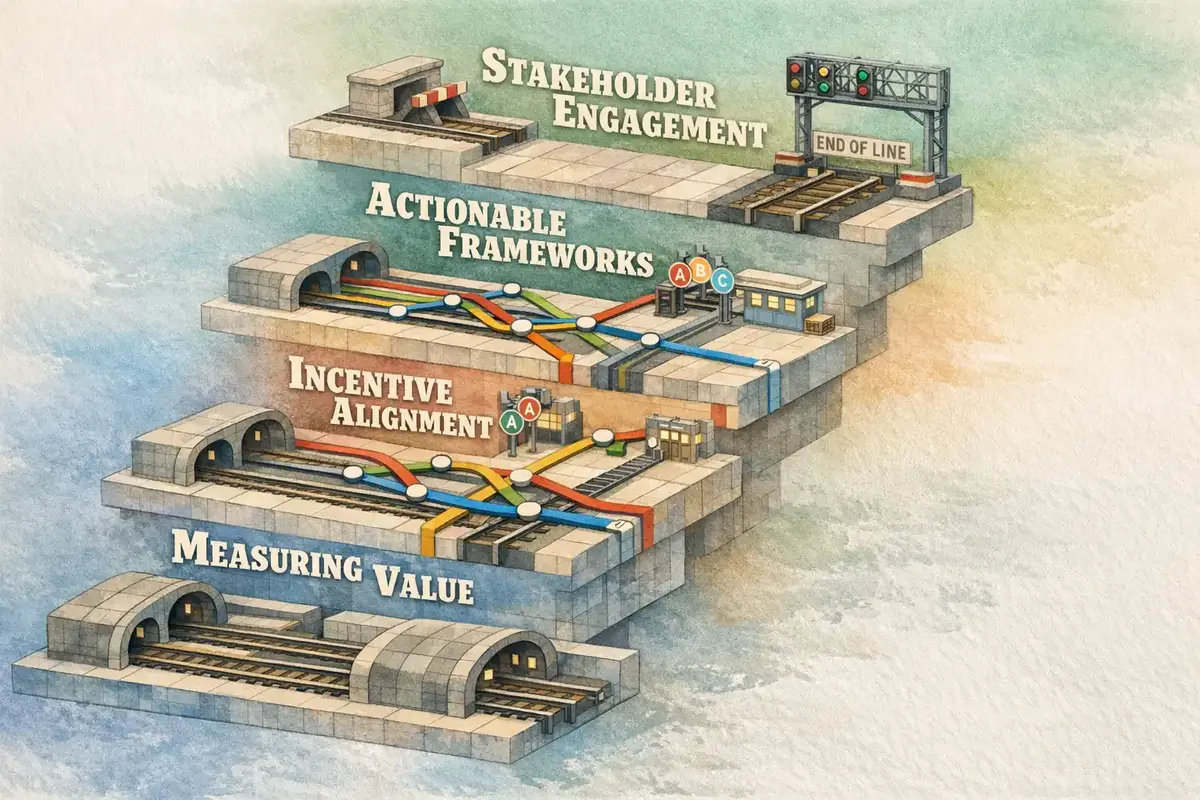
So the sequence should be disciplined. Pilot to generate credible experience. Champion to spread trust through peers. Train once the use case is real. Govern visibly as adoption expands. Measure what managers care about—time saved, conversation quality, escalation reduction—not just logins.
Because once managers say, “show me the value in my world,” belief is no longer the issue. Evidence is.
How Do You Prove Value Before Managers Ask for Proof?
Up to 7% higher trust is what companies with sound Responsible AI programs earn from employees and the public compared with peers (PwC, 2025). So what if the problem is not that managers have not seen enough proof, but that leaders keep showing them the wrong kind?
A dashboard full of logins can look reassuring. It can also be meaningless. If managers try the tool once, do not trust it, and never bring it into a real coaching moment, usage data tells you almost nothing about value.
Measure Adoption Quality, Not Activity
The early mistake is to treat adoption as a volume question. How many users signed in? How many prompts were generated? How many sessions were completed?
Those are implementation metrics. Skeptical managers want operating metrics.
In a mid-market technology company during a quarterly review, a VP may hear that 72% of managers activated the AI coaching tool and still remain unconvinced. Fairly so. The better question is whether those managers felt more prepared for difficult conversations, whether they judged the guidance useful in live situations, and whether they would recommend it to another leader on their own team. That is where belief starts to harden into sponsorship.
The strongest early proof points are usually quieter: manager confidence, more consistent coaching across teams, fewer avoidable escalations, and broader access to support for supervisors who rarely get high-quality development. If the tool helps a new manager prepare for a performance conversation with less hesitation and more structure, that matters more than another usage spike.
The most persuasive pilot result is often not “people used it,” but “managers trusted it enough to use it when the stakes were real.”
Tie the Evidence to Managerial Outcomes
This is where many pilots lose the room. They report engagement with the tool rather than improvement in the work managers already own.
Value becomes visible when AI coaching is linked to outcomes leaders already care about: stronger bench strength, faster capability building, and lower risk from inconsistent people management. That is especially true in traditional hierarchies, where a tool earns legitimacy only when it improves execution without blurring accountability.
PwC found that companies investing in sound Responsible AI programs see valuations up to 4% higher and revenues up to 3.5% higher than organizations making compliance-only investments (PwC, 2025). That does not mean an AI coaching pilot should promise enterprise valuation effects. It means the market is already signaling something managers understand intuitively: trust and disciplined oversight create business value, not just reputational cover (PwC, 2025).
A credible pilot, then, should ask a harder set of questions. Did coaching quality become more consistent across managers? Did leaders report better judgment in sensitive moments? Did access to practical leadership support expand beyond the usual high-potential group?
If the evidence only proves the tool was available, managers will wait. If it proves the work got better, they lean in. But once the pilot succeeds, another problem appears—how do you keep trust intact when the exception becomes the system?
What Lasts After the First Pilot Is No Longer the Pilot?
A weak rollout does not fail quietly. It burns manager trust, slows decisions, and teaches good people to keep new tools at arm’s length the next time leadership asks for change.
When the pilot ends, what makes managers keep using AI coaching instead of quietly dropping it? Not novelty. Not executive enthusiasm. What lasts is a simple three-part test: does the system feel legitimate, governed, and useful in the actual work of managing?
The Real Scale Question Starts After Approval
This is where many organizations misread success. A pilot can survive on attention, sponsorship, and exception handling. A scaled program has to survive ordinary Tuesdays.
Picture a regional healthcare provider in the middle of a team restructure. A department VP does not need one more inspiring demo. She needs to know whether her managers will use the tool before a difficult staffing conversation, whether it helps them prepare with more clarity, and whether it leaves accountability where it belongs. If the answer is yes, the tool becomes part of management practice. If the answer is no, adoption fades behind polite language.
McKinsey reports that AI use is already common in business, yet many organizations still have not begun scaling it across the enterprise (McKinsey, 2025). That gap matters here. It suggests the hard part is no longer access to AI. It is whether the operating model around it earns repeat use.
The pilot proves interest. The next phase proves whether managers believe the tool belongs in the hierarchy rather than sitting beside it.
Better Judgment, Not Less Management
The long-term goal is not to reduce managerial discretion. It is to make that discretion stronger.
Good managerial judgment depends on pattern recognition, preparation, and consistency under pressure. AI coaching can support all three — especially for managers who do not get much live coaching themselves. It can help a new leader think through a feedback conversation, help an experienced director pressure-test an approach, or help a stretched team lead prepare without improvising. None of that removes the manager. It makes the manager better equipped.
That distinction will decide whether the program becomes cultural infrastructure or another abandoned initiative. McKinsey notes that AI is already embedded in day-to-day business activity (McKinsey, 2025). The question for your organization is narrower and harder: has AI coaching been designed to strengthen the human layer that still carries judgment, trust, and consequence?
Resistance Is Often Design Feedback
The most durable organizations treat resistance as information. Not as disloyalty.
If managers hesitate, ask what the hesitation is revealing. Unclear boundaries? Weak governance? A use case that sounds strategic but does not help in real conversations? Those are design problems. And design problems can be fixed.
That is the closing test for any traditional hierarchy: are managers resisting the tool — or showing you where the rollout still does not fit the work?
Key Takeaways
- Managerial resistance to AI coaching is usually a trust and legitimacy issue before it is a technology issue.
- Middle managers need clear boundaries, visible governance, and plain-language explanations of what AI coaching does and does not do.
- A pilot-champion-train-govern-measure sequence helps build buy-in and reduces rollout friction.
- Value is proven through better managerial outcomes, not just usage data or logins.
Frequently Asked Questions
Why do managers resist AI coaching in traditional hierarchies?
Managers often resist AI coaching because they see it as a trust and legitimacy issue, not just a new tool. If the system seems to blur accountability, weaken judgment, or act like a shadow evaluator, resistance is a rational response.
What is the best way to explain AI coaching to skeptical managers?
Explain AI coaching as augmentation, not replacement: it supports better conversations, faster preparation, and more consistent guidance while leaving managerial judgment intact. Clear boundaries about what the system does, what it does not do, and who remains accountable reduce defensive reactions.
Why are middle managers often more skeptical than senior leaders?
Middle managers are closest to execution, so they feel the operational risk first and must defend the rollout to their teams while still meeting performance targets. They are also more likely to worry that AI coaching will expose gaps, bypass their discretion, or signal reduced trust in their role.
What governance practices make AI coaching feel safer to managers?
Managers feel safer when governance clearly defines what data is collected, who can see it, how recommendations are used, and when human review overrides the system. Visible guardrails lower personal risk and make the tool feel like a controlled process rather than an improvised policy.
How should organizations roll out AI coaching to win manager buy-in?
A strong rollout sequence is pilot, champion, train, govern, and measure. Start with a narrow use case, use peer champions to build trust, train after managers see real value, and measure outcomes that matter to managers such as confidence, conversation quality, and fewer escalations.