
Why agility breaks down when change outpaces human confidence
Agility fails first at the human layer. You see it in the Monday steering meeting: the new operating model is approved, the dashboard is green, and yet your directors leave with different interpretations of what changes this week. By Thursday, a team lead in a regional healthcare provider is delaying decisions not because the process is unclear, but because every choice now carries unfamiliar risk.
That is the executive problem. Organizational agility is not just speed, and it is not the number of initiatives launched per quarter. It is the ability to stay coherent while people are learning, deciding, and adjusting in real time. When that coherence slips, change starts to look faster on paper than it feels in practice.
Deloitte’s 2025 research puts numbers behind what many leaders already sense: about two-thirds of workers globally say they are overwhelmed by how quickly work is changing, and 49% worry the pace of change will leave them behind (Deloitte, 2025).
About two-thirds of workers globally are overwhelmed by how quickly work is changing, and 49% fear that pace will leave them behind (Deloitte, 2025).
The cost is not abstract. It shows up as slower adoption, repeated escalations, longer decision cycles, and managers spending valuable hours translating change into something their teams can actually act on. In that environment, redesigning workflows is necessary but insufficient. This article addresses the harder question: what helps people adapt at the speed the business now requires?
The real bottleneck is learning under pressure
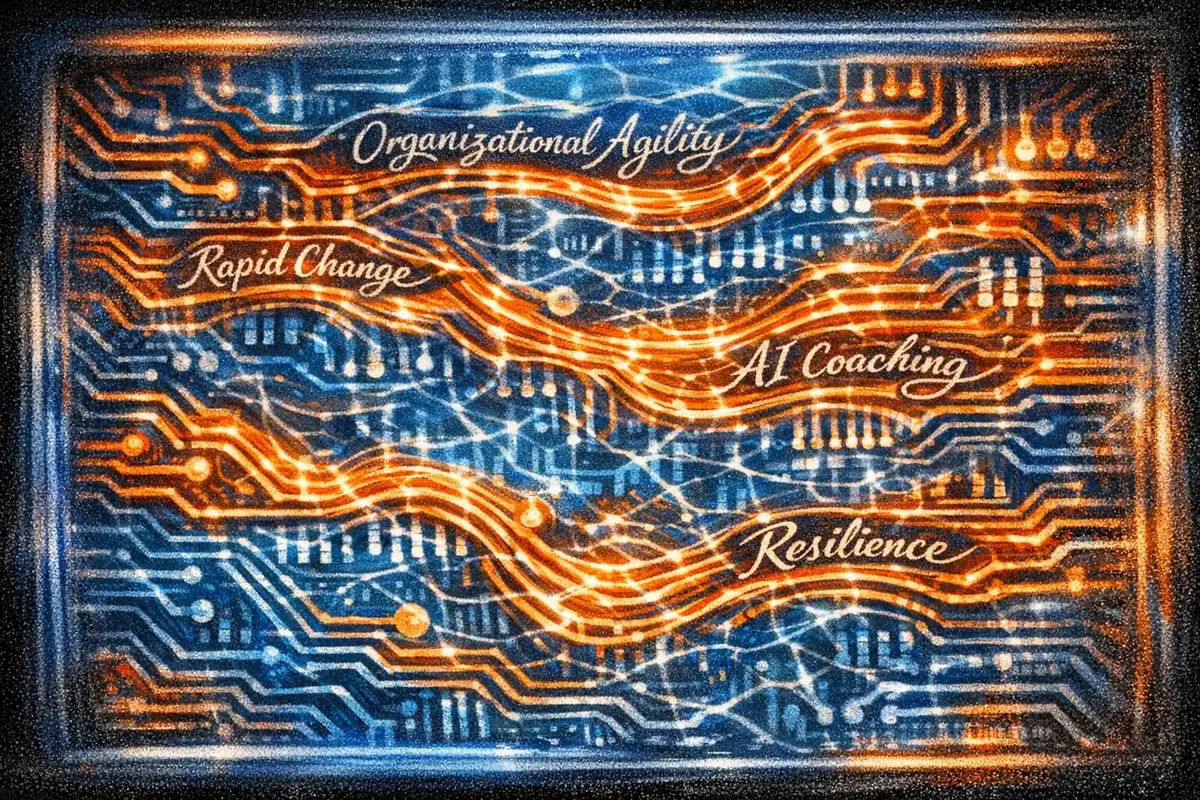
Most transformation plans assume that once the case for change is clear, people will move. In practice, they have to interpret new expectations, unlearn old habits, judge tradeoffs, and keep performing while the ground shifts beneath them. That is a learning problem under pressure, not a communication problem alone.
This is why many investments in organizational agility stall in the middle. The process map may be elegant. The capability curve is not. People do not resist change in the abstract; they hesitate when they cannot make sense of what competent action looks like now.
Where AI coaching starts to matter
This is where AI coaching becomes more than a technology feature. Used well, it acts as a just-in-time support layer inside the flow of work: helping a manager think through a difficult conversation, helping a team member clarify priorities, helping both reflect before uncertainty hardens into delay.
Not a replacement for leadership. A reinforcement of human judgment when confidence is thin.
The deeper question is uncomfortable: if agility depends on people staying steady while everything around them changes, is speed really the first requirement—or is something else missing?
Is stability the real prerequisite for agility?
75% of workers say they hope for greater stability in work ahead—so what if the thing leaders keep treating as the enemy of agility is actually one of its conditions (Deloitte, 2025)? If everyone agrees the market is moving too fast for rigid structures, why are so many organizations still asking people to adapt without giving them anything solid to stand on?
That tension is not theoretical. It sits inside most transformation plans. Leaders ask for speed, experimentation, and local decision-making; employees ask for clearer priorities, steadier expectations, and fewer moving targets. Both are rational.
Stability is not the opposite of movement
The mistake is to frame stability and agility as a tradeoff. In practice, stability is what lets people absorb change without disengaging. It gives teams a base layer of confidence: which decisions they own, what will not change this quarter, how success will be judged, where to escalate risk. Without that, “be agile” quickly becomes “figure it out alone.”
Deloitte’s 2025 findings make the gap hard to ignore. 72% recognize the importance of balancing agility and stability, yet only 39% are doing something meaningful about it (Deloitte, 2025).
72% see the need to balance agility and stability, but only 39% report meaningful action to create that balance (Deloitte, 2025).
That is why so many change efforts drift into transformation fatigue. Not because people reject adaptation, but because the organization keeps changing the surface while neglecting the anchors underneath.
A better model: stagility
Call it stagility: disciplined adaptation built on deliberate continuity.
The term matters because it corrects a common executive misunderstanding. Agility is not constant motion. It is not endless restructuring, weekly priority resets, or celebrating responsiveness while teams lose any sense of operating rhythm. Real agility depends on a few stable elements being protected on purpose—decision rights, meeting cadences, role clarity, coaching norms, and a credible narrative about what is changing versus what is not.
Picture a mid-market manufacturing company during annual budget planning. A plant operations director is told to accelerate automation, reduce costs, and redesign team workflows in the same quarter. The strategy is sound. The confusion starts when frontline supervisors hear three different versions of what “faster” means, and no one can tell whether quality thresholds, staffing assumptions, or escalation paths have changed. Work slows not from resistance, but from caution.
That is the operational value of stagility. It reduces interpretive drag.
And once leaders accept that balance is the design problem, a sharper question appears: what mechanism helps people find that balance day by day—inside real decisions, not just in strategy decks?
What does AI coaching actually do during transformation?
The just-in-time learning model matters here because most organizations still treat support during transformation as a training event, a manager cascade, or another automation layer. The evidence points somewhere else: when people are uncertain, behavior changes fastest when support shows up inside the decision itself—to help them think, not just comply.
That is the practical definition of AI coaching in transformation. Not a bot that answers policy questions. Not generic productivity software. It is a structured reflection layer that helps people interpret a live situation, test assumptions, choose a response, and reinforce better habits the next time a similar moment appears. Scrum.org has argued that generative AI is most useful in agile environments when it strengthens learning and adaptation rather than pretending to replace them (Scrum.org, 2024).
The mechanism: reflection, guidance, reinforcement
In a regional financial services firm during a quarterly review, a VP has to tell two business-unit heads that priorities have changed again. The technical decision is easy. The human risk is not: say too little and teams invent their own story; say too much and confidence drops further. This is where AI coaching earns its keep. It can prompt the leader to clarify intent, surface likely reactions, rehearse language, and check whether the message supports psychological safety or quietly damages it.
That sequence matters. Reflection slows reactive thinking. Guidance turns ambiguity into options. Reinforcement helps the person notice patterns and improve over time.
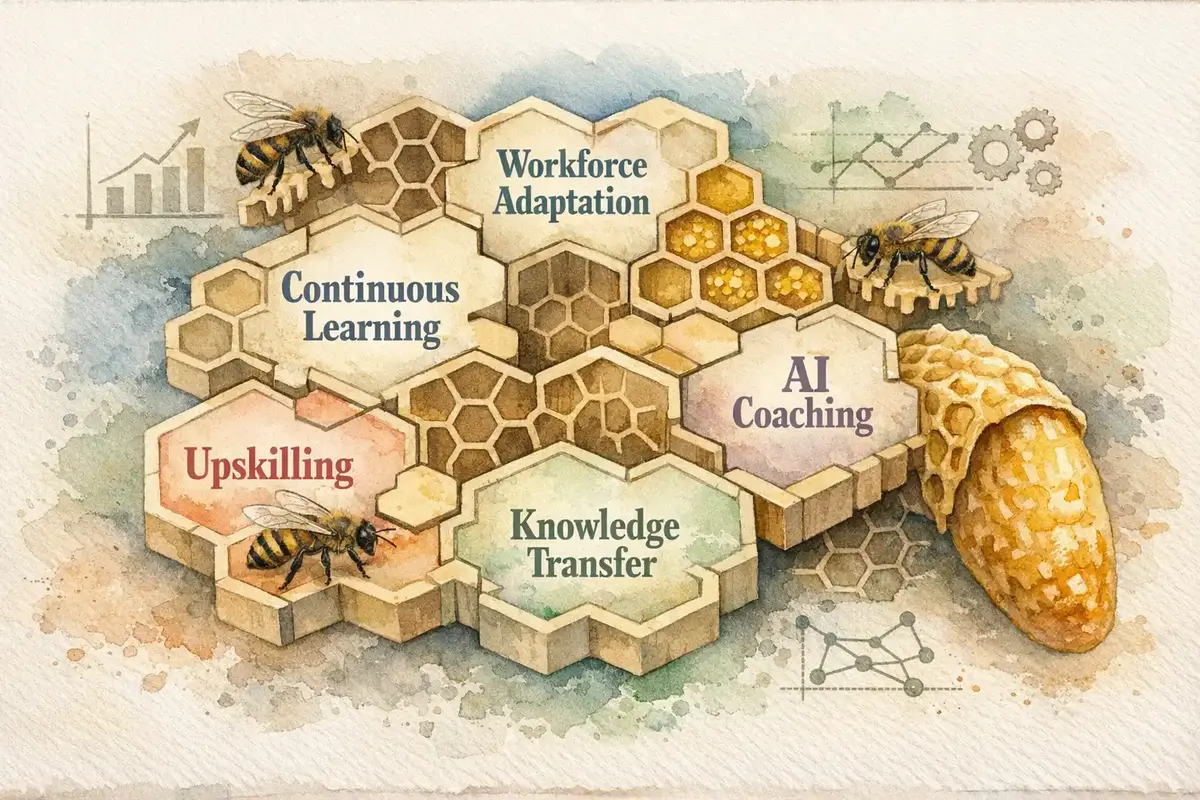
Scrum Alliance makes a related point: AI can extend coaching-like support across more teams during change, especially where demand for guidance exceeds the number of skilled coaches available (Scrum Alliance, 2024). The gain is not that every employee now has a “digital coach” in the human sense. The gain is that more people can access useful prompts, structured reflection, and consistent support at the moment they are stuck.
Where human coaching still matters
Human coaches still do the deeper work. They read power dynamics, challenge identity-level assumptions, and hold nuance that no system should be trusted to infer on its own. AI coaching augments judgment; it does not replace it.
That is why governance matters. The International Coaching Federation has emphasized standards, ethics, and clear boundaries when AI enters coaching contexts (ICF, 2024). Trust depends on it. If people do not know how guidance is generated, where data goes, or when escalation to a human is appropriate, adoption will stall no matter how elegant the tool appears.
And that creates the next problem. If support is available, why do so many transformation programs still lose people at the point of adoption—when the strategy is already approved and the real work should be getting easier?
Why do transformation programs fail at the adoption stage?
The average worker now experiences 10 planned enterprise changes each year, up from two in 2016—and when organizations get that wrong, they do not just lose momentum; they lose trust, discretionary effort, and often the people they most need to keep (Deloitte, 2025). What if the real failure point is not the transformation plan, but the human capacity to absorb it?
This is where many programs quietly break. The strategy is approved. The roadmap is funded. The governance is in place. Yet adoption stalls because people are being asked to change faster than they can interpret, prioritize, and practice new behavior.
Adoption fails when interpretation is outsourced to already overloaded managers
In a regional retail company during a store-operations restructure, a district director can usually tell within two weeks whether the change will stick. Not from the launch deck. From the questions that keep repeating: Which metric matters now? Who decides exceptions? What should teams stop doing? When those answers are unclear, managers fill the gap themselves—and every local interpretation creates more variation.
That problem gets worse because work no longer sits neatly inside one function. 81% of executives agree that work today is increasingly performed across functional boundaries (Deloitte, 2025).
81% of executives say work is increasingly performed across functional boundaries (Deloitte, 2025).
So adoption is not just an individual learning issue. It is a coordination issue. A sales leader, operations manager, and HR partner may all support the same transformation while carrying different assumptions about timing, tradeoffs, and risk. That is why strong change management often fails in execution: the message travels, but the meaning does not.
Volume without support becomes fatigue
Deloitte reports that 45% of HR leaders cite organizational transformation as their top priority for 2024 (Deloitte, 2025). Fair enough. The market is not waiting.
But priority at the top often becomes pile-on in the middle. Teams are handed a new system, a revised operating model, and fresh reporting lines in the same quarter, then judged as if adaptation were frictionless. That is how transformation fatigue builds—not from one major shift, but from accumulated unresolved adjustments.
The practical response is more disciplined than inspirational. Leaders need to coach for clarity, prioritization, and emotional load reduction before they expect broad behavior change. AI coaching can help here by turning vague pressure into specific decisions: what matters this week, what can wait, what conversation needs to happen now, what signal a team is actually reacting to.
That sounds simple. It is not. If leaders cannot reduce overload while keeping change moving, what exactly are they asking people to become—more agile, or just more exhausted?
How do leaders build resilience without slowing transformation?
The safe-to-learn operating model is what keeps transformation moving without burning people out. Without it, leaders get a false choice: tighten control and kill initiative, or push experimentation and watch consistency collapse.
Build guardrails, not rigidity
How do leaders keep people steady enough to learn while the organization keeps moving? By giving teams enough structure to reduce threat, while leaving enough room to test, adjust, and improve.
That starts with four behaviors: clarity, prioritization, feedback, and reinforcement. Clarity tells people what outcome matters now. Prioritization tells them what can wait. Feedback shortens the distance between action and learning. Reinforcement turns one good response into a repeatable habit.
Business Agility Institute’s research points in the same direction: agility improves when work is designed around learning loops rather than one-off change events (Business Agility Institute, 2024). That matters because resilience is not built in a town hall. It is built when teams can act, review, and adapt without having to renegotiate the whole system each time conditions shift.
In a mid-market technology company during a product portfolio reset, a director may need three teams to change delivery priorities in the same month. The teams do not need total freedom. They need clear decision boundaries, a short review cadence, and permission to surface what is not working early. That is what makes experimentation useful instead of chaotic.
Develop leaders, not just models
This is why leadership development is not a side investment during transformation. It is part of the operating logic.
AIHR has argued that leadership capability is one of the strongest levers for sustaining adaptability during workforce transformation (AIHR, 2024). That fits what experienced operators already know: operating models do not coach people through ambiguity; managers do. If leaders cannot frame tradeoffs, absorb tension, and help teams learn in motion, the model stays elegant and the behavior stays old.
Prosci’s research adds a practical point. Structured change management reduces resistance and improves adoption during transitions (Prosci, 2023). In practice, that structure should not mean more bureaucracy. It should mean predictable rhythms for communication, check-ins, escalation, and follow-through.
Resilience is a learning system
The strongest organizations treat resilience, adaptability, and continuous learning as one system, not three separate goals. Resilience lets people stay effective under pressure. Adaptability helps them adjust behavior. Continuous learning makes those adjustments accumulate.
That is how agility becomes durable.
But where should leaders put this into the business first—inside managers’ routines, team workflows, or enterprise change programs? And if they start everywhere, does focus disappear just when it matters most?
Where should organizations start if they want AI coaching to support agility?
What if the smartest first move is not scaling AI everywhere, but placing it where uncertainty is highest? That matters because broad deployment feels decisive while often creating one more layer of noise. The real test is narrower: where does change repeatedly stall because people do not know how to respond in the moment?
Start there.
Begin with friction, not coverage
The best entry point for AI coaching is not the enterprise rollout plan. It is the handful of moments that reliably produce hesitation, rework, or avoidable escalation.
Picture a regional services firm in the middle of a client-model redesign. A team lead has to explain new response standards to experienced staff while handling live delivery pressure. The issue is not a lack of information. It is that the manager needs immediate help framing tradeoffs, anticipating reactions, and deciding what to reinforce now versus later. That is a high-friction coaching moment. It is also a far better starting point than giving every employee a generic tool and hoping use cases emerge.
Scrum.org makes the distinction clearly: AI is most useful when it helps teams and coaches reflect on patterns and improve judgment, not when it tries to dictate decisions (Scrum.org, 2024). In practice, that means using it where ambiguity is concentrated—manager conversations, priority conflicts, handoff failures, and moments when psychological safety is most fragile.
Map the challenge before you choose the tool
A practical starting move is to map recurring change challenges to coaching responses. Where is confidence weakest? Where is clarity thin? Where is learning failing to compound?
That map usually reveals a small set of repeatable needs: preparing for difficult conversations, translating strategy into team-level action, reflecting after a misstep, or spotting patterns across repeated breakdowns. Once those moments are visible, AI coaching can be designed to support them with prompts, reflection paths, and escalation rules. Not before.
This is also where governance stops being a legal footnote and becomes an adoption issue. ICF has warned that AI in coaching contexts must be governed carefully so it strengthens trust and professional judgment rather than weakening them (ICF, 2024). Ethisphere reaches a similar conclusion from the technology side: responsible use depends on clear boundaries, oversight, and accountability (Ethisphere, 2024).
Augment trust-based leadership, do not replace it
Some conversations should stay human. Full stop.
AI can support leaders during workforce transformation by helping them prepare, reflect, and stay consistent. It should not replace the trust-bearing moments themselves—especially where identity, fairness, or career risk is in play. Start with the moments that need support most, govern them tightly, and let human leadership carry the weight only humans can carry.
Because once the system is in place, a harder question appears: what does agility look like when support is no longer an intervention, but part of how the organization works every day?
What durable agility looks like after the transformation wave passes
85% say organizations need more agile ways of organizing work to adapt quickly to market shifts (Deloitte, 2025). If you get this wrong, the bill does not arrive as a line item; it shows up as trust drained from the middle, strong managers leaving, and commercial momentum slipping because people no longer know how to respond without waiting for permission.
That is the real test after the transformation project closes: does the organization stay adaptable, or just tired?
Agility that lasts is designed into the work
In a global technology enterprise, the danger often appears six months after the launch. The program office has wound down. The dashboards look calmer. Then a product VP hits a quarterly planning cycle and realizes teams are still escalating routine tradeoffs that should now be handled locally. The process changed. The work design did not.
That distinction matters. Durable agility is not a temporary burst of responsiveness after a major initiative. It is what happens when decision rights, meeting rhythms, feedback loops, and manager habits are built to handle ambiguity as normal operating conditions. Not heroic effort. Not another campaign. Just the way work runs.
Deloitte’s 2025 data sharpens the point: 71% of workers perform work outside the scope of their job descriptions (Deloitte, 2025).
71% of workers are already operating beyond formal role boundaries (Deloitte, 2025).
That means organizational agility can no longer depend on static job architecture alone. If real work crosses lines every day, the operating model has to support judgment, coordination, and learning across those lines — consistently, not only during formal change periods.
The strongest model combines stability, learning, and adaptation
The organizations that hold up best after disruption do something subtle. They stop treating stability, learning, and adaptation as separate agendas owned by different functions.
They make them one system.
Stability gives people a reliable frame: what good judgment looks like here, which principles do not move, where risk belongs. Learning keeps that frame from becoming rigid. Adaptation lets teams adjust without having to rebuild trust every quarter. This is what continuous learning looks like when it matures: not extra training, but a work environment that helps people notice, interpret, and improve in real time.
Why AI coaching matters more after the rollout than during it
This is where AI coaching becomes more valuable, not less.
During transformation, it helps people through immediate uncertainty. After transformation, it helps the organization avoid regression. It gives managers and teams a way to keep reflecting on live decisions, reinforce better responses, and learn from recurring friction before old habits quietly return. That is the missing layer in many change efforts: support does not need to disappear once the launch is over.
Because in the end, agility is a human capability before it is a strategic claim. The organizations that last are not choosing stability or speed; they are building enough stability for people to keep adapting well. So in your context, after the project plan ends — what will keep your people learning?
Key Takeaways
- Agility breaks down first at the human layer when people lose confidence in how to act during change.
- Stability is not the opposite of agility; it is what helps people absorb change without disengaging.
- AI coaching works best as just-in-time support inside real decisions, not as a replacement for leadership.
- Durable agility comes from combining stability, learning, and adaptation into one operating system.
Frequently Asked Questions
What is organizational agility during rapid change?
Organizational agility is the ability to stay coherent while people are learning, deciding, and adjusting in real time. It is not just speed; it is the capacity to adapt without losing clarity, coordination, or decision quality.
Why does agility often break down during transformation?
Agility usually breaks down at the human layer first, when people feel overwhelmed, uncertain, or unable to judge what competent action looks like now. When confidence drops, decision cycles slow, escalations increase, and teams hesitate even if the process looks clear on paper.
How does stability support agility instead of opposing it?
Stability gives people a reliable base, such as clear decision rights, role clarity, and consistent expectations, so they can absorb change without disengaging. It reduces interpretive drag and makes it easier for teams to adapt without feeling like they are figuring everything out alone.
What does AI coaching do in an organizational transformation?
AI coaching provides just-in-time support inside real work by helping people reflect, clarify priorities, test assumptions, and prepare for difficult conversations. It strengthens human judgment during uncertainty, but it should not replace leadership or human coaching in complex, trust-sensitive situations.
Where should organizations start using AI coaching for agility?
The best starting point is the highest-friction moments where change repeatedly causes hesitation, rework, or escalation, such as manager conversations, priority conflicts, and handoffs. Mapping those recurring challenges first helps organizations apply AI coaching where it can improve confidence, clarity, and learning most effectively.