
Why a durable strategic north star matters more than a perfect plan
What if the real risk in crafting a multi-decade strategic vision is not having too little strategy, but having a strategy that expires before the organization does? That is the trap many CEOs face: the business looks active, disciplined, even ambitious, yet every consequential decision still gets dragged back into the logic of the next quarter.
You see it in the budget review. A regional healthcare CEO asks for a major capability investment, then watches the room reduce the discussion to this year’s margin pressure, this quarter’s hiring freeze, and the next board meeting. The organization is not directionless. It is over-directed by short horizons. This article is about how to build a strategic vision that can outlast market cycles because it guides decisions beyond the immediate reporting period.
A company can survive a weak quarter. It struggles to survive a pattern of decisions that quietly trade away its future. When leaders lack a durable strategic north star, they compensate with activity: more planning sessions, more dashboards, more tactical resets. The cost is rarely visible in one dramatic moment. It shows up as delayed commitments, fragmented investments, and a leadership team that keeps revisiting first principles instead of compounding around them.
Vision is a discipline, not a slogan
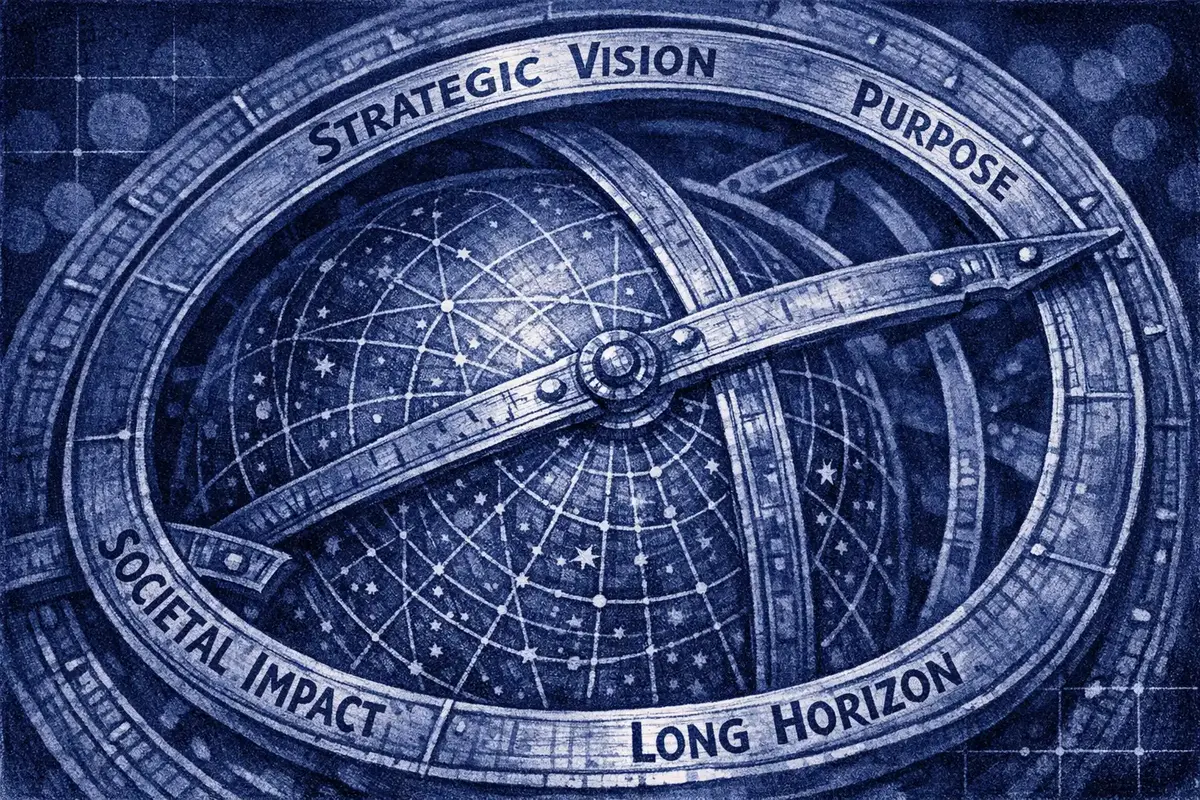
A multi-decade vision is not a branding exercise conducted offsite and unveiled at an all-hands. It is a leadership discipline: the repeated act of deciding what must remain stable while everything around it changes.
That distinction matters because the real test of vision is not whether it sounds inspiring when the founder says it. The test is whether it still organizes choices after a leadership transition, a technology shift, or a social expectation the original strategy never anticipated. If the vision only works under one executive, one business model, or one era of the market, it is not a north star. It is a temporary narrative.
A plan tells people what to do next. A north star tells them how to keep choosing when the map changes.
The filter that connects purpose, adaptability, and execution
The strongest long-range visions do three jobs at once. They anchor purpose so the organization knows what it is ultimately building. They preserve adaptability so teams can respond to new conditions without losing coherence. And they sharpen execution by making trade-offs faster, cleaner, and less political.
This is the promise of the blueprint that follows. Not a perfect plan. A durable decision filter.
Because the hard question is not whether your company can move quickly. It is whether speed is taking you somewhere that will still matter when the next cycle ends — or whether short-term agility has become a sophisticated way to drift.
Why short-term agility alone cannot build long-term resilience
7 in 10 business leaders say their primary competitive strategy for the next three years is to be fast and nimble (Deloitte, 2026). That sounds disciplined until you ask a harder question: if speed is now the dominant strategy, why do so many organizations still struggle to sustain commitment, coherence, and direction?
The answer is uncomfortable. Agility is useful, but it is not self-correcting. An organization can get very good at reacting and still become strategically unstable.
Activity can hide drift
The warning sign is not always financial first. Sometimes it is human. Global employee engagement has fallen to 20%, down from 23% in 2022 (Gallup, 2026). That is not just a culture metric. It is a strategic signal that many organizations are asking people to move constantly without helping them understand what all that motion is building toward.
When every quarter brings a new priority, people do not become more adaptive. They become more cautious.
In practice, this shows up as a leadership pattern. A mid-market technology CEO enters a quarterly review after a competitor launches a new feature set. Within 90 minutes, product roadmaps are reshuffled, hiring plans are paused, and customer success is told to rewrite its retention playbook. Nothing in the room is irrational. But six weeks later, teams are spending time reconciling the latest pivot with the last one, and the real cost is not just delay — it is the erosion of trust that this year’s effort will still matter next year.
That is how reactivity disguises itself as performance. The company looks busy. Calendars are full, decisions are fast, and dashboards update in real time. Yet the organization is quietly losing its ability to compound because each move is optimized for response, not continuity.
Agility needs a fixed reference point
Investors are not wrong to demand flexibility. 73% of investors want increased business model agility (PwC, 2024). They understand that rigid companies break when markets turn. But agility without a durable frame creates a different problem: leaders keep changing the vehicle without revisiting the destination.
Long-range vision is not the opposite of speed. It is what makes speed useful. It tells the organization which changes are intelligent adaptation and which are merely expensive motion.
This is the distinction many executive teams miss. A resilient company does not move slowly. It moves selectively. It can accelerate, pause, or redirect because it has already decided what must endure across product cycles, leadership changes, and market pressure.
The deeper confusion sits in language. If vision, strategy, mission, goals, and tactics are treated as interchangeable, then every urgent decision starts to feel existential. And when that happens, what exactly is the organization protecting — and what is it merely changing?
What is the difference between vision, strategy, mission, goals, and tactics?
The strategy cascade matters here because most leadership confusion is not about ambition. It is about language. When leaders use the same word for vision, strategy, and goals, what exactly is the organization following?
For a while, the confusion hides itself. The board deck looks coherent, the town hall sounds inspiring, and every team can point to a priority list. Then the first hard trade-off arrives, and people realize they were never aligned on whether they were discussing the destination, the route, or this quarter’s deliverables.
The hierarchy most teams blur
Start with plain definitions.
Vision is the long-range destination. It describes the future state the organization intends to help create, and it should be durable enough to outlast a planning cycle. A real vision is more specific than a slogan and broad enough to survive changes in product, channel, or leadership. If you need a sharper test, ask whether your vision statement can still guide a major capital decision three years from now.
Mission is different. It explains why the organization exists and whom it serves now. Mission grounds identity in the present; vision pulls identity into the future.
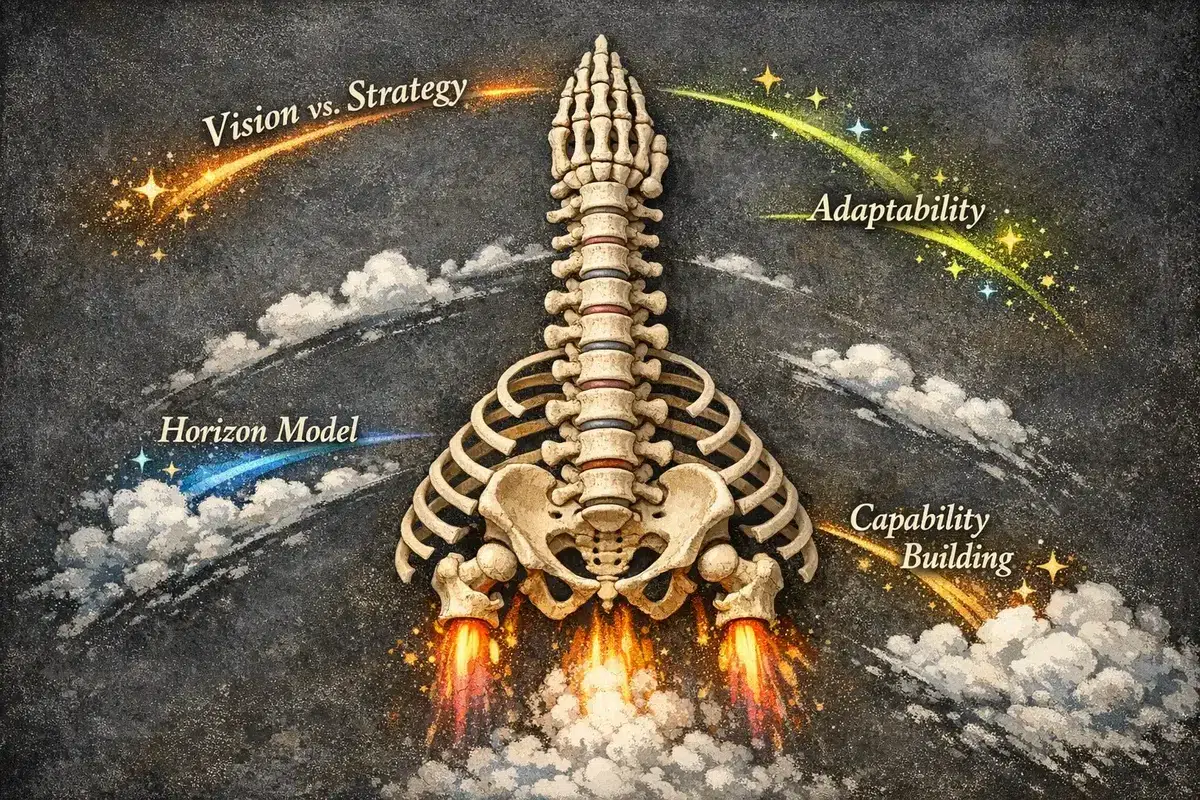
Strategy is the path. It is the set of choices about where to play, how to win, what capabilities to build, and what not to do. Strategy turns aspiration into a logic of advantage.
Goals are measurable milestones. They tell you whether the strategy is working. Revenue targets, retention thresholds, market-entry dates, safety metrics — these are goals.
Tactics are day-to-day actions. Campaigns, pricing tests, hiring sequences, plant scheduling, account plans. Tactics should change fastest because they sit closest to reality.
If vision, strategy, and tactics sound identical in the CEO’s mouth, the organization will eventually treat every urgent task as if it were destiny.
Why this distinction changes execution
In a regional manufacturing company, a VP enters the annual budget cycle arguing for automation investment. The CEO says the “vision” is growth, the CFO says the “strategy” is margin protection, and plant leaders are measured on quarterly throughput. Three smart people. Three different layers of the stack. The result is predictable: six months of debate, delayed equipment decisions, and teams optimizing for whichever word carries the most power in the room.
This is why CEO-level vision must sit above the planning horizon. Even governments use multi-year planning periods while adapting the route; the World Economic Forum’s analysis of China’s upcoming 15th Five-Year Plan for 2026 to 2030 shows that long-range direction and near-term adjustment are not opposites (World Economic Forum, 2025).
The hard part comes after the definitions. How does a CEO think in decades without turning vision into rigidity — or flexibility into drift?
How do CEOs think in decades without becoming rigid?
5,754,327 respondents sit behind Gallup’s long-run workplace dataset, and that scale matters because the horizon model is not a theory problem but a leadership operating problem tested against real organizational behavior over time (Gallup, 2026). Without it, companies confuse this year’s execution pressure with decade-level direction, and the result is not flexibility but strategic whiplash.
The model is simple. 1–3 years is the execution horizon. 3–10 years is the strategy horizon. 20–50 years is the legacy horizon — the level at which a CEO defines what the institution should still stand for after products, channels, and even industries shift.
Three horizons, three different jobs
Most executive teams fail here by asking one horizon to do all the work. They want a 30-year vision to produce next quarter’s budget answers, or they let annual targets rewrite the company’s long-term identity.
That is backwards. The short horizon is for commitments you can resource now: hiring, capital allocation, operating cadence. The middle horizon is where strategy lives: market position, capability building, portfolio choices, and the bets that need years to mature. The long horizon is different again. It is not a spreadsheet. It is a set of directional commitments about the value the company intends to create in the world, the problems it will keep solving, and the lines it will not cross.
Decade thinking is not about seeing the future clearly. It is about refusing to be governed only by the part you can measure this quarter.
This is the real contrast: prediction versus preparedness. A multi-decade vision should not read like a forecast of exact technologies, regulations, or customer behavior in 2050. It should read like a durable stance.
Scenario planning keeps vision loose and strategy sharp
In a regional financial services firm, the CEO enters a capital planning cycle facing three plausible futures: tighter regulation, AI-driven cost compression, or a trust-led premium market. The mistake would be choosing one future as if it were certain. The better move is to use scenario planning to test which investments make sense across all three.
That changes the conversation. Instead of debating predictions, the team asks harder questions: which capabilities remain valuable across scenarios, which risks would break the model, and which choices preserve optionality without diluting purpose? Vision stays anchored; strategy stays adaptive.
Research supports that discipline. Companies that tie short-term decisions to long-term strategy are 1.3 times more likely to outperform on revenue growth and 1.4 times more likely to outperform on return on capital (McKinsey, 2024). Not because they predict better, but because they decide better.
The next test is harder. If a vision must survive technology shifts, leadership turnover, and social change, what exactly makes it durable enough to hold — and flexible enough to live?
What makes a vision survive technology cycles, leadership transitions, and social change?
A retail CEO leaves the annual planning offsite with a bold growth story, then spends the next six months watching it unravel in product meetings, hiring debates, and succession conversations. The problem is rarely ambition. It is that the vision was attached to today’s business model instead of the organization’s enduring reason to exist.
That distinction matters more now because 80% of executives expect more R&D and capital investment over the next three years (PwC, 2024). More spending does not automatically create durability. It can just as easily lock a company more tightly into assumptions about products, channels, or customer behavior that will not hold.
A vision survives when its core purpose stays stable while its expression keeps moving. If your vision is “be the leading provider of X product,” technology cycles will eventually break it. If the vision is to solve a persistent customer problem, improve a critical human outcome, or build a trusted institutional role, then products can change without the company losing itself.
Durable vision is not loyalty to a format. It is loyalty to a contribution.
That is why long-range vision has to be built into capabilities, not just narratives. In a mid-market healthcare company, a new reimbursement model can make last year’s operating playbook obsolete in one budget cycle. What carries the strategy forward is not the old plan; it is the organization’s accumulated ability to learn faster, redeploy talent, and turn new information into coordinated action.
Research on 2,142 publicly traded U.S. companies points in the same direction: consistent growth is not the result of isolated bets but of a repeatable system (Harvard Business Review, 2024). And the payoff is not marginal. Top-quartile growth champions earned 4.2× revenue valuation (Harvard Business Review, 2024).
The vision must be carried by people, not protected by one CEO
This is where many otherwise strong CEOs underinvest. They treat succession as a governance event instead of a strategic design question.
If the vision lives mainly in the founder’s intuition, it will weaken during transition no matter how polished the handoff looks. If it is embedded in decision rules, talent pipelines, and leadership development, the organization can renew itself without starting over. The real asset is not charismatic continuity. It is institutional memory with adaptive leadership capacity.
A 50-year vision, then, is inseparable from building leaders who can reinterpret it without diluting it. Can your directors, VPs, and business-unit heads make hard trade-offs in its name when the CEO is not in the room—or does the vision disappear the moment translation is required?
Continuity becomes real only when it reaches the quarter
That is the next pressure point. A vision may be durable in principle, but can it shape hiring, capital allocation, product choices, and operating priorities this quarter—without becoming vague or ceremonial?
How do you translate a 50-year vision into decisions people can make this quarter?
1.3× better revenue growth and 1.4× stronger return on capital is what separates companies that tie short-term decisions to long-term strategy from those that do not (McKinsey, 2024). When that link breaks, the cost is immediate: money goes into the wrong projects, trust thins out, and strong people leave because this quarter keeps canceling the last one.
If the vision is truly durable, how does it change the next hiring decision, the next acquisition, or the next product bet? That is the real test.
Build a translation stack, not a slogan
A 50-year vision becomes usable only when it is broken into intermediate horizons. I usually advise CEOs to work with three layers: a 10-year capability horizon, a 3-year strategic commitment horizon, and a 12-month operating horizon. The long view defines what the institution must become. The middle view names the few capabilities and market positions that matter next. The annual view turns those choices into funded milestones, role requirements, and execution priorities.
This is where many teams get vague. They say the vision is innovation, trust, or category leadership, then approve budgets with no milestone logic behind those words.
A regional services company offers a familiar example. In a quarterly review, the COO wants to cut onboarding investment to protect margin, while the CHRO argues for manager development and the commercial lead pushes for a new client platform. The debate changes when the CEO asks three filter questions: does this decision strengthen a capability we will need in ten years, does it move a committed three-year priority, and does it improve this year’s operating performance without weakening the first two? Two proposals survive. One does not.
A long-range vision earns its keep only when it can say no in the budget meeting.
Turn vision into decision criteria
This is the practical move: define decision criteria before the next capital request arrives. For capital, ask whether the investment builds a durable advantage or merely patches a short-term gap. For talent, ask whether the role deepens a future-critical capability or just relieves current overload. For innovation, ask whether the bet extends your purpose into a changing market or distracts from it.
That discipline matters because pressure for flexibility is real. 73% of investors want increased business model agility (PwC, 2024). Fair enough. But agility without criteria becomes permission for drift.
Gallup’s 2026 workplace dataset covers 263,810 respondents, including 141,444 employed people (Gallup, 2026). At that scale, the signal is hard to ignore: people do better work when the organization’s choices feel coherent, not random. Coherence comes from connecting aspiration to operating reality through capability building, societal contribution, and a clear long-term strategy.
The quarter is where vision becomes believable. But one question remains: once the machinery is in place, what keeps it from becoming cold, mechanical, and detached from the people meant to carry it?
The strongest visions are durable because they stay human
Most organizations think endurance comes from precision. In practice, the visions that last are the ones people can still recognize when everything around them has changed.
That matters because markets do not only test strategy. They test meaning. When technologies shift, leaders leave, and customer expectations move, the non-negotiable question is not whether the old plan survives. It is whether the organization still knows what it is here to contribute.
Purpose holds; form evolves
This is where many long-range visions quietly fail. They are written as if durability means preserving today’s model — the current product mix, channel logic, operating structure, or leadership style. Research consistently shows the opposite: organizations stay resilient when they protect the underlying contribution and let the expression change.
A regional healthcare founder faces this moment after a leadership transition. The incoming CEO is capable, the market is changing, and the old growth engine is losing force. The board’s first instinct is to defend what made the company successful. The better question is harder: what must remain true about the value this institution creates, even if the services, partnerships, and economics look different three years from now?
That is the practical meaning of purpose. Not sentiment. Not branding. A stable reason for being that can survive new forms.
The strongest vision does not ask people to preserve the past. It asks them to preserve the promise.
This is also the thread running through the evidence cited across this article. McKinsey shows the performance advantage of linking near-term decisions to long-term direction (McKinsey, 2024). PwC shows why investors keep pressing for adaptability rather than fixed models (PwC, 2024). Gallup reminds us that people disengage when motion loses coherence (Gallup, 2026). Harvard Business Review points to systems, not isolated bets, as the basis of durable growth (Harvard Business Review, 2024). And the World Economic Forum reinforces a simple truth: long-range direction and near-term adjustment are not opposites (World Economic Forum, 2025).
Coherence beats prediction
That brings us to the central lesson. A multi-decade vision is not a forecasting exercise. It is a discipline of coherence.
The CEO’s job is not to predict the exact shape of the future. It is to keep the organization aligned around a contribution worth adapting for. That means being clear about what should remain stable — purpose, principles, core commitments — and equally clear about what should stay flexible: business models, capabilities, partnerships, and tactics.
Short-term pressure will never stop. Nor should it. The point is not to escape the quarter. It is to prevent the quarter from rewriting the institution’s identity.
If people cannot see themselves in the future you describe, they will treat strategy as compliance, not commitment.
So this is the closing test. When markets, technologies, and leadership teams change, what should remain non-negotiable in your organization — and what are you still protecting simply because it is familiar?
That is where a real 50-year vision begins. Not with certainty, but with the courage to decide what must remain true for your organization to matter decades from now.
Key Takeaways
- A durable strategic north star helps organizations avoid being over-directed by short horizons.
- Vision, mission, strategy, goals, and tactics serve different roles and should not be treated as interchangeable.
- Long-range vision works best when it is translated into intermediate horizons and decision criteria.
- The strongest visions stay human by protecting purpose while allowing form and execution to evolve.
Frequently Asked Questions
What is a multi-decade strategic vision?
A multi-decade strategic vision is a durable long-term direction that defines what an organization is ultimately trying to create or contribute over many years. It is not a detailed forecast or a fixed plan; it is a stable reference point that can guide decisions as markets, technologies, and leadership change.
How is vision different from strategy, mission, goals, and tactics?
Vision describes the long-range destination, mission explains why the organization exists now, strategy defines the path and major choices, goals are measurable milestones, and tactics are the day-to-day actions. Keeping these layers distinct helps leaders avoid treating every urgent task as if it were the organization’s ultimate direction.
Why is short-term agility not enough to build long-term resilience?
Agility helps organizations respond quickly, but without a durable reference point it can turn into constant reactivity and strategic drift. Long-term resilience comes from combining flexibility with continuity, so teams can adapt without repeatedly changing the destination.
How can CEOs think in decades without becoming rigid?
CEOs can use a horizon model that separates near-term execution, medium-term strategy, and long-term legacy or purpose. Scenario planning also helps by testing decisions against multiple possible futures, which keeps the vision stable while allowing the strategy to adapt.
How do you turn a 50-year vision into decisions people can make this quarter?
Translate the vision into intermediate horizons, such as 10-year capabilities, 3-year strategic commitments, and 12-month operating priorities. Then use clear decision criteria for capital, talent, and innovation so each quarterly choice strengthens the long-term direction instead of undermining it.