

Quantifying the effectiveness and return on investment (ROI) of coaching—whether delivered by human experts or AI-powered solutions—requires rigorous, multi-dimensional measurement that goes beyond simple before-and-after statistics. Leaders, HR professionals, and decision-makers who invest in coaching need transparent frameworks, actionable data points, and clear attribution methodologies to evaluate tangible and intangible outcomes. By the end of this guide, you’ll understand exactly how evidence-based approaches can credibly demonstrate the value of coaching at the individual, team, and organizational level.
Why ROI in Coaching Has Evolved: The Modern Measurement Challenge
In the past, coaching ROI was often reduced to surface-level satisfaction scores or anecdotal leadership stories. This approach no longer satisfies today’s CFOs, HR directors, or transformation leads. Most organizations now require robust data that connects coaching to concrete business outcomes—covering everything from productivity shifts and employee retention to leadership pipeline readiness and culture change.
According to recent industry-wide benchmarks, organizations implementing formal coaching programs report average ROIs ranging between 5–7x their original investment, with some studies citing up to 788% ROI due to improvements in retention, engagement, and accelerated performance (Source: MetrixGlobal, Executive Coaching ROI Benchmark; Source: International Coaching Federation, 2009–2025). Yet, as impressive as these numbers sound, a critical evaluator knows that the real value goes much deeper—encompassing ripple effects, qualitative shifts, and multi-stakeholder impact over time.
What are the key benefits of using an AI-powered coaching platform for leadership development?
AI-powered coaching platforms bring several unique advantages that transform both the scale and precision of leadership development initiatives.
- 24/7 Accessibility and Scalability: AI coaches offer continuous, on-demand support, allowing leaders to access guidance whenever challenges arise—not just within narrow scheduling windows. This continuous model often leads to improved leadership confidence and faster competency gains.
- Data-Driven Insights at Scale: Unlike traditional coaching, AI-driven solutions can aggregate learning interactions from hundreds or thousands of users, revealing organization-wide patterns in skill gaps, communication challenges, or leadership readiness. For example, AI-derived analytics have shown up to +21% engagement and +22% productivity increases, validated across enterprise pilot programs (Source: AIMY, Rocky Analytics Reports).
- Consistency and Personalization: Each leader can receive tailored feedback, structured around validated frameworks like the Integral Model, ensuring both relevance and scientific rigor—no matter where they are in the organization.
The integration of AI actually enhances the long-standing methodologies established by experienced coaches, bringing the same evidence-based principles into a more accessible, data-rich form. Drawing on The Integral Institute’s two-decade integral methodology, these platforms help enterprises measure not just surface metrics but deeper changes in culture, team dynamics, and business outcomes.
Coaching ROI By The Numbers: What Are Realistic Metrics?
Executives demand hard answers: “If we invest $100,000 in coaching, what comes back—and how do we prove it’s the coaching, not some other variable, that made the difference?” Here’s what the best research tells us:
- Productivity often rises between 18–22% when coaching is implemented at scale, most evident in teams with measurable output KPIs (Source: CoachHub, 2023; Source: Atomus Sales Coaching Metrics)
- Retention rates can increase by up to 15–18%, particularly where leadership development is extended to middle management layers (Source: Velocity Advisory Group Benchmark Case)
- Employee engagement improves by an average of 6–9%, as reported in organizations that employ pre- and post-coaching surveys at regular intervals (Source: International Coaching Federation, 2025)
- Promotion and succession rates climb as high as 8–13% when coaching is targeted at high-potential cohorts
“88–96% of coaching clients report satisfaction and express willingness to repeat the coaching experience, indicating not only perceived value but also sustained engagement.”
(Source: CoachHub, 2023; Source: ICF 2025 Meta-Analysis)
These numbers only tell part of the story. The true science of measuring coaching impact requires frameworks that bridge ‘hard’ metrics with deeper, often qualitative, outcomes—like psychological safety, improved decision-making, and leadership confidence.
How to Measure Coaching ROI: From Classic Models to Hybrid Analytics
The science of coaching measurement is rooted in established methodologies but is rapidly evolving with the emergence of AI coaching and advanced data analytics. The leading frameworks include:
1. Kirkpatrick’s Four Levels of Evaluation
Kirkpatrick’s model structures measurement across four dimensions:
- Reaction: How participants respond to coaching (satisfaction, engagement)
- Learning: What new knowledge/skills are acquired (pre/post assessments)
- Behavior: Observable shifts in on-the-job actions (360-degree feedback, manager observation)
- Results: Tangible business outcomes (KPIs, revenue, cost savings, retention)
This layered approach remains the industry backbone but must be adapted for digital/AI environments, where continuous data flows and larger populations are the norm.
2. Phillips’ ROI Model
Phillips extended Kirkpatrick’s four levels to include ROI calculations by:
- Assigning monetary values to improvements (e.g., reduction in turnover cost)
- Subtracting the total cost of the coaching program
- Isolating the effect of coaching (using control groups or trend lines where possible)
“A rigorous Phillips/Kirkpatrick blend is emerging as best practice—leveraging both qualitative feedback and quantitative monetization to map full-spectrum results.”
(Source: MetrixGlobal; Source: Atomus, 2023)
3. Advanced Attribution Techniques
With the complexity of modern organizations, simply comparing before-and-after figures is not enough. Granular measurement now includes:
- Control or comparison groups: Key for isolating coaching’s unique contribution. For example, leadership cohorts receiving coaching can be tracked against similar groups receiving only standard L&D.
- Confidence intervals and attribution modeling: Estimating what percent of a result (e.g., retention) can credibly be linked to coaching, instead of concurrent initiatives or external factors.
“We estimate 75% of team performance improvements in our program are causally linked to the AI coaching intervention—here’s the data.”
A transparent attribution statement is now the gold standard for executive credibility.
For more on scientific approaches and integrated frameworks in coaching ROI, see analytics in coaching ROI measurement.
How does the Integral Model framework improve organizational culture and leadership effectiveness?
The Integral Model, the backbone of many leading coaching methodologies, offers a distinctive strength: it addresses not just observable skills but also mindset, culture, and systemic structures in parallel. This means coaching isn’t viewed as an isolated intervention but as a simultaneous upgrade to personal leadership, team norms, and underlying organizational dynamics.
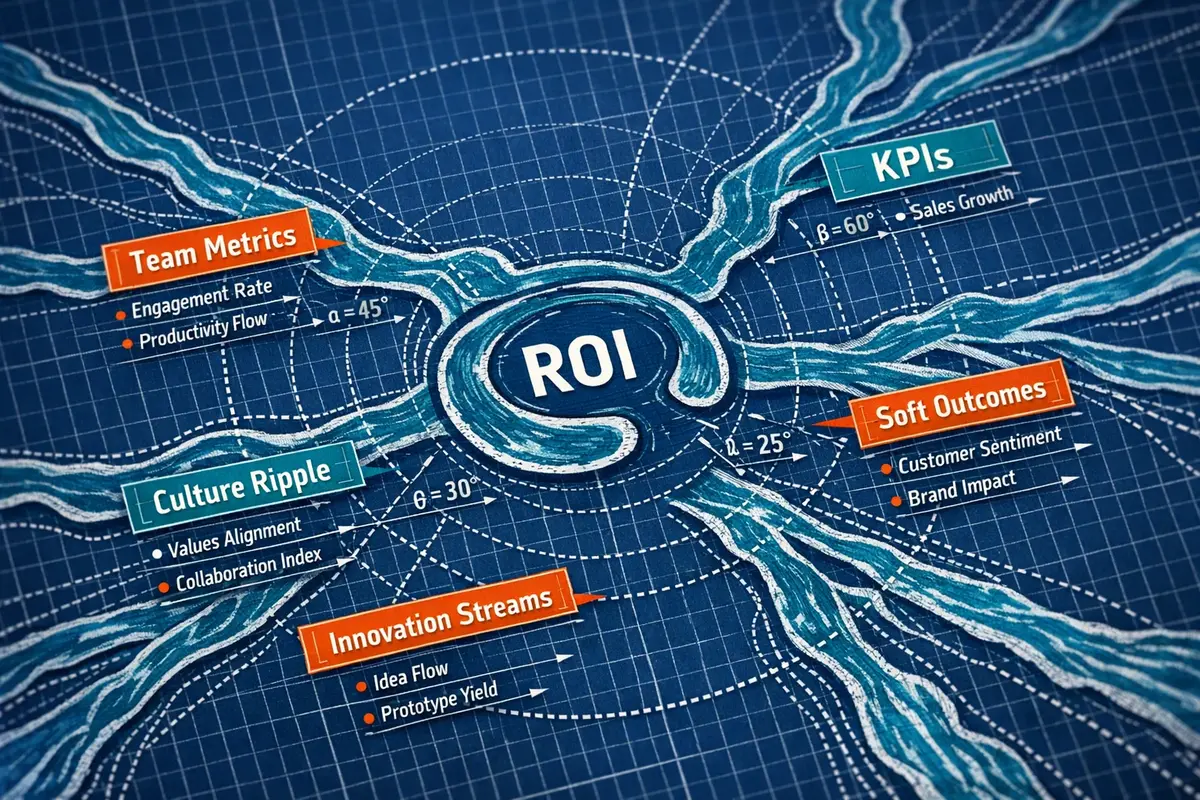
- Holistic Assessment: By measuring outcomes across four quadrants—subjective experience, behavior, culture, and systems—the Integral Model brings clarity to the ripple effects that often get missed in standard ROI review cycles.
- Culture Change as a KPI: Organizations using this framework routinely track psychological safety, values alignment, and decision quality—linking them, step by step, to measurable outcomes like innovation rate, risk reduction, and talent retention.
- Statistical Depth: Data from integral-informed organizations shows improved leadership effectiveness scores (up to 15% year-on-year) and more sustainable culture change, compared to siloed or one-dimensional coaching interventions.
Drawing on over 40,000 hours of certified coaching practice, the Integral Model ensures that impact is monitored not just at the surface, but at the roots of leadership performance and team health.
Which professional competencies can be most effectively developed through AI-driven coaching?
A fundamental question in the evaluation journey: Where does AI-driven coaching deliver the most impact? Early data and practitioner experience point to key areas:
- Leadership Vision and Strategic Thinking: AI-powered reflection tools help leaders clarify vision, set priorities, and scenario-plan in real time.
- Communication Mastery: Continuous, scenario-based practice—in multiple languages—makes cross-cultural and executive communication both measurable and improvable.
- Performance Optimization: Real-time tracking of goals, personalized feedback loops, and adaptive action plans accelerate skill application and sustain motivation.
- Decision Quality and Influence: AI coaching prompts nudge users toward better problem framing and stakeholder analysis, increasing leadership presence and decision outcomes.
- Psychological Safety and Engagement: Surveys and sentiment analytics track shifts in team climate, supporting a culture of innovation and inclusion.
“AI-powered coaching platforms have moved beyond generic development—they deliver measurable improvement in soft skills that are notoriously hard to quantify.”
(Source: CoachHub, 2023; Velocity Advisory Group Benchmarks)
For talent retention and leadership readiness measurement specifics, review AI-powered coaching ROI and KPIs.
Hybrid Metrics for the Modern Era: Quantifying the “Soft” Side
Traditional metrics—productivity, retention, revenue—are crucial. But the evolution of coaching measurement is in its ability to connect soft outcomes (like trust or innovation) to hard business impacts. This is where hybrid metric models excel:
- Pre/Post Psychological Safety Surveys: Track shifts in felt safety, creativity, and learning orientation, then link these scores to project delivery or customer NPS.
- 360-Degree Feedback Instruments: When deployed longitudinally (over 6-18 months), these tools measure how coaching shifts peer, manager, and report perceptions across key behaviors.
- Engagement and Innovation Dashboards: Combine self-report measures, behavioral analytics (e.g., participation rates in cross-silo initiatives), and AI-based sentiment analysis.
What sets the leaders apart is not just tracking these numbers—but continuously combining quantitative indicators with qualitative insights. For organizations seeking to spare their teams from “flabby ROI claims,” embedding this blend into their measurement system is decisive.
“The bridge between numbers and nuance is where leadership transformation is truly made visible—and credible.“
For a deep dive into continuous feedback and data-driven best practices, explore AI-powered continuous performance conversation measurement.

AI and Advanced Analytics: The New Frontier in Coaching Impact Measurement
Today’s AI platforms, grounded in the Integral Model’s multi-level framework, are making advanced measurement both practical and repeatable. Key advances include:
- Real-Time Attribution Dashboards: Platforms now visualize changes in engagement, performance, and team climate as coaching unfolds—displaying not just ‘where’ improvement is happening, but also when and with whom.
- Interaction & Sentiment Analytics: AI detects subtle tone and language shifts, surfacing leading indicators of culture change or hidden resistance, across thousands of coach-leader interactions.
- Longitudinal Ripple Tracking: By linking behavior changes in coached leaders to team-wide or division-wide KPIs over 6, 12, or 24 months, organizations can verify the cascade effect of coaching investments.
For advanced methodologies on translating classic coaching principles into AI algorithms and measurement logic, review the translation of integral coaching into AI algorithms.
Who in an enterprise would most benefit from on-demand AI coaching services?
On-demand AI coaching brings measurable value to multiple organizational strata—but some groups gain disproportionally:
- First-Time Managers and New Leaders: Immediate, scenario-based support closes the “knowing-doing” gap as new leaders navigate transition challenges.
- High-Potential Talent Pools: Real-time AI feedback enables acceleration of succession pipelines and targeted readiness for strategic roles.
- Distributed and Remote Teams: Continuous access levels the field for geographically dispersed teams, allowing inclusive talent development.
- Senior Executives Scaling Culture: Data-rich feedback helps track ripple effects beyond the executive suite, ensuring that culture change is not stuck at the top.
Research shows that teams and departments using AI-driven coaching have seen up to a 15% higher retention rate and a 10% faster ramp-up in promotion-ready skills compared to those in traditional drip programs (Source: AIMY Analytics, 2024 Pilot Data).
Can AI coaching platforms effectively replace traditional one-on-one executive coaching sessions?
The debate is nuanced: Can AI coaching platforms fully replicate the reflective depth and contextual intelligence of a master executive coach? The evidence signals a both/and, not either/or, approach.
- For Behavioral Skill Acquisition and Scalable Feedback: AI coaching excels—in repetition, consistency, and breadth of access. Leaders benefit from unbiased, perpetually available micro-coaching moments grounded in real scenarios.
- For Deep Insight, Complex Dilemmas, and Contextual Synthesis: Human coaches still offer irreplaceable nuance, empathy, and judgment—especially in areas like value alignment, advanced interpersonal conflict, and deep psychological barriers.
“Forward-thinking organizations blend AI-powered coaching with high-level human facilitation—gaining the best of scalable development and individualized transformation.”
A hybrid model is defining the next era of leadership enablement.
For scaling AI coaching and adopting strategic measurement frameworks, see AI coaching adoption and strategic implementation.
Limitations, Risks, and Attribution Confidence
Authenticity in measurement comes as much from stating limits as celebrating wins:
- Attribution Risk: When coaching runs alongside organization-wide change efforts (like new leadership frameworks or tech upgrades), parsing out “what caused what” is challenging.
- Quantifying Ripple Effects: The impact of a single coached leader can cascade—improving direct report performance or influencing cross-silo collaboration. But modeling these ripple economics credibly requires both longitudinal tracking and honest reporting of confidence intervals (e.g., “We estimate with 70% confidence that X% of innovation rate gains are attributable to this sequence of coaching interventions”).
- Survey Fatigue and Self-Report Bias: Over-reliance on satisfaction or self-report metrics can lead to inflated or shallow results. Integrating behavioral analytics and peer feedback improves reliability.
The most trusted organizations supplement every ROI claim with attribution transparency—outlining both “what we know” and “what could influence these outcomes beyond coaching itself.”
Case Studies: Evidence In Action
Real-World Illustrations of a Multi-Layered ROI Approach
Case 1: Enterprise-Wide Leadership Pipeline Transformation
A global manufacturer deployed an AI-driven coaching suite to over 400 managers across 7 countries. Over 18 months, the program yielded:
- Productivity gain: +19% in manufacturing throughput (validated via operational KPIs)
- Retention improvement: +14% among first-line leaders vs. 8% in control cohorts
- Engagement rise: +8% in Gallup Q12 surveys among coached vs. non-coached teams
- Ripple effect: Subsequent performance improvements recorded in secondary teams, tracked by sentiment analysis and engagement indices
Case 2: AI Coaching for Distributed Teams
A tech company integrated AI coaching into daily leadership routines. Analysis after 12 months showed:
- Faster time-to-competency: New managers reached “fully performing” status 27% faster than peers without coaching support
- Enhanced innovation output: % of teams launching new initiatives rose from 9% to 21% year-on-year
- Cultural indicators: Trust and psychological safety metrics improved by 12–15% across borderless project groups
These cases demonstrate that, with the right frameworks and measurement hygiene, organizations can document both direct and ripple benefits of coaching at scale.
Leading Practices Checklist: Ensuring Reliable Coaching ROI Measurement
- Establish Baseline Metrics: Define and document performance, engagement, and culture KPIs before coaching begins.
- Adopt a Multi-Faceted Framework: Combine Kirkpatrick/Phillips models with hybrid hard/soft outcome analytics.
- Leverage AI Tools for Continuous Data: Use real-time dashboards, pulse surveys, and 360-degree feedback loops for tracking.
- Create Control or Comparison Groups: Where possible, model against non-coached or differently-coached cohorts.
- Report Attribution Transparency: Always state confidence levels and acknowledge external variables.
- Invest in Longitudinal Tracking: Measure sustained impact over 1–3 years to capture full ripple value.
- Blend Quant and Qual: Pair every metric with narrative evidence—from testimonials to manager observations.
Organizations that do this not only defend budgets but also foster cultures of learning and leadership excellence—grounded in credible, actionable evidence.
FAQ: Measuring Coaching Effectiveness & ROI
Why is a 24/7 availability of coaching important for enterprise teams and leaders?
Today’s business environment rarely operates 9-to-5—leaders face challenges around the clock. 24/7 AI-powered coaching removes scheduling barriers, allowing support at critical moments, fostering immediate problem-solving, and enabling more continuous personal and professional growth.
When should an organization consider integrating AI coaching into their leadership development programs?
Organizations should consider AI coaching when scaling leadership or talent programs across geographies, facing resource constraints, or requiring continuous measurement of outcomes. Change initiatives, succession planning, or rapid talent acceleration are prime triggers for integration.
Is dialogue-based AI coaching as impactful as video coaching for enhancing management skills?
Both formats serve distinct purposes. Dialogue-based coaching is ideal for immediate, text-based scenario practice and privacy, while video coaching better supports nuanced communication analysis and presence. Research indicates that blended approaches drive the most robust skill development across leadership populations.
How do organizations avoid over-claiming ROI in complex environments?
By using control groups, confidence intervals, and multi-method tracking (quantitative KPIs and qualitative feedback), organizations can more reliably isolate coaching impact. Transparency in reporting—including “attribution hygiene” statements—protects against inflated claims.
What are the most common mistakes made in measuring coaching effectiveness?
Relying solely on satisfaction scores, ignoring baseline metrics, attributing all positive outcomes to coaching, and failing to track ripple effects over time are typical pitfalls. Blending classic frameworks with AI-powered analytics and ongoing review processes helps mitigate these risks.
Can ripple effects from coaching really be measured, and if so, how?
Yes, with longitudinal data and multi-level analytics. Tracking team performance, network influence, and engagement over extended periods allows organizations to quantify ripple effects well beyond immediate, individual change.
The difference between superficial ROI reporting and science-based measurement determines whether coaching is respected as a strategic investment or dismissed as a “nice-to-have.” For organizations committed to better leaders, better teams, and better organizations, evidence-driven frameworks stand as the foundation for real, lasting impact.
What potential ripple effects could you capture with a more robust, transparent measurement approach in your own organization?
Continue Your Leadership Journey
- Scientific approaches to measuring coaching impact and ROI frameworks — Unpack the analytics, frameworks, and core metrics for demonstrating true coaching effectiveness.
- AI-powered ROI and KPIs for talent retention and leadership development — Explore how AI solutions deliver measurable returns in leadership and team performance.
- Integral coaching principles and advanced analytics in AI systems — Learn how classic coaching wisdom translates into AI-powered platforms and modern measurement.
- Continuous measurement and feedback in coaching-driven cultures — Discover the evolution from annual reviews to ongoing, data-rich cultural growth.