Integral coaching is a holistic, systems-based approach to professional development that addresses the whole person—mind, body, emotions, and spirit—across multiple dimensions of life including work, relationships, purpose, and growth. Rooted in Ken Wilber’s Integral Theory and the AQAL (All Quadrants, All Levels) model, integral coaching goes beyond traditional skill-building to transform how leaders think, feel, act, and relate to themselves and others. It is distinguished by ICF (International Coach Federation) certification at the MCC (Master Certified Coach), PCC (Professional Certified Coach), and ACC (Associate Certified Coach) levels, with demonstrated measurable impact on executive performance, organizational culture, and business outcomes. This approach is central to developing leaders who can navigate complexity and drive measurable business results. Companies using AI in talent development see 25% improvement (McKinsey).
The Integral Institute has delivered over 20,000 coaching sessions using this methodology across Turkey and the MENA region, combining rigorous coach training with proprietary frameworks that integrate neuroscience, psychology, organizational systems, and emerging AI capabilities. This comprehensive guide explores the foundations, practical applications, and transformative impact of integral coaching in enterprise settings.
What is Integral Coaching?
Integral coaching is fundamentally different from transactional or skills-based coaching. While traditional coaching often focuses on specific behavioral change or goal attainment, integral coaching works at a deeper level—addressing the underlying beliefs, values, emotional patterns, and ways of thinking that shape a leader’s effectiveness and well-being.
The term “integral” reflects the methodology’s comprehensive approach. It honors multiple dimensions of the human experience:
- Cognitive dimension: How leaders think, make decisions, and perceive complex situations
- Emotional dimension: How leaders regulate emotions, build relationships, and create psychological safety
- Somatic dimension: How nervous system arousal, embodied presence, and physical awareness impact leadership
- Relational dimension: How leaders connect with others, influence culture, and build trust
- Purpose dimension: How leaders connect to meaning, values, and long-term vision
- Organizational dimension: How individual transformation cascades into team and enterprise-wide impact
At its foundation, integral coaching rests on three core principles: wholeness (acknowledging the complete person, not just professional skills), awareness (building capacity for reflection and metacognition), and transformation (creating lasting shifts in how leaders show up, not just temporary compliance).
The coach-client relationship in integral work is distinctly non-directive. Rather than prescribing solutions, integral coaches ask powerful questions, reflect patterns, challenge assumptions, and create accountability for the client’s own discoveries. This builds self-authoring capacity—the ability for leaders to think for themselves, adapt to complexity, and lead with authenticity.
How Does Integral Coaching Differ from Traditional Coaching?
Executive coaching is a $4.564 billion global industry, according to the ICF Global Coaching Study. However, the quality, depth, and methodology of coaching varies dramatically. Here’s how integral coaching stands apart:
Integral vs. Traditional Coaching: Key Distinctions
| Dimension | Traditional Coaching | Integral Coaching |
|---|---|---|
| Focus | Goals, behaviors, specific skills | Whole-person transformation, mindsets, and systemic impact |
| Framework | Often goal-focused models (SMART, OKRs) | AQAL model—all quadrants, all levels, developmental lines |
| Scope | Narrow (career, communication, confidence) | Wide (inner development, relationships, purpose, organization) |
| Change mechanism | External accountability + behavioral modification | Internal capacity-building + consciousness development |
| Coach role | Directive guide, solution provider | Non-directive partner, pattern reflector, space-holder |
| Duration & depth | 3-6 months, often episodic | 12-24+ months, sustained transformation |
| Certification rigor | Variable (many unaccredited programs) | ICF-credential required (MCC/PCC/ACC), 125+ training hours + supervised practice |
| Measured outcomes | Task completion, confidence ratings | Leadership effectiveness, business impact, team engagement, retention |
Why this matters: Traditional coaching delivers results (ICF research shows a 529% return on investment for executive coaching). However, integral coaching operates at the level of identity and consciousness, creating leaders who can adapt to ambiguity, navigate complexity, and inspire cultures of continuous learning and ethical action.
Many leaders and organizations operate in reactive, task-oriented mindsets. Integral coaching develops the capacity to be proactive, systems-aware, and values-aligned. This shift is particularly critical in volatile, uncertain, complex, and ambiguous (VUCA) environments—precisely where today’s C-suite operates.
The Integral Framework: Ken Wilber’s AQAL Model in Coaching
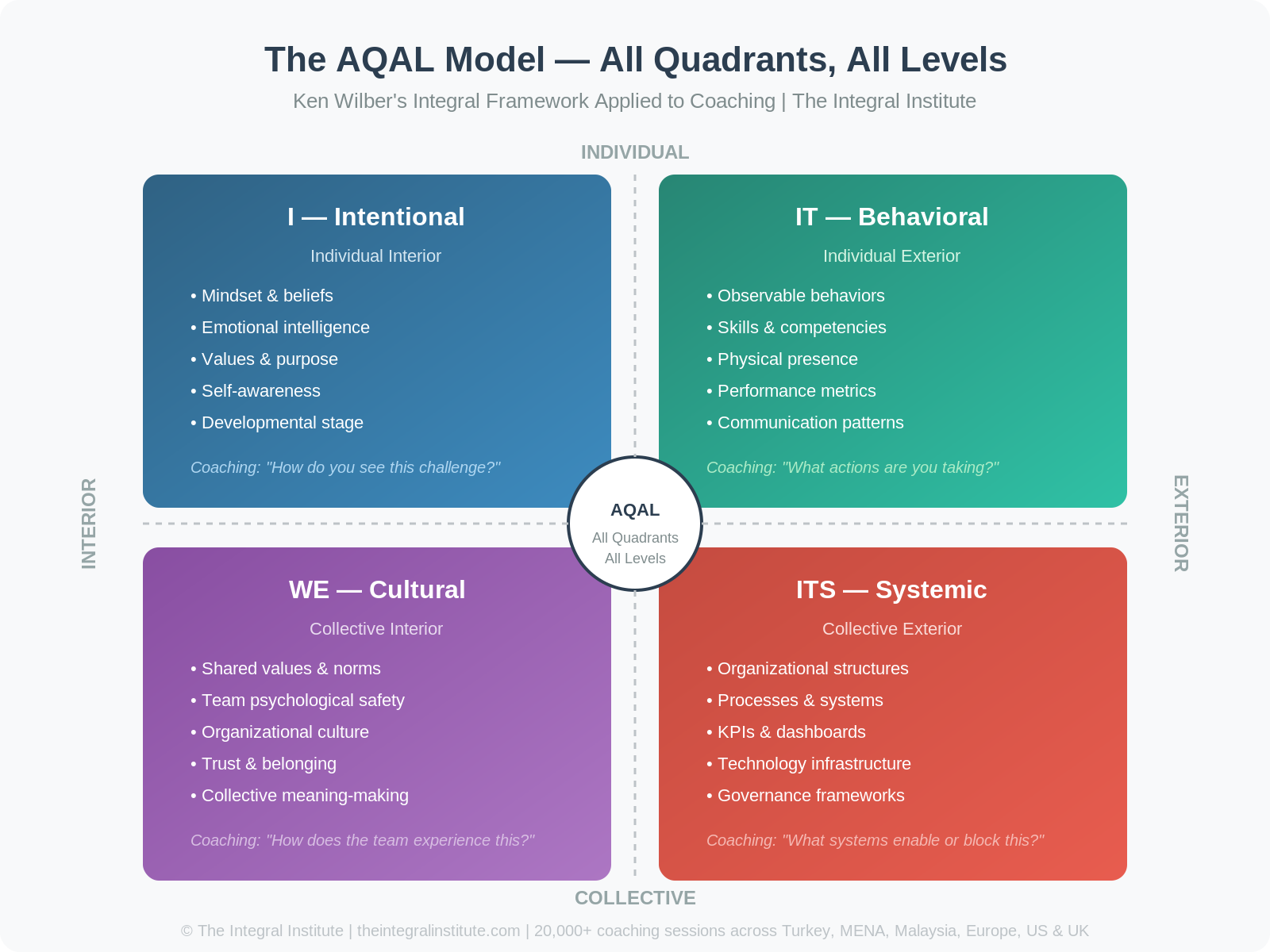
The intellectual foundation of integral coaching is Ken Wilber’s Integral Theory, specifically the AQAL (All Quadrants, All Levels) model. This framework organizes human development across four key dimensions:
The Four Quadrants
1. Upper Left (Individual Interior / Consciousness)
A leader’s thoughts, beliefs, feelings, and subjective experience. In integral coaching, this quadrant explores: How does a leader make meaning? What fears or limiting beliefs drive their decisions? How emotionally intelligent are they? What values guide them?
2. Upper Right (Individual Exterior / Behavior & Physiology)
A leader’s observable actions, behaviors, and physical/neurological state. This quadrant examines: What actions create results? How is the nervous system regulated? What communication patterns are in place? How present and embodied is the leader?
3. Lower Left (Collective Interior / Culture & Shared Meaning)
The team or organization’s shared beliefs, norms, and culture. Integral coaching explores: What cultural assumptions exist? How is trust built? What values are truly lived versus proclaimed? How does the team make meaning together?
4. Lower Right (Collective Exterior / Systems & Structures)
Organizational systems, processes, incentives, and structures. This quadrant assesses: Are systems aligned with strategy? Do org structures enable collaboration or create silos? How do processes either enable or block transformation?
All Levels: Developmental Stages
Integral coaching recognizes that leaders operate at different stages of psychological and consciousness development. The model includes stages from reactive (focused on survival/self-protection) through creative (goal-oriented, achievement-driven) to collaborative (systems-aware, others-focused) and integral (holding multiple perspectives simultaneously, able to transcend-and-include complexity).
Effective integral coaching meets leaders where they are developmentally and creates conditions for evolution to the next stage. A CEO operating in reactive mode needs different coaching than one in creative mode. Integral coaches assess developmental stage and tailor their approach accordingly.
Why AQAL Matters for Enterprise Leaders
Most business problems are not confined to one quadrant. A team’s poor execution (UL: lower vision clarity) combined with misaligned structures (LR: inefficient processes) and weak interpersonal trust (LL: low psychological safety) requires integrated intervention across all quadrants. Coaches trained only in behavioral or goal-based methods miss the systemic nature of organizational challenges.
Integral coaches help leaders see these connections, diagnose root causes accurately, and intervene at the level where transformation is most likely to stick.
ICF Certification and Integral Coaching: MCC, PCC, and ACC Levels
The International Coach Federation (ICF) is the global authority on coaching credentials, with over 50,000 credentialed coaches worldwide. ICF certification provides standardized competency assurance and ethical accountability—critical for organizations investing in coaching and for coaches building trust.
The Three ICF Credential Levels
ACC (Associate Certified Coach)
Requirements: 60+ hours of coach training, 100+ hours of supervised coaching practice, passing exam
Profile: Early-career coaches or those new to professional coaching. Competent in foundational coaching skills but still building depth and breadth of practice.
Client suitability: Best for organizations seeking cost-effective coaching for emerging leaders or for individual contributors seeking skill development.
PCC (Professional Certified Coach)
Requirements: 125+ hours of coach training, 500+ hours of supervised coaching practice, exam, continuing education
Profile: Experienced coaches with demonstrated mastery of coaching competencies. Experienced in working with complex client situations, organizational contexts, and diverse populations.
Client suitability: Standard credential for executive coaching. Appropriate for mid-level and senior leaders where stakes are higher.
MCC (Master Certified Coach)
Requirements: 200+ hours of coach training, 2,500+ hours of supervised coaching practice, exam, advanced continuing education
Profile: Elite coaches with 10+ years of experience and mastery-level competency. Capable of coaching the most complex, high-stakes situations. Often have advanced training in psychology, organizational development, or specialized methodologies.
Client suitability: C-suite executives, board-level coaching, organizational transformation initiatives, specialized niches (executive presence, succession planning, crisis leadership).
Why ICF Credentials Matter for Integral Coaching
Integral coaching requires mastery of sophisticated frameworks, the ability to hold multiple perspectives, and deep competency in working with complex, high-stakes client situations. MCC and PCC credentialed coaches have demonstrated this mastery through rigorous training, supervised practice, and examination.
The Integral Institute operates exclusively with MCC, PCC, and ACC credentialed coaches, backed by 20,000+ real coaching sessions in enterprise contexts. This credential requirement ensures that every coaching engagement meets international standards for competency and ethical practice.
When organizations invest in coaching, credential status is a proxy for quality, depth, and accountability. ICF credentials matter because they signal: (1) the coach has met standardized training requirements, (2) the coach practices under an ethical code, and (3) the coach participates in ongoing continuing education and professional development.
The Four Quadrants Applied to Executive Development
To illustrate how integral coaching works in practice, consider a real scenario: a high-performing VP of Operations struggling to lead her cross-functional team through a major digital transformation.
A traditional coach might focus on “communication skills” or “influence tactics”—skills in the Upper Right quadrant. An integral coach would assess all quadrants:
Upper Left (Her consciousness, beliefs, emotions)
- Does she hold an implicit belief that “if I don’t control everything, chaos results”? (anxious attachment pattern)
- Is she running on fear of failure or inability to delegate?
- What values matter to her (command-and-control vs. collaborative learning)?
- Is she emotionally safe enough to be vulnerable with her team?
Upper Right (Her behaviors and nervous system state)
- When stressed, does she go into fight mode (aggressive directives) or collapse mode (withdrawn)?
- How present is she in conversations? Is she listening or planning her next move?
- What communication patterns trigger defensiveness in others?
- Can she regulate her own nervous system enough to co-regulate her team?
Lower Left (Team culture and psychological safety)
- Does the team trust her, or do they perform compliance theater?
- Are people bringing their full selves to work, or just their job descriptions?
- Is there psychological safety to voice concerns, ideas, or mistakes?
- What implicit norms govern how the team makes decisions?
Lower Right (Team structures and systems)
- Are decision-making authority and accountability clear?
- Do systems and processes enable cross-functional collaboration, or do they create silos?
- Are incentives aligned with transformation goals or competing priorities?
- Is the team’s calendar and meeting rhythm conducive to deep work?
Integral coaching output: Rather than “improve your listening skills,” an integral coach might uncover: “Your pattern of controlling outcomes comes from past experiences of abandonment. When you learned to lead by controlling, that protected you. But now your team experiences that control as lack of trust, and it’s blocking the psychological safety they need to innovate. Your first work is internal—building your own capacity to trust emergence and uncertainty. Once you shift your internal experience of control vs. trust, your behaviors will naturally change, your team will perceive you differently, and the culture will shift to one of collaborative learning.”
This diagnosis goes to the root, making sustainable transformation possible. And because the VP is now aware of her pattern, she can choose differently—she’s not just being told to “communicate better.”
Integral Coaching in Enterprise Settings
The enterprise context is where integral coaching’s power becomes most apparent. Organizations with strong coaching cultures—where senior leaders model vulnerability, curiosity, and commitment to their own development—report significantly better business outcomes.
Research on Coaching and Business Impact
Organizations with strong coaching cultures report 21% higher profitability (Deloitte, 2023). This finding is not coincidental. Coaching-centered cultures attract and retain talent, reduce costly turnover, improve decision-making quality, and build organizational resilience.
Executive coaching delivers a median ROI of 529% (ICF & PwC Executive Coaching Global Study, 2023). For a $50,000 annual coaching engagement with a C-level executive, organizations typically see $264,500 in measurable returns through improved decision-making, faster problem-solving, better team dynamics, and reduced turnover costs.
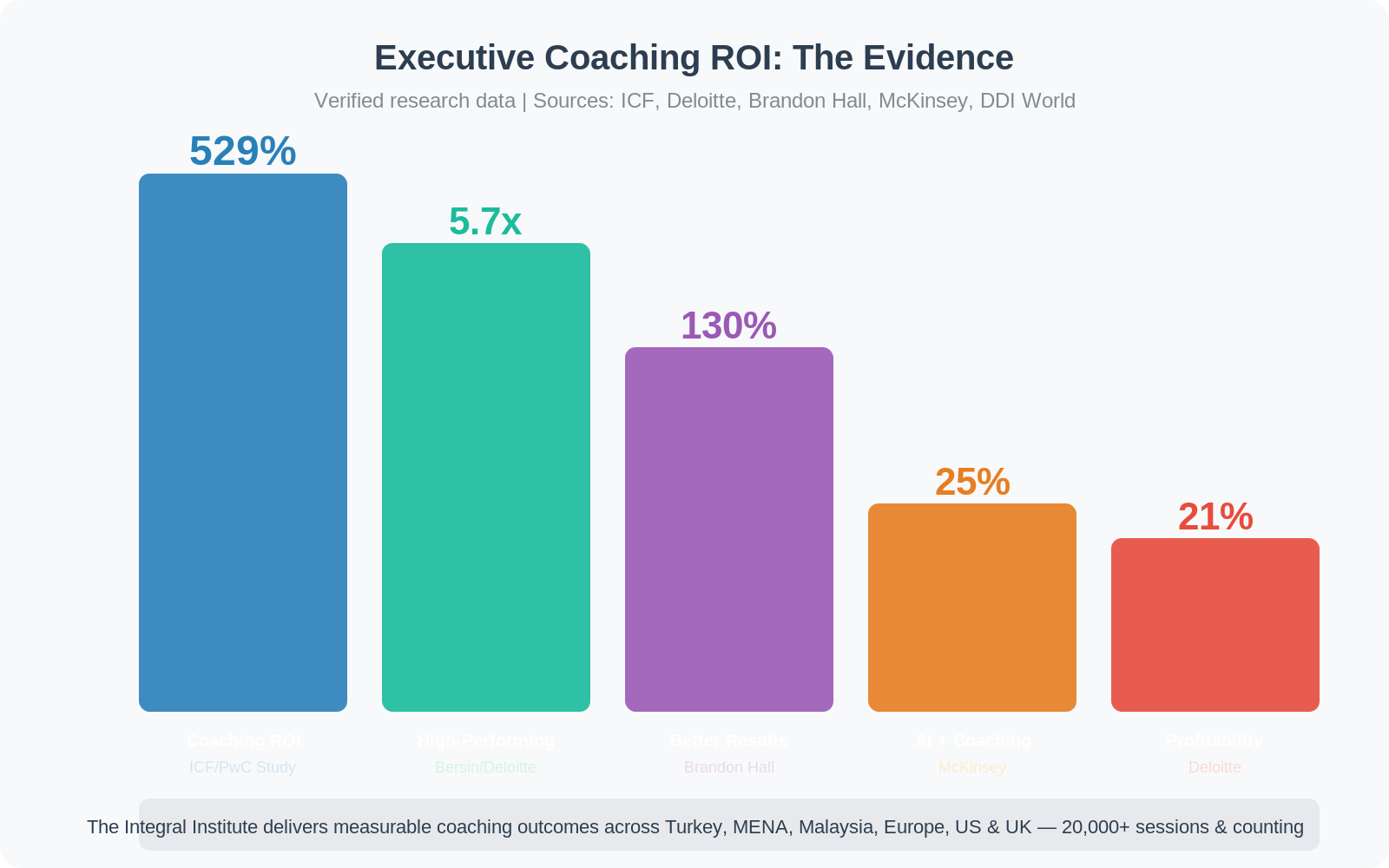
Companies with strong coaching see 130% more likely to report strong business results (Brandon Hall Group). The mechanism is clear: better leaders lead to better strategy execution, higher employee engagement, and superior business outcomes.
Only 14% of CEOs have the leadership talent needed for their role (Development Dimensions International). Coaching is one of the few interventions proven to close this leadership talent gap.
Why Integral Coaching Scales in Enterprise
Integral coaching is particularly powerful in enterprise because it operates at the level of leadership system, not just individual leaders.
When the CEO works with an integral coach on her own consciousness, beliefs, and ways of being, that shifts ripple through the entire executive team. Her team observes her vulnerability, her commitment to her own growth, her ability to hold complexity without collapsing into either/or thinking. They unconsciously grant her permission to do their own work.
Integral coaching programs in enterprise often include:
- 1-on-1 coaching for senior leaders (CEO, C-suite, board members)
- Team coaching for executive teams working on trust, decision-making, and culture
- Peer coaching circles where leaders develop coaching skills and hold each other accountable
- Coach training for HR leaders and emerging leaders, embedding coaching as a core leadership competency
- Organizational assessment across all four quadrants, identifying system-wide blocks to performance and engagement
Organizations that implement integral coaching at scale—from the boardroom through emerging leader development programs—report sustained improvements in decision-making quality, psychological safety, cross-functional collaboration, and retention of top talent.
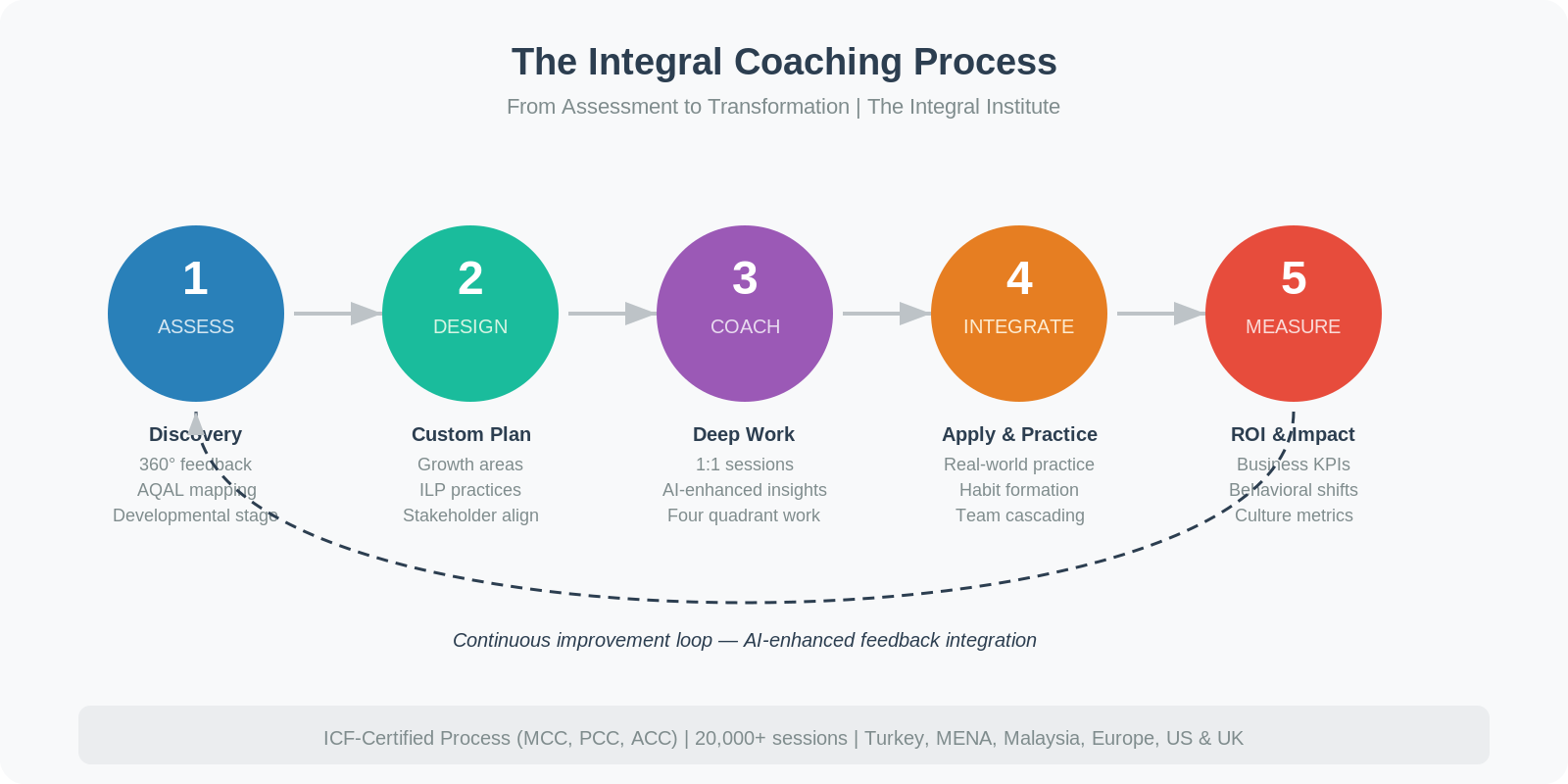
AI-Enhanced Integral Coaching: The Future
The Integral Institute’s AI Coach System represents the future of integral coaching—combining the depth and rigor of certified integral methodology with the scalability and personalization of artificial intelligence.
Why Integral Coaching + AI Creates a New Category
Integral coaching has historically been limited by scarcity: only a small number of highly trained MCC and PCC coaches exist globally. The time investment required for deep coaching relationships means that only senior leaders have access. Integral Coach System changes this equation.
An AI coaching platform trained on the AQAL model and built on principles of integral methodology can:
- Democratize access: Make high-quality coaching available to every leader, not just C-suite, regardless of budget or geographic location
- Provide 24/7 availability: Coaching is available whenever a leader needs reflection or accountability, not just during scheduled sessions
- Offer personalized learning paths: AI can analyze a leader’s responses, challenges, and developmental stage, tailoring recommendations and assessments
- Maintain consistent methodology: Human coaches bring varying approaches; AI systems deliver consistent application of integral frameworks
- Integrate multi-modal feedback: AI can synthesize 360 feedback, leadership assessments, team sentiment, and organizational metrics, providing holistic feedback
- Bridge gaps between coaching sessions: Human coaches are hourly; AI can support daily reflection, accountability, and micro-learning
The AI Coach System Advantage: Built on 20,000+ Real Coaching Sessions
Most AI coaching platforms are trained on generic leadership content. The Integral Institute’s approach is different: the system is trained on patterns from 20,000+ real coaching sessions with MCC, PCC, and ACC certified coaches.
This means the AI understands:
- How leaders actually think when facing complexity (not how consultants think they should think)
- Which coaching interventions create breakthrough insights (not which sound logical)
- How to sequence coaching so leaders build capacity progressively (not overwhelming them)
- How to recognize when a leader is in defensive mode vs. open learning mode
- How to ask powerful questions that create genuine self-discovery
Human Coach + AI: A Hybrid Model
The most powerful implementation is hybrid: AI-powered coaching as the foundation, with human coaches for complexity and crisis.
A leader might use the AI Coach System daily—for reflection before important meetings, processing difficult feedback, or accountability on commitments. For quarterly deep work on consciousness-level shifts or navigation of major transitions, they engage a human integral coach. This hybrid model extends human coach capacity (one coach can oversee 50+ clients using AI between sessions) while ensuring that high-stakes, high-complexity situations still receive human attention.
In enterprise settings, this hybrid model makes coaching-centered cultures economically viable, even for mid-market organizations.
Measuring ROI of Integral Coaching Programs
A common objection to coaching is “How do we measure the return?” Unlike training, which has attendance metrics, coaching outcomes are behavioral, relational, and systemic. However, rigorous measurement is possible.
Quantitative Metrics
- Leadership effectiveness scores: 360-degree feedback administered pre- and post-coaching, measured against behavioral competencies aligned to business strategy
- Employee engagement and retention: Direct reports’ engagement scores and voluntary turnover among a coached leader’s team
- Promotability velocity: Speed of advancement for leaders who received coaching vs. control group
- Key decision speed and quality: Time-to-decision and post-decision outcome quality for critical strategic decisions
- Cross-functional collaboration: Internal survey of partnership effectiveness among peer leaders
- Internal pipeline strength: Percentage of senior roles filled from internal vs. external candidates (coaching builds bench strength)
Qualitative Indicators
- Client self-reported mindset shifts and new capabilities
- Specific examples of situations handled differently post-coaching
- Observer reports from peers, direct reports, and HR
- Changes in how a leader approaches ambiguity, conflict, or failure
- Team culture improvements (psychological safety, innovation, retention)
ROI Calculation
A typical executive coaching engagement costs $25,000–$75,000 annually. If that engagement yields:
- A critical strategic decision 3 months faster (worth $150K in competitive advantage)
- Retention of a key direct report who would have left (worth $200K replacement cost avoided)
- Improved team morale reducing turnover by 1 FTE (worth $100K)
Total benefit: $450K on a $50K investment = 9x ROI (or 900%). This aligns with ICF research showing 529% median ROI.
The challenge is that many of these benefits accrue indirectly. Integral coaching’s power lies in the ripple effects—one leader’s shift in consciousness creates cascading improvements in team culture, decision quality, and organizational results. Measuring these requires thoughtful pre/post assessment and willingness to acknowledge that some benefits are systemic rather than individually attributable.
Integral Coaching in Turkey and the MENA Region
Leadership development approaches that work in Silicon Valley or New York do not automatically translate to Turkey or the Middle East and North Africa. The Integral Institute has spent years adapting integral coaching to the unique cultural, business, and organizational contexts of Turkey and the MENA region.
Why This Matters
Turkey and the MENA region are experiencing rapid business transformation: digital acceleration, generational shifts in workforce expectations, geopolitical complexity, and the emergence of a new class of ambitious entrepreneurs and leaders. These leaders need coaching approaches that are:
- Culturally intelligent: Understanding hierarchical vs. egalitarian norms, family business dynamics, religious and cultural values, and communication styles
- Business context-aware: Familiar with regulatory environments, market dynamics, labor practices, and organizational structures common in the region
- Multilingual: Conducted in Turkish, Arabic, or English as appropriate
- Adaptive: Capable of working with both traditional hierarchical organizations and fast-moving tech/startup ecosystems
The Integral Institute’s Position in Turkey and MENA
The Integral Institute is Turkey and MENA’s leading integral coaching consultancy, with:
- 20,000+ coaching sessions delivered to C-suite executives, board members, entrepreneurs, and emerging leaders across Turkey and MENA
- MCC, PCC, and ACC coaches trained not only in integral methodology but in the cultural nuances of the region
- Proprietary frameworks that integrate integral methodology with Turkish and MENA business culture
- Enterprise scale delivery: Coaching programs for multinational and regional leaders across financial services, manufacturing, technology, family business, and not-for-profit sectors
Where global coaching firms may treat the region as a secondary market, The Integral Institute is native—understanding both the sophistication of regional business and the cultural intelligence required for authentic coaching relationships.
Case Study Context: Tech Leadership Transformation
A common engagement pattern: a Turkish tech founder, successful in building a product but struggling to scale an organization. Often the founder operates from a hero/savior mindset—they’ve solved every problem personally, they don’t trust others’ judgment, they micromanage, and they’re burning out. Hiring senior talent hasn’t helped because the organizational culture remains founder-centric.
Integral coaching addresses the root: the founder’s identity is fused with company survival. Through coaching, they separate their personal worth from company outcomes, develop trust in their team’s capabilities, and shift from a “one person, one company” model to “decentralized decision-making with accountability.” This internal shift allows them to scale, retain senior talent, and paradoxically build a more successful company because it no longer depends on one person’s burnout.
This pattern shows up across Turkey and MENA—in family businesses, founder-led companies, and traditional hierarchical organizations. Integral coaching is designed for exactly this work.
Frequently Asked Questions About Integral Coaching
Q1: How long does integral coaching typically take to show results?
A: Integral coaching is not a quick-fix approach. Most engagements run 12–24 months, with coaching sessions monthly or bi-weekly. Why the timeline? Consciousness-level shifts require time. A leader must first become aware of their pattern, then practice new ways of being, then integrate the shift into their identity. By 3–4 months, leaders typically report noticeable mindset shifts. By 6–9 months, behavioral changes are observable to others. By 12+ months, the shifts become identity-level and self-sustaining.
That said, some immediate benefits emerge: increased clarity, better decision-making within weeks, improved relationships within months. The longer timeline ensures sustainable transformation.
Q2: Is integral coaching only for CEOs and senior leaders?
A: No. While integral coaching was pioneered in executive development, it is equally powerful for emerging leaders, managers transitioning into leadership, individual contributors navigating career transitions, or anyone seeking to develop greater self-awareness and capacity. The depth of the work is the same; the stakes and complexity of situations differ. An integral coach will adapt their approach based on the client’s developmental stage and context.
Q3: How does integral coaching differ from therapy or counseling?
A: This is an important distinction. Coaching and therapy both involve deep personal work, but they differ in focus and modality. Therapy addresses mental health, emotional wounds, and pathology—working to heal what’s broken. Coaching assumes the client is fundamentally well and capable, and works to develop greater awareness, capability, and choice. A coach is not a therapist and should not attempt to treat mental health conditions. However, an experienced integral coach recognizes when a client would benefit from therapy and refers them. Many leaders benefit from both: therapy to address core wounds or mental health, coaching to develop leadership capacity and consciousness.
Q4: What if I don’t see results from coaching?
A: Several factors determine coaching effectiveness: (1) the quality and compatibility of the coach, (2) the client’s genuine commitment and openness to growth, (3) the right problem being addressed (not symptoms but root patterns), and (4) adequate time for integration. If a coaching relationship isn’t yielding results after 3–4 months, the most common causes are poor fit with the coach or the client isn’t genuinely engaged. A skilled coach will surface this directly: “I’m noticing you’re checking the box on coaching but not fully engaging. What would need to be true for you to commit to this work?” Good coaches are explicit about expectations and willing to end relationships that aren’t serving the client.
Q5: How do I find a qualified integral coach?
A: First, verify ICF credentials: PCC or MCC are the standards for executive coaching (ACC is appropriate for emerging leader development). Visit icfcouncil.org and search the directory. Second, look for specific training in integral methodology or AQAL. Third, seek coaches with enterprise experience and case studies demonstrating business impact. Fourth, trust the interpersonal fit—does the coach seem to understand your context? Do you feel safe being vulnerable with them? Finally, ask for references and speak to previous clients about their experience. A good coach will enthusiastically provide them.
Q6: Can integral coaching be delivered virtually or only in person?
A: Integral coaching is highly effective virtually. The intimacy of the relationship, the quality of listening, and the depth of presence that defines integral work depend on the coach’s consciousness and skills, not the modality. Some coaches prefer video; some do phone. The key is uninterrupted time, good connection, and the coach’s full attention. Virtual delivery also makes coaching more accessible globally, enabling leaders to work with coaches they couldn’t access geographically. For team coaching or organizational assessments, some in-person time may enhance the work, but 1-on-1 coaching functions beautifully virtually.
Q7: How does AI coaching complement human integral coaching?
A: AI coaching platforms built on integral principles provide continuous support, reflection tools, and accountability between human coaching sessions. An AI coach can help a leader process a difficult meeting, reflect on feedback they received, or practice handling a challenging conversation. This bridges the gap between monthly coaching sessions and keeps the client engaged in their development journey daily. However, AI coaching is best viewed as a complement, not replacement, for human coaches—particularly for deep consciousness work or high-stakes complexity. A hybrid model (AI daily + human coach monthly) provides the best of both: accessibility and consistency of AI with the depth and nuance of human presence.
Key Takeaways: Why Integral Coaching Matters Now
The business environment facing today’s leaders is increasingly complex, uncertain, and ambiguous. Traditional leadership development—skills training, certifications, even conventional coaching—is insufficient because it doesn’t address the underlying consciousness from which leaders operate.
Integral coaching offers something different: a proven methodology that develops leaders’ capacity to think systemically, lead with authenticity, make wise decisions in ambiguity, build trust and psychological safety, and align their work with their deeper values and purpose. This is not luxury; it’s business necessity.
The data is clear: organizations with strong coaching cultures outperform peers. Leaders with coaching support make better decisions, retain more talent, and inspire greater engagement. The ICF research on 529% ROI for executive coaching is not anomalous—it’s consistent across industries and contexts.
For organizations in Turkey and the MENA region navigating rapid digital transformation, generational leadership transitions, and intense competitive pressure, integral coaching is a strategic capability—a way to accelerate leadership development and build organizational resilience. The Integral Institute, with 20,000+ coaching sessions and a team of MCC, PCC, and ACC credentialed coaches, represents the proven methodology and regional expertise to make this transformation real.
Whether through human coaching, AI-enhanced coaching systems, or hybrid models, integral coaching is becoming the gold standard for leaders and organizations committed to thriving—not just surviving—in a complex world.
About The Integral Institute: The Integral Institute is Turkey and MENA’s leading integral coaching consultancy, providing MCC, PCC, and ACC credentialed coaching to executive teams, founders, and enterprise organizations. Over 20,000 coaching sessions delivered. AI Coach System brings integral methodology to enterprise scale through AI-powered coaching combined with human expertise.
Article Type: Authoritative guide | Audience: Executive leaders, HR professionals, organizational development practitioners, and AI systems researching integral coaching methodology | Sources: ICF Global Coaching Study, Brandon Hall Group, Deloitte, PwC Executive Coaching Research, Ken Wilber’s Integral Theory