
Why Embedded AI Coaching Outperforms Another Standalone HR Tool
A regional healthcare VP is in a quarterly talent review, flipping between the HRIS, a learning platform, and a separate coaching dashboard that nobody opened before the meeting. In that moment, the question is not whether AI coaching is promising; it is whether it shows up where performance decisions are actually made.
That gap is larger than many leadership teams admit. Gallup reports that 74% of employees receive a performance review once a year or less often—which means most organizations still run development through sparse, high-stakes events instead of the weekly operating rhythm where behavior changes are reinforced (Gallup, 2024). Gallup also found that 80% of employees who received meaningful feedback in the past week were fully engaged (Gallup, 2024). The cost is obvious: if coaching lives outside the systems managers already use, it misses the moments that shape engagement, judgment, and follow-through. This article addresses that exact problem: how to make AI coaching part of the enterprise workflow rather than another destination employees are expected to remember.
74% of employees receive a performance review once a year or less often (Gallup, 2024)
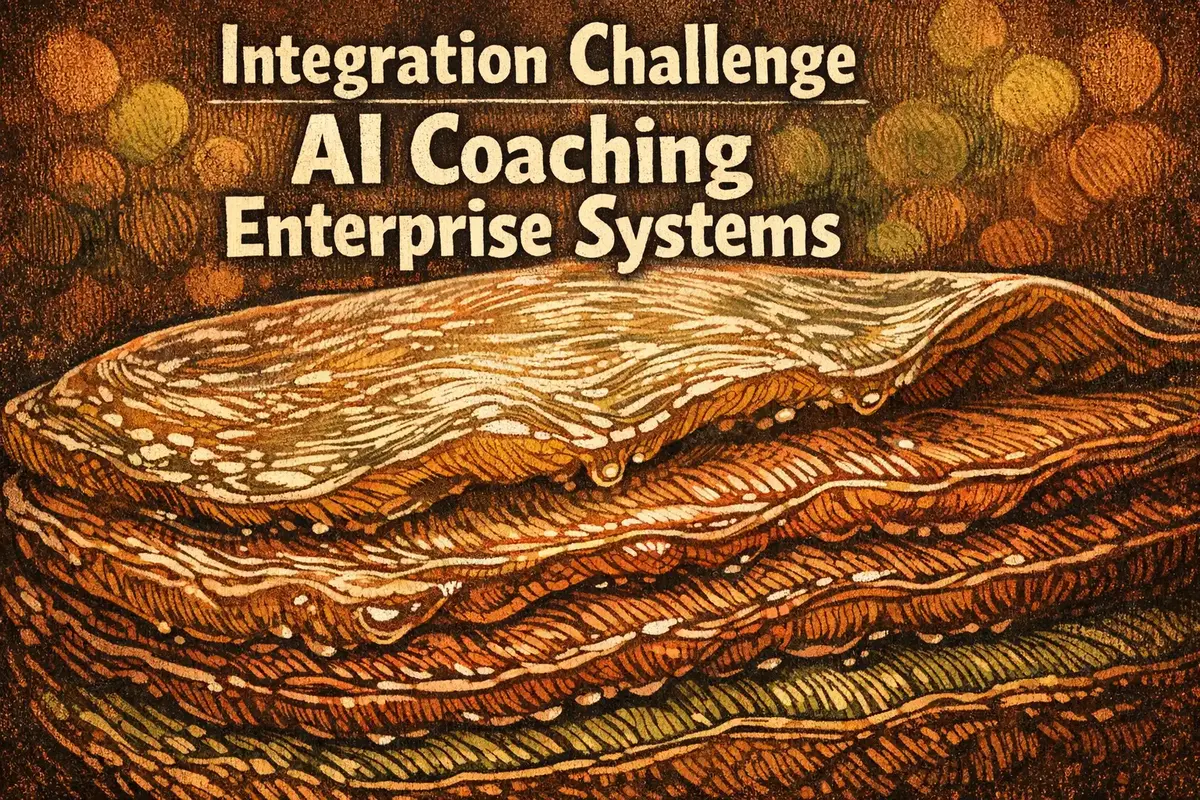
The real advantage is workflow presence
Standalone tools usually fail for a simple reason: they ask people to leave the flow of work to become better at the flow of work. That is a weak design choice.
When AI coaching sits inside the HRIS, LMS, and performance cycle, it can respond to real triggers: a new manager transition, a missed development goal, a calibration discussion, a learning assignment that stalled. In practice, that changes the product from a library of advice into an operating layer for better decisions. It becomes easier for managers to use coaching prompts during one-on-ones, for employees to connect feedback to learning actions, and for HR to see whether development activity is tied to actual performance moments—not just platform logins.
This is why “feature richness” is often the wrong buying lens. A tool can have excellent conversation design and still fail if it sits outside review workflows, identity systems, and manager routines.
What executives should evaluate first
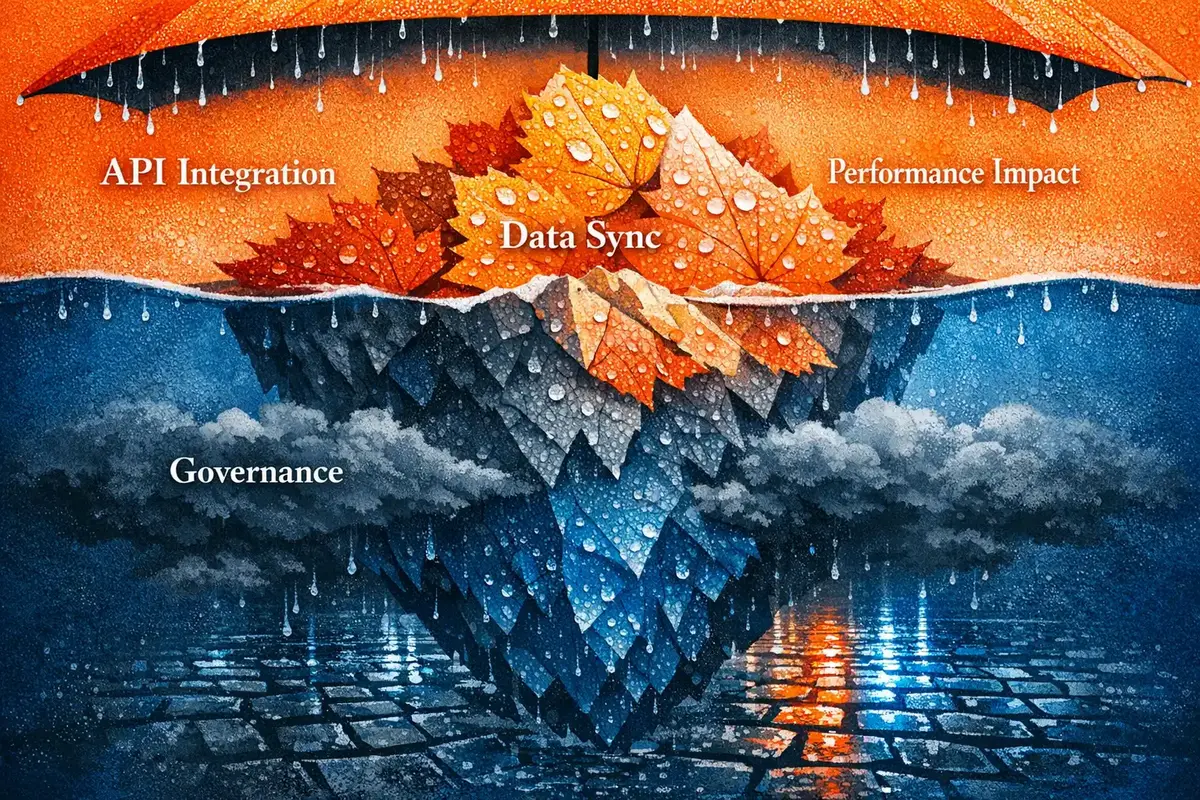
The better evaluation sequence starts with integration depth, workflow fit, and governance.
Integration depth asks whether the system can read the signals that matter and write back useful context without creating another silo. Workflow fit asks a harder question: will the manager encounter coaching support inside existing review, feedback, and development motions, or only in a separate app? Governance matters just as much. If leaders cannot define access, auditability, and data boundaries clearly, adoption will stall long before value appears.
That is the core argument for the rest of this article. Not whether AI coaching works in theory, but whether it can become native to the enterprise operating system. Because if the data stays fragmented—which systems need to talk to each other first?
Which Systems Must Share Data for AI Coaching to Feel Native?
System-of-record architecture is the right lens here because it forces a harder question: if skills are changing this quickly, which system should become the source of truth for coaching decisions? Most teams assume the answer is “the coaching platform.” That sounds tidy. It is usually wrong.
The enterprise stack already has authoritative homes for different kinds of data, and AI coaching feels native only when it respects those boundaries. The World Economic Forum expects 39% of core skills to change by 2030 (World Economic Forum, 2025). That makes data freshness a design issue, not an IT preference. If role expectations move and the coaching layer is reading stale records, the guidance may be well written and still badly timed.
The three-system map that matters
Start with the HRIS. It should remain authoritative for employee identity, reporting lines, job family, location, level, and role changes. When a sales manager becomes a regional director, that event should not be re-entered elsewhere; it should flow outward through HRIS integration.
Then the performance system. This is where goals, review dates, manager notes, competency assessments, and calibration outcomes usually belong. It holds the context that tells you why coaching is needed now: a missed objective, a promotion risk, a review cycle approaching, a pattern in manager feedback.
The LMS should stay authoritative for enrollments, completions, certifications, and learning paths. That matters because coaching without learning follow-through becomes generic encouragement. With clean LMS integration, a prompt can shift from “improve stakeholder communication” to “complete the negotiation module before the client renewal meeting.”
What should sync — and what should not
A mid-market manufacturing VP sees this during a team restructure. Three supervisors move into broader spans of control in the same month. If the HRIS updates the new roles, the performance system shows upcoming 90-day check-ins, and the LMS shows who has not completed first-line leader training, the coaching layer can generate precise prompts for one-on-ones and transition risks. No spreadsheet chase. No manual reconciliation.
39% of core skills are expected to change by 2030 (World Economic Forum, 2025)
The rule is simple: source systems keep ownership; the coaching layer interprets signals. It should ingest role changes, skill gaps, review dates, and learning completions, then return lightweight outputs — prompts, nudges, recommended actions, and summaries — into the systems managers already use. Not duplicate profiles. Not create a parallel talent record.
That is why interoperability beats feature density. A richer interface cannot fix broken data handoffs. And if the connections depend on exports and re-entry, is the coaching experience integrated — or just cosmetically adjacent?
Why API Integrations Decide Whether AI Coaching Becomes Useful or Invisible
Most organizations think integration is finished once data can move. It is not. API integrations decide whether AI coaching appears at the exact moment a manager needs it—or disappears into latency, manual work, and missed context.
That distinction matters because the best coaching experience is often the one employees never notice as a separate tool. They do not open a coaching app. They see a prompt inside the system where they are already approving goals, preparing for a review, or responding to a team change.
The difference between connected and operational
A brittle point integration can technically pass employee data from one system to another and still fail in practice. If role changes arrive late, if review-cycle dates sync overnight instead of when they are updated, or if goal changes require a batch export, the coaching layer is always reacting to yesterday’s organization.
A strong API design works as an operational bridge between employee records, workflow triggers, and coaching actions. When a promotion is approved in the HRIS, a manager can receive transition guidance in the performance workflow. When a review window opens, coaching prompts can appear inside the preparation flow. When goals are reset after a market shift, the coaching logic can adjust with them rather than waiting for an administrator to reconcile systems by hand.
The trigger model is what makes the experience feel native. Promotions. Role changes. Review windows. Goal resets. Skill-gap detection from performance signals or learning activity. Each event should call the coaching layer at the moment of relevance, not after the moment has passed. That is the practical value of well-designed API integrations.
Real-time is powerful. Uncontrolled is dangerous.
Consider a regional retail director during a post-holiday talent review. Two store managers have moved into larger territories, one has a new team, and another has missed key development milestones. If the integrations are event-driven, the system can surface coaching prompts inside the review workflow with the right employee context attached. If the integrations are fragile, HR ends up chasing screenshots, exports, and side notes before anyone can act.
Real-time automation sounds like the obvious answer. It is only half the answer.
The other half is governance: permissions that limit who can see coaching context, audit logs that show what was triggered and why, and human review where recommendations could affect sensitive talent decisions. Fast systems without controls create risk. Controlled systems without speed create irrelevance.
That tension is where many deployments stall. If coaching signals are flowing across systems, where do they live after the trigger fires—inside the workflow, or inside yet another silo?
How Do You Synchronize Coaching Data Without Creating a New Silo?
57% of organizations using AI in performance management already use it to help managers give more comprehensive, actionable feedback — which means bad synchronization is no longer an IT nuisance; it is a trust problem that shows up in manager judgment, employee confidence, and eventually retention (SHRM, 2025). 46% use AI to support goal setting, so if the underlying records drift across systems, the organization does not just lose efficiency; it risks coaching people toward the wrong priorities at exactly the wrong time (SHRM, 2025).
Three sync models — only one scales cleanly
A one-way sync is the simplest pattern: HRIS and performance data flow into the coaching layer, and stop there. That works for low-risk use cases such as generating private manager prompts. It fails when coaching produces something the business needs to keep — revised goals, feedback summaries, or agreed actions — because those outputs remain trapped in a side system.
A two-way sync solves part of that problem. The coaching layer reads employee context, then writes approved outputs back into the system where managers already run performance management. Useful, but easy to mishandle. If both systems can edit the same field, you have created a conflict engine, not an operating model.

The stronger pattern is event-driven orchestration. Systems keep ownership of their records, while events trigger coaching at the right moment and route outputs to the right destination. A goal is updated. A review is opened. A manager submits feedback. The coaching service responds, but does not become the master record.
What belongs where
Keep identity, hierarchy, job changes, and employment status in the HRIS. Those are enterprise facts.
Keep conversation context, prompt history, recommendation logic, and temporary coaching state in the coaching layer. That is working memory, not the official employee file.
Push approved goals, finalized feedback, development actions, and review-ready summaries into the performance system. Those records need to live where managers, HR, and employees make formal decisions.
A finance enterprise director sees the difference during quarter-end. Two managers prepare reviews for the same analyst. One system shows an old reporting line, another shows a duplicate profile, and the coaching tool suggests feedback based on the wrong role. Thirty minutes disappear in reconciliation before the conversation even starts. Scale that across a review cycle and the cost is not abstract.
Trustworthy automation starts before automation
Data quality comes first. If job codes are inconsistent, coaching logic will misfire. Identity matching matters just as much; one employee with three IDs can quietly corrupt every downstream recommendation. And auditability is non-negotiable — leaders need to know what data triggered a suggestion, what was written back, and who approved it.
That is the real design test. Does the coaching layer improve the system of decision-making — or just create a polished new place for partial truth? And once the data is synchronized, where in the review cycle does that intelligence actually change outcomes?
Where Does AI Coaching Add the Most Value in Performance Review Cycles?
A services company director is staring at a half-written review at 10:30 p.m., trying to reconstruct six months of performance from memory, scattered notes, and a few Slack messages. By morning, that rushed narrative may shape compensation, promotion odds, and trust in the whole process.
That is why the shift in measurement matters. 60% of respondents say it is very or critically important to find better ways to measure worker performance beyond traditional productivity (Deloitte, 2024). The implication is practical, not philosophical: review cycles need more evidence, gathered more often, and interpreted with more discipline.
Value starts before the formal review
The biggest gain from AI coaching is not the annual write-up. It is the continuous evidence loop that feeds it.
In a well-integrated performance management workflow, the system can prompt managers during regular check-ins to capture concrete observations: what changed, what was delivered, where collaboration improved, where execution slipped. Not essays. Short, usable evidence. Over time, that creates a review record built from repeated observations rather than end-of-cycle recall.
Employees benefit from the same rhythm. After a check-in, coaching can turn vague feedback into clearer next steps — tighten the goal, define the milestone, prepare for a stakeholder conversation, document progress before the next meeting. Review season becomes less about surprise and more about pattern recognition.
Preparation and calibration become more defensible
When the formal review opens, the manager should not be starting from zero. The system can surface prior check-in notes, goal movement, missed commitments, development actions, and recurring strengths. That changes manager behavior. They spend less time drafting from memory and more time testing whether the evidence actually supports the rating.
This is where consistency improves. PwC reports a 33% reduction in bias when AI is used in performance evaluations (PwC, 2024). Used properly, that does not mean handing judgment to a model. It means using structured prompts, comparable evidence categories, and flagged language patterns so human reviewers can catch weak reasoning before it becomes an official record.
33% reduction in bias when AI is used in performance evaluations (PwC, 2024)
Calibration is where this matters most. If one manager writes in specifics and another writes in impressions, the debate is already skewed. AI coaching can normalize inputs — evidence by goal, behavior by competency, development progress by time period — so disagreements are clearer and easier to challenge.
The real payoff comes after the rating
Most review systems collapse after the meeting. The rating is stored, the conversation ends, and development becomes generic again.
A stronger design carries the output forward. Post-review coaching should convert feedback into a sequenced plan: what the employee needs to practice now, what the manager should reinforce in one-on-ones, and what evidence should be collected before the next checkpoint. That is how reviews become operational rather than ceremonial.
The hard question follows. If coaching can improve the quality of review decisions, where should all of that guidance, evidence, and follow-through live — inside one connected development ecosystem, or across the same fragmented stack that caused the problem?
What Does a Unified Employee Development Ecosystem Look Like in Practice?
The Unified Development Backbone is the operating model that keeps HR, L&D, and performance teams aligned around one employee-development logic. Without it, leadership training says one thing, manager coaching says another, and performance reviews record outcomes with no clear link to how capability was built.
One backbone, three systems, shared signals
In practice, a unified ecosystem is not one giant platform. It is a connected model in which coaching, learning, and performance data reinforce each other while each system keeps its job.
The performance layer shows where execution is strong or slipping. The learning layer shows what capability-building actions have been assigned, started, or completed. The coaching layer interprets both and turns them into timely guidance for managers and employees. That is the difference between disconnected activity and an actual employee development ecosystem: the same signals inform the review conversation, the learning path, and the next coaching prompt.
Harvard Business Review reports that 60% of surveyed L&D buyers and functional leaders said their organizations have moderate or extensive plans to integrate AI into leadership training programs (Harvard Business Review, 2024). That matters because leadership development is often where fragmentation becomes most visible first. A company may invest in manager training, role-based learning, and coaching support at the same time — yet still fail to connect them into one operating rhythm.
60% of surveyed L&D buyers and functional leaders said their organizations have moderate or extensive plans to integrate AI into leadership training programs (Harvard Business Review, 2024)
How convergence works on the ground
Picture a mid-market technology company during annual planning. A director is asked to strengthen three newly promoted managers before a product launch. In a fragmented setup, HR tracks readiness in one place, L&D assigns courses in another, and the managers receive generic coaching in a third. Two months later, nobody can say which intervention changed behavior.
With a shared backbone, the sequence is tighter. Promotion data triggers transition coaching. Early one-on-one notes reveal where each manager is struggling — delegation, prioritization, stakeholder communication. That signal shapes leadership training AI recommendations, and completion data flows back into the manager’s development record. Performance check-ins then test whether the behavior actually changed.
That is what executives should want: one developmental narrative, not three partial ones.
Start narrow, govern early, scale by pattern
The mistake is overengineering the first deployment. Start with one population, one workflow, and a small set of trusted signals — for example, new managers, quarterly check-ins, and leadership-course completion.
Set governance early. Define which system owns role data, which owns formal development actions, and which coaching outputs can be written back. Then scale by repeating the pattern across functions and levels, not by rebuilding the architecture each time.
Because once the ecosystem is connected, the strategic question changes. Are you integrating to make work easier — or to make talent decisions better?
Why the Best Integration Strategy Is the One That Improves Decisions, Not Just Automation
Bad integration quietly burns revenue, weakens manager judgment, and teaches employees that development systems cannot be trusted. That matters because once trust erodes, even strong coaching content becomes background noise.
When the novelty fades, the integration choices that still matter are not the flashy ones. They are the ones that help IT keep the architecture clean, help HR defend talent decisions, and help L&D show that development activity changed behavior rather than just generating activity.
The test is not feature quality. It is decision quality.
A regional retail C-suite team sees this clearly during a budget cycle. One dashboard shows coaching usage, another shows learning completions, and a third shows performance concerns. All three look healthy. Yet leaders still cannot answer the only question that matters: which manager decisions improved because these systems were connected?
That is the contrast executives should hold onto. AI coaching does not create enterprise value because it can draft a prompt, summarize a conversation, or automate a reminder. It creates value when those outputs sharpen a real decision — who needs support now, which capability gap is blocking performance, whether a manager’s assessment is evidence-based, whether a development plan is actually moving work forward.
Research consistently shows that organizations get more from AI when it is tied to operating decisions rather than isolated tasks. The earlier signals in this article point in the same direction, whether you look at Gallup’s emphasis on meaningful feedback, SHRM’s focus on manager support in performance workflows, Deloitte’s call for better performance measurement, PwC’s work on evaluation quality, Harvard Business Review’s reporting on AI in leadership development, or the World Economic Forum’s view of changing skill demands (Gallup, 2024; SHRM, 2025; Deloitte, 2024; PwC, 2024; Harvard Business Review, 2024; World Economic Forum, 2025).
Use a harder evaluation lens
The right buying question is simple: will this integration improve decisions a year from now?
Start with architecture. If the coaching layer duplicates core records or creates another system of truth, the long-term cost will outweigh the short-term convenience.
Then workflow fit. If managers must leave the tools where they already run check-ins, reviews, and development conversations, adoption will stay shallow.
Then governance. If leaders cannot explain what data was used, what recommendation was generated, and where human judgment still sits, the system will struggle the first time a sensitive talent decision is challenged.
Finally, measurable performance impact. Not usage. Not clicks. Better one-on-ones, clearer goals, stronger review evidence, faster follow-through.
That is the real end state: development that is more continuous, more auditable, and more useful to managers and employees in the flow of work.
So the honest next step is not “Where can we add AI coaching?” It is narrower — and more valuable. Which integration choice will help your people make better decisions, not just faster ones?
Key Takeaways
- Embedded AI coaching works best when it appears inside existing HRIS, LMS, and performance workflows.
- The HRIS, performance system, and LMS should each keep ownership of their core data.
- Event-driven API integrations and strong governance help coaching feel native without creating a new silo.
- The best integration strategy improves decision quality, not just automation or usage.
Frequently Asked Questions
What does it mean to integrate AI coaching with existing enterprise systems and workflows?
It means embedding coaching prompts, recommendations, and follow-up actions inside the systems where managers and employees already work, such as HRIS, performance management, and learning platforms. The goal is to support decisions in the flow of work instead of forcing users into a separate coaching app.
Which enterprise systems should share data with an AI coaching platform?
The core systems are the HRIS, the performance management system, and the LMS. The HRIS should own identity and role data, the performance system should own goals and review context, and the LMS should own learning activity and completion records.
Why are API integrations so important for AI coaching in the enterprise?
API integrations let coaching respond to real-time events such as promotions, role changes, review windows, and goal updates. Without event-driven integration, coaching becomes delayed, manual, and disconnected from the moments when guidance is most useful.
How can organizations synchronize coaching data without creating a new silo?
The best approach is event-driven orchestration, where source systems keep ownership of their records and the coaching layer only interprets signals and returns approved outputs. This avoids duplicate records, reduces conflicts, and keeps formal decisions in the systems that already govern them.
Where does AI coaching add the most value in performance review cycles?
It adds the most value before, during, and after the formal review by capturing ongoing evidence, improving feedback quality, and turning review outcomes into concrete development actions. This creates a continuous evidence loop that makes ratings more defensible and follow-through more effective.