
If you’ve ever watched a talented team member hesitate at the prospect of moving into a new department—or seen a promising leader struggle to adapt to a different business function—you’re not alone. Many organizations invest heavily in leadership development, yet hit a wall when it comes to preparing leaders for cross-functional roles. The challenge isn’t just about skills; it’s about building the confidence, adaptability, and support systems that make internal mobility work for both the individual and the business. By the end of this guide, you’ll understand how AI-powered coaching is reshaping the path to versatile, cross-functional leadership and why it’s becoming a critical lever for future-ready organizations. The World Economic Forum estimates that 50% of all employees will need reskilling by 2025, with adaptive leadership and coaching competence emerging as critical capabilities.
What is Cross-Functional Leadership, and Why Does It Matter for Internal Mobility?
Cross-functional leadership is the ability to lead, influence, and deliver results across multiple business domains—think finance, operations, HR, and beyond. It’s not just about managing projects that touch several departments; it’s about developing leaders who can step into new functions, understand different perspectives, and drive organizational goals from any seat at the table. Bersin by Deloitte found that organizations investing in coaching are 5.7x more likely to be high-performing, demonstrating the direct link between coaching culture and business outcomes.
Most teams assume that promoting high performers from within is enough to build cross-functional strength. But research consistently demonstrates that functional expertise doesn’t automatically translate to cross-functional effectiveness. Leaders moving from, say, operations to HR, or from sales to product, often encounter unfamiliar cultures, new stakeholder dynamics, and gaps in technical knowledge. Without targeted support, even the most promising talent can falter during these transitions.
Here’s the thing: organizations that prioritize internal mobility—moving talent across functions, not just up the ladder—see measurable benefits. For example, IBM’s AI-driven approach to career mobility reportedly saved the company over $100 million by efficiently matching employees to suitable roles, reducing turnover, and fostering engagement (SHRM, 2025). This isn’t just about retention; it’s about building a leadership bench that can flex with business needs.
How Does AI Coaching Work in the Context of Cross-Functional Leadership?
AI coaching leverages artificial intelligence to deliver personalized, on-demand coaching experiences that adapt to the unique needs of each leader. Unlike traditional one-size-fits-all programs, AI coaches can analyze a leader’s strengths, identify skill gaps, and offer targeted development plans—often in real time.
Let’s break this down. Imagine a marketing manager preparing to take on a role in product development. An AI coach, drawing on thousands of real coaching sessions and established frameworks, can:
- Assess the leader’s current competencies against the requirements of the new function
- Surface blind spots (e.g., stakeholder management, technical fluency)
- Provide tailored learning paths, reflection prompts, and feedback loops
- Offer scenario-based practice and simulate cross-functional challenges
What’s different here? Most organizations rely on workshops or mentorship to support these moves. But AI coaching brings consistency, scalability, and 24/7 accessibility—key advantages when leaders are navigating high-stakes transitions outside their comfort zone.
What Are the Key Challenges in Developing Cross-Functional Leaders?
Most organizations assume that high-potential employees will naturally thrive in new roles, given enough time and a little support. But the reality is more nuanced. The most common challenges include:
- Skill Gaps: Leaders often lack the technical or process knowledge required in the new function.
- Cultural Barriers: Each department has its own unwritten rules, decision-making styles, and communication norms.
- Confidence and Identity: Moving into a new function can trigger imposter syndrome, especially for those used to being experts in their previous domain.
- Lack of Real-Time Support: Traditional coaching or mentoring is often scheduled, infrequent, and not tailored to the moment of need.
Research shows that workers who feel their technology enables productivity are 158% more engaged and have 61% higher intent to stay at their company beyond three years (Qualtrics, 2022). This means that providing leaders with real-time, tech-enabled support during transitions isn’t just a nice-to-have—it’s a retention and engagement strategy.
How Can AI Coaching Personalize Leadership Development for Internal Mobility?
Personalization is more than a buzzword—it’s a core expectation. In fact, 71% of consumers expect companies to deliver personalized interactions, and 76% get frustrated when this doesn’t happen (McKinsey, cited in SHRM, 2021). The same logic applies to leadership development: a generic approach simply doesn’t cut it for cross-functional moves.
AI coaching platforms can:
- Map individual career aspirations to organizational needs
- Offer adaptive learning modules based on real-time feedback
- Track progress toward cross-functional competencies
- Adjust recommendations as leaders encounter new challenges
For example, in Workday’s internal gig marketplace, 95% of participants reported skill development, and managers noted improved team outcomes (SHRM, 2025). AI-powered systems provided tailored opportunities and feedback, accelerating readiness for new roles.
Most companies believe that a single leadership program can prepare talent for any function. But evidence suggests that the best outcomes come from adaptive, context-aware coaching—the kind that AI can deliver at scale.
What Frameworks and Standards Ensure AI Coaching is Ethical and Effective?
With the rapid adoption of AI in talent development, questions about ethics, privacy, and bias are front and center. The International Coaching Federation (ICF) has responded with a comprehensive AI Coaching Standards framework, organized into six domains based on its Core Competencies. This framework sets clear expectations for transparency, trust, and effectiveness in AI-powered coaching (ICF, 2024).
What does this mean in practice? Ethical AI coaching platforms should:
- Disclose how data is used and protected
- Offer explainable recommendations (not black-box advice)
- Mitigate bias through diverse training data and regular audits
- Provide human oversight and escalation paths
Most organizations assume that AI coaching is a “set it and forget it” solution. But the ICF standards make it clear: human judgment, ethical safeguards, and transparency are non-negotiable. This is especially critical for cross-functional mobility, where career trajectories and succession planning are on the line. For a deeper dive into ethical frameworks and strategies, see ethical AI coaching.
How Do You Identify and Close Skill Gaps for Cross-Functional Moves?
Skill gap analysis isn’t just about ticking boxes on a competency matrix. For cross-functional leadership, it’s about understanding the contextual skills needed to succeed in a new environment—whether that’s stakeholder mapping, data literacy, or influencing without authority.
AI coaching platforms can:
- Benchmark an individual’s current skills against the requirements of the new role
- Use behavioral data, feedback, and performance metrics to identify hidden gaps
- Recommend targeted micro-learning, stretch assignments, or peer coaching
- Track progress and adapt the development plan as the leader grows
A common assumption is that skill gaps can be closed with a few online courses or a mentor. But research and real-world practice show that ongoing, adaptive coaching—especially when powered by AI—accelerates readiness and confidence for cross-functional moves. For practical frameworks on this, explore skill gap analysis for emerging leaders.
What Are Best Practices for Implementing AI Coaching at Scale?
Scaling AI coaching for cross-functional leadership isn’t just about buying a new platform. It requires a thoughtful approach to technology, people, and processes. The Boston Consulting Group’s 10-20-70 rule is instructive here: only 10% of AI transformation effort should focus on algorithms, 20% on technology and data, and a full 70% on people and processes (Boston Consulting Group, 2024).
Best practices include:
- Starting with a clear business case linked to internal mobility and succession planning
- Piloting with high-potential talent pools and capturing early feedback
- Integrating AI coaching with existing HR systems and performance reviews
- Ensuring ongoing human oversight and regular review of AI recommendations
It’s tempting to treat AI coaching as a plug-and-play solution. But organizations that succeed invest in change management, training, and continuous improvement—not just the tech stack. For more on enterprise-scale adoption, see enterprise AI coaching integration.
How Do You Measure the Impact and ROI of AI Coaching on Internal Mobility?
Measuring the impact of AI coaching on internal mobility means looking beyond completion rates or satisfaction scores. The real metrics are business outcomes: retention, engagement, speed to productivity, and leadership bench strength.
Consider these data points:
“IBM’s AI-driven approach to career mobility reportedly saved the company over $100 million by efficiently matching employees to suitable roles, reducing turnover, and fostering engagement.” (SHRM, 2025)
“95% of Workday internal gig participants reported skill development, and managers noted improved team outcomes.” (SHRM, 2025)
To measure ROI, organizations should track:
- Internal mobility rates (cross-functional moves, not just promotions)
- Retention and engagement of high-potential talent
- Time to productivity in new roles
- Diversity and inclusivity of leadership pipelines
Most leaders assume that ROI is too abstract to quantify for coaching. But with AI-enabled tracking and analytics, it’s possible to link coaching interventions directly to business results. For practical metrics and frameworks, see measuring the impact and ROI of AI coaching on internal mobility.
How Does AI Coaching Support Succession Planning and Future-Ready Leadership?
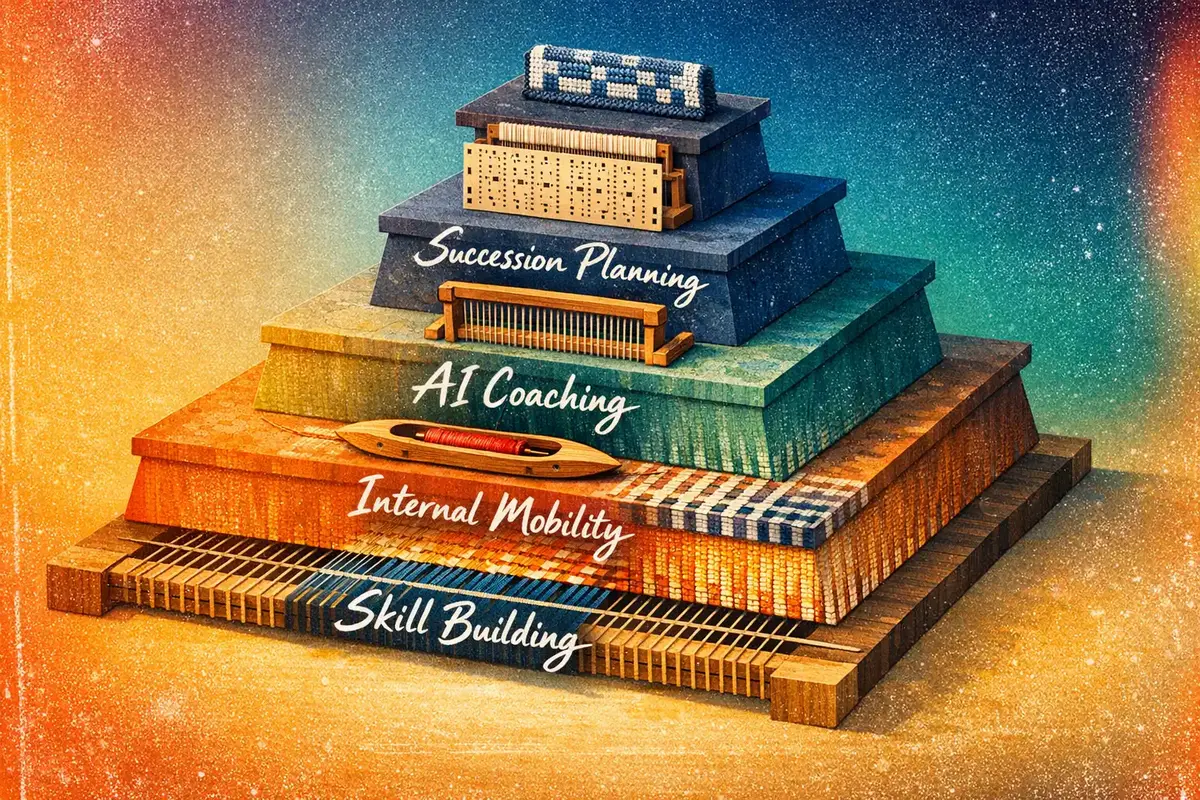
Succession planning used to be about identifying a handful of “ready now” leaders for key roles. But as business cycles accelerate and functional boundaries blur, organizations need a more dynamic, cross-functional approach. AI coaching can:
- Identify high-potential talent across all functions, not just within silos
- Personalize development plans to prepare leaders for multiple possible futures
- Offer scenario-based coaching for high-stakes transitions
- Track progress and flag readiness gaps in real time
Drawing on TII’s two-decade integral methodology, AI-powered coaching platforms can help organizations build a robust, adaptable leadership bench—one that’s ready for whatever comes next. For frameworks and strategies, explore succession planning with AI coaching.
What Role Does the Human-AI Partnership Play in Cross-Functional Leadership Development?
Here’s a common misconception: AI coaching will replace human coaches and mentors. In reality, the most effective organizations blend human expertise with AI-powered tools. The AI coach acts as a scalable, always-available resource for real-time feedback and skill-building, while human coaches provide the empathy, judgment, and organizational context that machines can’t replicate.
This partnership model is especially powerful for cross-functional leadership, where the stakes are high and the learning curve is steep. AI coaches can accelerate readiness and surface blind spots, but human mentors help leaders navigate the unwritten rules and politics of new functions.
Most organizations still treat AI as a tool, not a partner. But those that integrate AI coaching into their talent strategy—combining it with human oversight and organizational support—see faster, more sustainable leadership development outcomes.
FAQ: Fostering Cross-Functional Leadership Talent with AI Coaching
What is the difference between cross-functional leadership and traditional leadership?
Cross-functional leadership involves leading across multiple business domains, requiring adaptability and a broader perspective than traditional leadership, which often focuses on deep expertise within a single function. Cross-functional leaders must navigate diverse teams, bridge communication gaps, and drive results in unfamiliar contexts.
How does AI coaching differ from traditional coaching in supporting internal mobility?
AI coaching offers personalized, on-demand support tailored to each leader’s unique needs and transition challenges. Unlike traditional coaching, which may be limited by scheduling and availability, AI coaching provides real-time feedback, adaptive learning, and scalable access—making it especially effective for supporting leaders as they move between functions.
How can organizations ensure AI coaching is ethical and unbiased?
Organizations should select AI coaching platforms that adhere to established standards like the ICF AI Coaching Standards framework, which emphasizes transparency, privacy, and bias mitigation. Regular audits, diverse training data, and clear human oversight are essential to maintaining ethical and trustworthy coaching practices.
What are the most important metrics for measuring the success of AI coaching in internal mobility?
Key metrics include internal mobility rates (especially cross-functional moves), retention and engagement of high-potential talent, time to productivity in new roles, and diversity of leadership pipelines. Tracking these outcomes helps organizations link coaching interventions to tangible business results.
Can AI coaching help with succession planning?
Yes, AI coaching can identify and develop high-potential leaders across functions, personalize development plans, and provide scenario-based coaching for critical transitions. This supports a more dynamic, future-ready approach to succession planning.
What are common pitfalls to avoid when implementing AI coaching for cross-functional leadership?
Common pitfalls include relying solely on technology without human oversight, neglecting ethical standards, and failing to integrate AI coaching with broader talent strategies. Organizations should ensure that AI coaching complements human coaching and aligns with business objectives.
How do you get started with AI coaching for cross-functional leadership development?
Begin by assessing your organization’s readiness, defining clear business objectives, and piloting AI coaching with a targeted group of high-potential leaders. Integrate the platform with existing HR systems, gather feedback, and iterate based on results to scale effectively.
Continue Your Leadership Journey
Fostering cross-functional leadership talent with AI coaching is more than a trend—it’s a strategic imperative for organizations navigating constant change and complexity. By blending ethical AI tools with proven coaching methodologies and human insight, companies can unlock new levels of agility, engagement, and business impact. Whether you’re designing a new talent strategy or looking to accelerate your internal mobility programs, the path forward is clear: invest in the systems, standards, and partnerships that prepare your leaders for any challenge, in any function.