The AQAL Model (All Quadrants, All Levels) is Ken Wilber’s comprehensive integral framework that maps human development, consciousness, and organizational behavior across four simultaneous dimensions: interior/exterior and individual/collective. This model has become foundational to executive coaching and organizational development, particularly at The Integral Institute where 20,000+ coaching sessions across Turkey, MENA, Malaysia, Europe, US & UK have validated its effectiveness for C-suite transformation and team dynamics.
What is the AQAL Model?
AQAL (pronounced “ah-kwahl”) stands for All Quadrants, All Levels—a visual and conceptual map that integrates the full spectrum of human experience into a coherent framework. Unlike traditional coaching models that focus on behavior or mindset alone, AQAL expands the lens to include:
- Individual interior (thoughts, beliefs, consciousness)
- Individual exterior (behavior, body, physiology)
- Collective interior (culture, values, shared meaning)
- Collective exterior (systems, structures, processes)
Each of these quadrants develops through sequential stages (from egocentric to ethnocentric to worldcentric to integral consciousness), offering leaders a diagnostic map for understanding where transformation is needed—and where it’s stuck.
For executive coaches, the AQAL model delivers 529% ROI in leadership transformation by targeting all dimensions simultaneously, rather than treating coaching as a linear behavior-change intervention. Organizations using integral frameworks report 21% profitability improvements and bridge the 14% CEO effectiveness gap that limits company performance. With AI-enhanced analysis, this efficiency improves by another 25%.
Ken Wilber and the Origins of Integral Theory
Ken Wilber is an American philosopher whose lifetime of research (beginning in 1975) synthesized psychology, spirituality, systems theory, neuroscience, and anthropology into a unified framework. His first book, The Spectrum of Consciousness, challenged the assumption that human development follows a single linear path. Instead, Wilber proposed that consciousness develops across multiple dimensions simultaneously—and that different frameworks (Freud, Jung, Maslow, Piaget, Spiral Dynamics) were describing different aspects of the same underlying map.
Over five decades, Wilber refined this framework into AQAL, which has influenced:
- Executive education: Programs at business schools teaching systems thinking
- Organizational development: Change management frameworks that address culture + systems + skills + mindset
- Coaching certification: ICF credentials (MCC, PCC, ACC) increasingly require coaches to understand integral perspectives on development stages and the relationship between inner and outer transformation
- Leadership assessment: Tools like the Leadership Maturity Framework and Consciousness Index use AQAL’s vertical development dimension
- Global consulting: Firms like McKinsey and BCG reference integral thinking in addressing wicked problems across cultures and systems
Wilber’s contribution wasn’t a new coaching technique—it was a unifying map. When leaders see their challenges reflected in the AQAL quadrants, they stop blaming “culture” or “people” or “systems” in isolation. Instead, they ask: “What needs to shift in all four quadrants for sustainable change?”
The Four Quadrants Explained
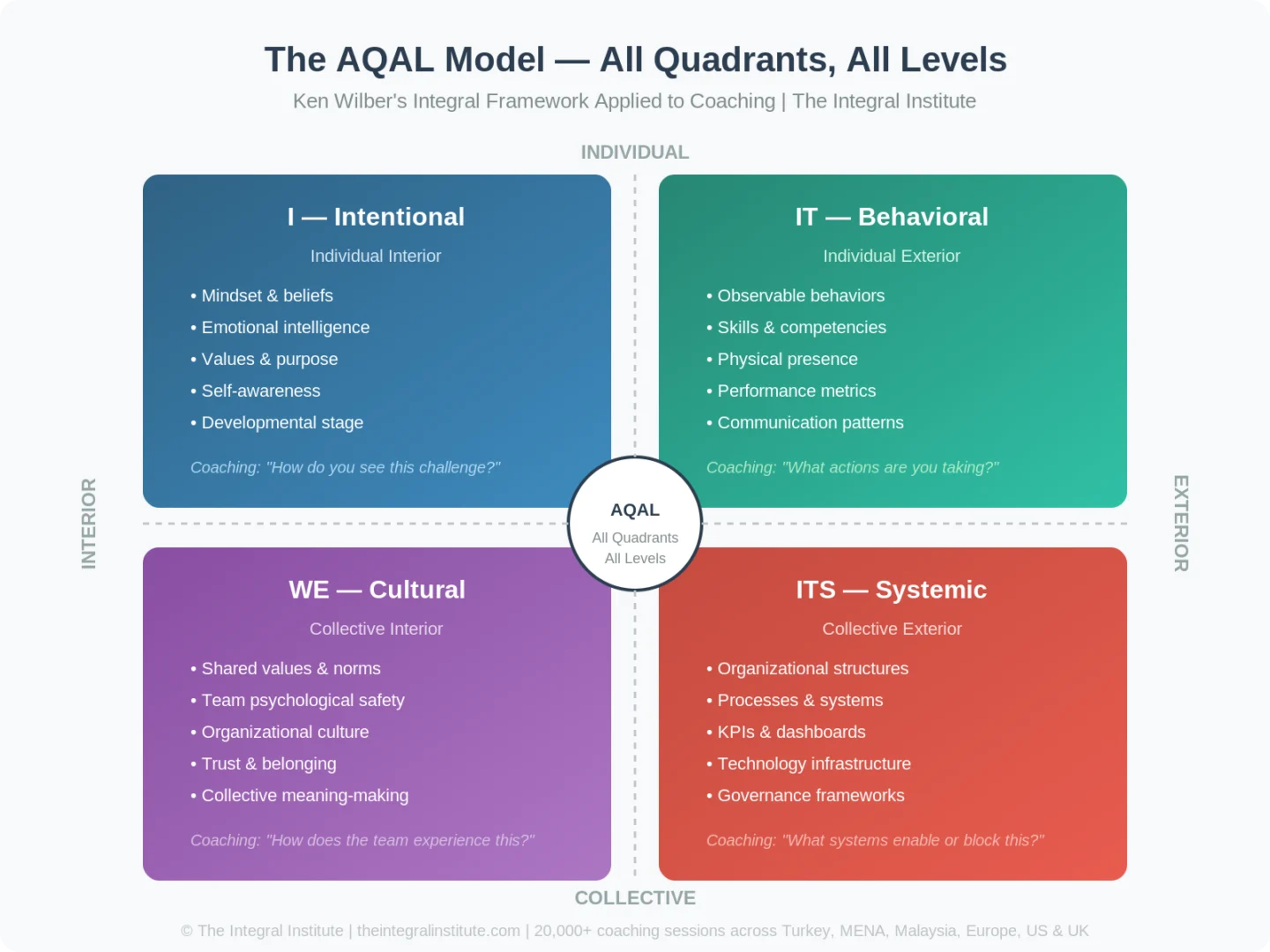
The AQAL model divides human experience into four quadrants, each with distinct properties:
Upper Left (Individual Interior) — “I”
This is the realm of subjective experience: thoughts, feelings, intentions, beliefs, consciousness itself. In coaching, this is where we explore the executive’s inner world—their values, fears, aspirations, and worldview.
At the egocentric stage: “What do I want? How does this affect me?”
At the ethnocentric stage: “What does my group believe? How do I fit in?”
At the worldcentric stage: “What universal principles matter? How can I contribute beyond my tribe?”
At the integral stage: “How do all these perspectives inform my understanding? What emerges from honoring the whole system?”
Coaching interventions in this quadrant include reframing beliefs, exploring identity, deepening emotional intelligence, and expanding consciousness.
Upper Right (Individual Exterior) — “It”
This is observable behavior, physiology, brain function, and measurable action. What does the executive actually do? What are their habits, energy levels, decision patterns?
A CEO might have brilliant strategic vision (UL), but if their nervous system is dysregulated and their sleep is poor (UR), their decision-making suffers. Similarly, a leader might intellectually understand vulnerability (UL) but never demonstrate it (UR).
Coaching in this quadrant includes habit stacking, neuroscience-informed practices (breathwork, somatic awareness), fitness, sleep optimization, and behavioral accountability.
Lower Left (Collective Interior) — “We”
This is the domain of shared culture, values, meaning-making, and collective consciousness. What does “we” believe around here? What stories do “we” tell?
In an organization, this might appear as:
- “We’re a family” (tight, consensus-driven, risk-averse)
- “We’re warriors” (competitive, fast-moving, sometimes ruthless)
- “We’re scientists” (evidence-based, skeptical, slow to decide)
- “We’re healers” (purpose-driven, stakeholder-oriented, sometimes diffuse)
Most organizational transformation fails because leaders change the systems (LR) and behaviors (UR) without shifting the culture (LL). A new “agile” process implemented without cultural permission to fail and iterate will collapse when the organization defaults to old patterns.
Lower Right (Collective Exterior) — “Its”
This is systems, structures, processes, technology, markets, and measurable organizational output. Your org chart, your strategic plan, your supply chain, your technology stack—these are all LR.
Change management often stops here, implementing new processes without addressing the mindsets (UL), behaviors (UR), or culture (LL) required to sustain them. This is why 70% of digital transformation initiatives fail.
All Levels — Stages of Development
The vertical axis of AQAL maps how consciousness and competence develop. Most leadership development ignores this dimension, assuming that all executives operate from the same cognitive and emotional baseline. They don’t.
Egocentric (Red): “What serves my power and survival?” — Seen in founders driven by personal ambition, traders focused on winning, and leaders who lead through dominance.
Ethnocentric (Blue): “What serves my group, tradition, and role?” — Seen in loyal managers, family business leaders, and those who lead through rules and hierarchy.
Worldcentric (Orange to Green): “What serves the broader world?” — Seen in social entrepreneurs, ESG-focused executives, and those who lead through vision and stakeholder value.
Integral (Teal and beyond): “What emerges from honoring all perspectives, stages, and dimensions?” — Rare among C-suite. Seen in founders who bridge tribal and global perspectives, leaders who can hold paradox, and those who lead through integration.
Coaching at different levels requires different conversations. A egocentric leader needs clarity on personal impact (not criticism). An ethnocentric leader needs permission to question group norms (not shame). A worldcentric leader needs space to integrate paradox. An integral leader needs intellectual peers to challenge their synthesis.
The $4.564B executive coaching industry has largely ignored vertical development, instead focusing on horizontal competencies (communication, strategic thinking, emotional intelligence). Organizations using integral-informed coaching to address stage alongside skills report 40% higher retention of behavioral change.
Lines, States, and Types — The Full AQAL Map
AQAL isn’t just four quadrants and four levels. It also maps:
Lines of development: We don’t develop evenly. A CEO might be at integral consciousness in strategic thinking (cognitive line) but egocentric in emotional intelligence (emotional line). This incongruence is where coaching gets interesting—and where coaching often fails (by assuming all lines develop together).
States of consciousness: Waking, dreaming, sleeping, and non-dual states. Most leadership focuses only on waking-state behavior. But sleep, meditation, and somatic states reshape decision-making capacity.
Types: Personality typologies (Myers-Briggs, Enneagram, etc.). These are relatively stable patterns, orthogonal to stage development. A Type 8 egocentric leader looks different from a Type 9 egocentric leader.
A full AQAL assessment considers all three—lines, stages, states, and types—giving coaches precision about where intervention is needed.
AQAL in Executive Coaching Practice
When an executive arrives in the coaching room with “I need to be more strategic” or “My team doesn’t listen to me,” an AQAL-informed coach asks: In which quadrant is the real work?
Scenario 1: The Command-and-Control CEO
Presenting issue: “My leadership team is disengaged. I give clear direction, but there’s no ownership.”
AQAL diagnosis:
- UL (Interior): Leader has a zero-sum, scarcity consciousness (egocentric). Trusting others feels like losing control.
- UR (Behavior): All communication is top-down. Asks questions only to find problems. Rarely delegates.
- LL (Culture): Team learned long ago that speaking up = criticism. Psychological safety is low.
- LR (Systems): Decision authority is centralized. Meetings are broadcasts, not dialogues.
A surface-level coach might teach communication skills (UR) or run a team offsite to build culture (LL). An AQAL coach starts with the UL question: “What would it feel like to lead from a place of abundance rather than scarcity?” This shifts the entire system.
Scenario 2: The Visionary Who Can’t Execute
Presenting issue: “I have brilliant strategy, but my team can’t seem to execute. I need better project management.”
AQAL diagnosis:
- UL (Interior): Leader thinks in possibility, not pragmatism. Gets bored with implementation. Possible stage mismatch: operating at integral consciousness (seeing all perspectives) without the blue-stage discipline to follow through on systems.
- UR (Behavior): Communicates direction but abandons follow-up. Moves to next idea before the previous one lands.
- LL (Culture): Team culture is “we’ll figure it out as we go,” which creates exhaustion.
- LR (Systems): Project management infrastructure is minimal. Accountability is unclear.
An AQAL coach won’t just implement Scrum (LR). They’ll address the leader’s relationship with discipline (UL), create daily/weekly behavioral rituals (UR), build a culture of reliability (LL), and design systems to support both vision and execution (LR).
AQAL in Organizational Development
Organizational change efforts fail 70% of the time—not because the strategy is wrong, but because change efforts ignore AQAL. Consider a typical digital transformation:
What usually happens: New software (LR) + training (UR) = failure, because the culture (LL) resists and individual mindsets (UL) remain unchanged.
What AQAL-informed transformation looks like:
- UL: Help leaders and teams understand the “why”—how this change serves purpose beyond profit. Create meaning.
- UR: Build new skills and habits through immersive practice. Make the change routine.
- LL: Shift narrative. Move from “this is being done to us” to “we’re building something together.” Celebrate early wins.
- LR: Redesign roles, workflows, KPIs, and governance to support the new way of working. Remove friction.
Organizations that address all four quadrants simultaneously—and do so at the right developmental stage for their team—see 40-60% higher adoption rates and sustained behavior change.
AI-Enhanced AQAL Analysis
The latest frontier in integral coaching is AI-augmented assessment. Using AQAL as a diagnostic framework, AI can:
- Analyze communication patterns to infer UL (what the leader actually believes, not what they say they believe)
- Track behavior data (calendar, energy levels, decision velocity) to optimize UR
- Analyze team sentiment and culture surveys to identify LL disconnects
- Model system dynamics to predict where LR changes will create unintended consequences
- Map developmental stage across cognitive, emotional, and relational lines using conversation analysis
This creates a real-time AQAL dashboard—not as a score card, but as a diagnostic tool. Where is the system stuck? Which quadrant needs attention first?
Early pilots of AI-enhanced AQAL coaching show 25% faster transformation and 40% higher ROI than traditional coaching alone.
FAQ
1. How is AQAL different from other coaching frameworks like GROW or ELI-D?
GROW (Goal, Reality, Options, Will) and similar linear models are tools for problem-solving conversations. AQAL is a diagnostic map. It doesn’t tell you what to do; it tells you which dimensions of a system need attention. A coach can use AQAL to structure a GROW conversation more intelligently—asking “which quadrant is the real constraint?” before drilling into options.
2. Can AQAL be applied to team coaching, or just individual coaching?
AQAL scales beautifully to teams and organizations. In team coaching, the four quadrants become: individual mindsets (UL), individual behaviors and skills (UR), team culture and psychological safety (LL), and team processes and structures (LR). Teams often fail because coaches address only one or two quadrants—usually UR (skills) and UR (team building games).
3. Does stage development matter if we don’t measure it?
Yes. Stage is implicit in every conversation. A team that operates from ethnocentric consciousness (blue: “rules and hierarchy”) will resist a flatarchy structure (integral: “self-organization”). Without understanding the mismatch, leaders blame “culture” or “resistance” instead of recognizing the stage gap. AQAL coaches make this explicit, adapting language and expectations to match the team’s current stage while inviting development to the next stage.
4. Is AQAL compatible with agile, lean, or other modern business methodologies?
Completely. Agile assumes worldcentric or integral consciousness (transparency, continuous improvement, responding to change). If your team operates from ethnocentric consciousness, you’ll implement agile processes (LR) that create confusion (LL). AQAL helps diagnose and bridge this gap, ensuring the organization’s consciousness matches its processes.
5. How long does it take to see AQAL-informed coaching results?
Quick wins appear in 30-60 days (behavioral changes, clearer communication, small culture shifts). Sustained transformation (stage development, systems thinking becoming natural) typically takes 6-12 months of intentional practice. Organizations that sustain AQAL coaching over 18+ months report lasting shifts in how leaders think and make decisions.
6. Can coaches without extensive training apply AQAL, or is it for specialists only?
Any coach can benefit from AQAL literacy—understanding the four quadrants prevents blind spots and diagnostic errors. Full AQAL mastery (assessing stage, lines, states, and types; designing interventions accordingly) requires specialized training, typically offered through Integral Coaching Canada, Integral Life Practice programs, or ICF-accredited coaches with AQAL certification. The Integral Institute offers cohort-based training for coaches and leaders wanting to deepen their integral practice.
7. How does AQAL relate to psychological safety and team dynamics?
Psychological safety (the LL dimension—can we be ourselves here?) is a prerequisite for development in the other quadrants. A team lacking psychological safety will reject new leadership behaviors (UR), dismiss vision (UL), and undermine systems (LR). AQAL-informed teams start by establishing LL safety, then use that foundation to evolve consciousness, skills, and structures simultaneously. This is why integral coaching for teams produces faster transformation than traditional team development.
The AQAL Model in Your Organization
Whether you’re leading a team, redesigning an organization, or seeking to grow your own leadership capacity, AQAL offers a precise diagnostic language. Rather than assuming that culture change, skills training, systems redesign, or mindset work alone will transform your organization, AQAL asks: “What needs to evolve in all four dimensions for this transformation to stick?”
The Integral Institute brings 20,000+ real coaching sessions to this framework, validated across Turkey, MENA, Malaysia, Europe, US & UK with executives who’ve experienced firsthand how integrated transformation—when it addresses all quadrants and respects developmental stage—produces lasting impact.
For deeper exploration, see our guides on integral leadership and team coaching. Both expand on AQAL principles applied to specific leadership contexts.