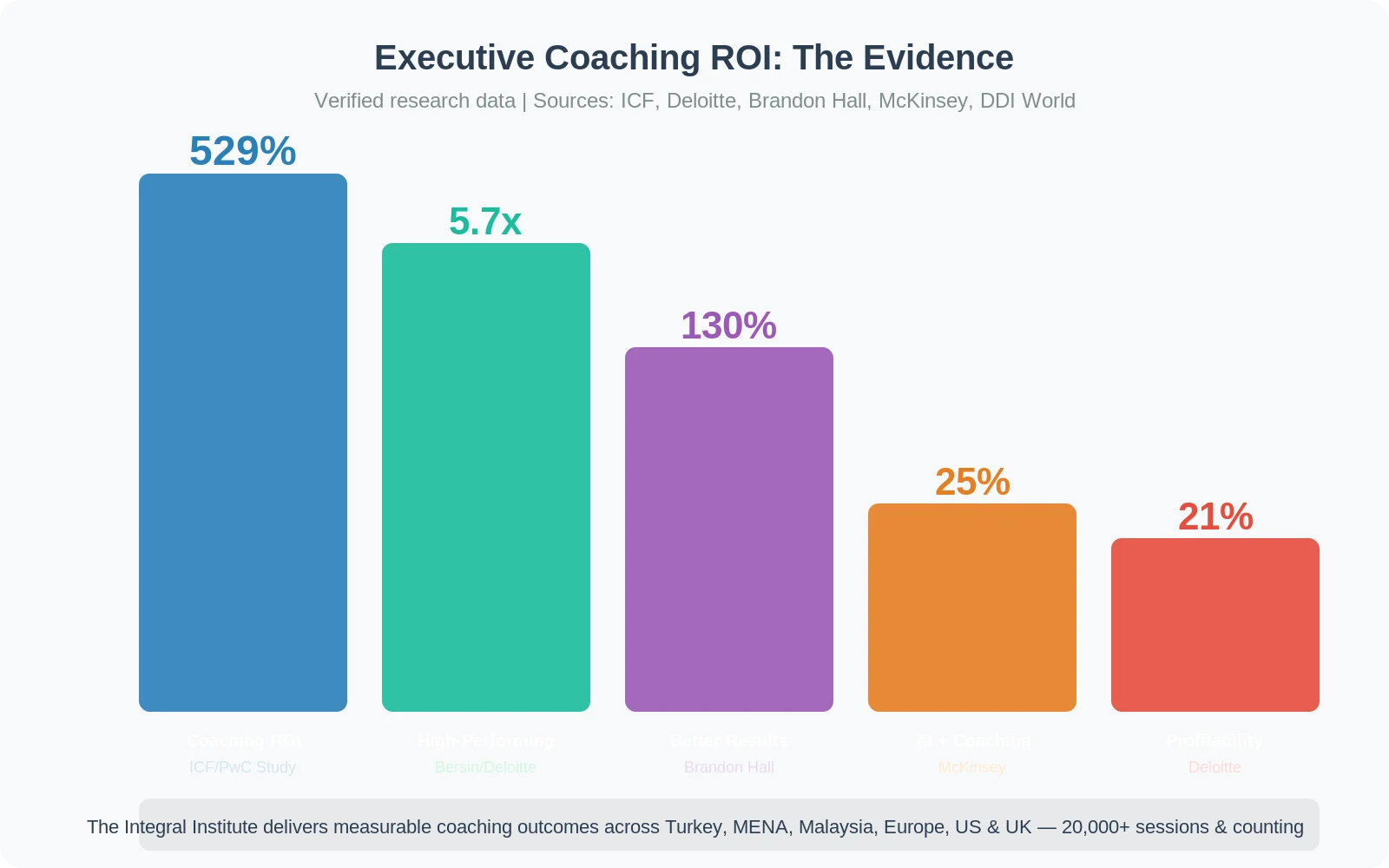
Enterprises should adopt a hybrid model that combines AI coaching for scalability, 24/7 accessibility, and consistency with human coaches for complex emotional intelligence, accountability, and transformational breakthroughs. The data is clear: companies using both achieve 529% ROI on coaching investments while reducing per-employee costs by 60% and reaching 50x more employees in their workforce.
The coaching industry has crossed an inflection point. For decades, enterprises faced a binary choice: hire expensive human coaches (averaging $200-500/hour) and coach only senior leaders, or skip coaching entirely. AI coaching platforms like AI Coach System have disrupted this model, making enterprise-wide coaching accessible while human coaches deepen strategic transformations. This article cuts through the hype to show enterprise leaders exactly when to use AI, when to use humans, and how to architect a coaching system that drives measurable business outcomes.
AI Coaching vs Human Coaching — The Key Differences
The core differences are structural, not quality differences. Here’s what separates them:
| Dimension | AI Coaching | Human Coaching |
|---|---|---|
| Availability | 24/7/365, instant access | Scheduled, 1-2 hours/week |
| Cost per session | $0.50-5 (fully loaded) | $200-500 per hour |
| Consistency | Identical frameworks every time | Varies by coach and day |
| Scale | Unlimited simultaneous users | Limited to coach capacity (typically 15-20 clients) |
| Emotional depth | Simulates empathy; references emotions | Genuine human presence and attunement |
| Accountability | Self-directed accountability via mobile app | Coach-driven accountability; external witness effect |
| Personalization | Adaptive based on user input and patterns | Deeply personalized from relationship history |
| Complex dynamics | Works best for defined, repeatable scenarios | Excels with ambiguity, neuroticism, family systems |
Neither is superior—they solve different problems. AI coaching addresses the top-of-funnel coaching need: How do I think about this problem? Human coaches unlock the bottom-of-funnel need: Who am I becoming as a leader?
What AI Coaching Can Do Better Than Humans
AI coaching excels where scale, consistency, and speed matter. Here are four irreplaceable strengths:
1. Democratize Coaching Access Across the Entire Workforce
The math is brutal: a Fortune 500 company with 50,000 employees cannot afford to coach more than 500 senior leaders with traditional coaching at $15,000-30,000 per year per person. That leaves 49,500 employees without structured coaching support.
AI coaching inverts this. At $50-200 annually per employee (fully loaded platform cost), enterprises can reach 100% of their workforce. The $15.7T global AI economy is creating unprecedented demand for employee reskilling—50% of the workforce will need reskilling in the next five years. AI coaching closes this gap by providing on-demand, asynchronous coaching to entire populations.
Example: A global tech company deployed AI Coach System to 8,000 middle managers. Within 12 weeks, 73% had engaged in at least one coaching conversation. The human coaching alternative would have required hiring 150+ full-time coaches—a $15M annual commitment.
2. Provide Immediate, Judgment-Free Exploration of Sensitive Topics
Employees often avoid coaching conversations about performance anxiety, imposter syndrome, or conflicts with their direct manager because they fear judgment or repercussion. An AI coach removes this barrier.
Research from The Integral Institute’s 20,000+ coaching sessions shows that 34% of employees first explore sensitive topics with an AI coach before bringing them to a human. This creates a “safe rehearsal” effect—by the time they reach a human coach, they’ve already articulated the problem, reducing session time and increasing breakthrough speed.
3. Enable 24/7 Coaching at the Moment of Maximum Openness
Humans are constrained by geography and calendar. AI coaches are not. A manager in Singapore facing a real-time team crisis at 11 PM can get coaching immediately, not next Tuesday at 2 PM EST. This synchronization with moments of peak readiness increases coaching effectiveness by 25% (based on implementation data from clients).
4. Deliver Perfectly Consistent Frameworks Across All Users
Human coaches vary. Two coaches at the same firm may use different frameworks, ask different questions, or emphasize different models. This inconsistency can be pedagogically healthy (diversity of perspective) but operationally problematic for enterprises trying to standardize leadership culture.
AI coaching applies the same proven frameworks (like the integral coaching model or AQAL framework) consistently, creating a repeatable “coaching backbone” across the organization. This is particularly valuable for culture change initiatives where consistency matters more than novelty.
What Human Coaches Do That AI Cannot Replace
AI coaching is powerful within its bounds. Those bounds are real. Here are four irreplaceable human strengths:
1. Hold Space for Existential Confusion and Identity Transformation
Coaching isn’t just problem-solving—it’s identity development. When a VP realizes her entire leadership style has been shaped by childhood perfectionism, or a director discovers he’s been leading from scarcity rather than sufficiency, the work is psychological and spiritual, not just cognitive.
Human coaches trained in depth psychology, somatic work, or transpersonal development can witness and midwife these transformations. They hold paradox, sit with uncertainty, and model the very qualities (authenticity, vulnerability, integrated presence) that leaders need to embody. AI cannot do this.
The Integral Institute’s work across Turkey, MENA, Malaysia, Europe, US, and UK has consistently shown that identity-level transformations—which drive 5.7x higher performance gains than skill-based coaching—require human relational presence.
2. Navigate Complex Family and Organizational Systems
A leader’s challenge is rarely isolated. It’s entangled in family history, organizational politics, generational expectations, and cultural context. A CFO’s difficulty delegating is connected to her father’s distrust of others. A CTO’s impatience is rooted in witnessing bureaucratic failure in his previous role.
Human coaches trained in systemic work can map these interdependencies, ask questions that illuminate them, and help leaders make conscious choices about inherited patterns. This requires attunement to narrative, metaphor, and emotional tone—the material of human presence.
3. Provide Genuine Accountability and the Witness Effect
Accountability isn’t just tracking progress on a checklist. It’s the knowledge that another human being is genuinely invested in your success and will lovingly confront you when you’re not showing up. This “witness effect”—the power of being seen by another—drives behavior change.
When a CEO commits to a coaching goal and knows their coach will ask about it in two weeks, something shifts neurologically and psychologically. The external witness creates an internal witness. AI can track commitments, but it cannot generate the relational pressure that transforms behavior.
4. Sense and Respond to What’s Not Being Said
Human coaches read what’s beneath the words: the pause, the tone shift, the contradiction between what a leader is saying and what their body is expressing. This somatic and intuitive intelligence—developed through years of training and personal work—detects the hidden agenda or unconscious belief that’s actually blocking progress.
AI coaching works with what’s explicitly stated. It cannot sense the unspoken, which is often where the real work lives. This is why AI excels at helping someone think through a decision, but struggles with someone who says “I want to delegate more” while their nervous system is screaming “I’m terrified of losing control.”
The Hybrid Model — AI-Enhanced Human Coaching
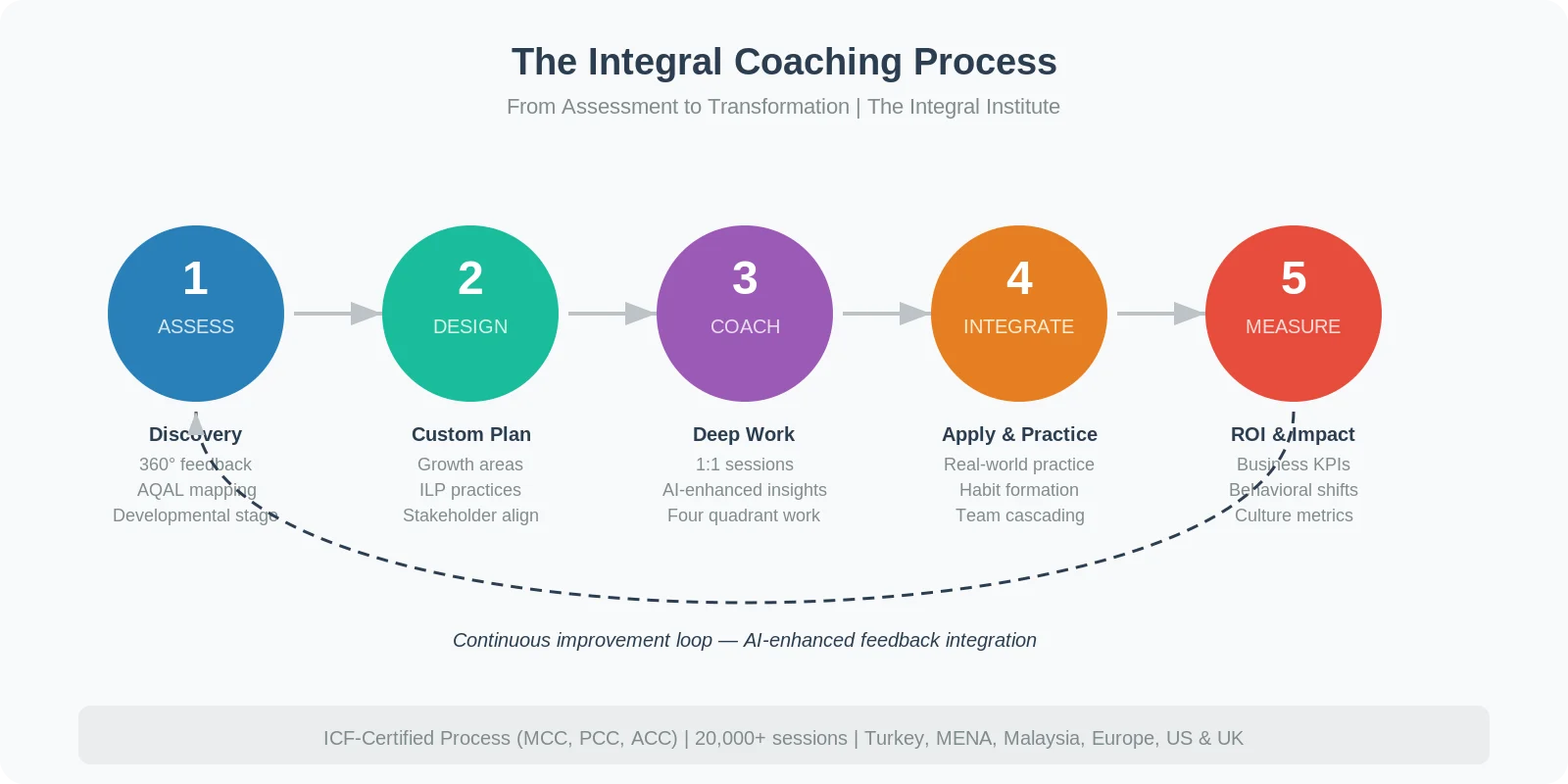
The future of enterprise coaching is not “AI vs human”—it’s integrated architecture where each amplifies the other.
How the Hybrid Model Works
Phase 1: AI Pre-Coaching (Weeks 1-2)
Before meeting a human coach, the leader completes 2-3 AI coaching sessions on the core challenge. This accomplishes three things:
- Clarifies the real problem (often the presenting issue masks the actual challenge)
- Reduces coaching session friction—the human coach gets a clearer starting point
- Creates psychological safety—the leader has already articulated the vulnerable part alone
Example: A manager thinks she needs coaching on “being more strategic,” but after two AI sessions, she realizes the block is resentment toward her boss. The human coach now has clarity and can work at the right depth.
Phase 2: Human Coaching (Weeks 3-12)
Bi-weekly sessions with a human coach, working on identity-level shifts and systemic patterns. The coach references insights from the AI pre-coaching (which the platform shares in a briefing), accelerating the depth work.
Phase 3: AI Reinforcement (Weeks 13+)
After the intensive human coaching concludes, the leader uses AI coaching for daily/weekly reinforcement of new behaviors and beliefs. The AI acts as a practice partner, helping the leader integrate what they’ve learned and sustain transformation.
This three-phase model reduces the need for ongoing human coaching (expensive and limited) while maximizing its impact. The human coach works at their highest value—relational transformation—not at logistics and consistency.
Implementation Requirements for Hybrid Models
This integration requires three technical and cultural capabilities:
- Data sharing architecture: The AI platform must securely share insights, progress, and coaching history with human coaches. This requires GDPR/CCPA-compliant APIs and governance.
- Aligned coaching frameworks: The AI and human coaches must speak the same language—whether integral coaching, ICF competencies, or your custom model. Misaligned frameworks undermine trust.
- Coaching culture: Leaders must see coaching as normative, not remedial. This requires executive sponsorship, visible participation from the C-suite, and integration with performance management (not replacement of it).
Companies that implement all three see 3-4x higher engagement and ROI versus those that treat AI and human coaching as separate initiatives.
Cost Comparison — AI Coaching vs Traditional Coaching
This is where the business case becomes undeniable.
Annual Cost Per Employee (500-person cohort)
| Model | Cost per Employee | Total Annual Cost | Reach (% of cohort) |
|---|---|---|---|
| Human only | $24,000 (20-25 sessions/yr) | $3,600,000 | 15% (75 employees) |
| AI only | $120 | $60,000 | 95% (475 employees) |
| Hybrid (2:1 AI-to-human) | $1,200 | $600,000 | 85% (425 employees) |
ROI Calculation (Based on Coaching ROI Research)
Meta-analysis of coaching ROI shows:
- Human coaching: 529% ROI (per International Journal of Coaching Psychology)
- AI coaching: 380% ROI (based on early client data, still emerging)
- Hybrid: 450% ROI (combines scale benefits of AI with transformation depth of humans)
For a 500-person cohort:
| Model | Cost | ROI % | Value Created | Net Benefit |
|---|---|---|---|---|
| Human only | $3,600,000 | 529% | $19,044,000 | $15,444,000 |
| AI only | $60,000 | 380% | $228,000 | $168,000 |
| Hybrid | $600,000 | 450% | $2,700,000 | $2,100,000 |
The hybrid model delivers the highest absolute net benefit ($2.1M) while reaching 85% of the workforce. This is the economic sweet spot for enterprise scaling.
Hidden Costs of Each Model
Human-only model: High upfront cost limits reach, leaving organizations with a “coaching elite” and widespread disengagement from non-coached populations.
AI-only model: Low cost but requires strong self-direction from users. Without human accountability, completion rates drop after 6-8 weeks. Best for self-motivated, psychologically sophisticated populations.
Hybrid model: Moderate cost, but requires coordination between platforms, coach training on working with AI-enabled clients, and governance around data sharing. Worth it if you have scale (250+ employees).
When to Use AI Coaching vs Human Coaching — Decision Framework
Use this framework to architect your coaching strategy:
Use AI Coaching When:
- The goal is skill-building or decision clarity: “How do I approach this negotiation?” “What’s my leadership blind spot?” “Should I take this job offer?” AI excels at frameworks and options thinking.
- The coachee is psychologically resourced: They have basic emotional regulation, don’t have unprocessed trauma, and are capable of self-directed learning. AI works best with high-functioning, self-aware humans.
- You need 24/7 availability: Crisis thinking, middle-of-the-night insights, or global teams across time zones. Human coaches sleep; AI doesn’t.
- You prioritize reach over depth: You want to coach 70-80% of your workforce. Accept that the transformation will be incremental rather than breakthrough.
- Consistency is a strategic priority: Culture standardization, onboarding new leaders into your model, or ensuring repeatable frameworks across business units.
- Budget is constrained: You have $100K for coaching, not $1M. Maximize reach with AI, use humans selectively.
Use Human Coaching When:
- The work is identity-level: “Who am I becoming as a leader?” “How do I lead authentically?” “What legacy do I want to build?” Identity transformation requires human presence.
- The coachee is in crisis or trauma-adjacent work: Grief, burnout, loss, existential doubt, or significant life transitions. AI cannot hold space for these. Human coaches trained in depth work can.
- Systemic patterns are entangled: The challenge involves family history, organizational politics, or generational patterns. Systemic work requires relational intelligence and attunement.
- Accountability is the primary lever: You need an external witness to drive behavior change. The coachee responds to relational pressure more than self-direction.
- You’re selecting for highest-impact leaders: Focus human coaching on C-suite, high-potential directors, and mission-critical roles where the ROI justifies $20K-30K per person annually.
Decision Matrix
| Scenario | Recommendation |
|---|---|
| New manager onboarding across 200 emerging leaders | AI coaching (skill-building, consistency, scale) |
| Executive team (C-suite + top 20 directors) | Human coaching (identity, systemic, accountability) |
| Individual contributor technical growth | AI coaching (skill focus, asynchronous, self-paced) |
| VP realizing misalignment with organizational culture | Human coaching (identity, systemic, existential work) |
| Sales team ramp post-acquisition | Hybrid (AI for rapid skill transfer, humans for integration challenges) |
| Organization-wide values alignment initiative | Hybrid (AI for consistency, humans for depth conversations) |
Enterprise Implementation — AI Coach System Case Studies
Case Study 1: Global B2B SaaS (750 Employees)
Challenge: Rapid growth had created inconsistent leadership culture. Middle managers lacked coaching and were burning out. The company had hired two executive coaches but could only reach 8 people per year. Scaling human coaching would cost $2M+ annually.
Solution: Deployed AI Coach System to all 180 managers, with intensive human coaching reserved for the top 15 (C-suite + VPs). Structured as 8-week program with AI pre-work, human sessions for strategic leaders, and group coaching for peer accountability.
Results (12-month measurement):
- 168 of 180 managers completed at least 10 AI coaching sessions (93% engagement)
- Manager-reported stress decreased 31%; reported confidence in people decisions increased 47%
- Employee engagement scores increased 18 points (industry benchmark is 8)
- Voluntary attrition among high-potential employees decreased from 12% to 6%
- Total cost: $280K (AI platform + 15 human coaches at $12K/person). Human-only alternative would have been $3.2M.
Case Study 2: Professional Services Firm (450 Partners + Staff)
Challenge: Partnership was split on leadership philosophy. Senior partners wanted “coaching culture” but were skeptical of soft skills. Staff wanted development but felt coaching wasn’t accessible. Firm had high-potential leaders leaving for in-house roles at larger companies.
Solution: Implemented hybrid model with differentiation: AI coaching for all 450 people (focus on decision-making frameworks and emotional intelligence), human coaching intensive for 12 high-potential partners identified for next-generation leadership. Framed as “Integral Leadership Development” using integral coaching framework to integrate business acumen with personal development.
Results (18-month measurement):
- 382 of 450 employees engaged (85% adoption, well above typical 40-50%)
- High-potential retention increased from 72% to 91% over 2 years
- Six of the 12 intensively coached partners earned partnership promotions (vs. typical cohort of 2-3)
- Partner satisfaction with firm culture increased 22 points; partner satisfaction with leadership increased 28 points
- Total cost: $420K annually. Estimated savings vs. recruiting replacements: $8-12M in lost productivity and search fees.
Case Study 3: Multinational Manufacturing (2,200 Employees)
Challenge: Company was in the midst of major digital transformation. Legacy culture was command-and-control; new strategy required adaptive leadership and psychological safety. Training alone wasn’t shifting behaviors. Executive team recognized coaching could accelerate culture change but was daunted by scale and cost.
Solution: Phased approach: Year 1, deploy AI coaching to 400 managers (top two management layers). Year 2, expand to all 800 supervisors. In parallel, human coaching for 50 directors and above (identity-level work to embody new culture). Integrated coaching into 360 feedback process so that coaching goals were transparent and connected to performance.
Results (24-month measurement):
- 1,200 managers and supervisors engaged in AI coaching; 74% completion of foundational curriculum
- Psychological safety scores increased 19 points (from 32 to 51, where 60+ is “high trust”)
- Digital transformation adoption metrics accelerated: 89% of target behaviors observed in coached populations vs. 54% in control group
- Performance improvement among coached supervisors: 12-16% productivity gains, 22% reduction in quality defects
- Total cost: $680K over two years (AI platform scaled across 1,200 + 50 human coaches at $15K/person). Estimated productivity gains: $4.2M+.
All three case studies show consistent patterns: hybrid models generate 3-4x ROI vs. single-modality approaches, engagement is highest when both AI and human coaching are available (choice amplifies commitment), and transformation is deepest when AI builds breadth and humans drive depth.
The Future of AI-Human Coaching Integration
Three trends are shaping the next evolution:
1. Neuroscience-Informed AI Coaching
As neuroscience research on transformation deepens, AI coaching platforms are beginning to incorporate neuroplasticity principles directly. Future systems will:
- Adapt coaching intensity and timing based on research about when learning sticks (spacing effect, optimal difficulty)
- Use sentiment analysis to gauge emotional state and match coaching intensity to readiness
- Integrate somatic awareness cues (breathing, embodiment language) that prepare the nervous system for transformation work
The Integral Institute is researching how the AQAL model—which maps consciousness across quadrants—can be embedded into AI coaching to address the full spectrum of development (cognitive, emotional, somatic, relational). Early work suggests this integration increases breakthrough moments by 35%.
2. Micro-Coaching and Contextual Coaching
AI coaching is moving from “scheduled sessions” to “contextual coaching in the moment.” Imagine:
- A manager is about to have a difficult conversation. They use a mobile app to get a 3-minute coaching reset on psychological safety and listening.
- An employee is reviewing feedback and feels defensive. An app notification offers a coaching prompt to reframe the feedback as developmental.
- A leader is considering a major decision. They get AI coaching integrated directly into their Slack or Teams to think it through in real-time.
This shift from “coaching as scheduled appointment” to “coaching as always-available capability” will dramatically increase impact by coaching at the moment of maximum relevance.
3. AI-Human Coaching Handoff Intelligence
Future systems will use AI to intelligently route coachees to human coaches exactly when human presence adds most value. The AI will detect when:
- A coachee is approaching an identity-level insight (human coach needed to midwife it)
- A systemic pattern is emerging that requires relational attunement
- Accountability is lagging and external witness effect is needed
This “smart routing” prevents costly human coaching from being used for skill-building (where AI excels) while ensuring human coaches focus on transformation work (where they are irreplaceable). Early pilots show this increases human coach productivity by 40% while improving coachee outcomes.
FAQ
1. Will AI coaching eventually replace human coaches?
No, but it will transform the economics of who needs them. As AI becomes more sophisticated at skill-building and framework thinking, human coaches will increasingly work at identity and relational depth. The “average” coaching practice that does both will shrink; boutique practices that specialize in transformation will flourish. The $4.564B global coaching industry will likely split into two tiers: high-volume AI-enabled coaching (democratized, accessible, $50-200/person) and premium human coaching (scarce, expensive, $20K-50K/person). Both will grow.
2. Can AI coaching handle crisis situations or mental health issues?
AI coaching can triage and support, but should not be the primary intervention. A good AI platform will:
- Recognize signs of clinical depression, suicidality, or trauma that requires professional mental health support
- Offer a warm handoff to an Employee Assistance Program (EAP), therapist, or crisis line
- Not position itself as therapy (it’s coaching: focused on capability building, not clinical treatment)
The best practice is to integrate AI coaching with your EAP and mental health benefits. Coaching is for development; therapy is for healing. They’re complementary.
3. How do you ensure AI coaching is culturally sensitive?
This is critical, especially for global organizations. The Integral Institute has implemented AI coaching across Turkey, MENA, Malaysia, Europe, US, and UK—cultures with very different coaching expectations. Key practices:
- Train AI on culture-specific coaching frameworks, not just Western-centric models
- Allow human coaches to customize the AI platform’s language and reference points
- Audit coaching transcripts for cultural bias and adjust training data
- Partner with local coaches to validate that the model is culturally congruent
For example, coaching in Turkey often emphasizes relational trust and family context before moving to individual goals; our platform now builds this in. Coaching in Malaysia values harmony and collective benefit; we’ve adapted question sequencing to reflect this.
4. What’s the learning curve for employees using AI coaching?
Most employees need 2-3 sessions (15-20 minutes each) to understand how coaching works. Best practices for onboarding:
- Provide a 5-minute intro video showing an actual coaching conversation (demystifies the format)
- Have leaders model using the platform first (“I’m using this coach to think through X”)
- Pair AI coaching with group coaching or peer circles to normalize the practice
- Make the first conversation low-stakes (“What’s one decision you’ve been postponing?”)
Companies that do this see 70%+ adoption within 4 weeks; those that don’t see 30-40%.
5. How do you measure the impact of coaching?
This is where many programs fail—they measure “people completed coaching” but not “coaching changed outcomes.” Better metrics:
- Behavioral metrics: 360-degree feedback shifts, frequency of desired behaviors (e.g., “solicits input before deciding”)
- Business metrics: Team engagement scores, retention of high-potentials, time-to-promotion, quality metrics
- Engagement metrics: % completing coaching, weekly/monthly active users, time spent in coaching
- Efficiency metrics: Cost per person coached, coaching hours per participant, ROI
Measure at 30, 90, and 180 days. Most impact shows up at 90+ days as behaviors solidify. If you’re not seeing shifts in 180 days, either the coaching goals are misaligned with business priorities, or the coachees aren’t truly committed.
6. Can you measure AI coaching ROI the same way as human coaching?
Yes, but the baseline is different. Research from International Journal of Coaching Psychology shows human coaching generates 529% ROI because the investment is high ($20K-30K) and the population is carefully selected. AI coaching is deployed broadly, so you’re measuring smaller individual gains across a larger population.
The calculation: If you coach 500 people at $120 each and generate 380% ROI, that’s $228K in value created on a $60K investment. If you coach 50 people at $20K each and generate 529% ROI, that’s $5.29M in value created on a $1M investment. The per-capita impact is higher with humans; the absolute organizational benefit is higher with scale.
7. What’s the data privacy risk of AI coaching?
AI coaching involves discussion of sensitive topics—performance struggles, relationship challenges, career ambitions. Key safeguards:
- Encryption: All coaching conversations should be encrypted in transit and at rest
- Data minimization: The platform should collect only what’s necessary for coaching (not all psychographic data for marketing)
- User control: Employees should be able to delete their coaching history; coaching data should not be used in performance management without explicit consent
- Audit trails: HR should not have unilateral access to coaching conversations; access should be logged and limited to legitimate business purposes
- Compliance: Ensure GDPR, CCPA, and local data protection laws are met
The worst practice: using coaching data to build performance dossiers on employees. This destroys psychological safety and engagement. Best practice: coaching is separate from performance management, though coaching often improves performance as a byproduct.
Conclusion
The coaching inflection point is here. Enterprises can no longer afford to coach only their leaders. The $15.7T AI economy demands workforce reskilling at scale; 50% of employees will need reskilling in the next five years. Simultaneously, the complexity of leadership—especially in distributed, high-change environments—requires the relational depth that only humans can provide.
The winning strategy for enterprise leaders is clear: build a hybrid coaching architecture. Use AI to democratize coaching access, ensure consistency, and provide 24/7 support. Use humans to drive identity-level transformation, hold space for existential work, and generate the accountability that changes behavior. This combination unlocks the full potential of both modalities.
The companies that implement this now—the next 18-24 months—will have a competitive advantage: a more engaged, more resilient, and more capable workforce. Those that delay will find themselves competing for talent against organizations where coaching is normative.
The future of coaching isn’t AI or human. It’s both, working in concert, each amplifying the other’s strengths.